This is the moment a small business operations consultant becomes relevant — not as a luxury, but as a practical outside expert who can see what you're too close to see.
This article covers what an operations consultant actually does, the signs it's time to hire one, what it costs in the US market, and how to choose the right fit for your business.
Key Takeaways
- Operations consultants fix how your business runs — not just what it's trying to do
- Small business owners lose an average of 96 minutes daily to workflow inefficiencies — roughly three weeks of productivity per year
- The founder-as-bottleneck is the most common trigger for bringing in outside help
- Gallup's 2024 research links top-quartile employee engagement to 23% higher profitability
- Effective consultants don't just hand off a plan — they stay through implementation
What Is a Small Business Operations Consultant?
An operations consultant is an external professional who analyzes how a business runs and improves its internal mechanics — workflows, team structure, accountability systems, reporting, and day-to-day execution. This is different from a strategy consultant who helps you decide where to go. An operations consultant focuses on why getting there keeps breaking down.
The Outsider Advantage
Because they aren't embedded in your culture, politics, or routines, a consultant can spot what internal teams have grown accustomed to ignoring. The process everyone follows because "that's how we've always done it" is exactly what an outside perspective challenges.
Their cross-industry experience matters too. A consultant who has worked across multiple business types brings tested approaches that most owners would never encounter inside one company.
What You're Actually Buying
The scope varies. Some consultants deliver a diagnostic and hand off recommendations. Others stay through implementation. For most small businesses, the latter is what actually creates results — a plan sitting in a folder changes nothing.
Either way, what you gain is access to expertise that would otherwise require multiple senior hires:
- Diagnostic-only engagements identify the gaps and hand you a roadmap
- Implementation engagements stay with you through the fix — which is where most small businesses see real change
- Hybrid models deliver both, adjusting depth based on where your business is most stuck
The US management consulting industry is valued at over $411 billion, with employment of management analysts projected to grow 9% through 2034. That trajectory reflects how many businesses have recognized they need outside expertise to grow past their current ceiling.
What Does a Small Business Operations Consultant Do?
Process Analysis and Redesign
Most engagements start here. A consultant maps how work currently flows through the business — identifying bottlenecks, redundant handoffs, and steps that consume time without creating value. They then redesign those flows to be more consistent and efficient, often drawing on established methodologies like Lean or Six Sigma.
The goal is a cleaner path from input to output — fewer steps, fewer failure points, less friction.
Workflow Optimization and Automation
Manual, repetitive tasks are where businesses hemorrhage time. Research from Salesforce and Slack found that US small business owners lose an average of 96 minutes of productivity daily — roughly three weeks per year — to workflow inefficiencies. The biggest culprits: searching for information in the wrong places (30%), repeating messages across platforms (29%), and waiting for status updates (28%).
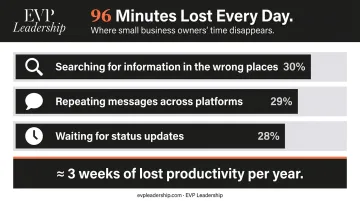
A consultant identifies which of these drains are fixable through process redesign and which warrant automation. Neither conversation happens without first mapping where the time is actually going.
Team Structure and Role Clarity
Process problems and structural problems often arrive together. As businesses grow, role ambiguity becomes a measurable drag — people don't know what they own, accountability is unclear, and things fall through the cracks not because the team is weak, but because the structure wasn't designed for the current size.
Gallup's 2024 workforce data found that only 47% of US workers strongly agree they know what's expected of them at work — a number that compounds quickly in growing small businesses without clearly defined roles.
Consultants help define responsibilities, clarify reporting lines, and build organizational structures that don't require rebuilding every time you add headcount.
Performance Tracking and KPIs
Without the right metrics, business owners make decisions based on instinct rather than evidence. A consultant helps establish what to measure, how to measure it, and how to review it consistently — so you have real visibility into what's working and what isn't.
Done right, this gives leadership a reliable signal in what otherwise feels like noise — not dashboards for their own sake, but a consistent read on operational reality.
Strategic Alignment of Operations
Rather than fixing processes in isolation, effective consultants align day-to-day operations with the business's longer-term goals — closing the gap between strategic intent and operational reality.
At EVP Leadership, Gennifer Baker's C-level executive consulting work is built around exactly this principle: aligning day-to-day operations to long-term business goals so organizations are prepared not just to grow, but to adapt.
Her engagement scope is designed to make strategic plans actually executable:
- Operations review and operating-rhythm design
- Accountability system design
- Delegation frameworks that hold at scale
Key Benefits of Hiring a Small Business Operations Consultant
Improved Efficiency and Time Recovery
Consultants identify where time, money, and effort are leaking — redundant processes, poor handoffs, manual work that should be automated, underutilized tools. These losses show up directly in margins, team capacity, and owner burnout.
Stronger Team Alignment and Accountability
Clearer roles, defined processes, and structured accountability create teams that perform more consistently. The business case for this is well-established: Gallup's Q12 meta-analysis, covering over 3.3 million employees across 53 industries, found that top-quartile employee engagement units delivered 23% higher profitability and 18% higher productivity in sales compared to bottom-quartile units.
Role clarity is a financial issue — not a soft one.
Scalable Systems for Sustainable Growth
One of the most valuable things an operations consultant delivers is infrastructure that handles growth without requiring you to double your cost base every time revenue doubles. Without scalable systems, growth creates chaos instead of profit — more customers, more complexity, more founder involvement, less margin.
The goal is systems built to last — not patches that hold until the next inflection point.
An Objective Expert Perspective
Internal teams often know something is broken. They're either too close to it or too politically constrained to fix it. A consultant brings both the diagnosis and the framework for change — without the organizational baggage that typically slows internal initiatives.
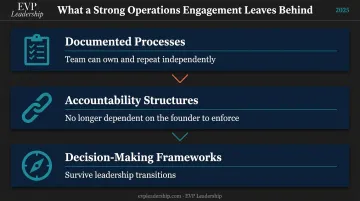
A good operations engagement leaves behind more than a plan. It leaves behind:
- Documented processes the team can own and repeat
- Accountability structures that don't depend on the founder to enforce
- Decision-making frameworks that survive leadership transitions
Signs It's Time to Hire a Small Business Operations Consultant
You're Still the Bottleneck
When the owner is handling day-to-day decisions, resolving team conflicts, managing vendor issues, and answering operational questions personally — they've outgrown the structure around them. Growth is being capped not by market demand, but by how much one person can personally process.
This is the most common trigger for bringing in outside help. An operations consultant's first move is usually breaking that founder-bottleneck pattern — building the structure that lets the team take genuine ownership while the leader gets time back.
The Same Problems Keep Recurring
When the same breakdowns happen repeatedly — missed deadlines, inconsistent quality, unclear handoffs — it signals a systemic issue that won't resolve itself. Recurring problems are symptoms of root causes that haven't been addressed, only managed.
A consultant's job is to find what's actually generating the pattern, not just respond to the latest instance of it.
Growth Is Straining the System
Rapid growth exposes structural weaknesses fast. The tells are familiar: new hires operating without clear processes, systems that worked at ten people breaking at twenty, customer experience slipping as volume climbs.
Outside operational expertise at this stage prevents growth from becoming a liability. Without structural support, the momentum that should build the business instead overwhelms it.
How Much Does a Small Business Operations Consultant Cost?
Pricing in this space varies significantly based on experience, scope, and engagement model. Exact SMB-specific benchmarks aren't published in one place, but here's a realistic market orientation:
| Engagement Type | Typical Structure | Cost Context |
|---|---|---|
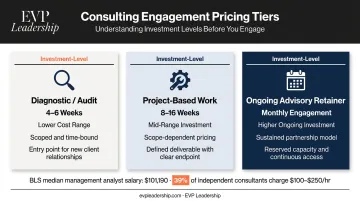
| Diagnostic / Audit | 4–6 week scoped assessment | Lower end of the range; scoped and time-bound |
| Project-Based Work | 8–16 week implementation | Mid-range; scope-dependent |
| Ongoing Advisory Retainer | Monthly engagement | Higher ongoing investment; typically reserved for complex or sustained needs |
For context, the Bureau of Labor Statistics reports median pay for management analysts at $101,190 annually as of 2024 — and consulting bill rates run substantially higher than employee wages once overhead, margin, and utilization are factored in. Consulting Success' 2026 survey found 39% of consultants charge $100–$250 per hour, with project-based pricing being the most common model at 30% of engagements.
The real cost question is about return. A diagnostic that sits unused delivers no value. A well-implemented engagement that recovers two hours of the owner's day and reduces rework can return multiples of its cost — in margin, capacity, and growth readiness.
EVP Leadership operates on custom engagement pricing with a complimentary scoping conversation preceding every engagement — which means the cost conversation happens in context of what the engagement is actually designed to solve.
How to Choose the Right Operations Consultant for Your Business
Look for Small-Business Experience, Not Just Consulting Experience
Consultants who have worked primarily in large enterprises may not understand the resource constraints, lean teams, and pace of a small business. The frameworks that work for a 10,000-person organization often don't translate to a 15-person company running on thin margins and tighter timelines.
Look for someone who has navigated similar-scale challenges and can work practically within real limitations — not someone who'll hand you a deliverable built for a client ten times your size.
Evaluate Methodology and Implementation Support
Ask any prospective consultant:
- How do you structure your engagements?
- What does your diagnostic process look like?
- Do you stay through implementation or hand off recommendations?
For most small businesses, a plan alone isn't enough. Execution support is what creates results. EVP Leadership's 90-Day PressurePoint System is built around this principle — a structured, time-bound engagement with accountability embedded throughout, designed to bridge the gap between the strategy and what actually gets executed day-to-day.
Assess Cultural and Communication Fit
The consultant who will have the most impact is one whose working style and values align with the owner and the team. Methodology matters — but so does chemistry. Before committing, ask for references and speak to past clients specifically about the working relationship, not just outcomes.
The best engagements function as true strategic partnerships. When evaluating fit, look for:
- Responsiveness and communication style during the sales process
- Whether past clients felt heard, not just advised
- Evidence of ongoing involvement beyond the initial deliverable
- Willingness to adapt their approach to your business context
Frequently Asked Questions
What does a small business operations consultant do?
They analyze how a business runs internally, identify inefficiencies, and implement practical improvements to workflows, team structure, reporting, and overall execution. The goal is a business that runs more smoothly, scales more sustainably, and depends less on the owner personally managing everything.
How much does consulting cost for a small business?
Costs vary by engagement type and scope. Diagnostics and audits sit at the lower end; full project engagements or ongoing advisory retainers are priced higher. The better measure is expected return — recovered margin, freed leadership capacity, and reduced operational drag all carry real financial value.
When should I hire a small business operations consultant?
The most common triggers: the founder is still the operational bottleneck, the same problems keep recurring without resolution, or rapid growth is straining systems that weren't built to scale. Any of these signals is worth taking seriously.
What's the difference between an operations consultant and a business coach?
A business coach typically focuses on the leader's mindset, habits, and personal development. An operations consultant focuses on the business's systems, processes, and structural efficiency. Some engagements — like those offered by EVP Leadership — address both dimensions, recognizing that leadership capacity and operational design are deeply interconnected.
How long does an operations consulting engagement typically last?
A diagnostic typically takes four to six weeks; a process improvement project runs eight to twelve weeks; ongoing advisory relationships may extend several months. Scope and complexity determine the right timeline, which should be defined clearly before the engagement begins.