Executive coaching has moved well past a corporate perk. The 2025 ICF Global Coaching Study estimated $5.34 billion in annual global coaching revenue and nearly 123,000 professional coach practitioners worldwide. That's not a trend — it's a signal that structured leadership development has become a strategic business function.
What the numbers don't show is where the real value lives: not in inspiration, but in sharper decisions, steadier execution, and leadership habits that hold when the pressure is highest.
Key Takeaways
- Executive coaching provides objective perspective that internal teams cannot replicate
- Coaching closes leadership skill gaps faster by applying development to actual business challenges
- Transitions — new roles, rapid growth, restructuring — are the highest-ROI moments for coaching investment
- Accountability structures inside coaching engagements drive behavior change that seminars and books rarely produce
- Conditioning builds habits and operating systems that outlast the engagement itself
What Is Executive Coaching?
Executive coaching is a structured, ongoing relationship between a leader and a professional coach — focused on unlocking performance, closing skill gaps, and building the capacity to sustain results under pressure. For most leaders who pursue it, the work is about developing what's already there, not fixing what's broken.
The International Coaching Federation defines coaching as "partnering with clients in a thought-provoking and creative process that inspires them to maximize their personal and professional potential." That plays out through real decisions, real pressures, and real leadership challenges — not simulated exercises.
Who Uses Executive Coaching
Executive coaching serves leaders across multiple contexts:
- Founder-CEOs transitioning from operator to leader-of-leaders
- Small business owners scaling past what instinct and hustle can carry
- C-suite executives navigating complexity, restructuring, or succession
- High-potential leaders being developed for broader organizational responsibility
Coaching vs. Training
Training is an event — a workshop, a course, a seminar. Coaching is conditioning. EVP Leadership's core thesis captures this directly: leaders don't rise to expectations — they fall back on their conditioning. A one-time training input creates awareness. Coaching builds the repeated behaviors and thinking patterns that leaders actually execute under pressure.
Top Reasons to Hire an Executive Coach
The reasons below reflect the highest-impact scenarios where coaching creates measurable change — not theoretical self-improvement, but real operational outcomes.
Reason 1: Gaining Objective Clarity and Focus
When you're inside the organization every day, everything starts to feel equally urgent. One of the most consistent findings in coaching research is that external perspective fundamentally reframes what's actually important versus what just feels that way.
A randomized controlled study of 41 executives found that coaching significantly enhanced goal attainment, resilience, and workplace well-being compared to controls. An HBR survey of 140 coaches found 26% were hired specifically to serve as a sounding board — a role no internal team member can fill without bias.
The operational impact of this clarity:
- Reduced reactive firefighting and fewer "urgent" decisions that weren't actually urgent
- Improved prioritization toward high-leverage activities
- Confident decisions made in the moment rather than deferred indefinitely
- A cleaner separation between what the leader must own and what should move down the organization
For small business owners wearing five roles at once, this reorientation is often the first place coaching pays for itself.
EVP Leadership's PressurePoint System addresses this directly through its Diagnostic Layer — specifically the Mission Clarity and Momentum Control components, which train leaders to identify what actually matters and measure progress on those things, rather than on activity volume.
Reason 2: Accelerating Leadership Development and Closing Skill Gaps
Promotion doesn't automatically develop leadership capability. Technical expertise — the quality that gets leaders their roles — has almost no overlap with the skills required to lead effectively: communication under pressure, influence, emotional regulation, delegation, and executive presence.
HBR notes that high-performing technical experts are routinely asked to lead teams and deliver results through others — without the conditioning that makes that transition successful. Gallup research shows managers account for 70% of the variance in team engagement, making this skill gap an organizational performance issue, not just a personal development one.
A 2023 meta-analysis of randomized controlled trials found that executive coaching produces stronger effects on behavioral outcomes than on attitudes or personal characteristics — meaning coaching changes what leaders actually do, not just how they think about doing it.
KPIs most affected by closing these gaps:
- Team engagement and retention
- Communication effectiveness across the organization
- Decision-making speed and consistency
- Promotion readiness within the leadership pipeline
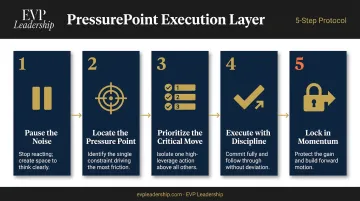
Coaching differs from a leadership workshop in one critical way: application. EVP Leadership's Execution Layer conditions leaders to use these skills in live situations, not controlled environments — through a five-step protocol built for high-pressure moments.
Reason 3: Navigating High-Stakes Transitions
Three transition types produce the most concentrated demand for coaching support:
- Stepping into a new executive role
- Leading an organization through rapid growth or restructuring
- Managing a merger, succession, or significant strategic shift
The risk profile of these moments is well-documented. Spencer Stuart reports that new-executive failure within the first 18 months is estimated at 30% or more. IMD research found that transition coaching can significantly reduce the time a newly hired executive needs to reach full effectiveness.
What coaching provides during transitions isn't a playbook. It's a confidential space to stress-test decisions, process complex stakeholder dynamics, and build early authority without the cost of public missteps.
EVP Leadership's Crisis Leadership and Founder Coaching services are built around these inflection points. The PressurePoint System's Execution Layer gives leaders a structured five-step protocol for exactly the kind of high-stakes decision-making transitions demand: Pause the Noise, Locate the Pressure Point, Prioritize the Critical Move, Execute with Discipline, Lock in Momentum.
The highest-ROI coaching rarely happens during steady-state operations. It happens at these moments, where early decisions set the trajectory for months or years of performance.
Reason 4: Building Accountability and Sustained Performance
Awareness doesn't change behavior. Most leaders who attend a leadership seminar or read a business book experience some version of this: the insight fades, the old habits return, and nothing materially changes in how they operate.
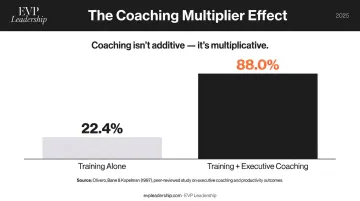
A peer-reviewed study published in Public Personnel Management found that managerial training alone increased productivity by 22.4% — but training combined with executive coaching increased productivity by 88.0%. The coaching component wasn't additive. It was multiplicative.
The structural reason is accountability. Coaching creates:
- Defined goals established at the start of the engagement
- Regular check-ins that create follow-through pressure
- Real-time feedback on actual decisions, not hypothetical ones
- A system for converting insight into embedded habit
EVP Leadership's conditioning philosophy connects directly to this mechanism. The firm's core premise — that leaders fall back on conditioning when pressure rises — explains why accountability structures inside coaching work where seminars don't. A seminar produces a temporary elevation in awareness. Conditioning produces a durable change in default behavior.
The 90-Day PressurePoint System builds this through repetition and real-scenario application: conditioning leaders, testing them in live situations, and embedding the system across their organization so accountability becomes internalized, not externally enforced.
Reason 5: Succession Planning and Strengthening Team Dynamics
Deloitte reports that failed CEO and C-suite successions cost the S&P 1500 approximately $1 trillion per year — and only about one-third of CEOs strongly agree they have a strong candidate pipeline ready. Separately, 91% of CEOs identify themselves as primarily responsible for developing that pipeline.
Given that cost, the lack of structured attention to succession is one of the most expensive gaps in executive leadership.
Executive coaching addresses succession at two levels. First, it develops sitting executives into the kind of leaders who build strong pipelines rather than create dependency. Second, it provides a structured, objective process for identifying and developing high-potential leaders into executive-ready roles.
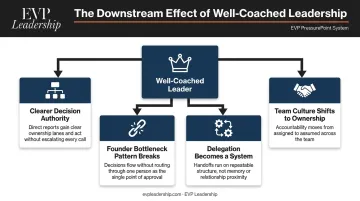
The downstream effect of a well-coached leader:
- Direct reports gain clearer decision-making authority
- Team culture shifts toward ownership and accountability
- The founder-bottleneck pattern — where every decision requires the leader's involvement — begins to break
- Delegation becomes a system, not a last resort
EVP Leadership's Leadership Development Programs offer multi-month cohort structures designed specifically for pipeline development. These engagements run separate from 1:1 coaching and move through a sequenced curriculum: self-leadership, communication, accountability, delegation, decision-making under pressure, and succession readiness.
Signs It's Time to Hire an Executive Coach
Most leaders wait too long. By the time the symptoms are obvious, the organizational cost is already compounding.
Common indicators that coaching is overdue:
- Recurring problems that keep returning despite solving them
- Business growth has stalled despite consistent effort and activity
- Difficulty delegating — everything still flows back to the leader
- Decision-making feels reactive rather than strategic
- Consistent feedback that leadership style is creating friction or disengagement
- Isolation in the decision-making process — no trusted outside perspective
These signs don't mean a leader is failing. According to an HBR survey of coaches, 48% of engagements were initiated for high-potential development or transitions — not remediation. Most executive coaching clients are already strong performers who want to operate at a higher level.
The cost of waiting is concrete: every month the gap persists, decisions get delayed, teams disengage, and the window on key opportunities quietly closes.
What Happens Without Executive Coaching
Leadership gaps left unaddressed don't stay contained. They compound. Left unaddressed, the effects move through every layer of an organization — from how decisions get made to how teams show up under pressure.
- Decision-making becomes reactive — pressure produces short-term thinking, missed windows, and strategies that shift with the wind
- Blind spots go unchallenged, creating hidden bottlenecks that limit growth without an obvious cause
- Accountability disappears — without it, leaders revert to comfortable patterns rather than effective ones
- Teams absorb the leader's lack of clarity — when the person at the top is unfocused or overwhelmed, execution problems follow
- Talent attrition, stalled revenue, and operational chaos become the visible symptoms of what started as an unaddressed leadership gap
How to Get the Most Value from Executive Coaching
Coaching works when it's treated as a discipline, not a service. The leaders who see the most measurable change share a few consistent behaviors:
- Define outcomes at the start — not vague goals, but specific, measurable markers of progress
- Engage honestly with feedback — the value of an outside perspective disappears if the leader filters what they bring to sessions
- Apply insights to real decisions immediately — not in the abstract, and not after the next quarter
- Commit to the cadence — consistency of engagement produces the repetition that creates conditioning
These behaviors don't happen by accident — they require a structured environment that holds leaders accountable to the process. EVP Leadership's 90-Day PressurePoint System is built to provide exactly that.
The engagement uses defined milestones to produce measurable change within a specific timeframe. By the end of 90 days, leaders leave with:
- A stronger decision-making framework for high-pressure situations
- Increased clarity under pressure
- A leadership operating system they can continue running independently
For leaders who need longer-term engagement — founder transitions, succession work, strategic planning, or extended executive team development — EVP Leadership offers multi-month consulting and coaching partnerships beyond the 90-day structure.
Frequently Asked Questions
Why do people hire executive coaches?
Leaders hire executive coaches to gain objective perspective they can't get internally, accelerate their own development, close skill gaps that aren't closing on their own, and navigate transitions without the cost of early missteps. The underlying goal is consistent performance — not relying on instinct to carry the organization through high-stakes moments.
What are the qualities of an effective executive coach?
Look for deep experience with real leadership challenges, a structured methodology with measurable outcomes, and the ability to ask hard questions without an agenda. Effective coaching builds durable capacity, not temporary confidence. Results should be visible and specific, not anecdotal.
How long does executive coaching typically take?
Focused conditioning programs typically run 90 days with defined milestones — EVP Leadership's PressurePoint System is structured around that timeframe. For broader organizational work — succession planning, founder transitions, or executive team development — engagements of six months to a year are common.
What's the difference between an executive coach and a mentor?
Mentors share experience and advice from their own path. Executive coaches use structured frameworks, objective questioning, and accountability systems to help leaders develop their own solutions. Both have value — mentorship accelerates learning from someone else's experience, while coaching builds the leader's own capacity to solve problems they haven't faced yet.
How do I measure the ROI of executive coaching?
Track leadership performance metrics defined at the start of the engagement: goal completion rates, team engagement, decision-making speed, revenue tied to strategic clarity, and reduction in leadership-driven bottlenecks. Quality coaching engagements define these metrics upfront — ROI should be quantifiable, not just felt.
Is executive coaching only for struggling leaders?
No. The majority of coaching clients are already high performers. The leaders who invest earliest tend to scale fastest and sustain results longest — the same way elite athletes use performance coaches not to recover from failure, but to extend their competitive edge.