

This is the most common gap in executive coaching engagements: leaders commit to the work but define success loosely, collect no baseline, and end up with a feeling rather than evidence.
This article gives small business owners, entrepreneurs, and executives a practical framework for evaluating coaching value — covering what to establish before coaching begins, which measurement methods to use, and how to interpret what you're actually seeing.
Coaching value shows up across three dimensions: quantitative business performance, behavioral change, and performance under pressure. Each requires a different lens.
Key Takeaways
- Measurement infrastructure must be built before coaching starts — baselines, success criteria, and KPIs established upfront
- Coaching value spans three layers: quantitative results (revenue, retention, productivity), qualitative shifts (behavior, communication), and pressure performance (consistency under stress)
- Behavioral changes often appear before business metrics move — early qualitative signals matter
- Training metrics measure knowledge transfer; coaching metrics measure whether that knowledge holds under real pressure — the two are not interchangeable
- Coaching has done its job when a leader performs consistently under pressure — no prompting, no safety net, just conditioned response
What You Need Before You Can Measure Coaching Value
Measuring coaching without a baseline is like checking your pace without knowing where you started. The infrastructure has to be in place at the start of the engagement — setting it up retroactively at the end defeats the purpose.
This setup phase is what separates leaders who can demonstrate coaching ROI from those who are left guessing.
Establish a Baseline
Before the first session, capture data across these areas:
- How often reactive decisions are replacing deliberate ones — and how quickly the leader recovers when pressure spikes
- Whether direct reports feel heard, trusted, and willing to give honest feedback
- How peers and team members describe the leader's clarity, responsiveness, and communication
- Hard numbers tied to the leader's scope: revenue, project completion rates, or retention
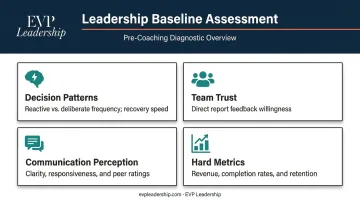
The ICF's 2024 ROI guidance recommends documenting a pre-coaching baseline — including a 1–10 proficiency scale on relevant competencies — and involving line managers in both initial goal setting and final evaluation. A 360-degree feedback tool works well here; a structured self-assessment also creates a reference point for later comparison.
A baseline without defined targets, though, leaves the measurement incomplete. That's where success criteria come in.
Define Success Criteria Upfront
Vague goals don't produce measurable coaching outcomes. "Become a better leader" cannot be tracked. These can:
- Reduce reactive decision-making in high-pressure situations
- Improve meeting effectiveness within the leadership team
- Increase delegation rate and reduce decision bottlenecks
The leader and coach should agree on success criteria before sessions begin — and align them to the business's strategic priorities. ICF's 2025 Core Competencies require coaches to partner with clients to define goals, success measures, and agreements from the outset.
At EVP Leadership, the initial scoping conversation serves this function — it's where scope, focus areas, and expected outcomes get defined before any conditioning work begins.
Three Frameworks to Measure Executive Coaching Value
Coaching impact doesn't live in a single number. Three complementary frameworks capture different layers of value. Use whichever combination fits the outcomes that matter most for your situation.
Framework 1: Quantitative / ROI Measurement
This framework tracks hard business metrics — the kind you can compare before and after.
What to measure:
- Individual productivity output
- Revenue contributions tied to the leader's function
- Employee retention within the leader's team
- Decision turnaround speed
The coaching ROI data spans a wide range — and the numbers are worth understanding in context. The MetrixGlobal case study — conducted with a Fortune 500 firm — reported 529% ROI excluding employee retention benefits, rising to 788% when retention was included. This is a 2001 case study, not an industry average, but it established the methodology that later research extended.
The 2009 ICF Global Coaching Client Study, drawing on 2,165 coaching clients across 64 countries, found that 70% reported improved work performance and 51% reported improved team effectiveness, with a median individual ROI of 344%.
Applying this framework:
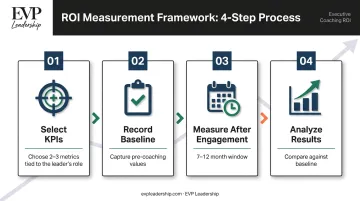
- Select 2–3 KPIs directly tied to the leader's role
- Record pre-coaching baseline values
- Measure again after a sustained engagement period — typical executive coaching engagements run 7–12 months; plan your measurement window accordingly
- This approach works best when coaching is anchored to a specific business challenge, such as scaling a team or improving profitability
Framework 2: Qualitative / Behavioral Measurement
Not every coaching outcome shows up in a spreadsheet. This framework captures observable changes in how a leader thinks, communicates, and responds.
What to look for:
- More deliberate communication — fewer reactive statements in high-stakes conversations
- Improved listening behavior observed by direct reports
- Higher self-awareness in debriefs and reflective journals
- Fewer escalations from team members who previously avoided the leader
Primary tools:
- Post-coaching 360-degree feedback compared against the pre-coaching baseline
- Structured stakeholder interviews with 2–3 direct reports
- The leader's own reflective self-assessment scores tracked at regular intervals
Research from Smither et al. (2003), using multisource feedback across 1,361 senior managers — 404 of whom worked with an executive coach — found that coached managers improved more than non-coached peers in direct-report and supervisor ratings. Effect sizes were modest (d = .17), which is what behavioral research typically shows: changes are real but build gradually.
Timing note: Behavioral shifts often precede business metric movement. Measuring exclusively at engagement completion misses the incremental signals that confirm whether conditioning is taking hold.
Framework 3: Pressure Performance Measurement
This is where EVP Leadership's 90-Day PressurePoint System focuses its evaluation lens. The question isn't just "did the leader improve?" — it's "does the leader hold their form when conditions are difficult?"
What this framework measures:
- Emotional regulation during organizational crises
- Decision clarity in time-constrained or high-ambiguity situations
- Alignment between stated values and actual behavior under stress
- Consistency across high-stakes conversations that previously triggered reactive patterns
A 2024 neurobiological review on decision-making under stress confirms that acute stress shifts behavior away from goal-directed control toward habitual, reflexive patterns. That's why this dimension requires its own measurement lens. The behaviors a leader has been conditioned to execute are the ones that survive pressure.
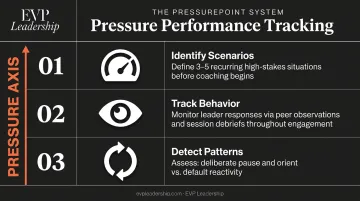
Tracking pressure performance:
- Identify 3–5 recurring "pressure scenarios" relevant to the leader's role before coaching begins
- Track leader behavior in those scenarios across the engagement using peer observations and session debriefs
- Look for patterns: does the leader pause and orient before responding, or revert to default reactivity?
EVP Leadership's tagline — leaders don't rise to expectations, they fall back on their conditioning — reflects exactly why this framework matters. When a leader performs under pressure the way they've been conditioned to perform, that's the measurement that counts.
How to Interpret Your Coaching Results
Data doesn't interpret itself. How you read results determines whether you make smart decisions about continuing, adjusting, or expanding the investment.
Strong Progress: What It Looks Like
Meaningful progress shows up across all three frameworks simultaneously:
- Quantitative KPIs trending upward, or stabilizing in previously volatile areas
- Behavioral feedback reflecting increased trust and communication effectiveness from direct reports
- The leader demonstrating composure in situations that previously triggered reactive behavior
- Decision-making speed improving in high-stakes scenarios without a drop in quality
One important note: strong progress doesn't always look dramatic. A leader who handles 8 out of 10 high-pressure scenarios with clarity — compared to 4 out of 10 before coaching — is showing clear, measurable growth. Consistency is the signal.
Plateau or Slow Progress: What It Means
Flat results during a coaching engagement don't automatically signal failure. They often mark the hardest phase of behavioral rewiring — old patterns disrupted, new ones not yet solidified.
When progress stalls, the right move is recalibration:
- Revisit success criteria — are they still aligned to what matters most?
- Adjust session focus to address what's actually blocking progress
- Examine external factors — organizational chaos or elevated personal stress can slow behavioral integration
Declining or No Movement: When to Reassess
Genuine reassessment is warranted when:
- No change appears across any framework after a sustained engagement
- The coach's approach is misaligned with the leader's actual development needs
- Follow-through between sessions is consistently absent
- The engagement's original success criteria no longer reflect the leader's real priorities
Before concluding that "coaching doesn't work," distinguish between a methodology problem and a commitment problem. A methodology mismatch calls for a different coach or framework. A commitment gap calls for an honest conversation about readiness — because no system closes that distance for you.
Common Mistakes When Evaluating Executive Coaching
Most measurement errors don't happen in data collection. They happen in how results are framed.
Measuring Too Early — or Only at the End
Evaluating coaching only at the final session misses the incremental progress that builds ROI. But measuring before a full conditioning cycle gives an equally inaccurate reading.
Research supports this: the average coaching engagement in the ICF Global Coaching Client Study ran 12.8 months. Osatuke et al. (2017) cites typical executive-coaching durations of 7–12 months.
Recommendation: Run pulse-check assessments at regular intervals throughout the engagement — not just at the start and finish.
Using Training Metrics on a Conditioning Process
Training metrics measure knowledge transfer: did the leader learn the framework? Coaching metrics measure behavioral integration: is the leader applying it under pressure?
Applying training-style evaluation to executive coaching rewards immediate recall rather than lasting behavioral change. Ely et al. (2010) argues that leadership coaching evaluation must include formative and summative elements across multiple dimensions of the engagement — client, relationship, process, and outcomes. Coaching is adaptive by design; standardized training metrics can't account for that.
EVP Leadership frames this distinction directly: most leaders have been trained but not conditioned. Training imparts knowledge; conditioning builds capacity that holds when pressure is real.
Confusing Comfort with Progress
A leader who says "coaching feels good" but shows no measurable behavioral change may be in a low-challenge engagement. Meaningful coaching surfaces difficult blind spots. The absence of discomfort is not evidence of effectiveness — it may be evidence of the opposite.
Best Practices for Measuring Coaching Impact Over Time
The leaders who get the most from coaching are those who build a measurement habit that outlasts the formal engagement.
Tie Measurement Cadence to the Coaching Cycle
Align checkpoints to engagement structure:
| Checkpoint | What to Measure |
|---|---|
| Start | Full baseline — KPIs, 360 feedback, behavioral self-assessment |
| Midpoint | Behavioral pulse-check — communication, decision patterns, team feedback |
| End | Full evaluation — quantitative + qualitative + pressure performance |
| 90 days post-engagement | KPI tracking to capture compounding results |
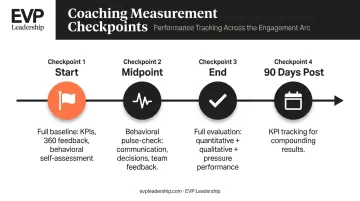
The post-engagement window matters. Coaching effects compound, and some business metric shifts won't appear until weeks after formal sessions conclude.
Involve Stakeholders in the Measurement Process
Leaders who involve direct reports, peers, or managers in measurement get richer data — and stakeholder feedback sharpens accountability to behavioral goals.
A 3-question pulse survey to direct reports every 4–6 weeks is enough. ICF's 2024 guidance recommends gathering multi-level feedback including peer, team, and client perspectives throughout the engagement.
Document and Communicate Results
Measurement loses value if it isn't reviewed regularly. Keep a simple progress log — weekly or bi-weekly self-reports work well — and conduct a brief ROI review at the close of each engagement covering:
- What changed behaviorally
- What the business impact was
- What the leader plans to sustain independently
Sustainable independence is the end goal. EVP Leadership's PressurePoint System is designed so executives carry the framework forward on their own — no ongoing external support required.
Conclusion
Measuring the value of executive coaching comes down to one question: is this leader performing better where it counts? Not just on paper — in the moments that actually test them. Setting baselines, selecting the right frameworks, and tracking results across a full conditioning cycle gives you the answer.
Leaders who do this well — who set baselines, choose the right measurement frameworks, and track results across a full conditioning cycle — find the returns consistently outpace the investment. The leaders who show up differently under pressure, make cleaner decisions in complexity, and build teams that execute without constant intervention — that's the outcome worth measuring toward.
If you're evaluating whether executive coaching is working — or deciding whether to start — EVP Leadership's complimentary scoping conversation is designed to help you define what success should look like before the engagement begins.
Frequently Asked Questions
How do you measure the effectiveness of executive coaching?
Effectiveness is measured through a combination of quantitative KPIs (productivity, retention, revenue), qualitative behavioral assessments (360 feedback, communication changes), and performance tracking under pressure — all compared against a baseline established before coaching began. No single metric tells the full story.
What is a good ROI benchmark for executive coaching?
Historical benchmarks are significant: the 2001 MetrixGlobal study reported 529% ROI (788% including retention benefits), and the 2009 ICF Global Coaching Client Study found a median individual ROI of 344%. Actual returns depend on how clearly goals were defined and how tightly coaching was tied to specific business outcomes.
How long does it take to see measurable results from executive coaching?
Early behavioral signals can emerge within the first few weeks, but hard business metrics typically require 7–12 months to reflect coaching-driven change. The ICF Global Coaching Client Study found average engagement lengths of 12.8 months. Measuring too early produces misleading conclusions.
What should I track before starting executive coaching?
Capture these before the first session: current team engagement indicators, 2–3 business KPIs tied to the leader's scope, a 360-degree feedback snapshot, and specific behavioral goals aligned to business priorities. This baseline is what makes post-coaching evaluation credible.
Can you measure executive coaching impact in financial terms?
Financial ROI is measurable when coaching is tied to specific outcomes: reduced turnover, improved sales performance, faster decision cycles. But financial metrics alone miss a significant portion of coaching value, which shows up in leadership durability, team culture, and decision quality under pressure.
How is measuring executive coaching different from measuring a training program?
Training is measured by knowledge acquisition, typically through post-program assessments. Coaching is measured by behavioral integration under real-world conditions, particularly under pressure, which requires a longer timeframe and different performance indicators. One tests recall; the other tests conditioning.