
Introduction
Most CEOs didn't build their business to spend their days reviewing expense approvals, triaging email chains, or sitting in status meetings. Yet that's exactly where many end up — trapped in the operational weeds while the strategic work sits untouched.
No amount of calendar blocking fixes the real problem: you've become the decision bottleneck for everything that moves through your organization. That's a delegation problem — and it requires a structural solution.
A CEO delegation framework isn't a reminder to "let go more." It's a structured operating system that tells you precisely what to keep, what to hand off, to whom, and at what level of autonomy. According to McKinsey research, executives spend 37% of their time making decisions — and more than half of that time is considered ineffective.
This framework shows you how to reclaim that time and build a team capable of running without your constant input.
Key Takeaways
- CEOs should retain only decisions requiring their unique judgment, authority, or irreplaceable perspective
- Delegation is a learnable system, not a personality trait or a one-time handoff
- A clear decision matrix removes emotion and guesswork from what to hand off
- Delegating decisions — not just tasks — is the real leverage point
- Effective delegation shifts your role from doing and approving to directing and multiplying
What Only a CEO Should Handle
Before building a delegation system, you need a hard boundary around what stays with you. Not tasks. Responsibilities.
The non-delegable CEO list is shorter than most leaders think:
- Setting vision and long-term company direction
- High-stakes decisions involving significant capital or irreversible risk
- Defining organizational priorities across functions
- Shaping culture, standards, and the leadership team's operating norms
- Building and aligning the senior leadership team itself
These are leadership functions, not execution activities. They require your perspective, your authority, and your judgment in a way that can't be systematized or replicated by a trained team member. That distinction matters — because most CEOs are also routinely handling work that looks nothing like this.
The Contrast That Matters
If a responsibility can be documented, systematized, or performed by someone with the right training, it doesn't belong on your desk. Most of the time, that work looks like this:
- Meeting coordination and scheduling
- Routine approvals (expenses, content, vendor invoices)
- Project status tracking
- Inbox triage and internal communications
These feel urgent in the moment. That urgency is exactly what keeps leaders stuck at the operational level instead of running the company.
A Three-Question Self-Check
When something lands in front of you, run it through this filter before engaging:
- Does this require my unique judgment — or just competent execution?
- Does it directly affect company direction or risk?
- Would the business meaningfully suffer if I didn't handle this personally?
If the answer to all three is no, it belongs with someone else. No exceptions.
Why Most CEOs Become the Bottleneck
The delegation problem isn't a character flaw. It's a predictable consequence of how most CEOs got where they are.
The Identity Layer
Most founders and senior executives were promoted or succeeded because they were exceptional individual contributors. High standards, deep expertise, fast execution — these qualities drove early success. They also make delegation feel counterproductive — why hand off something you can do better and faster yourself?
Harvard Business Review's research on founders frames this as the core tension: the capabilities that create a business are often different from those required to scale it. Holding control limits growth capital and professionalization. The same identity that built the company becomes the ceiling.
The Cognitive Cost
There's a compounding consequence to handling too many decisions. When a CEO processes dozens of low-value decisions throughout the day — approvals, status calls, ad hoc questions — the cognitive resources available for high-stakes strategic thinking erode. The cost isn't just time. It's the quality of judgment at the moments that matter most.
McKinsey's time management research found that only 9% of executives were very satisfied with how they used their time, and 48% said they didn't spend enough time on strategic priorities. Senior leaders routinely spent 15 to 20 hours per month on low-value administrative approvals — expenses, sick leave, routine requisitions.
The Emotional Barriers
The most common reasons CEOs hold on:
- Fear of losing quality: convinced no one else will meet their standard
- Lack of trust: the team hasn't yet proven it can handle the work
- Speed bias: doing it themselves is faster than explaining it to someone else
- Default ownership: they've always owned this task, so they never questioned whether they still should
Each concern is real. But holding on carries a larger risk: the business gets capped at one person's capacity.
The CEO Delegation Framework: Deciding What to Hand Off
The Impact/Reversibility Matrix
The core decision tool for delegation maps work across two dimensions:
- Impact — how significantly does this affect the business?
- Reversibility — how recoverable is a mistake?
This logic draws directly from Jeff Bezos's framework in Amazon's 2015 shareholder letter, which distinguished consequential, irreversible "Type 1" decisions from changeable "Type 2" decisions — arguing that most decisions are two-way doors and shouldn't require heavyweight processes.
The four delegation quadrants:
| High Impact | Low Impact | |
|---|---|---|
| Irreversible | CEO retains — major hires, strategic pivots, capital moves | Delegate with guardrails — process changes, system implementations |
| Reversible | Delegate with oversight — campaign strategy, vendor selection, quarterly priorities | Never reaches CEO — routine approvals, daily operations, scheduling |
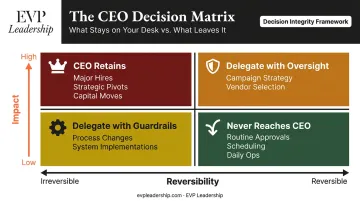
When low-impact, reversible decisions consistently reach your desk, that's a signal — the delegation system needs rebuilding, not just the individual decisions.
The 70% Rule
Waiting for a perfect match before delegating creates a bottleneck. The practical standard: if the person being considered can perform the task at least 70% as well as you, delegate it.
"Good enough" delegation with active support outperforms perfect work that never gets started. That remaining 30% gap isn't a liability — it's where the coaching actually happens.
The 4 P's of Delegation
Most delegation fails because one or more of these elements is missing when the handoff happens:
- Purpose — why the task matters and what outcome is expected
- Person — who has the right skill and readiness for this specific work
- Process — what structure, constraints, or guardrails apply
- Performance — how success will be measured and reviewed
Before delegating anything, confirm all four are defined. Vague handoffs produce vague results. That applies equally to what you hand off and how much authority travels with it.
Task vs. Decision Delegation
Task delegation hands off execution: "Send this report."
Decision delegation hands off thinking: "You own Q1 pipeline reporting — decide what data matters and how to present it."
Only decision delegation removes the CEO from the critical path. If you hand off the work but retain every judgment call, you've moved the labor without moving the dependency. The bottleneck stays.
The 5 Levels of Delegation for CEOs
Delegation isn't an on/off switch. Most leaders fail because they jump from doing everything to handing it off completely, with no structure in between. A five-level model — adapted from Michael Hyatt's Full Focus framework — builds trust and capability incrementally.
The Five Levels Defined
| Level | Description |
|---|---|
| 1 — Do as instructed | CEO provides the approach; team member executes with no independent judgment |
| 2 — Research and report | Team member gathers information; CEO decides |
| 3 — Research and recommend | Team member brings options and a preferred choice; CEO approves |
| 4 — Decide and inform | Team member makes the decision and reports what they did |
| 5 — Full ownership | Team member acts independently; no required reporting unless exceptional |
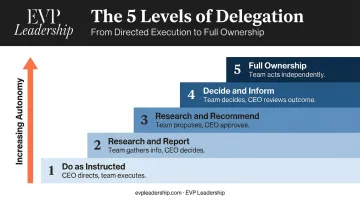
Knowing the levels is only half the equation. The harder part is matching the right level to the right person — which is where most delegation decisions break down.
The 3 C's: Choosing the Right Level
Before assigning a delegation level, assess the team member against three criteria:
- Clarity — do they understand the task, expected outcome, and boundaries?
- Competence — do they have the skill and experience to execute?
- Commitment — are they motivated and accountable for the result?
Delegating to the wrong level for someone's current 3 C's profile is one of the most common causes of delegation failure. A high-competence team member given a Level 1 assignment disengages. A low-clarity team member given Level 5 ownership fails and loses confidence.
A Practical Progression Arc
A CEO can move a direct report from Level 2 to Level 4 over a single quarter:
- Month 1: Team member researches and reports. CEO decides and explains the reasoning aloud.
- Month 2: Team member researches and recommends. CEO approves, adjusts occasionally, coaches the thinking.
- Month 3: Team member decides and informs. CEO reviews outcomes, not process.
Most CEOs skip the reasoning step during handoffs. When a CEO explains why they'd decide something a certain way, they transfer their decision-making framework — not just the task. Do that consistently, and the team starts making better calls without needing to ask.
How to Build a Delegation System That Actually Sticks
Delegation fails when it's treated as a series of ad hoc handoffs rather than a designed system. One good delegation conversation doesn't create an organization that runs without you.
The Structural Components
A sustainable delegation system requires four elements:
- Documented processes for recurring decisions, so the same question doesn't reach the CEO twice
- Defined ownership for each functional area — one person owns each domain, not a committee
- Agreed check-in cadences — not to manage progress, but to coach and remove blockers
- A feedback loop that diagnoses and improves performance without micromanaging
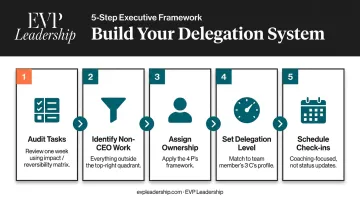
A Starting Sequence for CEOs
- Audit one week of tasks and decisions using the impact/reversibility matrix
- Identify everything outside the top-right quadrant — these don't belong with you
- Assign clear ownership using the 4 P's framework for each item
- Assign an appropriate delegation level based on the team member's 3 C's profile
- Schedule check-ins focused on coaching, not status updates
Delegation vs. Abdication
The two look similar from the outside. The results are completely different.
Delegation includes context, defined authority, clear criteria, and ongoing support. Abdication is handing work off without setting the team up to succeed.
When CEOs report that delegation "didn't work," a closer look almost always reveals that one or more of the 4 P's was missing at the handoff.
Building It as a Sustained Habit
The shift from doing → reviewing outcomes → directing strategy isn't passive. It requires the CEO to actively condition new habits over time.
Sustainable delegation is a leadership capacity built through consistent practice — not a skill absorbed from a single workshop. EVP Leadership's 60–90 day engagement structure for delegation, accountability, and operating discipline is built specifically to embed the system, not just introduce the concept.
Common CEO Delegation Mistakes That Stall Growth
The Three Most Damaging Patterns
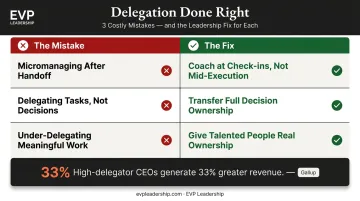
1. Micromanaging after handing off Assigning a task but staying involved at the execution level signals distrust and destroys team confidence. If you've delegated it, let it run. Coach at the check-in, not in the middle of execution.
2. Delegating tasks but not decisions This is the most common and least visible bottleneck. The CEO is no longer doing the work, but every judgment call still routes through them. The organization moves faster tactically but remains strategically dependent on one person.
3. Under-delegating meaningful work Only passing off the least important tasks fails the team and wastes delegation's leverage. Talented people want ownership. Gallup's research on entrepreneurs found that CEOs with high delegator talent generated 33% greater revenue — averaging $8M versus $6M for low-delegator counterparts. Giving people only administrative work doesn't develop the bench strength required to scale.
The "Taking It Back" Trap
When a delegation goes poorly, the instinctive response is to reclaim the work. This is almost always a mistake. Taking it back teaches the team that ownership is temporary.
Treat the failure as information instead. Work out what actually went wrong:
- Were expectations unclear? (Missing Purpose or Process from the 4 P's)
- Was the delegation level wrong for where the person is? (3 C's mismatch)
- Is there a genuine capability gap that requires coaching?
Use it as a coaching moment, not a reason to centralize control again.
The Retention Cost
This one doesn't show up on a P&L, but it's real. Talented senior leaders want ownership and growth. When a CEO holds onto decisions that could belong to the leadership team, the cost appears in efficiency — and in attrition.
The people most capable of carrying the organization forward are often the first to leave when meaningful ownership isn't on the table.
Frequently Asked Questions
How do you delegate as a CEO?
Start by identifying what only you can do — vision, culture, high-stakes irreversible decisions. Use an impact/reversibility matrix to categorize everything else, assign clear ownership using the 4 P's, match the delegation level to the team member's readiness, and build in coaching check-ins rather than progress monitoring.
What is the 70% Rule of delegation?
If the person being considered can perform a task at 70% of the CEO's capability level, delegate it. The rule exists to prevent perfectionism from becoming a bottleneck — "good enough" delegation with support outperforms work that stays on the CEO's plate.
What are the 4 P's of delegation?
Purpose (the expected outcome and why it matters), Person (who has the right readiness for this task), Process (the structure and guardrails), and Performance (how success is measured).
What are the 3 C's of delegation?
Clarity (the team member understands the task and boundaries), Competence (they have the skills to execute), and Commitment (they are motivated and accountable).
What should a CEO never delegate?
Company vision and long-term direction, high-stakes irreversible decisions involving significant capital or risk, culture standards, leadership team development, and any decision where the CEO's unique authority or judgment is genuinely irreplaceable. When in doubt, ask whether someone else can own it at 70% — if yes, hand it off.