
Introduction
Most leaders don't fail because they lack effort. They fail because they can't let go.
Small business owners and executives spend their days buried in tasks their teams could handle: approving decisions that don't need them, answering questions that shouldn't require them, fixing work that shouldn't have come back to them.
Meanwhile, the strategic work that actually moves the business forward sits untouched.
The problem isn't a personality flaw. It's the absence of a system.
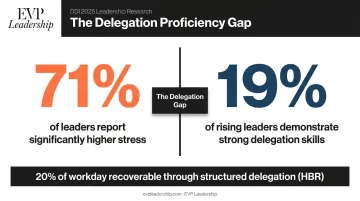
According to DDI's 2025 research, 71% of leaders experienced significantly higher stress after entering their current role, and delegation was identified as the top skill for preventing burnout. Yet only 19% of rising leaders demonstrated strong delegation proficiency. That gap is where leadership capacity breaks down.
This article covers seven proven delegation models—frameworks that replace guesswork with structure. Each one solves a different problem, and knowing when to use which determines whether you build a capable team or remain the ceiling it can't grow past.
Key Takeaways
- Delegation models are structured frameworks that define authority, responsibility, and accountability — not personality traits some leaders happen to have
- Different models solve different problems: RACI clarifies roles, the Skill-Will Matrix assesses readiness, and the Five Levels calibrates authority
- Effective leaders use more than one model; the situation determines which one fits
- Consistent delegation reduces burnout, builds team capability, and directly enables organizational growth
What Is a Delegation Model and Why Leaders Need One
A delegation model is a structured system that brings discipline to the act of assigning work. It specifies not just who does what, but at what level of authority, with what degree of oversight, and how accountability gets tracked.
Without one, delegation becomes a coin flip. Vague handoffs lead to misaligned expectations, work that bounces back to the leader, and teams that wait for permission before acting. Harvard Business Review notes that by eliminating, delegating, or outsourcing low-value work, leaders can reclaim as much as 20% of their workday—but most never capture that time because they lack a system for making delegation decisions.
The costs compound quickly:
- Leaders stay trapped in operational tasks rather than strategic priorities
- Teams develop learned helplessness rather than expanding capability
- Organizations hit growth ceilings tied directly to the leader's personal bandwidth
The seven models below address these root problems directly. Each takes a different angle—some clarify authority, others assess team readiness or define accountability structure. The goal is to find the one that fits your situation, not to apply all seven at once.
7 Delegation Models for Effective Leadership
These seven models address the most common delegation challenges leaders face, from role confusion to misjudged team readiness.
The Five Levels of Delegation
Michael Hyatt's Five Levels of Delegation organizes authority across a clear spectrum:
| Level | Description |
|---|---|
| 1 | Do exactly as I say |
| 2 | Research and report back |
| 3 | Research and recommend |
| 4 | Decide and inform me |
| 5 | Act independently |
The model forces leaders to specify the authority level before handing off any task, eliminating the ambiguity that causes most delegation failures.
When to use it: Best suited for leaders managing team members at varying experience levels, or when onboarding someone new. It helps leaders increase autonomy progressively rather than oscillating between micromanagement and hands-off confusion.
The DELEGATE Model
The DELEGATE acronym functions as a step-by-step briefing checklist for complex or high-stakes assignments:
Define → Empower → Let them Know → Establish → Generate → Authorise → Track → Evaluate
Each step ensures nothing gets skipped during the handoff: defining the task clearly, establishing timelines, granting authority, and setting review checkpoints. Note that this model appears primarily in practitioner circles without a clearly established origin; treat it as a practical checklist rather than a formally researched framework.
When to use it: Ideal when delegated tasks frequently stall or return incomplete. The structured briefing process replaces vague verbal handoffs with documented, trackable instructions.
The RACI Matrix
RACI maps stakeholder involvement across every task or project using four roles:
- Responsible — who does the work
- Accountable — who owns the outcome
- Consulted — who provides input before decisions
- Informed — who needs to know what happened
The matrix prevents the most common cross-functional breakdown: "I thought you were handling that." By making roles explicit, RACI surfaces gaps and overlaps before they become performance problems.
When to use it: Most effective for projects involving multiple team members or departments. It's most effective during leadership team development work, where Teri Evans at EVP Leadership uses facilitated team alignment to clarify exactly who owns what across organizational functions.
The MoSCoW Method
Originally developed in agile project contexts by the Agile Business Consortium, MoSCoW sorts work into four categories:
- Must-haves — non-negotiable; delegate immediately
- Should-haves — important but not critical; schedule
- Could-haves — optional if capacity allows
- Won't-haves — dropped for now
The framework answers a question that stalls most leaders before they even start delegating: What do I hand off first?
When to use it: Particularly valuable during high-pressure periods with competing demands. Leaders use MoSCoW to align on priority before delegating, so teams work on what actually matters rather than what's loudest.
The Skill-Will Matrix
Attributed to Max Landsberg's The Tao of Coaching, this model assesses team members across two dimensions: skill (competence) and will (motivation). It then prescribes the appropriate delegation approach for each quadrant:
| Quadrant | Leadership Response |
|---|---|
| High Skill / High Will | Delegate fully |
| High Skill / Low Will | Coach and re-engage |
| Low Skill / High Will | Direct and develop |
| Low Skill / Low Will | Supervise closely; address root cause |
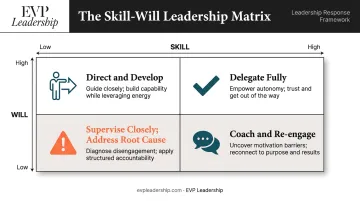
This is where most delegation goes wrong: leaders apply the same approach to everyone. A team member who's capable but checked out needs something completely different than one who's eager but inexperienced.
When to use it: Especially useful when certain team members are stalling on delegated work. The matrix reveals whether the problem is a skill gap, a motivation issue, or both, so the leader responds appropriately rather than defaulting to micromanagement across the board.
The Ladder of Leadership
David Marquet's Ladder of Leadership, developed through his Intent-Based Leadership system, frames delegation as a shift in how team members communicate: from asking permission to expressing intent. The highest rung is "I intend to," which signals ownership without requiring leader approval.
Where Hyatt's Five Levels specify what authority the leader grants, Marquet's Ladder focuses on the team member's development. The goal is moving from a leader-follower organization to a leader-leader organization, building from dependence toward full leadership capability.
When to use it: Works well for leaders building future-ready teams or developing emerging leaders internally. The visible progression from lower to higher rungs makes growth concrete and motivating for team members, not just leaders.
The Delegation Diamond
The Delegation Diamond is a diagnostic framework built on four components. Before delegating, the leader answers four questions:
- Task — What exactly is being delegated?
- Responsibility — Who is responsible for completing it?
- Authority — What decisions can they make independently?
- Accountability — Who is accountable for the outcome?
This model is less widely sourced than RACI or the Five Levels; treat it as a practical diagnostic tool rather than an established formal framework.
Use this when: Recurring confusion or conflict follows delegation. The diamond surfaces misalignments in authority or accountability before they become performance problems.
How to Choose the Right Delegation Model
No single model fits every situation. Effective leaders treat these frameworks as a toolkit, switching based on context rather than committing to one approach permanently.
Three Factors That Drive Model Selection
- Team size and structure — Cross-functional complexity calls for RACI; small teams with clear lines of reporting may only need the Five Levels
- Task complexity — High-stakes assignments with multiple dependencies warrant DELEGATE or the Delegation Diamond; routine work may need nothing more than a Level 4 or 5 handoff
- Individual readiness — When you're unsure whether someone can handle a task, the Skill-Will Matrix should come first
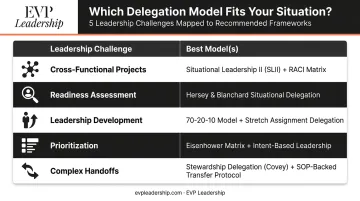
Practical Pairing Guide
| Challenge | Best Model(s) |
|---|---|
| Cross-functional projects with many stakeholders | RACI or Delegation Diamond |
| Assessing whether someone is ready for more | Skill-Will Matrix |
| Progressive leadership development | Five Levels or Ladder of Leadership |
| Prioritization before delegating | MoSCoW |
| Complex high-stakes task handoffs | DELEGATE Model |
The Most Common Mistake
Leaders choose one model and apply it to every situation—then blame the model when it doesn't work. Delegation fluency means reading the situation and selecting the right framework for that specific moment. That's a skill, and it improves with deliberate practice.
Building that practice is the focus of EVP Leadership's Delegation, Accountability & Operating Discipline engagement. Working with founders and executives, it produces a defined delegation protocol covering:
- What gets delegated and to whom
- What authority level accompanies each handoff
- What accountability looks like and how it's tracked
- What success criteria the leader and team are working against
The outcome is a repeatable system leaders can execute consistently — including under pressure, when the instinct is to pull the work back instead of trusting the handoff.
Conclusion
Delegation is not a personality trait. It's a leadership capacity—one that can be built deliberately, practiced consistently, and deployed with precision.
The seven models covered here address different root problems: role clarity, task prioritization, team readiness, authority structure. No single model solves all of them. The leaders who delegate well aren't choosing the right framework every time—they're choosing based on what the situation actually requires.
What holds most leaders back isn't awareness of these frameworks—it's the gap between knowing and doing. Under pressure, leaders fall back on conditioning, not training. That's the foundation of EVP Leadership's approach: conditioning leaders to delegate effectively in real situations.
If you're ready to build stronger delegation habits as part of a broader leadership operating system, connect with EVP Leadership for a complimentary scoping conversation. The work is about conditioning leaders to perform consistently—not a one-time coaching event, but a system that holds.
Frequently Asked Questions
What are common leadership delegation models, like the 4 P's and 3 C's?
The 4 P's (Purpose, Picture, Plan, Part) originated as a change communication framework, not a delegation model. The 3 C's circulate in informal versions with no consistent authoritative source. The most widely applied and well-sourced frameworks are the Five Levels of Delegation, the RACI Matrix, and the Skill-Will Matrix.
What is the difference between the Five Levels of Delegation and the Delegation Ladder?
Both describe a spectrum from close supervision to full autonomy, but they're framed differently. Hyatt's Five Levels specify the authority level granted for each task. Marquet's Ladder frames delegation as the team member's developmental progression—measured by whether they're asking permission or expressing intent to act.
How do I know which delegation model is right for my team?
Consider task complexity, the team member's experience and motivation, and whether the core challenge is role clarity, prioritization, or authority structure. Each factor points toward a different model—and most leaders find they need more than one at a time.
What is the RACI matrix and how is it used in delegation?
RACI stands for Responsible, Accountable, Consulted, and Informed. It maps each team member's involvement in a task or project, making clear who executes the work, who owns the outcome, who provides input, and who receives updates—preventing accountability gaps and duplicate effort.
What are the biggest mistakes leaders make when delegating?
The most common pitfalls are delegating without defining the authority level, handing off work that doesn't match the person's readiness, and treating delegation as a single handoff instead of an ongoing process with built-in accountability.
How does using a delegation model help prevent leadership burnout?
Models replace ad hoc handoffs with repeatable systems, which cuts the cognitive load of constant judgment calls. That frees leaders from low-value work and preserves their capacity for decisions that genuinely need them.