Introduction
Picture a founding team that closed Series A on momentum, instinct, and sheer speed. Eighteen months later, they've raised Series B — and the company has ground to a halt. Not because the product failed. Not because the market shifted. Decisions are stalling at the top, departments are pulling in different directions, and the CEO is trapped in operational noise that functional leaders should be handling.
The business didn't break. The leadership system did.
Scaling from Series B to Series D is less a funding challenge than a leadership conditioning challenge. According to McKinsey, investors attribute 65% of portfolio failures to people and organizational issues — not product, not market fit.
The behaviors that built the company to this point are the exact behaviors that will slow it down next.
Understanding why that happens is the first step to preventing it. This article covers what changes at each funding stage, the most common leadership failure patterns, and how to condition your team to perform at scale.
Key Takeaways
- Series B leaders must shift from hands-on operators to architects who build systems others can execute
- Series C demands cross-functional alignment — a leadership team that manages complexity without constant escalation
- Series D requires leaders who delegate deeply and prepare the organization for institutional-scale decisions
- The most common scaling failures — decision bottlenecks, delegation gaps, cross-functional tension — are behavioral, not strategic
- Conditioning leaders for pressure at each stage is a deliberate, ongoing process — not something that happens once and holds
Why Series B Is the Most Critical Leadership Inflection Point
At Seed and Series A, speed and founder instinct drive results. Series B changes the equation entirely. The company has validated its model — now it must scale the organization that delivers it. That's a completely different operational challenge, and most leadership teams aren't ready for it.
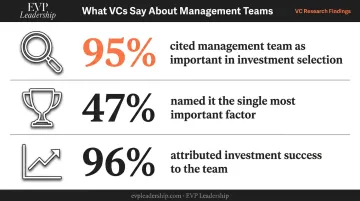
The VC data is clear on this. A survey of 885 institutional VCs across 681 firms found that 95% cited the management team as important in investment selection, and 47% named it the single most important factor. Those same investors attributed investment success to the team in 96% of cases and failure to the team in 92% of cases. Series B due diligence isn't just about revenue metrics — it's about whether the leadership team can own functions and execute without the founder in the room.
Most founder-leaders are highly capable builders who never had to formalize their leadership skills. They succeeded on instinct and proximity to the work. When the company demands something different — delegating ownership instead of solving problems directly — it can feel disorienting. Many resist the shift without recognizing that's what's happening.
The Compounding Risk
The habits that worked at 20 people become liabilities at 80 to 150:
- Informal communication — functional at small scale, chaotic at 100+
- Founder sign-off on decisions — fast when there are five people, a bottleneck when there are fifty
- Cross-functional generalism — valuable in early days, a substitute for ownership at scale
The longer these habits persist, the more expensive they become to unwind. At Series B, the cost of not addressing them compounds — slower decisions, blurred accountability, and leaders promoted into roles they weren't built for yet. Getting ahead of that requires deliberate work on the leadership architecture, not just the org chart.
The Series B Leadership Shift: From Builder to Architect
The central shift at Series B is from operator to orchestrator. Leaders must stop solving problems themselves and start building the systems, clarity, and culture that allow hundreds of decisions to happen without them.
Structural Changes: From Generalist to Specialist
Series B is when functional leaders — CFO, CRO, CMO, CPO — need to be true domain owners, not coordinators. The question isn't whether you have people in these roles. It's whether those people can fully own a function without leaning on the founder for direction, context, or final calls.
This creates real tension with founding teams. Promoting an early generalist who helped build the company feels right. But if they can't scale into a functional owner role, keeping them in place carries real costs:
- Slower execution as decisions bottleneck upward
- Continued founder dependence that should have ended months ago
- The organization building quietly around a capability gap
The honest assessment: Can this leader attract specialized talent, set the strategic direction for their function, and be held accountable for outcomes? If the answer is uncertain, that gap needs a defined owner and a timeline — not more runway to hope it resolves itself.
Delegation as Ownership Transfer
Most leaders think they're delegating when they're actually supervising with extra steps. Genuine delegation at Series B means three things:
- Clear authority — the leader can make decisions in their domain without checking in
- Defined accountability — there's an explicit standard they're measured against
- Explicit success criteria — everyone agrees on what "done well" looks like
Without all three, delegation is supervision in disguise. The functional leader senses the lack of real autonomy and keeps checking in. The founder senses the uncertainty and keeps weighing in.
This is the core of EVP Leadership's Delegation, Accountability & Operating Discipline work — defining what gets delegated, to whom, with what authority, and against what accountability standard. It connects directly to the Execution Layer of the PressurePoint System because delegation without structure doesn't free up leaders; it just relocates the bottleneck.
Decision-Making Architecture
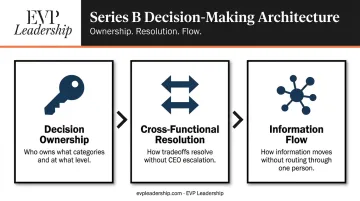
Unresolved delegation problems don't stay contained to one function — they surface at the top. When decision-making architecture is missing, the CEO becomes the default escalation point for every conflict and ambiguity. Every unclear ownership question lands on the same desk.
What needs to be formalized at Series B:
- Who owns what categories of decisions
- How cross-functional tradeoffs get resolved without escalating to the CEO
- How information moves across the organization without routing through one person
Structured operating rhythms replace informal hallway communication: weekly leadership team check-ins, quarterly priority alignment, cross-functional goal ownership. These aren't bureaucracy — they're infrastructure.
Series C: Managing Cross-Functional Complexity
By Series C, the company is scaling multiple functions simultaneously — often across geographies or market segments. The leadership team can no longer self-coordinate. It requires active, deliberate alignment.
Cross-Functional Tension Is Expected, Not a Failure
Each department head is optimizing for legitimate, role-specific goals that naturally conflict:
- Sales wants faster product releases
- Product wants clearer requirements before committing
- Finance wants spending discipline as headcount grows
Conflict between capable people running real functions is expected. The leadership failure is not having a shared framework for resolving it.
McKinsey research illustrates the cost of misalignment: in a study of 25 companies, individual functions scored above 90% on internal metrics, yet only 65% of customers received a working end product. Each team was succeeding by its own measure while collectively failing the customer.
What strong executive teams do differently at Series C:
- Create shared, cross-functional goals that override departmental priorities
- Clarify decision ownership at the leadership level so conflicts don't escalate
- Establish explicit norms for how tradeoffs are made — and enforce them
Teams that can't resolve these tradeoffs at the leadership level often need outside facilitation to reset. EVP Leadership's Teri Evans works with executive teams on exactly this — conflict resolution, alignment workshops, and post-disruption realignment focused on shared accountability and trust.
Culture Sustainability at Scale
Cross-functional alignment is only part of the equation. Rapid headcount growth can fragment the culture that was a competitive advantage in earlier stages — and that fragmentation is harder to reverse than most leaders expect.
Stanford's decade-long study of 150+ Silicon Valley startups found that companies were three times more likely to fail if they altered the founder's original employee-relations blueprint.
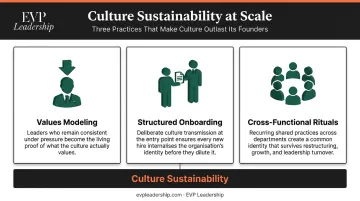
Leaders must actively steward culture — not through internal communications alone, but through:
- Consistent modeling of values under pressure (not just when it's easy)
- Structured onboarding that transmits culture to employees who never met the founding team
- Cross-functional rituals that reinforce shared identity as the org grows
Series D: Operating at Scale — Structure, Strategy, and Succession
At Series D, leaders are managing large organizations, multiple management layers, and long-horizon strategic bets — IPO preparation, market expansion, M&A. The executive team must hold complexity and operate in ambiguity without fragmenting into dysfunction.
Leadership Depth Below the C-Suite
The question at Series D is no longer just whether the top team is strong. It's whether the next layer — directors, VPs — is being developed to sustain growth.
Companies that neglect this layer create fragility. When the organization depends on a handful of people, those people become bottlenecks at scale. Analysis of the top 100 U.S. unicorns found that 59% of executives were hired externally — a signal that scaling companies consistently face gaps in internal leadership pipeline.
Building that second layer before it becomes the breaking point is a deliberate investment — one most organizations delay until the gap is already costing them.
Board and Investor Management
Without a credible, aligned executive team, board and investor management consumes disproportionate CEO bandwidth. Y Combinator advises that CEOs own the board agenda and spend no more than one-third of meeting time on status updates — focusing the majority on one or two strategic issues.
That only works when the leadership team can answer for their domains without the CEO stepping in to cover every domain. The executive team's job at this stage is to make the CEO's external focus possible — not to require it.
Three signals that the executive team is creating board risk rather than reducing it:
- Individual leaders can't speak credibly to their domain metrics without CEO prep
- Cross-functional decisions still escalate upward rather than resolving laterally
- Board meetings become status reviews instead of strategic working sessions
The Four Leadership Failure Patterns That Break Scaling Teams
Decision Bottlenecks
Well-intentioned leaders stay close to the work to protect quality. Over time, the organization learns to route decisions upward. Teams become approval-dependent, talented people disengage, and the CEO's bandwidth fills with operational noise.
The pattern is self-reinforcing: the more decisions route up, the more the leader feels needed in the details, and the more the team stops owning them.
Delegation Without Ownership Transfer
Leaders assign tasks but retain implicit ownership. Team members sense the lack of real autonomy and keep checking in. It can look like dedication. What it actually does is cap growth — because the leader has become the bottleneck without recognizing it.
Cross-Functional Misalignment
Two capable leaders solving different problems that are at odds. Without shared company-level priorities and explicit decision criteria, departments optimize for themselves. The misalignment is structural, not personal. But the damage is real: chronic tension, slow execution, and an executive team that spends its energy internally instead of externally.
Failure to Evolve Leadership Identity
Some leaders — particularly technical founders or early domain experts — resist moving from hands-on operator to strategic leader because their identity and confidence are tied to being the expert in the room. It doesn't show up as open resistance. It shows up as:
- Subtle micromanagement of decisions that should belong to others
- Reluctance to hire people stronger than themselves in their domain
- Inability to delegate meaningfully because letting go feels like losing relevance
- Reverting to operator mode under pressure, even after agreeing to step back
Because the pattern is rooted in identity, not skill, fixing it requires more than a new operating framework. The PressurePoint System's Identity Layer is built for exactly this — developing leaders whose foundation is consistency, capacity, and character. The goal is building the internal capacity to lead at the next level without abandoning what made them effective at the last.
Conditioning Your Leadership Team for the Pressure Ahead
There's a meaningful difference between leadership training and leadership conditioning. Training gives leaders information. Conditioning builds the habits, decision-making reflexes, and emotional resilience to perform when it matters — under pressure and in ambiguity.
Research from the Journal of Neuroscience supports this distinction: under stress, participants reverted to habit behavior at the expense of goal-directed action, with only 28% of stressed participants correctly identifying action-outcome associations versus 58% of controls.
Leaders under pressure don't rise to what they learned in a workshop. They fall back on what's most deeply conditioned.
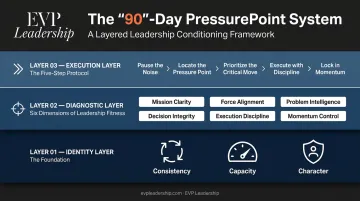
EVP Leadership's 90-Day PressurePoint System is built around this reality. The three-layer structure works as a system:
- Identity Layer — anchors leaders in consistency, capacity, and character
- Diagnostic Layer — trains leaders to see clearly through six dimensions: Mission Clarity, Force Alignment, Problem Intelligence, Decision Integrity, Execution Discipline, and Momentum Control
- Execution Layer — provides a protocol for critical moments: Pause the Noise → Locate the Pressure Point → Prioritize the Critical Move → Execute with Discipline → Lock in Momentum
The approach isn't workshop-based. It conditions leaders through real scenarios and embeds the system across the organization — so the behaviors become default, not deliberate.
A Practical Starting Framework
Before investing in leadership development, it helps to know where the real gaps are. These three questions cut straight to the highest-leverage areas:
- Where are decisions getting stuck? Follow the escalation patterns — they reveal who actually owns what.
- Who truly owns the most critical outcomes? Not who's responsible on paper, but who would be held accountable if it failed.
- Where are departments pulling against each other instead of toward a shared goal? Chronic cross-functional friction is almost always a structural problem, not a personality problem.
These questions surface where leadership development will have the most impact. EVP Leadership's free scoping conversations start here — working through this kind of diagnostic before any engagement begins.
Frequently Asked Questions
How do you scale leadership for Series B and beyond?
Scaling leadership from Series B onward requires a deliberate shift from informal, founder-led decision-making to structured systems of authority, delegation, and cross-functional alignment. It's built through repeated practice over time, not resolved in a single reorganization.
Is Series B considered the scale-up stage?
Series B is where true organizational scale-up typically begins. The company has validated its model and must now build the team, structure, and systems to grow it. Most experts consider this the most critical and difficult leadership transition a startup faces.
What leadership roles should be hired first at Series B?
Series B typically calls for functional owners: a CRO or VP of Sales for revenue, a CFO for finance, and a CPO or VP of Product for product. Each hire needs to fully own their domain, with the depth and bandwidth the founding team can no longer provide.
How do you know when your leadership team can't scale with you?
Common signals include persistent decision bottlenecks, visibly overwhelmed leaders, team members who've stopped growing, and a pattern of the CEO being pulled into operational details that should be owned by someone else.
What's the difference in leadership expectations between Series B and Series D?
Series B leaders are expected to own functions and build operating systems. Series D leaders are expected to think strategically across a complex organization, develop the next layer of leadership below them, and prepare the company for institutional-scale decisions like IPO or major M&A.
How can founders avoid becoming a bottleneck as the company scales?
Founders must transfer decision ownership to functional leaders — not just delegate tasks — with clear authority boundaries and accountability frameworks. Stepping back from decisions inside others' domains is uncomfortable but necessary.