The boardroom produces solid strategic plans every year. Vision statements get crafted, growth targets get set, priorities get agreed upon — and then reality intervenes. Research from Mankins and Steele found that companies typically realize only about 60% of their strategies' potential value because of breakdowns in planning and execution. The strategy wasn't wrong. The execution was.
This guide is for C-suite executives, founders, and small business leaders who already have a strategy on paper but struggle to make it operational. What follows covers five areas that separate organizations that execute from those that don't: what execution actually means at the C-suite level, why it breaks down, how to structure your team for it, a step-by-step framework to run it, and how to condition your leadership team to sustain it under pressure.
Key Takeaways
- Strategy execution is the C-suite's primary job — not just strategic planning
- C-suite misalignment, not a flawed plan, is the leading cause of execution failure
- Effective execution requires clear priorities, defined decision rights, and a regular review cadence — not three things running in parallel, but one system
- Incentives misaligned with enterprise outcomes quietly fragment even strong strategies
- Leaders don't rise to execution demands under pressure — they fall back on their conditioning
What C-Suite Strategy Execution Really Means
Strategy execution is not a project launch. It's the ongoing process of translating strategic intent into aligned decisions, resource allocation, leadership behaviors, and operational outcomes — sustained across every function, every day. Strategy formulation is about deciding what to pursue. Execution is about making it real through the choices leaders make when no one's watching the strategy document.
The Execution Gap
The gap between strategy stated and strategy realized is where most organizations lose. A company announces a growth strategy, but its leadership team spends 80% of its attention managing operational fires. The strategy is real on paper; the priorities in practice are entirely different.
MIT Sloan's Donald Sull describes strategy as a loop: making sense of a situation, making choices, making things happen, and making revisions. Most organizations handle the first two well. Making things happen and correcting course — that's where execution actually lives, and where most leadership teams fall short.
The C-Suite's Specific Role
The C-suite's job in execution is not to approve the strategy and step back. It's to:
- Model strategic priorities through visible decisions and real trade-offs
- Allocate resources — budget and talent proportional to stated priorities, not legacy habits
- Resolve cross-functional conflicts before they stall progress between teams
- Clear systemic barriers — the structural and cultural friction that slows execution down
If C-suite behavior doesn't visibly reinforce strategic priorities, the rest of the organization takes its cues from what leadership actually does — not what the strategy document says.
Why Strategy Execution Fails at the C-Suite Level
Execution failure is rarely about strategy quality. It breaks down in how strategy gets interpreted and operationalized across functions.
The Alignment Problem
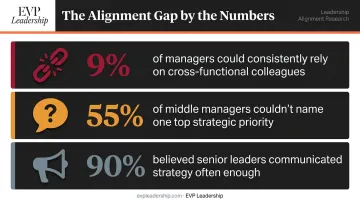
A landmark study by Sull, Homkes, and Sull surveyed roughly 7,600 managers across 262 companies and found that only 9% of managers could consistently rely on colleagues in other functions. Managers were about 3x more likely to miss strategic commitments because of failures by other units than by failures inside their own teams.
The same study found only 55% of middle managers could name even one of their company's top five priorities — despite 90% believing senior leaders communicated strategy often enough. The message was going out. It wasn't landing.
Each C-suite leader — CFO, COO, CMO — filters strategy through their functional lens. Without deliberate alignment, those lenses produce competing interpretations, and execution fragments along functional lines.
Strategy Compression
Alignment problems are compounded by how strategy gets measured. Long-term ambitions compress into annual financial targets and quarterly metrics — and short-term pressure reliably wins. CFO surveys have documented how financial reporting pressure leads executives to sacrifice long-term value to hit near-term earnings targets, not because they want to, but because the system rewards it.
The downstream effect is predictable:
- Teams learn that strategic commitments are aspirational
- The metrics that actually drive decisions are operational
- Organizational alignment erodes one quarter at a time
The Accountability and Bandwidth Gap
Even when alignment and measurement are managed well, two structural failure modes undercut execution:
- Diffuse ownership: when a strategic initiative belongs to everyone, no one is truly accountable for its outcome. Being "responsible" for a strategy is not the same as being accountable for specific execution results with a defined owner, success metric, and deadline.
- Tactical firefighting: C-suite leaders pulled into constant operational crises lose the capacity for strategic focus. In small and mid-size businesses, where executives routinely wear multiple hats, this is especially acute. The Yale SME CEO study found that operational and people crises are the dominant time consumers for SME leaders — not strategic work.
Execution discipline doesn't collapse in one dramatic moment. It erodes gradually — through accumulated pressure, interrupted priorities, and ownership that was never clearly assigned in the first place.
How to Structure Your C-Suite for Strategy Execution
Structuring the executive team around strategy — rather than inherited titles or legacy org charts — is where execution either takes hold or falls apart.
Design Around Priorities, Not Titles
Start by identifying the two or three strategic priorities that will drive the most impact over the next 12–24 months. Then ask: which C-suite roles and working relationships are most critical to executing those priorities? That question — not the org chart — should drive how the team operates.
Smaller, focused executive teams consistently outperform larger ones. Research by Wageman and Hackman, drawing on 120 senior leadership teams worldwide, found that high-performing teams function best with no more than eight members.
Bain's "rule of 7" goes further: each person added beyond seven reduces decision effectiveness by roughly 10%.
For small business leaders, this often means the founder or CEO needs to deliberately reduce their span of strategic oversight and build two or three "execution owners" who each hold a defined piece of the strategy.
Define Decision Rights
Without clarity on who holds decision authority, strategic decisions stall in consensus loops or get made inconsistently at lower levels. Rogers and Blenko's research at HBR documented a case where 83% of marketers and 64% of product developers both believed they owned the same product decision — a conflict that delayed execution substantially.
For each category of strategic decision, the team needs to know:
- Who has final authority
- Who must be consulted before the decision
- Who must be informed after
That clarity is the infrastructure that keeps decisions moving — and keeps them from being relitigated at every level. Once decision rights are locked in, the next structural lever is rhythm.
Establish a Strategic Cadence
Separate operational updates from strategic decision-making with a structured rhythm:
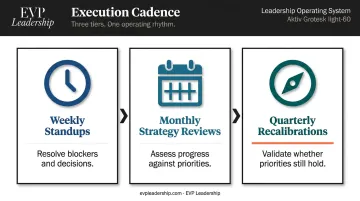
- Weekly standups: focused on blockers and decisions that need resolution
- Monthly strategy reviews: assess progress against priorities, not just financial performance
- Quarterly recalibrations: ask whether the priorities themselves still hold
Kaplan and Norton's work on the Balanced Scorecard argues that strategy must become a continual management process, not an annual planning event. McKinsey's survey of nearly 800 executives found that 45% of companies failed to track execution of strategic initiatives at all. A structured cadence closes that gap.
Align Incentives With Enterprise Outcomes
Kaplan and Norton reported that more than 90% of frontline employees and 70% of middle managers have no incentive compensation tied to strategy implementation. When C-suite leaders are rewarded primarily for functional performance — departmental KPIs, cost reduction — they optimize within their domain rather than across the enterprise.
Linking executive compensation to enterprise-wide outcomes shifts that dynamic. One caution: tying incentives to a single metric can backfire if leaders start treating the metric as the strategy rather than as an indicator of it.
The C-Suite Strategy Execution Framework: Step-by-Step
Step 1 — Translate Strategy Into a Small Set of Non-Negotiable Priorities
Execution fails when organizations try to do everything simultaneously. The C-suite must agree on the two to four strategic priorities that will receive disproportionate attention and resources over the next 90–180 days.
The prioritization conversation is not a brainstorm — it's a forcing function. The goal is explicit trade-offs and real alignment, not surface-level agreement where everyone nods and then returns to their own agendas. If the conversation doesn't produce genuine disagreement and resolution, it hasn't produced real alignment.
Step 2 — Assign Ownership and Define What "Done" Looks Like
Each priority needs:
- A single accountable executive owner — not a committee
- A defined success metric — specific and measurable
- A time horizon — with a date, not a quarter range
Without this, accountability becomes collective, which in practice means no one is accountable. Structure accountability conversations to be forward-looking: "What will you do by when?" — not backward-looking post-mortems that generate reports but no action.
Step 3 — Align the Organization Beneath C-Suite Priorities
Once the C-suite agrees on priorities, each function must translate enterprise priorities into team-level goals and individual contributions. This cascade is where most strategies stall. The C-suite reaches alignment — and then the translation to the next layer never fully happens.
Three concrete ways to close that gap:
- Require each functional leader to map their team's top three priorities to the enterprise priorities explicitly
- Run a cross-functional check: if a team member can't explain how their work connects to a strategic priority, the cascade has broken
- Review the cascade at monthly strategy meetings, not just once at the start of the year
Step 4 — Establish a Visible Execution Rhythm
Execution is not a one-time launch. It requires a consistent cadence of check-ins, course corrections, and re-prioritization. A three-tier rhythm — weekly standups, monthly strategy reviews, and quarterly recalibrations — only holds if it's protected. When strategic review time gets displaced by operational updates, the cadence collapses into firefighting and execution loses its anchor.
Step 5 — Build a Culture of Transparent Accountability
Execution culture is set by C-suite behavior, not policy. Specific behaviors that signal execution is real:
- Naming trade-offs explicitly in leadership meetings, not just in planning documents
- Holding difficult conversations early, before underperformance compounds
- Celebrating progress on strategic work, not just operational results
- Raising concerns without political consequence — which requires psychological safety at the executive level
Amy Edmondson's research on team learning found that psychologically safe teams reported more problems earlier — not because they performed worse, but because they were willing to surface and learn from what wasn't working. The same principle applies to C-suite execution reviews.

Conditioning Your C-Suite to Execute Under Pressure
There is a meaningful difference between knowing how to execute and being conditioned to execute. The first is a knowledge problem solved by frameworks. The second is a performance problem solved by repetition and deliberate practice under pressure.
Neuroscience research published in the Journal of Neuroscience found that acute stress shifts behavior toward habitual processes rather than goal-directed action. Under pressure, leaders don't rise to the occasion — they fall back on their habits. EVP Leadership's core philosophy captures this precisely: leaders don't rise to expectations — they fall back on their conditioning.
What Breaks Down Under Pressure
At the C-suite level, the breakdowns are predictable:
- Avoiding hard decisions — waiting for more information when action is required
- Reverting to functional thinking — protecting the department rather than serving the enterprise
- Abandoning long-term priorities — trading strategic work for short-term wins that feel more controllable
These are not character flaws. They are the predictable result of unconditioned leadership habits meeting real pressure.
Building Execution Conditioning: The PressurePoint System
EVP Leadership's 90-Day PressurePoint System is designed specifically to build this kind of conditioning into an executive team's operating rhythm. The system works through three layers:
Identity Layer — Develops the consistency, capacity, and character required to perform reliably under pressure. This is the foundation: who the leader is when conditions are difficult.
Diagnostic Layer — Trains leaders to see clearly and think decisively across six dimensions:
- Mission Clarity — Do we know exactly what we're trying to achieve, and why it matters now?
- Force Alignment — Are the right people aligned and accountable?
- Problem Intelligence — Are we solving the real problem, not its symptoms?
- Decision Integrity — Are decisions grounded in truth, not noise?
- Execution Discipline — Are we executing cleanly and without unnecessary complexity?
- Momentum Control — Are we making measurable progress on what actually matters?
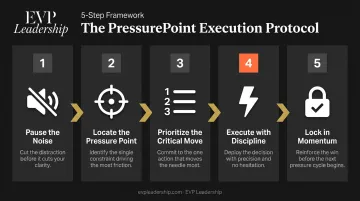
Execution Layer — A five-step protocol for critical moments:
- Pause the Noise
- Locate the Pressure Point
- Prioritize the Critical Move
- Execute with Discipline
- Lock in Momentum
The system conditions leaders, tests them in real scenarios, and embeds execution capacity across the organization — building what traditional coaching alone cannot: the internal capacity to perform when pressure rises and habits take over.
How to Measure C-Suite Strategy Execution
Outputs vs. Outcomes
Most C-suite teams over-index on output metrics — initiatives launched, meetings held, projects completed. These measure activity, not progress. Outcome metrics test whether strategic intent is actually being realized.
For each strategic priority, select two to three outcome-level KPIs that answer: "What changed as a result?" Not "what did we do?"
Kaplan and Norton's Balanced Scorecard, introduced in a 1992 Harvard Business Review article, put strategy and vision — not control — at the center of measurement. The scorecard combines financial measures with operational indicators tied to customers, internal processes, and organizational learning.
Build a Single Source of Strategic Truth
Fragmented data — each function reporting its own metrics in its own format — creates multiple competing versions of reality and undermines strategic alignment. A shared strategic scorecard, reviewed by the full C-suite on a consistent cadence, solves this.
The dashboard's job is not to report what happened. It's to surface the decisions that need to be made.
Use Reviews as Feedback, Not Performance Theater
The purpose of a strategy review is not to assign blame or celebrate wins. It's to answer three questions:
- What is working?
- What is not working?
- What do we need to change?
Answering those questions honestly requires psychological safety at the C-suite level. Leaders must be able to raise concerns, flag underperformance, and propose course corrections without fear of political consequences.
If your strategy reviews feel like performance theater rather than genuine feedback loops, they are failing you — no matter how polished the slide decks are.
Frequently Asked Questions
What is the C-suite's role in strategy?
The C-suite's role in strategy is to define organizational priorities, allocate resources against those priorities, align the executive team around a shared direction, and ensure strategic intent is translated into operational action across every function. That means owning both the plan and the daily leadership behaviors that make it real.
What are the four types of business-level strategies?
The four commonly recognized business-level strategies are cost leadership (competing on price and efficiency), differentiation (competing on unique value), focused cost leadership (low-cost within a niche), and focused differentiation (unique value within a niche). The C-suite's execution priorities and team structure should vary based on which strategy the organization is pursuing.
Why do most C-suite strategies fail during execution?
Most execution failures stem from C-suite misalignment, unclear decision rights, fragmented priorities across functions, and leadership behaviors that don't visibly reinforce strategic commitments — not from a poor strategy itself. The plan is usually fine; the operating system around it isn't.
How do you align your executive team around a single strategy?
Force an explicit prioritization conversation to land on two to four non-negotiable focus areas, each with clear ownership and defined accountability. Then build a structured execution cadence — weekly, monthly, quarterly — that sustains alignment beyond the annual planning retreat.
What's the difference between strategy planning and strategy execution?
Strategy planning is deciding what to pursue and why. Strategy execution is the ongoing work of translating that intent into aligned decisions, leadership behaviors, resource allocation, and measurable outcomes. Most organizations are far better at planning than executing — closing that gap is where durable competitive advantage is built.