Introduction
Most business owners know how to grow a business. Far fewer have built the leadership capacity to sustain that growth.
The pattern is familiar: a company scales its revenue, headcount, or operations — and the leadership structure buckles. Decisions stall. Teams escalate problems upward instead of solving them. A handful of people at the top carry everything, until they can't.
Only 26% of leaders rate their leadership development as high quality, according to DDI's Global Leadership Forecast. That gap doesn't stay invisible for long. When leadership doesn't scale alongside the organization, performance suffers, growth slows, and the business becomes deeply dependent on a few people who are already stretched thin.
If that describes your organization, this guide is the starting point. It breaks down what scaling leadership actually means, why most organizations get stuck, the core principles that make it work, and how to build a system that develops capable leaders at every level.
Key Takeaways
- Scaling leadership means deliberately expanding leadership capacity throughout an organization so growth doesn't bottleneck at the top
- You cannot scale ahead of your people — adding headcount without growing leadership capacity creates fragility, not strength
- The shift from hands-on management to systemic leadership is one of the hardest transitions a leader will make — and among the most consequential
- Culture is the operating system: without psychological safety and shared expectations, leadership development becomes a disconnected initiative
- Training builds knowledge; conditioning builds instincts — and it's instincts that determine performance under real pressure
What Is Scaling Leadership?
Scaling leadership is the deliberate process of expanding leadership capacity throughout an organization so that decision-making, accountability, and performance don't bottleneck at the top as the business grows.
That definition matters because it rules out two common substitutes:
- Promoting high performers — moving your best individual contributors into management roles doesn't automatically build leadership capacity; it often just elevates the people most at risk of becoming the next bottleneck
- Adding management headcount — filling org chart boxes without changing the systems, behaviors, and culture that produce leaders generates overhead, not capability
As Robert J. Anderson and William A. Adams describe in Scaling Leadership, the goal is leadership that produces other leaders — not leadership that consolidates decision-making authority at the top while everything else waits.
Two Dimensions That Must Grow Together
Scaling leadership operates on two levels simultaneously:
- Individual development — each leader expanding their personal capacity to handle greater responsibility, complexity, and pressure
- Organizational development — building the infrastructure, systems, and culture that distribute leadership effectively across layers
Both dimensions have to move in parallel. Developing individual leaders without the organizational infrastructure to support them produces capable people who still can't move freely. Building systems without developing the people inside them produces structure without substance.
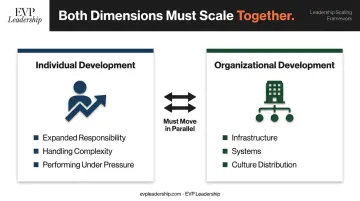
At EVP Leadership, every engagement is structured around both dimensions — building the individual leader's capacity and the organizational conditions that let that capacity actually show up when pressure is high and the stakes are real.
Why Most Organizations Struggle to Scale Leadership
The Person-Dependent Problem
Most leadership strategies in small and mid-size businesses are informal and person-dependent. The founder or a few senior leaders make the key decisions. This works at 10 people. It stops working somewhere between 30 and 50, and it typically breaks down visibly between 75 and 100.
The underlying issue isn't a shortage of talent. It's structural. When leadership exists only in people rather than in systems, every growth milestone exposes the gap.
Common structural barriers include:
- No shared leadership language or framework across the organization
- No clear definition of what "good leadership" looks like at each level
- A culture that rewards individual heroics over systemic development
- Leadership development treated as an HR initiative rather than a business strategy
The Mindset Barrier Is the Hardest One
Fixing the structure, though, only solves half the problem. Many leaders confuse being in control with being effective. The transition from hands-on management to trusting systems and other people is genuinely difficult — especially for founders and owner-operators whose identity is fused with the business.
Only 20% of executives say their organizations excel at decision-making, according to McKinsey research — and respondents reported spending 37% of their time on decisions, with 61% of that time used ineffectively. That's not a strategy problem. That's a leadership distribution problem.
Across EVP Leadership's client work, the same symptoms surface repeatedly when leadership hasn't kept pace with growth:
- Executive burnout from decisions that should be delegated
- Delegation gaps that create bottlenecks at the top
- Communication breakdowns between leadership layers
- Low ownership culture, where accountability stalls before it reaches the team
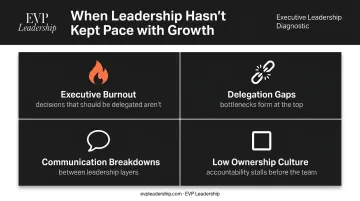
The pattern is consistent — and it's fixable. But only once leaders recognize the gap is structural, not personal.
Warning Signs Your Leadership Isn't Keeping Pace with Growth
Some of these signals are obvious. Others are easy to rationalize as temporary growing pains — until they're not.
Decision bottlenecks:
- Decisions stall without senior leader involvement
- Team members consistently escalate problems upward rather than solving them
- Senior leaders are in every meeting because no one else can answer the questions
Team performance signals:
- Communication breaks down between organizational layers
- Accountability is inconsistent — some things get done, others quietly disappear
- Performance is high at the bottom of the org and fragile everywhere else
Leadership fragility:
- The org chart relies heavily on two or three high performers at the top
- Key leaders show visible signs of burnout or chronic overload
- Growth adds people without growing their leadership capacity
That last point connects to what EVP Leadership describes as the founder bottleneck: the organization can't grow faster than the leader's ability to delegate, hold people accountable, and maintain operating discipline. This isn't a character flaw. It's what happens when leadership capacity hasn't been developed as a system — and the gap shows up precisely when growth demands the most.
Three Diagnostic Questions to Ask Now
These questions are worth sitting with before your next leadership team meeting — because the answers will tell you whether your infrastructure is ahead of your growth curve or already behind it:
- Are we adding people without growing their leadership capacity?
- Do we have the right people in the right roles for the next stage of growth — not just the current one?
- Is our growth curve outpacing our people?
Most scaling organizations find they can answer "yes" to at least one of these — and that's the signal. Growth doesn't wait for leadership to catch up on its own.
Core Principles for Scaling Leadership Effectively
Principle 1: Start with the Right People
Leadership scaling begins with character, competence, and chemistry. Adding headcount without vetting these three dimensions creates organizational fragility. Scaling with the wrong people accelerates dysfunction.
EVP Leadership's Identity Layer addresses this directly. Consistency, capacity, and character are the foundational pillars. Character, in particular, determines how a leader uses their skills and capabilities. Without it, competence becomes unreliable under pressure.
Principle 2: Culture Is the Operating System
A culture that values honest mistakes, personal development, and open communication is what allows leadership to scale. Without it, development programs become disconnected initiatives that leaders attend and forget.
Amy Edmondson's foundational research on psychological safety shows that when teams feel safe taking interpersonal risks, learning behavior increases significantly. Google's Project Aristotle later identified psychological safety as the single most important dynamic for effective teams.
Teri Evans, Leadership Facilitator at EVP Leadership, builds psychological safety into every team engagement. Without it, leaders won't surface the real problems — which means the real problems don't get solved.
Principle 3: Translate Vision into Measurable Behaviors
Abstract values don't scale. Specific behavioral expectations do.
"Hold regular one-on-ones" is not an expectation — it's a wish. A scalable expectation is specific enough to execute, measure, and hand off. For example:
- Weekly 30-minute one-on-ones, not "regular check-ins"
- Three standing questions, documented after each session
- Completed regardless of travel schedule
EVP Leadership's Delegation, Accountability & Operating Discipline work delivers exactly this: a clean delegation protocol that defines what gets delegated, to whom, with what authority, and against what success criteria — not a general reminder to delegate more.
Principle 4: Build Communication Infrastructure
Leadership scaling requires more than one visible communicator at the top. The shift to pursue: senior leaders who equip their direct reports to answer questions, rather than ones who simply attend meetings to field them.
When leadership communication only flows top-down, the organization becomes dependent on that single channel. Scaling requires amplifying leadership voices across layers — which is a design problem, not a personality problem.
Principle 5: Use a Consistent, Simple Framework
Complexity is the enemy of consistency at scale. A leadership framework must be simple enough to learn quickly, apply broadly, and teach to others — without requiring constant reinforcement from the top.
EVP Leadership's PressurePoint Diagnostic Layer functions as exactly this kind of shared organizational language. Its six components — Mission Clarity, Force Alignment, Problem Intelligence, Decision Integrity, Execution Discipline, and Momentum Control — give every leader a common framework for assessing situations and making decisions. No senior leader needs to be in the room to interpret it.
How to Build a Scalable Leadership System
Step 1: Link Leadership Development to Business Outcomes
Leadership strategy shouldn't exist separately from business strategy. Organizations most effective at scaling leadership tie talent development directly to operational KPIs and growth goals.
Programs that focus leadership development on behaviors critical to business performance are 8x more likely to succeed, according to McKinsey research — yet only 11% of executives strongly agreed their programs actually achieved and sustained results.
Gennifer Baker's C-level consulting work at EVP Leadership reflects this integration — strategic planning and leadership capacity development happen in the same conversation, not in separate workstreams.
Step 2: Define Leadership Expectations at Every Level
What does successful leadership look like for a front-line manager? A mid-level director? An executive? Without role-specific clarity, people default to managing the way they were managed — which may not match where the organization is going.
Role clarity needs to be explicit at each level. That means defining:
- What decisions belong to that role
- What accountability looks like in practice
- What "good leadership" actually produces at that stage
EVP Leadership's programs are custom-scoped to each client's leadership team profile and growth stage — from owner-led small businesses building their first leadership team to scaling mid-size businesses developing their next layer of leaders.
Step 3: Delegate Responsibility, Not Just Tasks
Task delegation assigns work. Responsibility delegation assigns ownership — with authority, accountability, and defined success criteria attached. Only the latter builds leadership capacity in others.
When companies delegate decisions at the right level, they are 6.8x more likely to be classified as decision-making leaders, McKinsey research found. Empowering employees through coaching and space for safe failure made organizations 3.9x more likely to be decision-making winners.
Mentorship and sponsorship compound these gains — they create pathways for lower-level leaders to develop faster by connecting their growth to people who can open doors and advocate for their readiness.
Step 4: Activate Informal Leaders
Every organization has informal opinion leaders who influence culture and behavior regardless of their title. These individuals carry high relational trust — and they can either reinforce or resist change.
Identifying and equipping them creates a critical mass of leadership influence that sustains itself without top-down directives. EVP Leadership's Force Alignment work addresses this directly — ensuring the right people are fully aligned and accountable, not just those at the top of the org chart.
Step 5: Build Feedback Loops Around Imperfection
Scaling leadership means placing people into leadership moments before they're fully ready. Mistakes will happen. The organizations that scale well don't prevent failure — they build systems for rapid learning.
Structured debriefs improve team effectiveness by approximately 25%, according to a meta-analysis of 46 studies. That result doesn't come from avoiding mistakes — it comes from building a culture where surfacing and analyzing them is expected and safe.
Why Leadership Conditioning Is the Foundation of Sustainable Scale
Training vs. Conditioning: The Critical Distinction
Training is episodic — a workshop, a seminar, a curriculum. It transfers knowledge. Conditioning is systematic and cumulative — it builds the habits, mental frameworks, and emotional capacity that allow a leader to perform under pressure, consistently, over time.
Most organizations dramatically over-invest in training events and under-invest in conditioning systems.
Adults retain roughly 10% of what they hear in classroom lectures, versus nearly two-thirds when they learn by doing, according to McKinsey. The 70-20-10 model — developed at the Center for Creative Leadership — formalizes this: 70% of leadership development comes from on-the-job experience, 20% from coaching and feedback, and 10% from formal training. Most organizations invert this ratio, spending heavily on the 10% while underfunding the other 90%.
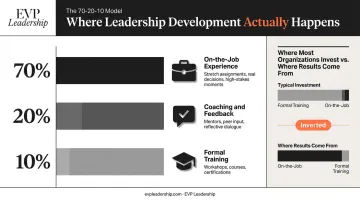
Why Conditioning Matters Under Pressure
EVP Leadership's core philosophy is direct: Leaders don't rise to expectations — they fall back on conditioning.
This isn't motivational language. It's grounded in behavioral science. Research on stress and habit behavior shows that under pressure, humans default to habitual responses rather than goal-directed behavior. The conditioned response takes over.
At the moment of organizational pressure — rapid growth, team conflict, a key hire departure — trained knowledge recedes. Conditioned instincts take over. If those instincts haven't been built deliberately, the organization pays for it: slow decisions, inconsistent execution, momentum lost.
The Role of Small Habits Over Time
Scalable leadership is built through daily disciplines — how a leader handles a difficult conversation, how they give feedback under pressure, how they delegate when time is short. These small, repeated behaviors compound over time into something durable.
EVP Leadership's core value reflects this: actionable change starts with small habits practiced consistently over time. Get your reps in. You don't need to revamp an entire organization to create meaningful transformation — you need to build the right practices and repeat them.
The 90-Day PressurePoint System
That habit-compounding logic is what the 90-Day PressurePoint System operationalizes. Built for founders, CEOs, and executive teams at small and mid-size businesses, it works through three interconnected layers:
- Identity Layer — builds consistency, capacity, and character as the leadership foundation
- Diagnostic Layer — trains leaders to see clearly through six components: Mission Clarity, Force Alignment, Problem Intelligence, Decision Integrity, Execution Discipline, and Momentum Control
- Execution Layer — installs a five-step protocol for critical moments: Pause the Noise → Locate the Pressure Point → Prioritize the Critical Move → Execute with Discipline → Lock in Momentum
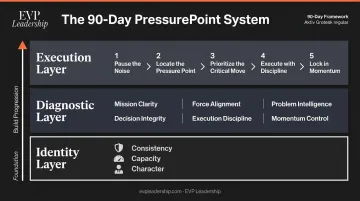
The system is structured to outlast the engagement — practiced in real scenarios so the protocols become instinct, not just knowledge leaders carry out of a room.
Frequently Asked Questions
What is scaling leadership?
Scaling leadership is the process of deliberately growing leadership capacity throughout an organization so growth doesn't create bottlenecks at the top. It goes beyond hiring managers — it means building systems, behaviors, and culture that develop leaders at every level.
What's blocking you from scaling up as a leader?
The most common blockers include:
- Inability to delegate meaningfully
- No clear leadership framework to guide decisions
- A culture built on individual heroics rather than systems
- Inconsistent conditioning that leaves leaders unprepared when complexity grows
What are the key qualities of a good leader?
For leaders who need to scale, the most critical qualities are:
- Consistency under pressure
- Capacity to develop others
- Clear, direct communication
- Decisiveness when stakes are high
- Character that doesn't shift when circumstances get hard
None of these are innate — they're built through ongoing conditioning.
What is the 70-20-10 rule for leaders?
The 70-20-10 model holds that 70% of leadership development happens through on-the-job experience, 20% through coaching and feedback, and 10% through formal training. Most organizations invert this, spending heavily on the 10% while neglecting the experiential conditioning that accounts for the other 90%.
How do you know if your leadership is ready to scale?
Three readiness signals to look for:
- Leaders at multiple levels make sound decisions without constant escalation
- A shared leadership language and framework travels across the organization
- Development happens consistently — not only when a crisis forces it
What's the difference between leadership training and leadership conditioning?
Training is an event that builds knowledge or awareness in the moment. Conditioning is a systematic process that builds the habits and instincts leaders fall back on under real pressure. Sustainable organizational scale requires conditioning — not just training.