Introduction
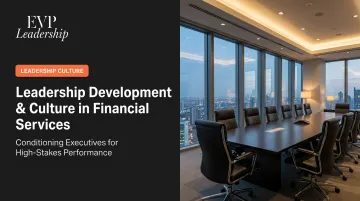
Financial services leaders operate under a pressure few other industries match. Every decision carries regulatory scrutiny, reputational consequence, and real impact on customers' financial lives. Yet technical expertise alone — deep knowledge of markets, risk, and compliance — no longer defines what makes a leader effective in this environment.
The industry is navigating several simultaneous forces — and they don't stay separate:
- Ongoing regulatory demands following conduct failings
- A talent retention crisis straining leadership pipelines
- Rapid digital disruption from fintech competitors
- A trust deficit that post-crisis investigations traced directly to leadership behavior and cultural drift
These pressures compound each other.
The result is that financial services leaders are being asked to build authentic cultures, develop the next generation, and perform consistently — all while managing sustained external pressure. Most understand what good leadership looks like. The harder problem is what happens when conditions deteriorate and established patterns reassert themselves. This article examines what separates leaders who hold their standard under pressure from those who don't — and what organizations can do to build that capacity deliberately.
Key Takeaways
- Culture breaks down through misaligned incentives, inconsistent leader behavior, and middle-management resistance — rarely from ignorance of stated values
- The most common leadership gaps — self-awareness, customer-centricity, inspiring others — are often invisible to the leaders who have them
- Sustainable culture change requires conditioning leaders to perform under pressure consistently, not one-time training events
- Future-ready leadership development hinges on ethical judgment, human-centered decision-making, and leaders who act on purpose — not just policy
Why Culture Breaks Down in Financial Services
Cultural breakdown in financial services rarely announces itself. It accumulates slowly, through thousands of small decisions where business outcomes are prioritized over values-aligned behavior — until the pattern becomes the norm.
Post-crisis investigations reached the same conclusion. The UK's Financial Conduct Authority's 2018 discussion paper on transforming culture identified culture as a key root cause of major conduct failings — not a symptom of a few rogue actors.
The PPI scandal had cost over £35 billion in compensation and fines by 2017. The Parliamentary Commission on Banking Standards found a "striking limitation" in leaders' sense of personal responsibility, with ignorance used as an excuse for widespread failings.
The Permafrost Problem
The FCA has warned specifically about middle management becoming a "permafrost" layer between C-suite values statements and frontline behavior. Senior leaders publicly champion the right behaviors. Customer-facing staff often want to do the right thing. But middle managers are caught in the middle — translating top-management pressure into frontline practice in ways that don't always match what's written in the mission statement.
When a team watches how a misconduct event is actually handled — whether the manager who hit their numbers gets protected — that signal overrides any policy document. Tacit messaging is always louder than official messaging.
Misaligned Incentives and the Consistency Gap
Incentive structures are often the clearest indicator of what a firm actually values. The PCBS found that remuneration had incentivized misconduct and excessive risk-taking, reinforcing a culture where poor standards were "considered normal." FCA guidance documented specific bonus structures that made the gap hard to ignore:
- Bonuses multiplied by up to 8x for cross-selling protection products
- "Super Bonuses" of up to £10,000 for rapid target achievement
- Performance metrics tied exclusively to volume, not conduct
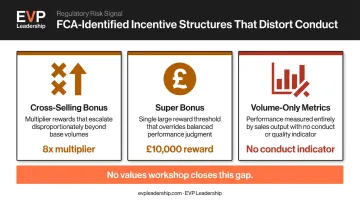
When those structures exist, no values workshop closes the gap.
The FCA put it directly: leaders must visibly and consistently live up to stated expectations because "what is done speaks more loudly than what is said." Culture is shaped by the decisions leaders make under pressure — not by what's printed on the wall.
The Purpose Distance Problem
The further employees feel from understanding why their work matters to real customers and to society, the easier it becomes to rationalize poor behavior and retreat into hitting numbers. When a bank introduced text alerts to help customers avoid overdraft fees — knowing it would cost £120 million in revenue — it sent a clear signal that customer purpose was real, not rhetorical. That kind of decision, made visibly, does more for culture than any internal communication campaign.
The Leadership Capability Gaps Holding Financial Firms Back
There's a genuine paradox at the heart of financial services leadership. The same analytical discipline that makes leaders excellent at risk management and long-term planning creates blind spots in inspiring teams, adapting to change, and leading with human-centered approaches. This isn't a personal failing — it's a structural pattern.
The Self-Awareness Gap
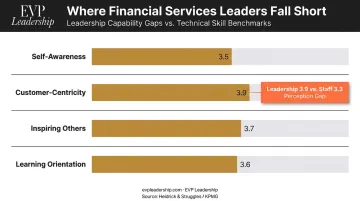
KPMG's financial services culture assessment found a consistent pattern: senior leaders perceive their organization's culture significantly more positively than the rest of the organization does. On customer centricity specifically, leadership rated their organization 3.9 out of 5 — while staff rated it 3.3 out of 5.
That gap has real consequences. Leaders who can't accurately see their impact on others struggle to build followership, catch culture problems early, or develop talent effectively.
Heidrick & Struggles identified financial services leaders as strong at spotting business threats — but consistently weaker in customer-centricity, inspiring others, self-awareness, and learning orientation. These are the capabilities that determine whether a leader builds culture or erodes it.
The Customer-Centricity Deficit
APRA's prudential inquiry into Commonwealth Bank of Australia offers a sobering example. The board relied on aggregate customer satisfaction data that reinforced a "good news" narrative. Only 3.4% of all customer complaints were reviewed for systemic issues. As of 2017, just one full-time employee was dedicated to identifying patterns in complaint data. Financial objectives were consistently prioritized over customer outcomes.
Distance from the customer is a governance and culture risk. When leaders aren't seeing what customers actually experience, they lose the ability to make decisions that protect long-term trust.
The Inspiring and Adaptability Gaps
Technical credibility doesn't automatically translate into the ability to create shared purpose. When leaders fail to inspire, discretionary effort drops, talented people leave, and culture stagnates.
Vulnerability, admitting mistakes, and direct communication about what the organization is working through — these are underutilized tools in financial services leadership precisely because the culture often treats them as weaknesses.
That same cultural resistance makes adaptability harder. CFA Institute research found that 91% of investment professionals said developing new skills is critical — but only 46% said their firms actually provide the training support needed. Leaders who protect existing knowledge rather than cultivating curiosity become a liability in an environment that demands constant change.
Conditioning Leaders, Not Just Training Them
Here's the core distinction: training gives leaders information and frameworks. Conditioning builds the habits, reflexes, and emotional capacity to apply those frameworks when it matters most.
Financial services leaders don't fail under pressure because they don't know what good leadership looks like. They fail because stress triggers deeply conditioned default behaviors — and those defaults often undermine the culture they're trying to build.
The New York Fed's culture reform work put it clearly: leaders must be "continuously exemplary," with accountability depending on conduct as well as revenue contribution. Meeting that standard requires leaders who have practiced the right behaviors until those behaviors are instinctive — not leaders who've attended the right seminars.
What Conditioning Actually Targets
EVP Leadership's 90-Day PressurePoint System is built on this principle. The program's core thesis — "leaders don't rise to expectations under pressure, they fall back on their conditioning" — reflects exactly what the research shows about how financial services culture fails.
The system works across three integrated layers:
- Identity Layer — developing leaders anchored in consistency (acting in alignment with values over time), capacity (handling increasing complexity and pressure), and character (the willingness to act with integrity regardless of circumstances)
- Diagnostic Layer — training leaders to see clearly through six dimensions: Mission Clarity, Force Alignment, Problem Intelligence, Decision Integrity, Execution Discipline, and Momentum Control
- Execution Layer — a repeatable protocol for critical moments: Pause the Noise → Locate the Pressure Point → Prioritize the Critical Move → Execute with Discipline → Lock in Momentum
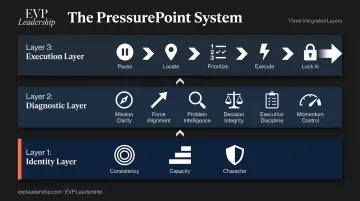
The identity layer is where the financial services application becomes most direct. Who a leader is under scrutiny — during a compliance event or a results miss — determines whether culture holds or fractures.
Integrity, humility, accountability, and moral courage are the observable behaviors every person on the team is reading. They either reinforce the culture or quietly erode it.
What Sustainable Conditioning Looks Like in Practice
The New York Fed noted that transforming financial services culture is a 5-to-10-year project. That long horizon makes the method matter: sustainable change comes from small habits practiced consistently, not periodic interventions. That's precisely what the PressurePoint system is designed to install. Practical conditioning for financial services leaders includes:
- Daily decision habits aligned with stated values — built before pressure arrives, not during it
- Pre-performance routines for high-stakes conversations and difficult moments
- Personal accountability structures that make self-assessment honest, not performative
- Regular values stress-tests — not just post-incident reviews, but proactive alignment checks
Building a Culture That Performs Under Pressure
The test of any financial services culture isn't how it behaves in good times. It's what happens when targets are at risk, when a compliance issue surfaces, or when a crisis breaks.
Practical Levers for Pressure-Resistant Culture
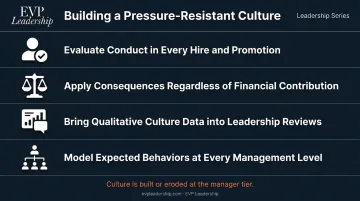
Building a culture that holds under pressure requires embedding conduct expectations into how decisions actually get made — not just into formal policy:
- Evaluate conduct alongside performance in every hiring and promotion decision — not selectively, but as standard practice
- Apply consequences for values violations regardless of financial contribution; protecting a top performer sends a louder culture signal than any policy document
- Bring qualitative culture data — turnover patterns, exit interview themes, complaint volumes, whistleblowing rates — into leadership reviews alongside financial metrics
- Model the expected behaviors at every management level; employees follow their immediate supervisors far more closely than the board, which means culture is built or eroded at the manager tier
The Role of Psychological Safety
The FCA defines psychological safety as "the willingness to express an opinion in the workplace" and explicitly links it to reduced unethical-behavior risk and improved team performance. Teams that feel safe to raise concerns, flag misconduct, and admit mistakes are the foundation of culture reform — and it's built through repeated behavioral signals from leaders over time, not through a single initiative.
A leader who responds to bad news with curiosity instead of punishment, who openly admits when they got something wrong — these behaviors, practiced consistently, mean problems surface before they escalate.
Developing the Next Generation of Financial Services Leaders
As the memory of 2008 fades, new leaders entering financial services lack firsthand experience of how quickly culture can collapse when incentives misalign and accountability disappears. The New York Fed has been direct about this risk: firms must actively pass on the lessons learned, because technical onboarding doesn't transfer cultural understanding.
CFA Institute's 2025 research confirms that firms are responding — moving beyond technical development toward mentoring, stretch assignments, leadership exposure, rotations, and ethics-centered judgment development. The finding that hiring managers value T-shaped skills three times more than purely technical skills signals how much the expectation has shifted.
What Future-Ready Development Actually Requires
Next-generation leadership development in financial services can't stop at technical competence and compliance orientation. It needs to include:
- Structured practice in navigating competing pressures — not just rules-based ethics training
- Coaching through decisions where purpose and profit pull in different directions
- Mentorship from leaders who model the right behaviors, not just sponsors who accelerate careers
- Pressure-performance conditioning that builds habits before leaders face their first real crisis
EVP Leadership's work with executive teams is built around this sustainability challenge. Their PressurePoint System gives leaders a personalized framework that continues to drive goals and manage priorities long after the formal engagement ends.
For organizations building leadership pipelines rather than just developing individuals, EVP Leadership's cohort and team facilitation programs develop these capabilities across entire teams through sequenced curriculum covering:
- Decision-making under pressure
- Accountability system design
- Leading through high-stakes moments
- Operating discipline
Frequently Asked Questions
What are the biggest leadership challenges in financial services today?
The most significant challenges cluster around leading consistently under sustained complexity: regulatory demands, talent retention pressure, digital disruption, and the need to build authentic culture simultaneously. The deepest problem is the accumulated strain of navigating all of them at once, without defaulting to short-term thinking or values-compromising behavior.
How does organizational culture affect financial performance?
Culture drives employee engagement, conduct decisions, and ultimately customer outcomes. Firms with purpose-aligned cultures show better long-term financial performance, lower turnover, and fewer conduct incidents. The inverse is also documented — over $100 billion in fines were imposed on large financial institutions following the financial crisis, most tied to systemic conduct failures rooted in cultural drift.
What leadership capabilities do financial services executives most need to develop?
Self-awareness, the ability to inspire and engage teams, customer-centricity, and a learning mindset are consistently the largest gaps identified in leadership assessments of this sector. These capabilities determine whether a firm builds sustainable culture or slowly erodes it — and they're measurable, developable gaps, not fixed personality traits.
What is the difference between leadership training and leadership conditioning?
Training delivers knowledge and frameworks. Conditioning builds the habits and reflexes to apply those frameworks consistently when under pressure. When a crisis hits, that distinction becomes visible: conditioned leaders execute on what they know, while leaders who were only trained often hesitate or revert to default behavior.
How can leaders rebuild trust and culture after misconduct or burnout?
Rebuilding requires consistent behavioral modeling from the top, transparent acknowledgment of what went wrong, realignment of incentive structures with stated values, and accountability maintained over time. Trust is rebuilt through repeated action, not announcements or one-time initiatives.
How do you develop financial services leaders who perform consistently under pressure?
Through systematic conditioning rather than episodic training. Leaders who perform under pressure have built habits and emotional capacity through repeated practice, not through workshop attendance alone. Development programs must be structured to create that depth, with accountability structures that outlast the formal engagement.