

Introduction
Picture a hospital department where a high-performing surgeon consistently dismisses nursing staff concerns in rounds. Leadership notices. Nothing is said. Within six months, three experienced nurses have quietly transferred, incident reporting has dropped, and patient satisfaction scores have followed. No single event caused it—just the slow erosion that happens when accountability gaps go unaddressed at the top.
This pattern repeats across healthcare organizations. The problem isn't that leaders don't understand accountability matters. Most do. The gap is between understanding it and actually practicing it—especially when the stakes are high, the relationship is complicated, or the timing is terrible.
At its most direct, this is a patient safety issue. It's also a staff retention issue and an organizational performance issue. A 2023 BMC scoping review found that adverse events affect at least 10% of in-hospital patients, with most studies reporting reduced adverse-event rates when patient safety culture scores improved.
This article covers the specific practices—behavioral standards, accountability conversations, and operating discipline—that move accountability from a value on the wall to a daily leadership habit.
Key Takeaways
- Accountability in healthcare is a patient safety issue first—not just a management concept
- Unaddressed leadership behavior sends a clear message: standards are negotiable
- Clarity before accountability: people cannot be held to expectations they were never given
- Psychological safety and accountability are not opposites—each makes the other possible
- Accountability culture is built through consistent daily behaviors, not one-time initiatives
What Accountability in Healthcare Leadership Really Means
Accountability in healthcare leadership is not about following rules or assigning blame after something goes wrong. It is the ongoing responsibility leaders carry for their decisions, their team's outcomes, and the environment they create—whether or not anyone is watching.
Two dimensions operate together:
- Individual accountability — a leader's direct ownership of their actions, decisions, and results
- Systemic accountability — the structures, rhythms, and expectations that keep teams consistently aligned to standards
Neither works without the other. A leader who holds themselves rigorously accountable but operates within a system with no shared standards will burn out trying to carry it alone. A system with robust performance tracking means little when the leaders inside it don't model the behavior—teams learn to perform for the process, not the standard.
Reframing the Concept
The most persistent misconception about accountability is that it is punitive by default. In practice, accountability done well is a developmental act. It says: I have seen where you are falling short, I believe you can do better, and I care enough to have this conversation.
That distinction carries real weight in healthcare, where staff already carry significant emotional load. Leaders who approach accountability as a form of respect—rather than consequence management—build teams that want to meet the standard, not teams skilled at avoiding getting caught.
This is the shift that separates leadership cultures from compliance cultures. EVP Leadership's PressurePoint System builds exactly this into its Identity Layer, grounding development in consistency, capacity, and character. The framework treats accountability not as a task leaders complete but as a behavior they condition—something that becomes reflexive over time rather than a response triggered only when performance slips.
The Real Costs of Leadership Accountability Gaps
When a leader avoids an accountability conversation—especially with a high-revenue or high-status individual—the message heard throughout the organization is not neutral. It is: standards here are negotiable depending on who you are.
That signal is expensive.
Patient Safety
Research from a 2017 BMJ systematic narrative review found that hospitals with formal medical leadership committee structures had process scores of 85.3% vs. 81.0% and risk-adjusted mortality of 5.6% vs. 7.3% compared to those without. Leadership presence and accountability structures translate into measurable clinical outcomes.
The Joint Commission has also documented that 40% of clinicians have stayed silent during patient-care situations rather than question a known intimidator—a direct consequence of unchecked disruptive behavior going unaddressed by leadership.
Staff Turnover
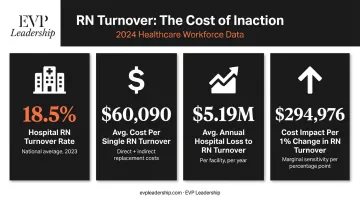
The financial cost of accountability-avoidant cultures lands hardest in workforce retention. According to NSI's 2026 National Health Care Retention Report:
- Hospital turnover currently sits at 18.5%
- The average cost of a single RN turnover is $60,090
- The average hospital loses $5.19 million annually to RN turnover alone
- Every 1% change in RN turnover represents approximately $294,976 in cost or savings
High performers leave first. They leave because they're tired of carrying the weight of upholding standards that their peers are allowed to ignore. Without intervention, the cycle accelerates.
Culture and Downstream Risk
Accountability gaps don't stay contained. Each unaddressed behavior sets a precedent, and the downstream effects follow a predictable sequence:
- Communication breaks down between clinical and administrative leadership
- Errors go unreported because staff have learned that raising concerns creates friction without resolution
- Compliance exposure, reputational damage, and deteriorating patient trust accumulate in the background
These consequences aren't hypothetical. They are the compounding cost of behavior that leadership chose not to address early.
The Theory: Core Principles Behind Accountable Healthcare Leadership
Accountability Flows From the Top
Leaders cannot build accountable teams without modeling accountability personally. When a leader admits mistakes openly, takes ownership of outcomes without deflection, and holds themselves to the same standard they apply to others, they create behavioral permission for the team to do the same.
The inverse holds just as firmly:
- Leaders who model ownership create teams that own their outcomes
- Leaders who deflect through status or political maneuvering teach their teams to do the same
Clarity Before Accountability
You cannot hold people accountable for expectations they were never given. Yet many healthcare leaders assume shared understanding exists around performance standards, communication norms, and professional conduct—without ever explicitly establishing it.
Setting clear, specific expectations is not micromanagement. It is the precondition for fair accountability. EVP Leadership's PressurePoint System addresses this through the Diagnostic Layer's Mission Clarity component, which ensures teams are operating from the same foundation before performance conversations begin.
Accountability Requires Psychological Safety
Here's the paradox most leaders miss: accountability only functions when people feel safe enough to acknowledge errors, ask questions, and surface concerns without fear of punishment.
A blame culture doesn't create more accountability—it drives problems underground. A 2025 systematic review covering 17,926 participants found a significant relationship between psychological safety and objective patient-safety outcomes, reinforcing that speaking up requires an environment where doing so is genuinely safe.

It Is Relational, Not Transactional
Effective accountability is built on trust. Leaders who have invested in genuine relationships with their teams—who know what their people are managing, where they're struggling, and what they're capable of—conduct accountability conversations that land differently than those from leaders who show up only when something goes wrong.
Humility is not a weakness in this dynamic. The willingness to say "I didn't handle that well" or "I should have been clearer" actually strengthens accountability because it establishes that standards apply to everyone, including the person delivering them.
Consistency Is the Differentiator
Sporadic accountability creates confusion. Consistent accountability builds culture. The differentiator is not whether a leader holds difficult conversations when conditions are easy—it is whether they do it when it is inconvenient, politically uncomfortable, or emotionally charged.
EVP Leadership's core belief that consistency as leaders is key—and that this is a conditioned skill, not a personality trait—is the foundation of this principle. Leaders who practice accountability consistently under pressure condition that behavior in their teams.
From Theory to Practice: Accountability Strategies That Work
Strategy 1 — Set Expectations Collaboratively
Co-creating expectations through team charters, shared performance metrics, or codes of professional conduct produces more genuine buy-in than top-down mandates. When team members participate in defining the standard, they have a stake in upholding it.
Practically: schedule a team session focused specifically on establishing shared norms. Document them. Return to them in performance conversations.
Strategy 2 — Monitor Progress With Objective Data
Accountability conversations without data become opinion contests. Build regular review of clinical outcomes, protocol adherence rates, patient experience scores, and team operating metrics into your leadership rhythm. When data is visible and reviewed consistently, deviations become observable facts rather than personal judgments.
Strategy 3 — Address Issues Early
Waiting always makes the situation worse. A small deviation ignored becomes a pattern — and patterns harden into culture.
The right intervention for an early or moderate issue is a private, non-punitive conversation—not a performance improvement plan. The goal is awareness and understanding: Did you know this was happening? What context should I understand? Early intervention preserves the relationship and usually resolves the issue before it requires escalation.
Strategy 4 — Use a Structured Framework for Difficult Conversations
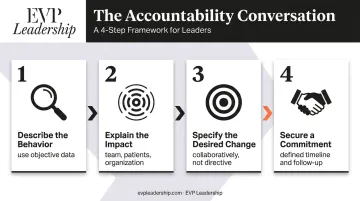
When a conversation requires more than a check-in, structure keeps it on track. A reliable sequence:
- Describe the behavior using objective data, not inference
- Explain the impact on the team, patients, or organization
- Specify the desired change collaboratively, not as a directive
- Secure a clear commitment with a defined timeline and follow-up
AHRQ's TeamSTEPPS program offers healthcare-specific tools—including the DESC framework and the Two-Challenge Rule—designed for these conversations. When the structure is practiced and repeatable, it holds under emotional pressure — which is precisely when leaders need it most.
Strategy 5 — Build Accountability as a Habit, Not an Event
Knowing the framework is not the same as executing it when stakes are highest. Training teaches the concept; conditioning develops the reflex.
EVP Leadership's 90-Day PressurePoint System is built on this distinction. Rather than covering accountability concepts in a single training session, the program conditions leaders to execute consistently — building the behavioral reflexes that show up when pressure is real, not just when conditions are comfortable. Accountability becomes part of how a leader operates, not something they revisit after a difficult quarter.
How to Have Accountability Conversations in Healthcare Settings
Healthcare leaders face accountability conversation challenges that leaders in most other industries don't. Status dynamics between physicians and administrators create implicit hierarchies that make direct feedback feel dangerous. Fear-of-litigation culture makes leaders cautious about what they document and say. Burnout-related emotional volatility means the person you need to confront may be operating on very little reserve.
None of these factors make the conversation optional — they make preparation non-negotiable. The higher the stakes, the more disciplined your approach needs to be before you walk in the room.
Before the Conversation
- Write down the specific behavior you're addressing—based on observable events, not impressions
- Prepare a clear purpose statement: what outcome do you need from this conversation?
- Use objective language: what happened, when, what impact it had—free from inference or accusation
- Anticipate emotional escalation and decide in advance how you'll hold the line without escalating yourself
When those preparation steps are in place, most conversations can be handled directly. Some situations, however, require a more formal response.
When to Escalate
Escalate to a formal performance improvement process when you observe:
- A recurring pattern after prior informal conversations
- Direct impact on patient safety outcomes
- Overt professionalism violations that create organizational or legal exposure
A formal PIP should include specific behavioral expectations, measurable outcomes, defined timelines, and documented support offered to the individual. Done right, it protects both the employee and the organization — and signals that accountability is a structured, supported process, not a punishment.
Building a Culture of Accountability That Lasts
Sustainable accountability culture is not built through a single initiative or an all-staff training. It is built through the accumulation of small, consistent leadership behaviors that compound gradually.
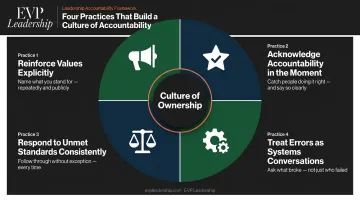
Key practices that compound into culture:
- Reinforce values explicitly — not just in onboarding, but as a recurring leadership conversation
- Acknowledge accountability in the moment — when a team member raises a concern, admits an error, or holds a difficult conversation, name it and recognize it
- Respond to unmet standards consistently — predictable responses signal that the standard is real, not situational
- Treat errors as systems conversations — following AHRQ's Just Culture framework, distinguishing human error from at-risk or reckless behavior keeps blame from forming around honest mistakes
The goal is not a culture of enforcement. It is a culture of ownership. Every team member — regardless of role or title — feels genuine responsibility for outcomes when leadership consistently signals that their contribution matters and their voice is heard.
That kind of ownership doesn't emerge from a policy rollout. It builds through the daily accumulation of small, deliberate choices — the same principle that anchors EVP Leadership's conditioning work: lasting change comes from habits practiced consistently, not from programs launched once and forgotten. Culture is what leaders do repeatedly, not what they declare occasionally.
Frequently Asked Questions
What are the 5 C's of leadership accountability?
The 5 C's framework, commonly described as Clarity, Communication, Commitment, Consistency, and Consequences, offers a practical leadership shorthand. Each element reinforces the others: without clarity, communication lacks direction; without consistency, consequences feel arbitrary. No single authoritative healthcare source has formally standardized this framework, so treat it as a practical reference rather than a clinical standard.
Why is accountability important in healthcare leadership?
Because the stakes attach directly to patient outcomes, staff retention, and organizational compliance—none of which are optional. When leaders model and enforce accountability, teams adhere more reliably to safety protocols, communicate more openly about near-misses, and deliver more coordinated care. In an industry where performance gaps cost lives, accountability is a non-negotiable leadership responsibility.
What are the signs that accountability is lacking in a healthcare organization?
Key warning signs include performance issues that go consistently unaddressed, high turnover among top performers, a culture of silence or blame around errors, declining patient safety or quality metrics, and the perception among staff that standards vary based on seniority or revenue generation.
How do you hold someone accountable without damaging the relationship?
Separate the behavior from the person, anchor the conversation in objective data rather than subjective judgment, and frame it as investment in the individual's success. Most people respond well to accountability delivered with respect and clarity. What damages relationships is feedback that feels personal, arbitrary, or punitive.
How does leadership accountability impact patient outcomes?
Safety culture is the clearest link between leadership accountability and patient outcomes. When leaders consistently enforce standards, teams report errors more openly, follow safety protocols more reliably, and coordinate care more effectively. Research consistently connects strong safety culture to lower adverse event rates.