Introduction
Most leaders weren't trained to handle what's hitting them right now. They were trained to execute under stable conditions—clear playbooks, settled teams, predictable markets. When those conditions disappear, a different problem surfaces: the gap between past leadership experience and present leadership capacity.
That gap is costly. According to DDI's research based on more than 100,000 assessments, only 18% of leaders feel prepared to lead through disruption—and that number has been falling for five years straight.
This article breaks down what leadership capacity actually means, why it breaks down under pressure, the key areas leaders must develop, and how to build it in ways that produce lasting behavioral change.
Key Takeaways
- Leadership capacity is about what a leader can carry—not how long they've held the title
- Most leaders collapse into reactive patterns under pressure because they've been trained, not conditioned
- Self-awareness, strategic clarity, communication, resilience, and delegation are the five core capacity areas
- Lasting capacity is built through repetition and deliberate practice, not one-time training events
- For small and mid-size business leaders, higher stakes per decision make conditioning more critical—not less
What Is Leadership Capacity?
Leadership capacity is the ability to handle responsibility, complexity, pressure, and growth. EVP Leadership uses that definition as a foundational pillar of their PressurePoint System — and it reframes the standard conversation immediately: this isn't about how long someone has held the role. It's about how much they can actually carry when conditions get hard.
The distinction between capacity and experience matters more than most organizations recognize. A leader with fifteen years of experience may have spent all fifteen years in stable conditions. That experience is real — but capacity for navigating disruption hasn't been tested, and untested capacity is unreliable capacity.
Why Complexity Is the Real Test
When organizations face disruption—rapid growth, team restructuring, market shifts—two types of leaders emerge:
- Leaders with thin capacity revert to reactive patterns: micromanaging, avoiding hard decisions, communicating poorly under stress, or defaulting to the playbook that no longer fits
- Leaders with strong capacity adapt. They stabilize their teams, make decisions with incomplete information, and keep execution moving even when the environment is uncertain
The critical point: capacity is dynamic, not fixed. It can be intentionally built through structured challenge, reflection, and consistent practice. Tenure alone doesn't build it — structured conditioning does.
Capacity also operates at two levels. A single leader's capacity directly affects their team's performance. Build it across a leadership team, and the organization itself becomes more resilient—less dependent on any one person to hold everything together.
Why Leadership Capacity Breaks Down Under Pressure
Most leaders develop their skills in relatively stable conditions. Systems are familiar. Teams are settled. The playbook exists. This creates what looks like competence—until significant change arrives.
The data here is stark. DDI's research from over 100,000 leadership assessments found that only 8% of executives demonstrated strong change-leadership capability. Specific weak points included rewarding change (1% strong), stretching boundaries (4% strong), and addressing resistance (11% strong).
The Most Common Warning Signs
When leadership capacity is under-developed, the signs are consistent across organizations:
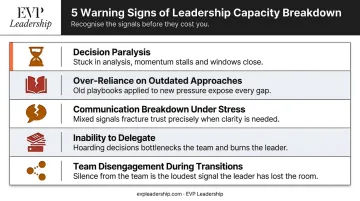
- Decision paralysis — leaders stall on calls they used to make quickly, waiting for certainty that won't arrive
- Over-reliance on outdated approaches — defaulting to what worked in the last cycle, even when conditions have fundamentally shifted
- Communication breakdown under stress — messages become vague, inconsistent, or absent exactly when teams need clarity most
- Inability to delegate as complexity increases — workload concentrates at the top, creating bottlenecks that slow everything down
- Team disengagement during transitions — Gallup research shows employees reporting extensive disruptive change were 67% more likely to cite an issue with a leader or manager
These patterns show up across industries, company sizes, and leadership levels. The root cause is rarely a skills gap. Leaders have been trained. They haven't been conditioned.
The Key Areas of Leadership Capacity Complexity Demands
Building leadership capacity isn't a single skill—it's a collection of interdependent capabilities that each become critical under pressure.
Self-Awareness and Emotional Regulation
Under complex conditions, a leader's internal state becomes highly visible. Anxiety travels fast. So does steadiness.
Research from HBR found that while 95% of people believe they're self-aware, only 10–15% actually meet the criteria. For leaders, that gap has consequences: poor self-awareness correlates with weaker decisions, damaged relationships, and communication failures—exactly when those failures hurt most.
In practice, self-awareness under pressure looks like pausing before reacting, recognizing when a decision is being driven by emotion rather than data, and naming what's happening internally before it shapes what happens externally.
EVP Leadership's PressurePoint System addresses this directly through the first step of its Execution Layer—Pause the Noise—which trains leaders to control the moment before the moment controls them.
Strategic Clarity and Decision-Making
Complexity creates noise. Leadership capacity includes the ability to separate signal from noise—to identify what actually matters and commit to a direction with incomplete information.
Analysis paralysis is a capacity gap, not a character flaw. Leaders who haven't developed Decision Integrity—grounding decisions in truth rather than noise and emotion—will default to waiting when they should be moving.
Communication and Influence
Change requires leaders to communicate with precision and confidence. That means clarifying vision when uncertainty is high, addressing fear without minimizing it, and maintaining team alignment when the path forward isn't fully visible.
When communication breaks down under pressure, teams fill the silence with their own interpretations—and those interpretations are rarely optimistic.
Resilience and Adaptability
The Center for Creative Leadership identified inability to develop or adapt as the most frequently cited reason for derailment among North American managers. Resilience isn't just bouncing back from setbacks—it's maintaining the emotional steadiness that allows teams to keep performing through disruption.
A leader's emotional state sets the ceiling for their team's stability. When leaders model instability, teams operate in a constant state of uncertainty—regardless of what's happening externally.
Delegation and Trust-Building
Under complexity, no single leader can carry the full load. Gallup's research on founders found that only one in four had high Delegator talent—and those who did generated significantly higher revenue and growth rates.
EVP Leadership identifies the founder-bottleneck pattern as one of the most common and costly they address: growth stalls not because of market conditions, but because the leader hasn't built the capacity to distribute responsibility. Developing that capacity is central to scaling sustainably.
How to Build Leadership Capacity: Strategies That Go Beyond One-Time Training
Start with an Honest Self-Assessment
Building capacity begins with a clear-eyed audit of how you currently perform under complexity. Where do you default to old habits? Where does your communication break down? What triggers reactive rather than intentional behavior?
EVP Leadership's Diagnostic Layer provides a structured framework for this audit, examining Mission Clarity, Force Alignment, Problem Intelligence, Decision Integrity, Execution Discipline, and Momentum Control. Peer feedback and structured reflection tools can surface blind spots that internal perspective misses.
Set Goals Tied to Real Conditions
Vague development goals produce vague outcomes. Effective capacity-building requires naming the specific leadership challenges you're currently facing—managing a growing team through a market shift, delegating to a team you're still learning to trust, communicating with confidence when the answer isn't clear—and designing development work around those actual conditions.
The more precisely you can define the pressure you're under, the more targeted your growth work can be.
Build Through Repetition and Deliberate Practice
Leadership capacity isn't built by attending a seminar. It's built through consistent, repeated practice of the skills that matter most.
EVP Leadership's core philosophy is direct on this: actionable change starts with small habits practiced consistently over time. The research supports it. A 2023 meta-analysis of 20 randomized controlled trials found that executive coaching produced significant behavioral outcomes, with the strongest effects in areas like goal attainment, leadership behavior, and resilience.
Deliberate practice means more than reading about leadership. It means:
- Running structured decision-making exercises on real scenarios
- Seeking regular feedback loops, not just annual reviews
- Placing yourself in situations that require growth, not just familiarity
- Reflecting on outcomes rather than moving past them
Seek Structured Coaching or Mentorship
External perspective accelerates capacity-building because coaches can observe patterns the leader cannot see from the inside. They create accountability, challenge assumptions, and help develop the clarity and communication discipline that complexity demands.
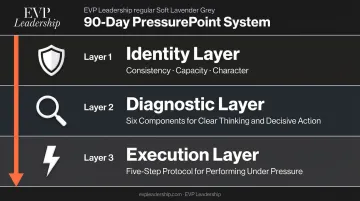
EVP Leadership's 90-Day PressurePoint System is built specifically for this purpose — providing structured, systematic conditioning for small business owners and executives rather than scattered workshops or one-time training events. The engagement works across three layers:
- Identity Layer: consistency, capacity, and character
- Diagnostic Layer: six components that develop clear thinking and decisive action
- Execution Layer: a five-step protocol for performing under pressure
Cultivate Continuous Learning
Leaders with strong capacity treat every challenge, mistake, and pivot as data. They debrief after high-pressure situations instead of moving past them. They seek feedback rather than avoiding it. They stay informed about what their industry and team dynamics require — and they adjust before they're forced to.
The difference between leaders who grow through complexity and those who stall in it often comes down to one habit: treating experience as curriculum, not just as workload.
Leadership Conditioning vs. Training: Why the Distinction Matters
Leadership training is episodic. A course, a workshop, a seminar—these transfer knowledge but don't reliably change behavior under pressure. The gap between knowing what to do and actually doing it when stakes are high is where most leadership development fails.
Leadership conditioning is different. It's the repeated, intentional practice of specific responses until they become instinctive—available even in high-stress moments.
EVP Leadership articulates this through their tagline: Because leaders don't rise to expectations—they fall back on conditioning. It's not a marketing line. It's a description of how human performance actually works.
The Athlete Analogy
An athlete doesn't rely on game-day information to perform. They rely on what they've conditioned their body and mind to do under pressure. A sprinter doesn't think through technique during the race—they execute what thousands of repetitions have made automatic.
Leaders operate the same way. Under pressure, leaders don't think their way to the right response. They execute what they've conditioned themselves to do.
EVP Leadership builds this conditioning through the PressurePoint System—a 90-day program designed to make effective behavior the default response, not just the described one. The goal isn't leaders who know what to do. It's leaders who do it automatically when the pressure is on.
Why This Matters More for Smaller Organizations
In small and mid-size businesses, leaders face high-stakes decisions more frequently and with less infrastructure to absorb mistakes. There's no deep bench. There's no enterprise support system to catch errors. The leader's capacity—or lack of it—has direct, immediate consequences for the organization.
That's what makes conditioning the differentiator. A leader who has internalized how to pause, locate the real pressure point, and execute a clear move doesn't freeze when the organization needs them most—they lead.
Frequently Asked Questions
What does building leadership capacity mean?
Leadership capacity is the developed ability to handle responsibility, complexity, pressure, and growth—not just under ideal conditions, but when stakes are high and circumstances shift fast. Building it is an ongoing, intentional process of developing skills, emotional resilience, and decision-making ability through deliberate practice.
How do you build leadership capacity?
Start with honest self-assessment to identify where you default to reactive patterns. Set specific development goals tied to real challenges you're currently facing. Practice core skills consistently with feedback, and work with a structured coaching engagement to surface blind spots and build accountability.
What are the key areas of leadership capacity?
Five core areas define leadership capacity:
- Self-awareness and emotional regulation
- Strategic clarity and decision-making
- Communication and influence
- Resilience and adaptability
- The ability to delegate and build trust
Each becomes especially critical during periods of organizational change or rapid growth.
Why is leadership capacity important during organizational change?
Organizational change exposes every gap in a leader's capability. Teams look to their leader for stability and direction when conditions are uncertain. Leaders with insufficient capacity become the bottleneck that slows or derails a transition—while those with strong capacity stabilize their teams and keep execution moving.
What is the difference between leadership training and leadership conditioning?
Training transfers knowledge in a structured setting. Conditioning builds reliable behavior under pressure through repetition and deliberate practice. When complexity hits, conditioned leaders default to effective responses. Trained leaders know what the right response is—but can't always access it when it matters most.
How do you measure leadership capacity?
Capacity shows up through structured self-reflection, peer and team feedback, and performance during high-pressure situations. Key indicators: decision quality under stress, communication clarity during transitions, and team alignment when conditions are changing.