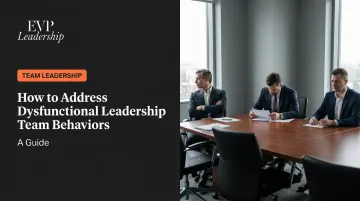
This is the defining challenge of leading at the executive level. And it's far more common than most leaders admit.
Dysfunctional leadership team behaviors rarely announce themselves. They develop gradually — through unresolved conflict, misaligned incentives, or patterns the team itself cannot see from the inside. By the time the dysfunction is undeniable, it's already expensive.
This guide covers how to recognize the specific behaviors, diagnose what's actually driving them, follow a structured process to address them, and decide when coaching is enough versus when a personnel change is necessary.
Key Takeaways
- Dysfunctional leadership team behaviors follow predictable patterns — recognizing them early is the first step to intervention.
- Most dysfunction is systemic: unclear accountability, competing priorities, and low psychological safety drive the patterns more than any single individual.
- Structured, step-by-step intervention outperforms reactive responses and one-time culture workshops every time.
- Leaders must distinguish between behaviors that can be coached and situations that require a personnel decision.
- Keeping teams high-performing under pressure requires deliberate, ongoing conditioning — not periodic fixes.
What Does Leadership Team Dysfunction Look Like?
A dysfunctional leadership team is one that cannot consistently make good decisions, hold each other accountable, or collaborate effectively — regardless of individual competence. That last part matters. You can have talented, experienced leaders who collectively produce dysfunction — the problem is at the team level, not the individual.
Research reinforces how common this is. A study of 120 top leadership teams found that only 24% were high performing, based on Hackman, Wageman, and Lehman's Team Diagnostic Survey research. The majority were operating below their potential — often without fully recognizing it.
Common Signs of a Dysfunctional Leadership Team
Watch for these specific behavioral patterns:
- Decisions get relitigated — agreements reached in meetings unravel afterward in side conversations
- Real conversations happen outside the room — hallway dialogue replaces honest in-meeting debate
- Artificial harmony — no one challenges ideas openly; disagreement is smoothed over, not resolved
- Inconsistent accountability — some leaders carry disproportionate load while others disengage without consequence
- Growing cynicism — energy and engagement among team members quietly erodes over time
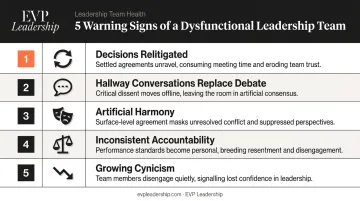
Four or more of these patterns showing up consistently signals systemic dysfunction, not a temporary rough patch.
What makes this difficult is that these signs are often mistaken for "healthy debate" or "diversity of perspectives." That ambiguity is what lets dysfunction persist unchallenged — and what delays the moment leaders feel confident enough to act.
Common Dysfunctional Leadership Team Behaviors
Most leadership team dysfunction clusters around a small set of recurring behavior patterns. Naming them precisely matters — vague labels trigger defensiveness; specific behavioral descriptions create the shared reality needed for change.
Conflict Avoidance
Leaders avoid difficult conversations. Topics get tabled indefinitely. Frustration leaks out sideways — as sarcasm, passive resistance, or sudden blowups — rather than through direct dialogue. At the executive level, this is particularly damaging because decisions require honest debate to be sound. A leadership team practicing artificial harmony isn't aligned; it's just quiet.
Accountability Gaps
Actions from meetings are vague. Owners are unclear. Deadlines slip without consequence. A small group of conscientious leaders ends up overloaded while others disengage.
Over time, this erodes trust across the entire team. Delegation, accountability system design, and operating discipline aren't separate skills — they function as a connected set of practices, and gaps in any one of them compound the others.
Silo Thinking and Territorial Behavior
Leaders optimize for their own functions, hoard information, and treat cross-functional work as a threat rather than an opportunity. The result: strategy gets executed in fragments, "us vs. them" cultures develop below the leadership layer, and unified organizational direction becomes nearly impossible.
Domineering or Disengaged Leadership Styles
Two opposite patterns, equally damaging:
- The overassertive leader dominates discussions, crowds out others' ideas, and effectively narrows the team's collective intelligence to one voice
- The ghost leader is present in title but emotionally and intellectually absent — contributing little while occupying a seat that influences the team's dynamics
Either pattern sets a ceiling on what the team can produce — and that ceiling is felt at every level below it.
Role Ambiguity and Decision Fog
No one is clear on who decides what. Decisions get escalated unnecessarily. Ownership diffuses across the team until no one owns anything.
Two elements tend to be missing when this pattern takes hold: Decision Integrity — grounding decisions in reality rather than noise and emotion — and Execution Discipline — establishing clean, consistent protocols for following through. When both are absent, the confusion radiates downward and slows every level of the organization below the leadership team.
Root Causes of Leadership Team Dysfunction
Treating symptoms — running more meetings, posting values on a wall, adding a workshop — fails because it bypasses the root cause. Most interventions that don't stick address the wrong level of the problem. Diagnose first, then act.
The most common structural and psychological root causes:
- Competing incentives that reward individual performance over collective outcomes
- Unclear decision rights that leave people unsure who is empowered to act — McKinsey research found role clarity has a 0.74 correlation with top-team performance
- Chronic overload that narrows thinking and increases reactivity
- Low psychological safety that causes leaders to hide risks and avoid candor — Google's Project Aristotle identified psychological safety as the first and most important dynamic of effective teams
- Unresolved interpersonal history where perceived slights or power dynamics have calcified into fixed behavioral patterns
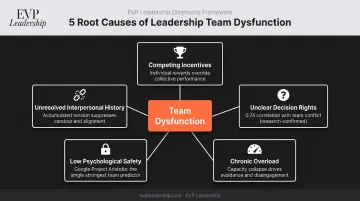
Left unaddressed, these root causes don't stay contained at the top. The organization below the leadership team absorbs the dysfunction — in slowed decisions, fragmented execution, and eroded trust. According to Mankins and Steele's HBR research, companies typically realize only 60–63% of their strategies' potential financial value because of planning and execution breakdowns. Fix the root cause, and you unlock the capacity that's already there.
How to Address Dysfunctional Leadership Team Behaviors: A Step-by-Step Approach
Attempting to fix leadership team dysfunction without understanding what's driving it is the most common — and costly — mistake leaders make. The following process identifies the specific dysfunction, isolates its cause, applies the right intervention, and tests whether the change is holding.
Step 1: Diagnose Before You Intervene
Start by observing patterns, not symptoms. Conduct 1:1 conversations with team members using neutral prompts: What helps this team perform? What consistently blocks us? What do we avoid saying out loud?
Map where handoffs and accountability repeatedly break down. Then share themes back to the team without attributing them to individuals. This reduces defensiveness and builds the shared reality the team needs to engage honestly with the real problem.
Step 2: Name the Dysfunction Without Assigning Blame
Surface the elephant in the room by presenting observable patterns — what happens, when it happens, what the impact is — rather than character judgments. The goal isn't to call anyone out. It's to create enough shared awareness that the team can work on the actual problem together. This distinction determines whether the conversation opens things up or shuts them down.
Step 3: Address the Root Cause Directly
Once you've named the dysfunction, the response has to match what's actually driving it.
If the issue is structural (unclear roles, competing incentives, vague decision rights): fix the system. Redefine ownership, clarify who decides what, and align incentives to shared outcomes.
If the issue is relational or behavioral (conflict avoidance, domineering styles, disengagement): invest in a facilitated process that gives leaders a safe environment to hear the impact of their behavior, explore its origins, and commit to change.
This is where working with an experienced external leadership consultant — such as EVP Leadership — changes the outcome. An outside perspective removes the political weight from the conversation, giving leaders room to engage honestly in ways internal-only efforts rarely achieve.
Step 4: Install Operating Rhythms That Reinforce Healthy Behavior
Structural habits are what lock change in. Without them, healthy behaviors erode under pressure. Build:
- Decision logs that record who decided what and why
- Standing huddles to surface blockers before they compound
- Meeting disciplines that end with clear owners, actions, and due dates
- Regular check-ins on both task delivery and team health
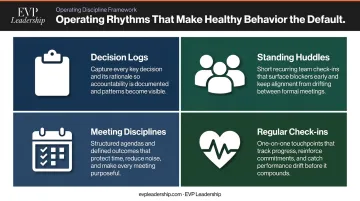
Under pressure, leaders default to old patterns. These rhythms make the new behavior the path of least resistance.
Step 5: Monitor, Measure, and Adjust
Track the specific behaviors that originally signaled dysfunction — whether decisions are sticking, whether the right conversations are happening in the room, and whether accountability is consistent.
Set a defined review window — 60 to 90 days — to evaluate whether change is holding. One difficult conversation or one workshop is not enough. Lasting change requires sustained leadership attention and consistent follow-through over time.
When to Coach vs. When to Make a Personnel Change
Not all dysfunctional behavior is equally addressable through coaching and process change. The key question is whether the leader is coachable: Do they acknowledge the impact of their behavior? Do they show genuine willingness to change? Are they demonstrating improvement over a defined period?
A 2023 meta-analysis found that executive coaching has significant positive effects, with behavioral outcomes being stronger than attitude or personality-characteristic outcomes. Coaching works best when the target is observable behavior, goals are specific, and the leader is engaged in the process.
If those conditions are present, coaching and structured support are the right investment. If not, continuing to accommodate the behavior carries real costs: to team performance, to organizational culture, and to the credibility of any leader attempting to address it.
Clearest signals that a personnel change may be necessary:
- The leader's behavior is causing psychological harm or creating a toxic environment
- The pattern has persisted despite clear feedback, fair opportunity, and adequate support
- The leader's presence is preventing the rest of the team from functioning at full capacity
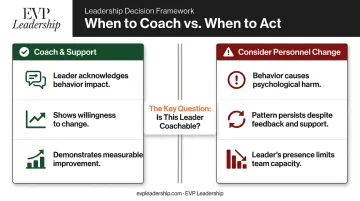
These conversations are difficult — and avoiding them compounds the damage.
When a personnel decision becomes necessary, lead with specific behavioral evidence rather than personality labels. Be clear about what must change, by when, and how progress will be measured. If separation becomes necessary, approach it with honesty and genuine regard for the individual. Most leaders don't arrive at dysfunction alone.
How to Build a High-Functioning Leadership Team Long-Term
The most resilient leadership teams are not assembled once and left alone. They are actively conditioned over time to maintain healthy habits under pressure. One-time interventions — off-sites, assessments, workshops — have value, but they don't build the capacity to perform consistently when stakes are high.
EVP Leadership's 90-Day PressurePoint System was designed specifically for this: to condition small and mid-size business leaders to perform under pressure through systematic, repeatable habits rather than training events. The difference shows up when pressure rises. Leaders fall back on conditioning — not on the content of a workshop they attended six months ago.
Preventive practices that high-functioning leadership teams maintain:
- Regular team reflection on how the team is operating, not just what it is producing
- Clear, living decision rights documentation that is revisited as the organization evolves
- A shared norm of direct, respectful challenge that is explicitly practiced, not assumed
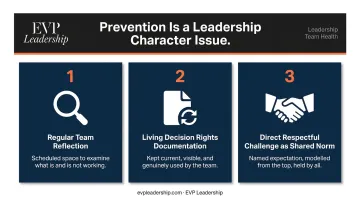
Prevention is a leadership character issue. Tasha Eurich's research found that while 95% of people believe they are self-aware, only 10–15% actually are. The gap matters here: a leader who cannot accurately see their own behavior cannot lead a healthy team. Self-awareness isn't soft — it's the foundation on which accountability, psychological safety, and honest collaboration are built.
That's the work EVP Leadership's Identity Layer is built around — developing leaders anchored in consistency, capacity, and character, so the team's health isn't contingent on circumstances but on who the leader has become.
Frequently Asked Questions
What are the five dysfunctions of a leadership team?
Patrick Lencioni's model identifies five dysfunctions that build on each other: absence of trust, fear of conflict, lack of commitment, avoidance of accountability, and inattention to results. Trust sits at the foundation; without it, each layer above it fails.
What is the most common cause of leadership team dysfunction?
The most common root causes are structural: unclear decision rights, competing incentives, and vague accountability. Low psychological safety compounds all three, making it harder for the team to name and address the dysfunction directly.
Can a dysfunctional leadership team be fixed without replacing members?
Yes. Most dysfunctional teams can improve significantly without personnel changes, provided leaders are willing to acknowledge the patterns, engage with root causes, and commit to sustained behavioral change. Some situations do require personnel decisions — specifically when behavior is harmful or the pattern is irrecoverable.
How long does it take to fix a dysfunctional leadership team?
Meaningful change typically requires a minimum of 60-90 days of consistent effort. Structural changes such as clarifying roles and decision rights can shift faster than relational or behavioral patterns, which require repeated reinforcement over time.
What is the 60-30-10 rule of team effectiveness?
In the Hackman-Wageman tradition, the 60-30-10 rule holds that 60% of a team's effectiveness comes from prework and design, 30% from the launch, and 10% from ongoing coaching. Most interventions invest in the 10% while neglecting the 60%.
What are the 5 C's of team effectiveness?
No single canonical "5 C's" model is established across the research literature. The most rigorous reference point is Eduardo Salas's work, which identifies seven conditions for team effectiveness — spanning capability, communication, coordination, and coaching — all of which appear in high-functioning leadership teams.