Introduction
Your leadership team spent three months building the plan. The offsite was productive. Everyone left aligned. Six months later, the revenue targets haven't moved, the new initiative is stalled, and your weekly meetings feel like reruns of the same conversation.
This is the strategy execution gap—the distance between what leaders plan and what actually happens. And it's not an isolated experience.
Research from Bridges Business Consultancy's 20-year longitudinal study found that when success is defined as achieving at least two-thirds of strategic objectives, 85% of implementations are failing. Meanwhile, Mankins and Steele's research published in Harvard Business Review found that companies typically realize only 63% of their strategy's promised financial value due to breakdowns in execution.
The problem isn't the plan. Leaders who can't see their own blind spots, revert under pressure, and operate in reactive mode drive the execution gap—and no strategic planning session fixes that. This article breaks down how executive coaching works on those root causes, and why it reaches places that offsite planning never does.
Key Takeaways
- The execution gap is a leadership behavior problem, not a planning deficiency
- Common barriers are human: blind spots, reactive habits, misaligned teams, and vague accountability
- Coaching builds the behavioral infrastructure execution requires, not just the strategic intent behind it
- In small and mid-size businesses, one leader's habits can determine the momentum of the entire organization
- Training transfers knowledge — conditioning builds the automatic responses that hold when pressure hits
Why Strategies Stall: The Root Causes of the Execution Gap
Execution failures rarely come from bad strategy. They come from what happens to leaders once implementation starts — when real-world pressure, competing priorities, and organizational complexity expose the gaps that planning never anticipated.
Blind Spots and Self-Awareness Failures
Most leaders cannot see the behaviors they're modeling that actively undermine execution. No one inside the organization has the standing—or the safety—to name them directly.
Tasha Eurich's research, published in Harvard Business Review, found that while 95% of people believe they are self-aware, only 10–15% actually meet the criteria. A separate Korn Ferry Institute analysis of nearly 7,000 self-assessments found that professionals at poorly performing companies were 79% more likely to have low self-awareness than those at high-performing firms.
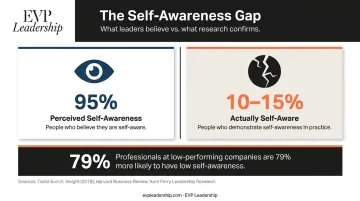
Indecision, over-control, poor delegation—these behaviors cascade through organizations silently, and the leader causing them is often the last to know.
The Alignment Gap: Strategy Without Buy-In
When strategy flows only from the top, it arrives as a mandate rather than a shared direction. Teams understand what to do but not why it matters now—which produces passive resistance, conflicting priorities, and fragmented execution.
People support what they help create. When mid-level managers have no hand in shaping how strategy translates to their work, they execute the letter of the directive while missing its intent entirely.
The Focus Gap: Urgency Defeating Importance
A Harvard Business School study tracking 27 CEOs found that 36% of their time was spent in reactive mode, responding to unfolding internal and external developments—and that CEOs average 37 meetings per week with 72% of total work time consumed by meetings.
For small and mid-size business owners, the numbers feel even worse. The operational demands are constant, and protected time for strategic thinking becomes a casualty of the daily schedule.
The Accountability and Mindset Gaps
The hardest gaps to close aren't structural — they're behavioral. Accountability and mindset failures are linked, and they tend to be the last ones leaders recognize in themselves:
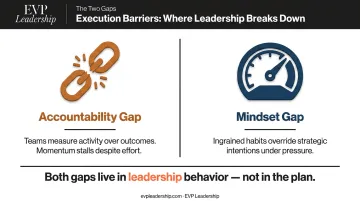
- Accountability gap: Without a clear line-of-sight between daily decisions and strategic goals, teams default to measuring activity—tasks completed, hours logged—rather than outcomes. Momentum stalls even when everyone is technically busy.
- Mindset gap: Experienced leaders carry deeply ingrained habits formed over years that surface under pressure and override their stated strategic intentions. This is why more planning doesn't solve the execution problem. The gap lives in leadership behavior, not in the plan itself.
The Real Cost of the Strategy Execution Gap
The Brightline Initiative has estimated that $1 million is wasted globally every 20 seconds due to poor strategy implementation. A separate EIU survey of 500 senior executives found that organizations fail to meet 20% of strategic objectives on average because of poor implementation.
Those numbers describe large enterprises. For small and mid-size businesses, the cost runs deeper than revenue — it erodes the organizational assets hardest to rebuild.
A single failed strategic initiative doesn't just cost revenue. It costs something harder to rebuild:
- High performers disengage when strategies get announced and abandoned — and they typically attribute the gap to leadership, not circumstances
- Each execution failure erodes confidence in the next initiative before it even launches, making teams skeptical of planning cycles altogether
- Repeated execution failures atrophy an organization's ability to course-correct, making every future cycle harder than the last
For a founder or owner-operator, one stalled initiative can represent years of growth postponed — and organizational momentum, once lost, rarely returns on its own.
How Executive Coaching Directly Closes Each Gap
Coaching is uniquely positioned to address the execution gap because it works on the leader, not the plan. A consulting engagement produces recommendations. Coaching produces behavioral change—and behavioral change is what execution requires.
Closing the Self-Awareness Gap
A skilled executive coach provides structured, honest feedback through observation and dialogue—surfacing the patterns a leader cannot see independently. This external perspective, delivered with both candor and psychological safety, allows leaders to identify and shift the specific behaviors slowing execution.
At EVP Leadership, this work is addressed through the Identity Layer of the 90-Day PressurePoint System, which builds three foundational elements:
- Consistency: Showing up aligned with stated values every day—not just in planning sessions
- Capacity: Carrying increasing responsibility and pressure without becoming the bottleneck
- Character: How a leader's consistency and capacity hold when the stakes are highest
Together, these eliminate the internal leadership breakdowns that cause external strategy execution to fail.
Closing the Alignment Gap
Coaching helps leaders communicate strategy in ways that are concrete, consistent, and personally meaningful to the people responsible for carrying it out. It also helps leaders involve key team members in shaping how strategy translates to action—shifting from top-down directives to shared ownership.
The Diagnostic Layer's Force Alignment component directly addresses this question: Do we have the right people, fully aligned and accountable? When leaders can answer that clearly, execution becomes a coordination problem rather than a motivation problem.
Once alignment is established, the next challenge is keeping it. That's where focus and accountability systems do the heavy lifting.
Closing the Focus and Accountability Gaps
Coaches help leaders design accountability systems that create a direct, visible connection between daily decisions and strategic goals. Research from MIT Sloan Management Review analyzed 600,000 goals and found that specific, ambitious goals with metrics and frequent feedback can move an average team to the 88th percentile of performance.
But structure alone isn't enough. Coaching also protects strategic time on a leader's calendar as a non-negotiable priority—not something that gets sacrificed when the week fills up.
EVP Leadership's accountability work includes an operating rhythm of 1:1 cadence, team review structures, scorecards, and performance conversations—designed to ensure delegated work and accountability measures actually land in practice.
None of those systems hold, however, if the leader's own mindset collapses under pressure. That's the final gap—and the deepest one.
Closing the Mindset Gap
This is where coaching produces its most lasting value. When a leader understands why they revert to control, avoidance, or perfectionism in high-stakes moments, they can replace that reflex with intentional, strategy-aligned action.
EVP Leadership's Execution Layer provides a structured five-step protocol for exactly these moments:
- Pause the Noise — control the moment before it controls you
- Locate the Pressure Point : pinpoint where the situation is actually breaking down
- Prioritize the Critical Move : narrow to the one action that matters most right now
- Execute with Discipline — clean action without unnecessary complexity
- Lock in Momentum : convert that action into forward traction that compounds over time
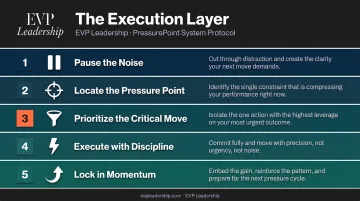
Practiced consistently, this sequence stops being a framework a leader follows—it becomes how they operate.
Why Conditioning Leaders—Not Just Training Them—Changes Everything
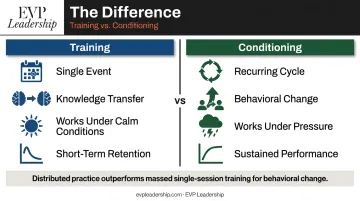
Training delivers knowledge and tools that leaders can apply when conditions are calm and predictable. Conditioning builds the automatic responses that govern how a leader acts when conditions are difficult.
EVP Leadership's core thesis is direct: leaders don't rise to expectations—they fall back on their conditioning.
Most strategies stall not because leaders don't know what to do, but because their conditioned responses—the habits and reflexes they default to under pressure—aren't aligned with the strategy they're trying to execute. A one-day training session cannot rewire this.
Research from the Journal of Applied Psychology confirms the mechanism: leadership development outcomes improve significantly when training is spread across multiple spaced sessions over time rather than concentrated in a single event. A Quality Improvement Center synthesis of this research states plainly that massed, one-session training is structurally less effective at producing behavioral change than distributed, sustained practice.
That finding is exactly what the 90-Day PressurePoint System is built on.
What Conditioning-Focused Coaching Actually Looks Like
The 90-Day PressurePoint System is not a periodic check-in. It's a structured, progressive engagement designed to build specific leadership behaviors until they become the leader's default mode:
- Prioritizing clearly when demands compete for the same bandwidth
- Communicating with discipline up, down, and across the organization
- Making confident decisions with incomplete information
- Executing consistently—not just when conditions are favorable
For small and mid-size business owners, the leader's behavior is the culture. There's no layer of management to absorb the gap. When a founder or CEO defaults to reactive, firefighting mode, the organization mirrors that pattern—regardless of what the strategy document says.
What to Look for in an Executive Coach for Strategy Execution
Not all coaching is designed to improve execution. A coach focused on strategy execution should bring a clear process for connecting leadership behavior to business outcomes—not generalized self-improvement conversations.
Two practical indicators of a strong engagement:
Practitioner experience in real operating environments — the coach has worked alongside leaders through genuine complexity, not just accumulated credential hours. Gennifer Baker's 30+ years in business strategy and leadership, and EVP Leadership's track record advising thousands of entrepreneurs and executive teams since 2009, translate directly into execution results.
A structured system with measurable milestones — the engagement tracks behavioral change across a defined timeline, not just conversation-by-conversation reflection. The 90-Day PressurePoint System is built precisely for this: the Identity, Diagnostic, and Execution layers provide a progressive framework for what gets built and when.
When evaluating a coach, ask directly: what does progress look like at 30, 60, and 90 days? The answer will tell you whether the engagement is built to produce lasting behavioral change—or just scheduled conversation.
Frequently Asked Questions
What is the strategy execution gap?
The strategy execution gap is the distance between a well-designed strategic plan and its real-world implementation. At its root, it's a leadership behavior gap driven by blind spots, reactive habits, and the absence of conditioned execution responses under pressure — not a flaw in the plan itself.
Why do most strategies fail during execution?
The most common root causes are leadership blind spots, misalignment across teams, a lack of protected time for strategic work, and leaders reverting to old habits when pressure rises. These are human problems, not logistical ones.
How is executive coaching different from strategic planning consulting?
Consulting produces plans and recommendations. Coaching develops the leader's capacity to carry those plans out through behavioral change and sustained accountability. Both have value — but only one builds the behavioral capacity that execution actually demands.
How long does it take for executive coaching to improve strategy execution?
Meaningful behavioral change typically requires a sustained engagement of 90 days to six months. EVP Leadership's 90-Day PressurePoint System is specifically designed to produce measurable leadership shifts within that defined window.
What does executive coaching for strategy execution actually look like?
A structured engagement includes regular coaching sessions focused on specific leadership behaviors, accountability check-ins tied to strategic milestones, and a structured conditioning framework — like the PressurePoint System — built to identify and shift the specific habits blocking execution.
Can small business owners benefit from executive coaching for strategy execution?
Small business owners often benefit most. In smaller organizations, the owner's behavior directly shapes organizational behavior, making their leadership habits the primary execution variable. Changing that one variable can shift how the entire organization moves.