Introduction: Why Founder-Led Companies Need a Different Kind of Consulting
The traits that make founders exceptional — relentless vision, personal ownership, bias toward action — are often the same traits that eventually cap their company's growth. A founder who built a $2M business by being everywhere in it may find those same instincts are precisely what prevent scaling to $10M.
This is a structural problem, not a character flaw. It shows up the same way across thousands of founder-led companies: decisions stall, teams stop developing judgment, and the founder's calendar fills with work that others should own.
This guide explains what business consulting actually does for companies like yours — what separates effective consulting from generic advice, and how to recognize when outside support will produce real traction — and when it won't.
Key Takeaways
- Founder-led companies outperform when leadership capacity grows alongside the business.
- Founder dependency silently caps revenue, team performance, and company valuation.
- Effective consulting converts founder knowledge into repeatable systems that the team can own.
- The right consultant amplifies your vision — they don't replace it with a corporate template.
- The best time to engage is before the bottleneck becomes a crisis.
What Makes Founder-Led Companies Unique
Founder-led companies aren't just smaller versions of corporations. They operate differently — and when that difference is working, it creates a genuine competitive edge.
Bain & Company's 2026 research found that founder-led S&P 500 companies outperformed non-founder-led peers by 2.1x in total shareholder returns since 2015. In the technology sector, that gap widens to 2.6x. Bain defines "founder-led" broadly — the founder as active CEO, board member, or as a sustained cultural force within the organization.
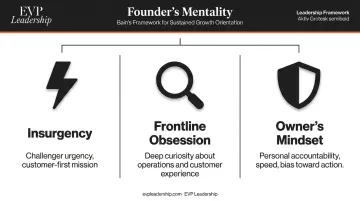
The Founder's Mentality Framework
Bain's research identifies three traits that explain this outperformance:
- Insurgency — challenging industry norms on behalf of underserved customers, operating with a challenger's urgency rather than an incumbent's complacency
- Frontline obsession — deep curiosity about day-to-day operations and direct customer experience, not just high-level strategy
- Owner's mindset — personal accountability, speed, and a bias toward action that most professionally managed companies struggle to replicate
These traits aren't abstract. They're the reason a founder will personally call an unhappy client, fix a broken process at 10pm, or spot an opportunity that a committee-run organization would study for six months before acting on.
When the Advantage Flips
These same traits create a fragile organizational structure. A company built entirely around one person's judgment and availability has a hard ceiling — it scales only as far as that person can stretch.
At some point, the founder's presence stops being the engine and starts being the bottleneck. When that shift happens, the competitive advantage begins to erode. That's precisely where structured consulting work earns its keep.
The Hidden Costs of Founder Dependency
Founder dependency is the state in which a company's operations, decisions, and client relationships are so tied to the founder's presence that meaningful growth or continuity becomes structurally impossible without them.
It's rarely obvious from the inside. The company is still functioning. Revenue may be growing. But the architecture of the business has a single point of failure, and those costs compound quietly.
The Decision Bottleneck
When every significant call, change order, or strategic shift requires the founder's sign-off, two things happen at once: projects slow down, and the team stops developing judgment.
McKinsey research found that managers spend 37% of their time making decisions, and 61% report that much of that time is used ineffectively. Concentrated decision authority pushes that inefficiency through every layer of the organization.
The deeper cost isn't the wasted hours — it's the organizational habit that forms around centralized decision-making. Teams learn to wait. They route everything upward. And the founder's inbox becomes a bottleneck by design.
Talent Atrophy
High-performing employees stop thinking like leaders when they know the founder will step in. Over time, this dynamic reshapes the talent pool: the company retains people who follow instructions well, and loses — or never attracts — people who want real ownership.
The problem is structural, and better recruitment won't solve it until the underlying authority structure changes.
Valuation and Exit Risk
A business that can't function without its founder is structurally less valuable to investors, acquirers, and succession candidates. M&A advisors and buyers consistently treat key-person dependency as a risk factor. They address it through lock-in agreements, earn-outs, and deferred consideration. When one person's exit would materially disrupt operations, buyers price that risk into the deal.
The Burnout Cycle
As the company grows, so does the founder's workload. Gallup data shows that 26% of self-employed Americans work at least 60 hours per week. For founders managing growing teams without adequate delegation infrastructure, 60-hour weeks aren't exceptional — they're the baseline.
The burnout cycle follows a predictable pattern:
- Founder absorbs more as the company grows
- Reactive decision-making crowds out strategic thinking
- Structural problems get patched with short-term fixes
- The founder's capacity erodes, and the business suffers with it
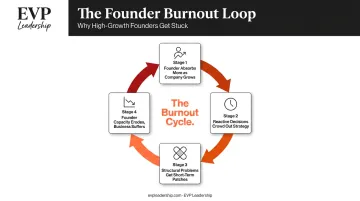
Without structural change, each stage of growth tightens the cycle. That's the intervention point — not the symptoms, but the architecture producing them.
What Business Consulting Does for Founder-Led Companies
Good consulting for a founder-led company starts with the founder's vision — then works backward to build systems that extend it. The goal isn't to impose a corporate framework. It's to make the company less dependent on the founder's constant presence.
Three specific areas drive the most meaningful outcomes.
Extracting and Systematizing Founder Knowledge
Every founder carries an enormous amount of implicit knowledge: how to qualify a prospect, when to escalate a client issue, which projects to prioritize when capacity is tight. The problem is that this knowledge lives entirely in the founder's head — and the team can't access it without asking.
The consulting work here involves translating that implicit knowledge into documented, repeatable systems:
- Decision frameworks for common scenarios
- Sales qualification criteria that don't require the founder to evaluate every lead
- Onboarding processes that deliver the founder's standard without the founder's direct involvement
- Escalation guidelines that give team members clear authority over defined situations
This isn't about removing the founder from the business. It's about making sure the founder's judgment can be applied consistently even when they're not in the room.
Building Leadership Capacity Across the Team
Delegation is the most commonly cited solution to founder dependency — and the most commonly misapplied one. Most founders have already tried delegating. The issue isn't that they haven't delegated; it's that the delegation hasn't held.
Gallup's research on entrepreneurial delegation found that CEOs with high Delegator talent generated 33% greater revenue than CEOs with low or limited delegation capacity, along with stronger three-year growth and more job creation. The gap isn't about intent — it's about the systems behind the handoff.
Delegation that actually holds requires three things most founders skip:
- Clear scope — the team member knows exactly what decisions they own
- Real accountability — defined success criteria with actual consequences
- Permission to fail — the founder stays out when something looks uncertain, not just when it's going smoothly
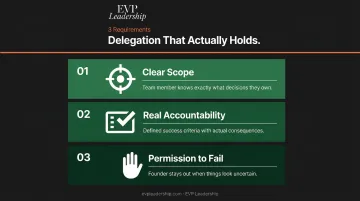
EVP Leadership's delegation work addresses all three. A clean delegation protocol establishes what gets handed off, to whom, and against what success criteria. An accountability operating rhythm — structured 1:1s, scorecards, performance conversations — ensures the handoff actually holds over time.
Designing Scalable Operational Structures
Once knowledge is documented and delegation is working, the remaining gap is usually operational architecture — the rhythms, reporting structures, and communication frameworks that let a business run without the founder as the default coordinator.
This typically means replacing reactive, interrupt-driven workflows with:
- Scheduled check-in cadences that reduce ad hoc escalations
- Defined decision boundaries — who decides what, at which level
- Clear accountability chains for recurring operational challenges
- Operating rhythms that create visibility without requiring the founder's constant attention
The result is a business that can operate, adapt, and grow without the founder as the bottleneck. That's also what makes the company more attractive to buyers, partners, and leadership candidates when the time comes to scale.
What to Look for in a Business Consultant for Founder-Led Companies
Not every consultant is suited to work with founder-led companies. Most consulting frameworks were built for organizations that already have HR departments, management layers, and institutional infrastructure. Apply those frameworks to a founder-led company and you'll get a sophisticated strategy document that nobody has the capacity to execute.
Conditioning vs. Training
The most important distinction when evaluating a consultant isn't their methodology — it's their delivery model.
A consultant who delivers a strategy document and exits has provided advice. One who stays in the work until behaviors and systems actually change has provided value.
EVP Leadership's approach is grounded in a straightforward observation: under pressure, leaders don't rise to expectations — they fall back on their conditioning. For founder engagements, this distinction matters.
Most founders already know what needs to change. The real challenge is building the operational habits, leadership capacity, and organizational systems to maintain that change when conditions get hard.
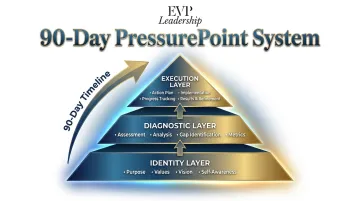
The 90-Day PressurePoint System is built on this premise. It's a time-bound engagement designed to install habits and systems that founders can run independently once the engagement ends. The program works across three layers:
- Identity Layer — consistency, capacity, and character as a leader
- Diagnostic Layer — six operational pressure points including Mission Clarity, Decision Integrity, and Execution Discipline
- Execution Layer — a repeatable protocol for navigating high-stakes decisions
Questions to Ask Before Engaging a Consultant
When evaluating any business consultant for a founder-led company:
- How do they define success for an engagement — deliverables or operational outcomes?
- What does their process look like in the first 90 days?
- Do they have specific experience with founder-led companies at your revenue stage?
- Can they show how they've built systems that outlast the engagement itself?
- Do they start by listening, or by presenting their framework?
Red Flags to Watch For
- Leads with a framework before understanding your specific situation
- Proposes an org-chart restructure without understanding company culture
- Measures engagement success by deliverables rather than operational change
- Has no process for working with the founder's psychology, only the business model
How to Know It's Time to Bring in a Business Consultant
Three signals consistently indicate that a founder-led company has outgrown its current structure:
- The founder is the last bottleneck on decisions they know others should be making — regularly, not occasionally
- Revenue has plateaued despite adding headcount, effort, or budget
- The founder is spending more time managing operations than thinking strategically about where the business is going
Most founders recognize these signals and choose to push through them. That approach works in early stages, when the company is small enough to hold in one person's head. Past a certain size, it becomes counterproductive. The complexity of the business has exceeded the founder's personal bandwidth, and no amount of harder work closes that gap.
Consulting to Start vs. Consulting to Scale
The scope, deliverables, and type of consultant you need depend entirely on where you are:
| Early-Stage Support | Scaling Support |
|---|---|
| Positioning and feasibility | Leadership infrastructure |
| Go-to-market strategy | Delegation and accountability systems |
| Business model validation | Operational structure design |
| Initial team structure | Leadership capacity development |
Both are valid use cases. But the scope, deliverables, and the type of consultant you need differ. A founder starting a business needs a strategist who can help them validate and launch. A founder scaling a business needs a partner focused on building the organizational capacity to grow — so the company stops depending on one person at the center of everything.
The best time to engage is when you can see the bottleneck forming. Waiting until burnout forces the conversation means you're already managing a crisis rather than preventing one.
Frequently Asked Questions
Do founder-led companies outperform?
Yes — Bain's 2023 research found founder-led S&P 500 companies outperformed non-founder-led peers by 2.1x in total shareholder returns since 2015. The advantage comes from traits like insurgency, frontline obsession, and an owner's mindset — qualities that drive speed and accountability that professionally managed companies struggle to replicate.
How much should I pay for a business consultant?
Consulting fees vary based on scope, engagement structure (project-based, retainer, or time-bound program), and the consultant's experience. Rather than anchoring on a rate, evaluate cost relative to the revenue impact or operational improvement the engagement is designed to deliver. Most reputable firms offer a scoping conversation before quoting.
Can I hire someone to help me start my own business?
Yes. Early-stage consultants and business strategists can help with positioning, feasibility, and go-to-market strategy — work that's distinct from the operational and leadership consulting a scaling founder-led company typically needs. The scope, deliverables, and type of expertise required differ significantly between the two.
What are the biggest challenges facing founder-led companies?
The most consequential are founder dependency, decision bottlenecks, leadership capacity gaps, and difficulty delegating. These compound over time — what starts as wearing many hats becomes a structural ceiling that caps revenue, limits talent retention, and erodes company value.
When is the right time to hire a business consultant?
When revenue has plateaued despite added effort, when the founder is consistently the last bottleneck in their own operations, or when the team can't execute without daily founder involvement. The right time is before those signals become a crisis.
What is the difference between business consulting and leadership coaching for founders?
Business consulting focuses on systems, strategy, and operational structure. Leadership coaching focuses on the founder's behavioral and decision-making capacity. For founder-led companies, the most effective engagements address both simultaneously — because operational problems and leadership capacity problems are almost always connected.