Introduction
Picture this: you're three months into a new hire who seemed perfect on paper, your sales pipeline is thinning, and a competitor just entered your market. You need to decide — fast — whether to double down on this person, pivot your offering, or cut costs. There's no board to consult. No committee to diffuse accountability. Just you, the weight of the business, and a decision that could ripple for years.
This is the daily reality of small business ownership. McKinsey's research on organizational decision-making found that 61% of respondents said most decision-making time is used ineffectively — and only 20% felt their organizations excelled at decisions. For small business owners, those numbers hit differently. You don't have layers of management to absorb a bad call.
Those stats exist for a reason: most owners receive no formal training in how to decide well. They develop instincts over time — some useful, some costly. This guide gives you a practical framework for stronger strategic decisions, the traps that derail even experienced owners, and a repeatable approach you can apply the next time pressure forces your hand.
Key Takeaways
- Strategic decisions that shape your business trajectory require a different approach than daily operational choices
- Poor decisions carry compounding costs: financial, relational, and reputational
- A repeatable five-step framework reduces cognitive overload and improves consistency
- The most dangerous decision-making mistakes come from bias, pressure, and short-term thinking — not lack of information
- Decision-making is a conditioned skill that improves through deliberate, consistent practice
What Is Strategic Decision-Making for Small Business Owners?
Not all decisions are created equal. Understanding which type you're making changes how much time and process you should apply.
Three decision levels small business owners navigate:
- Strategic decisions — choices that directly affect long-term direction, competitive positioning, or resource allocation. Entering a new market, making a key leadership hire, discontinuing a product line.
- Tactical decisions — how you execute on strategy. Which marketing channels to prioritize, how to structure a sales process.
- Operational decisions — routine daily choices. What to reorder, how to schedule staff.
Most owners instinctively handle operational and tactical decisions well. Strategic ones are where judgment breaks down — because they're infrequent, high-stakes, and often made under conditions of uncertainty and time pressure.
Why the Stakes Are Higher for You Than for Corporate Leaders
Corporate executives make consequential decisions too, but they have resources most small business owners don't: financial cushion to absorb mistakes, teams who can research and model options, and committees that distribute accountability.
You have none of that. A single misjudged strategic call can drain months of cash flow, damage a customer relationship built over years, or set growth back by an entire season. The margin for error is narrower, and the consequences land directly on you.
The Three Categories That Demand Different Thinking
A 2009 study of 646 entrepreneurs on strategic decision-making in small firms identified distinct decision-maker types — ranging from highly intuitive to highly analytical. The finding matters because it confirms that owners approach decisions differently, and what works for a resource-allocation call often fails on a people decision.
Regardless of your natural decision-making style, three recurring categories each require a different approach:
- Investment and resource allocation — Where does capital go? Which bets get funded?
- Growth and market positioning — Which customers, which markets, which offer?
- People decisions — Who do you hire, promote, or let go?
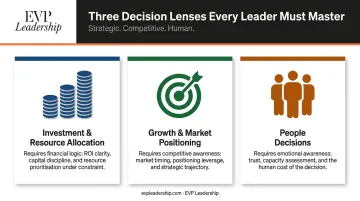
Each demands a different lens. People decisions are often emotional. Resource allocation requires clear financial logic; market positioning demands both competitive awareness and strategic patience.
The Real Cost of Poor Business Decisions
The financial damage from bad decisions is visible. The compounding damage is what most owners underestimate.
The Numbers Behind the Risk
BLS establishment survival data shows that of businesses opened in 2012, 47.9% survived to five years and only 34.9% reached ten years. Those numbers don't tell you why businesses fail, but they confirm the stakes. Poor strategic decisions — bad timing on expansion, wrong hires at critical growth stages, misread market shifts — don't show up in one catastrophic moment. They show up in a slow drain that suddenly looks terminal.
A bad hire at a leadership level, for instance, costs more than a salary. CareerBuilder estimates a bad hire can run at least 30% of that role's total compensation once you factor in lost productivity, the cost to re-recruit, and the downstream morale damage.
The Less Visible Costs
Beyond capital, poor decisions erode two things that are harder to rebuild: team trust and owner confidence.
Gallup research shows that managers account for 70% of the variance in team engagement. When your team senses that decisions are reactive, inconsistent, or unexplained, they disengage. They stop bringing you problems because they've stopped trusting the response.
And when you, as the owner, accumulate a string of decisions that didn't land, the damage isn't just financial: you start second-guessing yourself in the moments that require the most confidence. That erosion compounds forward into every high-stakes call that follows.
EVP Leadership sees this pattern consistently — leaders who decide under pressure without a structured system don't just lose money. They lose the decision-making clarity the next crisis will demand. As Gennifer Baker, Founder of EVP Leadership, puts it: "Under pressure, leaders don't rise to expectations — they fall back on their conditioning."
A Practical Decision-Making Framework for Small Business Owners
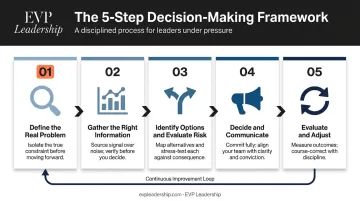
This five-step framework isn't a rigid checklist. It's a repeatable system that slows you down just enough to make a confident, informed choice — even under time pressure.
Step 1: Define the Real Problem
Most decision-making errors begin with solving the wrong problem. You see falling sales and assume it's a marketing gap. You push harder on advertising. The real issue turns out to be a fulfillment bottleneck — customers aren't coming back because orders are arriving late.
The Five Whys method — described in Eric Ries's Harvard Business Review explainer — is a simple tool for avoiding this trap. Ask "why" five times in sequence, each time answering the previous question, until you've moved from surface symptom to root cause.
One limitation: the Five Whys can oversimplify problems with multiple causes. Use it as a starting point, not a definitive diagnosis.
This maps directly to what EVP Leadership calls Problem Intelligence — one of six diagnostic dimensions in their PressurePoint System, defined simply as the ability to identify and attack the real problem fast.
Step 2: Gather the Right Information
The goal is not complete information. Complete information doesn't exist. Waiting for it is its own bad decision.
Jeff Bezos articulated this clearly in Amazon's 2016 shareholder letter: most decisions should be made with roughly 70% of the information you wish you had. Waiting for 90% means you're usually too slow, and most quality decisions can be course-corrected if needed.
For small business owners, "good enough" data typically looks like:
- Internal metrics — revenue trends, customer retention, margin by product or service
- Customer feedback — complaints, churn patterns, testimonials, direct conversations
- Competitive observation — pricing shifts, new entrants, customer movement
You don't need a consultant's research deck. You need clarity on what you know, what you don't, and what you can reasonably infer.
Step 3: Identify Options and Evaluate Risk
Force yourself to generate 2–3 distinct options before committing to any one. Single-option thinking looks decisive but skips the evaluation step entirely.
For each option, apply a quick pressure test:
- Short-term impact — what happens in the next 90 days?
- Long-term strategic fit — does this decision move me toward or away from my 3-year direction?
- Downside scenario — if this goes wrong, what specifically breaks?
Risk evaluation isn't about eliminating risk. It's about knowing which risks you're willing to own — and making that choice consciously rather than by accident.
Step 4: Decide and Communicate
Bezos also introduced a distinction that every small business owner should internalize, from Amazon's 2015 shareholder letter:
- Type 1 decisions — consequential and nearly irreversible. Take more time. Get more input.
- Type 2 decisions — changeable and reversible. Move fast. Don't over-deliberate.
Many owners apply Type 1 processes to Type 2 decisions (creating paralysis) or rush Type 1 decisions as if they were Type 2 (creating compounding damage).
Once you've decided, communicate it clearly — not just what was decided, but why. That context drives alignment rather than compliance.
Gallup's research on team engagement consistently identifies clear expectations as a foundational driver. When the reasoning behind a decision is explained, execution tightens.
Step 5: Evaluate and Adjust
A decision isn't finished when it's made. Set a specific review point — 30 or 60 days out — to assess whether the decision is producing the intended outcome.
This isn't about second-guessing yourself. It's about closing the feedback loop. Within EVP Leadership's PressurePoint System, this phase is called Lock in Momentum: turning completed action into measurable, sustained progress rather than simply moving on to the next fire.
The five steps work as a system. Each one builds the next — and returning to Step 5 consistently is what separates leaders who improve their judgment over time from those who stay reactive.
Decision-Making Traps That Keep Small Business Owners Stuck
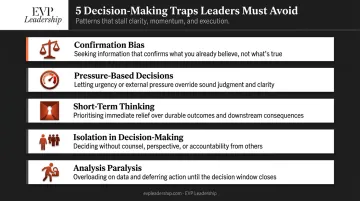
A strong framework only works if you can recognize when you're bypassing it. These five traps show up repeatedly in small business leadership.
Confirmation Bias
You form an opinion — often emotionally — and then gather data to support it rather than test it. A business owner convinced a struggling product just needs more marketing will find reasons to keep spending on it.
Assign someone (or yourself) to play devil's advocate on any significant decision. The Kellogg School of Management describes this as a formal technique — deliberately tasking a person with challenging assumptions before a decision is finalized. If you're deciding alone, write the opposing argument yourself before committing.
Pressure-Based Decisions
Urgency narrows thinking. Under genuine time pressure, most owners default to habit rather than strategy. That's why building a decision system before pressure hits is what separates reactive leaders from strategic ones.
The PressurePoint System's Execution Layer begins with a deliberate first step: Pause the Noise. Not a long pause — but enough of one to shift from reactive instinct to structured response. That pause is where better decisions get made.
Short-Term Thinking
Cash flow urgency is real. But operational demands crowd out longer-horizon thinking. A Vistage survey of more than 1,500 CEOs found that 72% rely exclusively on internal processes for strategic planning — without external frameworks or advisors.
When everything feels urgent, nothing strategic gets attention. The week gets managed; the year gets lost.
Isolation in Decision-Making
Deciding alone concentrates all blind spots on one perspective. Without outside input, you can't see what you can't see — and for small business owners who've built something from scratch, there's often a deep reluctance to admit uncertainty or ask for help.
Each of these resources serves the same function:
- Trusted advisors who challenge your assumptions before decisions are final
- Peer networks that surface what others in your position have already learned
- Formal coaching relationships that provide consistent external accountability
All three provide the perspective that internal logic misses.
Analysis Paralysis
The flip side of rushing is refusing to move. Over-researching and delaying decisions past the point where they're still actionable is its own form of failure. Opportunities close, team momentum stalls, and according to McKinsey's research, only 37% of organizations make decisions that are both high quality and high velocity — most sacrifice one for the other.
The 70% rule is the antidote here too. If you're waiting for certainty before you commit, you're waiting for something that won't come.
How to Strengthen Decision-Making as a Core Leadership Skill
Strategic decision-making isn't purely intellectual. It's a leadership capacity — and like any capacity, it's built through consistent conditioning, not a single insight or training event.
EVP Leadership's tagline captures this precisely: leaders don't rise to expectations — they fall back on their conditioning. That's not a critique. It's a design principle. The question is what you've conditioned yourself to do when the pressure is highest.
Three practices that build this capacity over time:
Carve out a weekly or monthly window to step outside operations — review key metrics, revisit priorities, and assess upcoming decisions intentionally. Reactive decisions made in the moment rarely match the quality of decisions made from a prepared strategic position.
Keep a decision log: document the context, options considered, reasoning, and outcome for significant calls. Over time, patterns surface — where you consistently underestimate risk, where you drag out decisions that should move fast, and where your judgment is genuinely strong.
Seek external accountability. Research confirms it: structured practice and feedback accelerate decision quality faster than experience alone. A 2021 study published in Organizational Behavior and Human Decision Processes found that observational learning interventions measurably reduced anchoring bias and improved judgment.
For small business owners who want to develop this capacity systematically, EVP Leadership's 90-Day PressurePoint System offers both the structured framework and the external accountability that accelerate real growth. The program conditions leaders to perform under pressure — specifically through the Decision Integrity component of the Diagnostic Layer and the Execution Layer's step-by-step protocol for high-stakes moments.
It's built for owners who are already operating and want a leadership foundation that holds when the pressure is highest.
Frequently Asked Questions
What is Jeff Bezos's 70% rule?
Bezos stated in Amazon's 2016 shareholder letter that most decisions should be made with roughly 70% of the information you wish you had. Waiting for 90% is typically too slow, and most high-quality decisions can be course-corrected if the direction proves wrong.
What is the 10-10-10 rule for decisions?
The 10-10-10 rule asks you to consider how you'll feel about a decision in 10 minutes, 10 months, and 10 years. It's a fast technique for separating emotional impulse from longer-term strategic thinking, developed by author Suzy Welch.
What are the most common decision-making mistakes small business owners make?
The top pitfalls: confirmation bias (deciding emotionally, then finding supporting data), making high-stakes decisions under pressure without a system, prioritizing short-term cash flow at the expense of long-term positioning, and deciding in isolation without outside perspective.
How do I build a decision-making framework for my small business?
Use this five-step approach:
- Define the real problem, not just the surface symptom
- Gather information to roughly 70% confidence
- Evaluate 2–3 options against short- and long-term criteria
- Decide and communicate your reasoning clearly
- Build in a 30- or 60-day review point
How do I make better decisions under pressure?
Build your system before the pressure arrives. Consistent practice with a clear framework means that when urgency hits, you reach for structure rather than defaulting to reactive instinct.