Introduction
Running a small business means wearing every hat — strategist, operator, HR department, and sometimes janitor. Most decisions get made before 9 a.m., without a trusted sounding board or objective feedback. Eventually, the business grows to the edge of the owner's leadership capacity and stalls.
That gap between what you're doing and what effective leadership actually requires doesn't close on its own — it widens.
Leadership coaching is a structured, ongoing process designed to close that gap — not by adding more knowledge, but by building the habits, decision-making frameworks, and resilience that hold up under real pressure.
According to the SBA, small businesses that received mentoring survived past five years at 70%, compared to roughly 50% of businesses without outside guidance — a difference that's hard to ignore.
This guide covers what leadership coaching is, why small businesses need it specifically, the skills it develops, and what to look for when choosing the right program.
Key Takeaways
- Leadership coaching builds the decision-making, communication, and resilience skills small business owners need to grow without burning out.
- Coaching is personalized and ongoing — it builds consistent habits that change how you lead day to day.
- Key gaps it addresses: reactive decisions, team misalignment, poor delegation, and no strategic clarity.
- The best programs condition leaders over time through repeated practice, not a single training event.
- Look for small business experience, a structured methodology, and measurable outcomes.
What Is Leadership Coaching for Small Business Owners?
Leadership coaching is a personalized development process where a coach works with a business owner to strengthen leadership effectiveness, decision-making, and strategic thinking. Three distinct services often get lumped together — here's how they differ:
- Consulting delivers answers and solutions to specific problems
- Mentoring shares experience and perspective from someone who's been there
- Coaching builds the owner's own capacity to think, decide, and lead more effectively
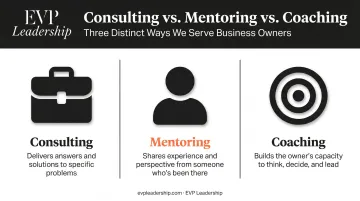
The goal of coaching is to develop the owner's own leadership capacity — not to create reliance on outside expertise.
How Small Business Coaching Differs from Executive Coaching
In a large organization, executives operate with teams, delegates, and infrastructure beneath them. In a small business, the owner is usually both the strategist setting direction and the executor making it happen on Tuesday morning. Leadership development has to address both dimensions — not just what to do, but how to show up consistently when resources are thin and pressure is high.
This dual role makes the owner the single biggest lever in the business. When their leadership improves, everything downstream improves with it.
Common Coaching Formats
The format should fit the owner's goals and schedule:
- One-on-one sessions — focused, personalized, high accountability
- Structured 90-day programs — defined milestones, builds habits over a defined timeline
- Peer group cohorts — shared learning with other owners at similar stages
- Virtual engagements — flexible access without geographic limits
EVP Leadership's 90-Day PressurePoint System, for example, is structured around three layers: Identity, Diagnostic, and Execution. The aim is to build durable leadership habits through conditioning, not deliver a curriculum and move on.
Why Small Business Owners Need Leadership Coaching
The Founder Bottleneck
Most small business owners started with deep subject-matter expertise and passion for what they do — not formal leadership training. That's fine at launch. It becomes a ceiling as the business grows.
The pattern shows up consistently:
- Communication breakdowns across the team
- Inconsistent performance with no clear accountability
- Poor delegation habits that stall execution
- An owner who can't step away because everything runs through them
These aren't operational problems. They're leadership problems that compound over time.
Gallup research shows managers account for at least 70% of variance in employee engagement scores across business units. In a business under 50 people, that manager is usually the owner. Their habits, communication style, and decision patterns are visible to everyone — daily.
Decision Fatigue and Isolation
Small business owners operate under constant cognitive load with little structural support. There's no board, no peer council, no HR department offering objective feedback. Gallup's 2012 Well-Being Index found 45% of entrepreneurs reported experiencing stress the previous day, compared to 42% of other workers — a gap that reflects the unique pressure of carrying decisions alone.
Coaching provides the structured reflection time and external perspective that prevents reactive, short-term thinking from dominating. It functions as the sounding board most owners don't otherwise have.
Burnout as a Leadership Problem
SCORE reports that 33% of small business owners work more than 50 hours per week, 25% work more than 60 hours, and 62% say ownership stress is worse than they imagined. That load is a delegation problem at its core, and delegation is a leadership problem.
When owners lack a clear leadership framework, they default to doing everything themselves. EVP Leadership frames this directly: "Burnout is real. Unsustainable business models create casualties, and growth is impossible under hostile conditions." Addressing it means building the systems and delegation capacity that let an owner function as a leader, not a one-person operation.
The "I'll Do It When I'm Bigger" Trap
Many owners delay leadership development until they feel they've earned it. That's exactly backwards. Leadership capacity is what creates the conditions for scale — it doesn't follow from it.
The challenges that cap growth — poor communication, lack of accountability, inconsistent execution — don't resolve as revenue increases. Without deliberate leadership development, they get harder to manage.
Key Leadership Skills Coaching Develops
Leadership coaching builds specific, practical skills — not abstract personality traits.
Strategic Decision-Making and Planning
Reactive decision-making is one of the most common patterns coaching addresses. Without a framework, owners default to gut instinct, whoever is loudest, or whatever feels most urgent. The result: decisions that solve the immediate problem while creating three more downstream.
A structured coaching program builds the habit of evaluating decisions against long-term priorities, identifying where a situation is actually breaking down, and creating space between stimulus and response.
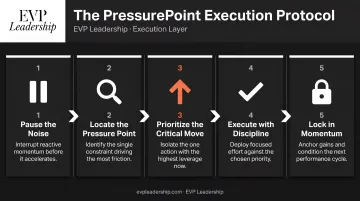
EVP Leadership's Execution Layer illustrates this well. Its five-step protocol — Pause the Noise, Locate the Pressure Point, Prioritize the Critical Move, Execute with Discipline, Lock in Momentum — gives owners a repeatable process for high-stakes moments rather than improvising under pressure.
Strategic planning also gets sharper. Coaching helps owners define clear goals, break them into actionable steps, and build accountability structures that keep daily operations aligned with long-term direction — instead of letting urgent tasks permanently crowd out important ones.
Communication, Influence, and Team Development
In a small business, the owner is the primary source of team clarity and motivation. Ambiguous direction, inconsistent feedback, and over-reliance on direct control all create drag on team performance.
Coaching builds communication habits that reduce confusion and increase trust:
- Communicating expectations clearly and consistently
- Giving feedback that's direct without being demoralizing
- Delegating based on team strengths, not just convenience
- Building accountability without micromanaging
EVP Leadership's Diagnostic Layer includes a component called Force Alignment — assessing whether the right people are fully aligned and accountable. This framework helps owners see delegation not as risk, but as a leadership tool.
Resilience and Leading Under Pressure
Cash flow stress, personnel issues, rapid growth, and market shifts don't pause while leaders get ready. The owners who perform best under that pressure aren't the most naturally resilient. They're the ones who've built consistent habits for staying composed when conditions deteriorate.
The Center for Creative Leadership identifies three research-based resilience practices for leaders: managing personal energy, shifting perspectives on adversity, and cultivating purpose. These are conditioned responses built through repeated practice, not fixed personality traits.
EVP Leadership's Identity Layer addresses this at the root level, developing three foundations:
- Consistency — showing up aligned with values regardless of conditions
- Capacity — the ability to handle increasing levels of responsibility and pressure
- Character — how consistency and capacity are used when stakes are high
These three foundations form the behavioral floor — what owners reliably execute from when pressure peaks and there's no margin for error.
Leadership Coaching vs. Leadership Training: Why the Difference Matters
Most small business owners have attended a leadership seminar or completed an online course. Few would say it changed how they actually lead. That gap is the difference between training and coaching.
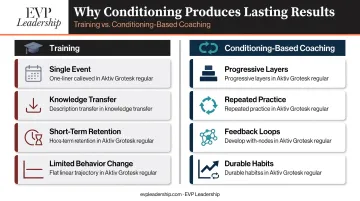
Training transfers knowledge — it tells you what good leadership looks like. A seminar, workshop, or online course can do that effectively. The problem is knowledge transfer and behavior change aren't the same thing.
Coaching produces behavior change through repeated practice, feedback, and accountability over time.
A 2017 meta-analysis published in The Leadership Quarterly — drawing on 335 independent samples — found leadership training improved results most when it included practice, feedback, multiple delivery methods, and spaced sessions rather than single events. That's not a training argument. That's a conditioning argument.
It's a distinction EVP Leadership builds its work around: "Most leaders haven't been conditioned to think clearly, stay focused in complexity, or execute with discipline when it matters most. They've been trained, but not prepared for real pressure."
Why Conditioning Matters for Small Business Owners Specifically
Corporate executives often have time to implement new frameworks in relatively low-stakes situations before facing a real test. Small business owners don't. Every week brings actual pressure — a difficult employee conversation, a cash flow decision, a client crisis. There's no practice round.
This is why a conditioning-based approach — one that builds decision-making reflexes, communication habits, and resilience through structured repetition — produces more durable results than a training event. The measure isn't how a leader performs when conditions are ideal. It's whether they perform consistently when conditions aren't.
EVP Leadership's 90-Day PressurePoint System is built around this logic. Rather than delivering a curriculum, it conditions leaders through progressive layers — Identity, Diagnostic, Execution — and tests them in real scenarios. The system is designed to keep working after the coaching engagement ends.
How to Choose the Right Leadership Coach for Your Small Business
Not all leadership coaches are the right fit for small business owners. Three criteria separate the ones worth hiring from the rest.
1. Direct Experience with Small Businesses
The challenges of a 10-person company differ in kind, not just scale, from those of a 500-person organization. Founder psychology, resource constraints, and the pace of small business decision-making require a coach who's worked in that context. Corporate frameworks rarely map to the constraints and speed of a small business — ask for specific examples before assuming they do.
2. A Structured Methodology with Measurable Outcomes
Effective coaching isn't just a supportive conversation. It needs a defined process, clear milestones, and a way to evaluate progress. When talking to prospective coaches, ask:
- What does your engagement look like from start to finish?
- How do you measure results?
- What should a client expect to walk away with?
Vague answers to these questions mean the coach lacks a repeatable process. Move on.
3. Fit on Approach and Communication Style
The best coaching relationship functions as a genuine strategic partnership. The coach should challenge you, hold you accountable, and take your business goals as seriously as you do. Use the discovery call to evaluate this: notice whether the coach listens as much as they speak, and whether their questions open up new thinking or just confirm what you already know.
Frequently Asked Questions
What is leadership coaching for small business owners?
Leadership coaching is a personalized, ongoing development process that helps small business owners build leadership capacity, improve decision-making, and create sustainable systems for growth. Unlike consulting (which solves specific problems) or training (which transfers knowledge), coaching builds the owner's ability to lead more effectively over time.
How is leadership coaching different from business consulting?
Consulting delivers expert advice and solutions to specific problems. Coaching builds the owner's own ability to think strategically and lead effectively — so they can solve future problems without relying on outside expertise. The distinction matters: consultants fix the immediate issue, while coaches develop the person responsible for every issue that follows.
How long does it take to see results from leadership coaching?
Many owners see meaningful shifts in clarity, decision-making, and team dynamics within 60–90 days when working with a structured 90-day program. Sustained behavioral change and lasting performance improvements typically develop over six months or more, especially as new habits get tested under real pressure.
Can leadership coaching help prevent burnout?
Burnout is often a symptom of leadership gaps — missing delegation frameworks, unclear systems, and no one else equipped to carry the load. Coaching addresses the root cause by building the structures and habits that let owners lead without being the single point of failure.
What should I look for when choosing a leadership coach?
Prioritize coaches with real small business experience, a clearly articulated methodology, defined measurable outcomes, and a communication style that challenges and supports in equal measure. Ask them to walk you through their process — a coach who can't explain it clearly isn't ready to guide yours.
Is leadership coaching worth the investment for a small business?
The cost of underdeveloped leadership shows up concretely — in stalled growth, high turnover, missed opportunities, and owner burnout. A 2009 ICF/PwC study found a median individual coaching ROI of 3.44x among clients reporting financial benefits. Because leadership affects every function in the business, improving it compounds returns across the entire organization.