Key Takeaways
- Strategic leadership coaching builds decision-making capacity and execution habits—not just motivation
- It differs from general training by targeting behavior change under real pressure, not just knowledge transfer
- The ROI extends beyond the individual leader to team alignment, culture, and the organization's ability to grow
- Structured programs with defined metrics consistently outperform ad hoc coaching engagements
What Is Strategic Leadership Coaching?
Most business owners and executives are competent operators. They can manage a team, hit quarterly targets, and solve yesterday's problems. What they struggle with is leading with consistent clarity when complexity increases, communicating vision under pressure, and scaling without burning out. That's not a strategy gap. It's a leadership gap—and strategic leadership coaching exists to close it.
Strategic leadership coaching is a focused, structured process that develops a leader's ability to cast vision, make confident decisions, align teams to long-term goals, and perform consistently under pressure. Unlike consulting (which delivers a plan) or a one-day workshop (which delivers frameworks), it builds the leader's capacity to generate clarity repeatedly — and it goes deeper than general executive coaching, which tends to address broader personal development.
Strategic leadership coaching sits at the intersection of leadership identity, decision-making, and business outcomes. It's designed for leaders who are navigating complexity, growth transitions, or organizational change—and who need more than inspiration. They need a repeatable system for leading with intention.
Who It's Designed For
The primary beneficiaries are:
- Founder-CEOs and owner-operators transitioning from doing the work to leading the people who do it
- Small and mid-size business owners hitting a growth ceiling caused by leadership capacity, not market opportunity
- C-suite executives managing rapid scale, team dysfunction, or high-stakes organizational change
According to the ICF's 2025 Global Coaching Study, coaching has moved from a personal perk to "strategic infrastructure" and a "performance multiplier"—with more than 50% of coaching clients now employer-sponsored. That shift reflects how seriously organizations are taking leadership development as a business investment.
Core Principles of Strategic Leadership Coaching
Effective strategic leadership coaching isn't a collection of conversations—it's built on principles that translate into measurable behavioral change. Here are the five that matter most.
1. Self-Awareness as a Leadership Foundation
Leaders who overestimate their capabilities make poor strategic bets. Leaders who underestimate them play it too safe. Both patterns create organizational drag.
Coaching builds the feedback mechanisms: 360-degree assessments, structured reflection, and real-time accountability. Together, they give leaders an accurate picture of their strengths, blind spots, and default behaviors under stress.
EVP Leadership's PressurePoint System addresses this through its Identity Layer, which develops consistency (acting in alignment with values over time), capacity (the ability to handle responsibility and complexity), and character (how you use both). These aren't personality traits. They're conditioned habits.
2. Emotional and Social Intelligence
Research from TalentSmartEQ found that emotional intelligence explains 58% of a leader's job performance, with 90% of top performers scoring high in EQ. Daniel Goleman's framework maps EQ across four domains: self-awareness, self-management, social awareness, and relationship management.
Strategic leadership coaching develops all four. Without these capabilities, even a sound business strategy produces friction, disengagement, and culture problems at the execution layer.
3. Strategic Thinking and Vision Alignment
Most leaders aren't short on ideas. They're short on the discipline to operate at the strategic level consistently. Coaching builds the habit of setting direction, communicating it clearly, and aligning daily operational decisions to long-term goals rather than reacting to whatever's loudest.
EVP Leadership's Diagnostic Layer reinforces this through six components: Mission Clarity, Force Alignment, Problem Intelligence, Decision Integrity, Execution Discipline, and Momentum Control. Together, they train leaders to see where performance is breaking down and where to focus first.
4. Decision-Making Under Pressure
Strategic leaders are not defined by how they perform in calm conditions. They're defined by how they respond when complexity, conflict, and high stakes converge.
Coaching builds the mental frameworks and practiced responses that allow leaders to make sound decisions in those moments. EVP Leadership's Execution Layer conditions this through a five-step protocol:
- Pause the Noise — interrupt the reactive impulse
- Locate the Pressure Point — identify the real constraint
- Prioritize the Critical Move — choose what matters most right now
- Execute with Discipline — act on the decision without second-guessing
- Lock in Momentum — reinforce the pattern for next time
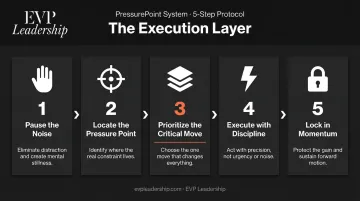
The goal is automatic, reliable performance. Not improvised responses.
5. Accountability and Measurable Growth
The difference between effective coaching and unfocused conversations is measurement. Outcomes must be defined at the start, tracked throughout, and evaluated honestly.
High-impact programs use tools like 360-degree feedback, behavioral benchmarks, and scorecard systems to quantify progress. The ICF Global Coaching Client Study found that 73% of clients cited relationships as an area of measurable improvement, with communication skills, work performance, and interpersonal effectiveness also ranking near the top.
Key Benefits of Strategic Leadership Coaching
Stronger Team Alignment and Execution
Gallup research shows that managers account for at least 70% of the variance in employee engagement scores. When a leader becomes clearer in their vision and more consistent in communication, the effects on team clarity, morale, and accountability are real and measurable.
ICF's research with the Human Capital Institute found that 69% of organizations agreed coaching increased employee engagement, and 73% agreed it accelerated leadership development for high-potential employees.
Measurable Financial ROI
Strategic leadership coaching is not a soft investment. The ICF Global Coaching Client Study found that 86% of organizations able to calculate ROI said they at least made back their coaching investment, with a median company ROI of 7 times the initial investment. That figure comes with appropriate caveats—small sample sizes and varying program designs—but the trend holds across multiple studies.
For small business owners evaluating the spend: the question isn't whether coaching has ROI. It's whether your specific engagement is structured to deliver it.
Confidence, Clarity, and Reduced Decision Fatigue
Effective coaching installs a personalized decision framework that allows leaders to respond to challenges from a grounded position. EVP Leadership's approach addresses this directly—building Decision Integrity (grounding choices in truth rather than noise and emotion) and designing an operating rhythm that creates structure where reactive chaos used to live.
The outcome is better decisions made consistently—without the burnout that comes from operating without a system.
A Coaching Mindset That Spreads
Leaders who develop self-awareness and emotional intelligence through coaching tend to model those behaviors with their teams—asking better questions, creating psychological safety, and empowering others to lead. EVP Leadership's methodology is explicitly designed to "condition leaders, test them in real scenarios, and embed the system across the organization." The individual work creates organizational traction.
Leadership Pipeline and Succession Readiness
DDI's Global Leadership Forecast 2025 found that only 20% of HR leaders say they have leaders ready to fill critical roles. For small and mid-size businesses preparing to scale or transition, this is a serious constraint.
Strategic leadership coaching at the executive level builds the infrastructure that sustainable growth requires. EVP Leadership's work with founders and C-suite teams specifically addresses:
- Building bench strength so the organization isn't dependent on one person
- Supporting succession planning before a transition becomes a crisis
- Developing exit-readiness so scale doesn't collapse under a founder bottleneck
Leadership Conditioning vs. Traditional Leadership Training
Here's the core problem with training: leaders complete workshops, absorb the frameworks, and then return to the same organizational pressure—and revert to old patterns within weeks.
McKinsey found that adults retain roughly 10% of what they hear in classroom settings, versus nearly two-thirds when learning by doing. Companies spent approximately $356 billion globally on employee training in 2015—yet for the most part, the learning didn't translate into better organizational performance.
McKinsey identifies four reasons leadership development programs fail:
- Overlooking organizational context
- Decoupling reflection from real work
- Underestimating the role of mindset
- Failing to measure results
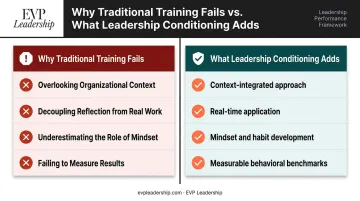
What Conditioning Adds
Athletic conditioning offers a useful parallel. Athletes don't just learn plays—they drill until the right responses become automatic under game-day pressure. When the moment arrives, the right response is already built in.
Leadership conditioning builds the same foundation: habitual responses, emotional resilience, and mental stamina that hold up when the stakes are highest—not only when conditions are favorable.
EVP Leadership's 90-Day PressurePoint System is built on this premise. Rather than delivering episodic training, it conditions small business owners and C-suite executives through a structured process designed to build reliable leadership performance habits that persist long after the formal engagement ends. The emphasis is on aligning daily operations to long-term goals so leaders are equipped to grow and adapt as conditions change.
Sustainable conditioning in practice includes:
- Small, consistent habits reinforced over time (not one-time insight)
- Real-time application during high-pressure decisions
- Accountability structures that track behavioral change, not just intention
- A personalized strategy system the leader can run independently after the engagement
What a Strategic Leadership Coaching Program Looks Like
Program Structure
Effective strategic leadership coaching programs move through three phases:
- Assessment — Identifying leadership style, strengths, gaps, blind spots, and the specific strategic priorities the engagement will address
- Development — Working through defined leadership competencies with real-time application to actual business challenges
- Integration — Embedding new habits, measuring outcomes, and creating a plan for continued growth beyond formal coaching
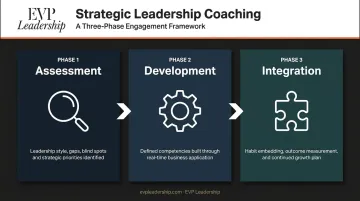
EVP Leadership's PressurePoint System operates through three interconnected layers — Identity, Diagnostic, and Execution — that map to this progression. Each layer deepens the work of the previous one, so leaders finish the engagement with a functioning operating system — not a set of disconnected techniques.
The Coach's Role vs. the Client's Role
The coach is not a consultant who delivers answers. A strong coaching partner asks the right questions, creates accountability, and helps the leader cut through the urgency and noise that obscures clear thinking. The leader does the work — the coach builds the structure that makes that work stick.
What Separates High-Impact Programs from Ineffective Ones
- Customization to the leader's specific business context—not a generic curriculum
- Alignment to business objectives, not just personal development goals
- Defined metrics for success established at the start of the engagement
- Senior-level buy-in when coaching is part of a larger organizational initiative
McKinsey research identifies the failure to connect leadership development to business outcomes as one of the primary reasons these programs fall short. If coaching isn't tied to measurable business goals from the start, there's no mechanism to evaluate whether it's working — and no reason for the organization to sustain it.
How to Choose the Right Strategic Leadership Coach
What to Look For
| Criterion | What It Means in Practice |
|---|---|
| Relevant experience | Experience with your business context—SMB, founder-led, C-suite—not just general coaching |
| Proven methodology | A structured, documented approach—not ad hoc advice sessions |
| Demonstrated outcomes | Specific results, not just testimonials about process |
| Sustainable behavior change | Focus on lasting habits, not short-term motivation |
The right coach checks every box above. Plenty of coaches fail on one or more — here's what to watch for.
Red Flags to Avoid
- Coaches who provide all the answers without developing the leader's own capacity
- Programs with no clear objectives or success metrics
- Generic group programs not tailored to the individual leader's challenges
- Engagements that end with no plan for what comes next
Treating Selection as a Strategic Decision
Ask prospective coaches about their process, how they measure progress, how long programs run, and how they track outcomes. The relationship needs to function as a true strategic partnership—with the discipline and accountability you'd expect from any high-stakes business engagement.
EVP Leadership has applied this standard since 2009, advising thousands of small business owners and C-suite executives with a disciplined focus on lasting operational change. Every engagement begins with a complimentary scoping conversation to evaluate fit and design the right structure before any commitment is made.
Frequently Asked Questions
What are the core principles of strategic leadership coaching?
The five core principles are self-awareness, emotional intelligence, strategic thinking, decision-making under pressure, and accountability to measurable outcomes. Together, they build leaders who perform consistentlyacross all conditions, not only favorable ones.
How is strategic leadership coaching different from executive coaching?
Executive coaching typically addresses broader personal leadership development. Strategic leadership coaching goes further — it aligns leadership behaviors directly to business strategy, long-term goals, and organizational performance. At EVP Leadership, that distinction also means conditioning leaders to perform under pressure, not just developing them in comfortable conditions.
Who benefits most from strategic leadership coaching?
Those who benefit most include small business owners at growth inflection points and entrepreneurs moving from operator to strategic leader. C-suite executives navigating rapid scale, organizational complexity, or high-stakes change also see strong results.
How long does a strategic leadership coaching program typically take?
Structured programs commonly run 90 days to 12 months. Shorter intensive programs—like EVP Leadership's 90-Day PressurePoint System—focus on building specific performance habits. Longer engagements cover broader leadership development, strategic planning, and organizational alignment work.
What results can I expect from strategic leadership coaching?
Expect improved decision-making confidence, stronger team alignment, and reduced operational dependency on the leader. Measurable business outcomes — including improved retention, profitability, and scalability — follow when the program is tied to clear business objectives.
How do I know if I'm ready for strategic leadership coaching?
Key signals include struggling to communicate or execute a clear strategy, making decisions from a place of constant pressure rather than intention, experiencing burnout or decision fatigue, or recognizing that your business has outgrown your current habits and operating systems.