This is the pattern EVP Leadership has observed across thousands of entrepreneur and executive engagements since 2009: as a company scales, complexity compounds, and the founder or executive becomes either the engine of growth or its greatest constraint. More decisions. More people to manage. More at stake. And far less margin for reactive leadership.
That inflection point—where the business has outgrown its leader's current capacity—is where most growth plateaus. And it's where leadership coaching shifts from a discretionary expense to a strategic necessity.
This guide covers what leadership coaching for scaling actually involves, why leadership capacity is the real bottleneck, the capabilities coaching builds, and how to choose the right approach for your stage of growth.
Key Takeaways:
- Scaling demands a parallel evolution in leadership capacity, not just operational upgrades
- Coaching builds durable, pressure-tested behaviors—not short-term awareness
- The most common growth bottlenecks are delegation, decision-making under pressure, and team alignment
- A structured, outcome-defined coaching engagement consistently outperforms ad hoc or one-time training
- The right coach brings direct experience with scaling businesses and a conditioning-focused methodology
The Leadership Gap: Why Scaling Stalls at the Top
The Founder Identity Trap
Founders who built their business by being the best executor in the room often hit a wall when it's time to lead other leaders. The behaviors that drove early success—hands-on involvement, fast personal decisions, direct ownership of outcomes—actively undermine growth at scale.
This isn't a character flaw. It's a transition failure. The skills that got you to seven figures don't automatically carry you to eight. And the longer a founder stays in executor mode, the harder it becomes to build the team infrastructure the business needs to grow without them.
According to research published in the Harvard Business Review, founders face a recurring dilemma: prioritizing control often constrains the venture precisely when organization-building and professional management become essential. The business requires a different kind of leader—and the founder must become that person or bring one in.
When Leadership Complexity Multiplies
That transition doesn't happen in a vacuum. During growth phases, the volume and consequence of decisions increase simultaneously—communication must reach more people with more nuance, and the leader's emotional bandwidth gets tested at every level.
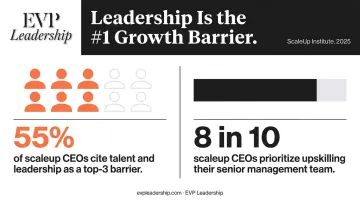
According to the ScaleUp Institute's 2025 survey of over 1,000 scaleup CEOs, 55% cite talent and leadership as a top-three barrier to further growth, and 8 in 10 prioritize upskilling their senior management team.
That's not an HR problem. That's a leadership capacity problem.
Operational Readiness vs. Leadership Readiness
Most business owners invest in operational readiness—systems, processes, hiring—and neglect leadership readiness. The distinction matters: operational infrastructure can only scale as fast as the leader's ability to make confident decisions, delegate effectively, and hold teams accountable.
This gap shows up repeatedly in practice: well-designed plans collapse when a leader's behavior under pressure is inconsistent, unclear, or rooted in old habits. EVP Leadership's work with founders and C-suite executives confirms the pattern. Strategy is rarely the issue. Readiness is.
Common symptoms when a leader has become the organizational ceiling:
- Every significant decision requires the owner's personal input
- Delegated work doesn't land cleanly—or isn't delegated at all
- The team lacks accountability and ownership culture
- Executive burnout and overwhelm are chronic, not situational
- Communication breakdowns increase as the team grows
The cost of leaving these gaps unaddressed is measurable. Gallup research shows managers account for at least 70% of variance in employee engagement—and top-quartile engagement correlates with 23% higher profitability and significantly lower turnover. When leadership falters, the financial consequences follow.
What Leadership Coaching for Scaling Actually Involves
Conditioning vs. Training
Leadership coaching is a structured, ongoing engagement focused on changing how a leader thinks, decides, and behaves — especially under the pressure that scaling creates. It goes well beyond workshops, personality assessments, or one-time motivational sessions.
The most important distinction is between training and conditioning. Training gives a leader information. Conditioning builds repeatable responses that hold up when stakes are high and time is short.
EVP Leadership's core thesis is direct: leaders don't rise to expectations — they fall back on their conditioning. Most leaders have been trained. Very few have been conditioned for real pressure. That gap surfaces exactly when it's most costly — during growth phases where decision speed, delegation clarity, and execution discipline directly determine outcomes.
The 90-Day PressurePoint System
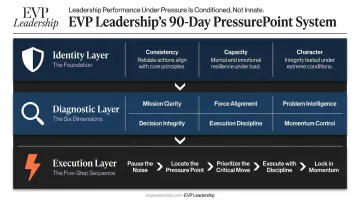
EVP Leadership's 90-Day PressurePoint System is built specifically for leaders who need to perform consistently under the demands of scaling. The system operates through three interconnected layers:
Identity Layer — Develops the foundation: consistency (acting in alignment with values over time), capacity (the ability to handle responsibility, complexity, and growth), and character (how those two are deployed).
Diagnostic Layer — Trains leaders to see clearly and think decisively through six dimensions:
- Mission Clarity — knowing exactly what must be achieved and why
- Force Alignment — ensuring the right people are accountable and aligned
- Problem Intelligence — identifying the real problem, not just the symptoms
- Decision Integrity — grounding decisions in truth rather than noise or emotion
- Execution Discipline — executing cleanly and consistently without excess complexity
- Momentum Control — making measurable progress on what actually matters
Execution Layer — A five-step protocol for critical moments: Pause the Noise → Locate the Pressure Point → Prioritize the Critical Move → Execute with Discipline → Lock in Momentum.
How Progress Gets Measured
A structured coaching engagement tracks progress through observable behavioral shifts — how a leader communicates, delegates, decides, and responds when pressure spikes. Feelings about sessions aren't the measure. Behavior change is.
For a business owner at growth stage, meaningful outcomes look like:
- Time recovered from operational firefighting
- Decisions moving down the organization without bottlenecking at the top
- A team that executes with greater consistency and ownership
The Role of Self-Awareness
Self-awareness is the entry point, not the destination. Effective coaching begins with honest assessment of where blind spots, reactive patterns, and default behaviors are creating drag on the organization. The goal isn't awareness for its own sake. It's using that clarity to build more intentional, consistent leadership habits that hold under pressure.
Core Leadership Capabilities Coaching Builds for Scale
Strategic Decision-Making Under Pressure
Scaling accelerates both the pace and weight of decisions. McKinsey research across 1,259 organizations found that only 20% of organizations excel at decision-making, and decision speed and quality are strongly linked to company performance.
Coaching helps leaders build a reliable decision-making framework through the PressurePoint System's Diagnostic Layer—specifically Decision Integrity and Problem Intelligence. Leaders stop reacting to urgency and start making decisions with direction. They distinguish what's important from what merely feels urgent, delegate appropriately, and commit with confidence.
Delegation and Accountability
Gallup research found that 75% of entrepreneur-employers studied had limited-to-low delegator talent. That's not a personality trait—it's a conditioned behavior that coaching directly addresses.
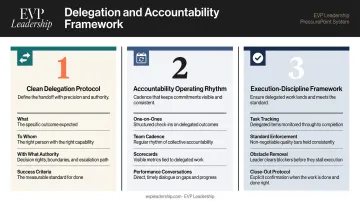
EVP Leadership's delegation and accountability work builds three reinforcing systems:
- Clean delegation protocol — defines what gets delegated, to whom, with what authority, and against what success criteria
- Accountability operating rhythm — one-on-one cadence, team operating rhythm, scorecards, and performance conversations
- Execution-discipline framework — ensures delegated work actually lands and is completed to standard
When all three systems are in place, leaders reclaim time, teams own more of the work, and the founder-as-bottleneck dynamic stops running the business.
Building a High-Performance Team
As a business scales, the leader's job shifts from managing tasks to developing people. Coaching addresses the specific behaviors required for this transition:
- Establishing clear decision rights and ownership throughout the organization
- Building psychological safety so team members take initiative
- Giving effective, consistent feedback
- Creating a culture where accountability is structural, not personality-dependent
This work extends beyond the individual leader. EVP Leadership's Teri Evans leads executive team development engagements across healthcare, education, nonprofit, and small business settings—with sessions built around communication, trust, and team alignment as measurable outcomes.
Communication and Organizational Alignment
Misaligned messaging becomes a critical failure point as organizations grow. A leader who communicated effectively with five people often struggles to communicate consistently with fifty.
Coaching builds the capacity to communicate at scale. Specifically, leaders develop the ability to:
- Translate strategic priorities into clear direction at every level of the organization
- Differentiate their positioning externally with consistent, intentional messaging
- Influence culture through deliberate leadership presence—not just words
The PressurePoint System's Force Alignment and Mission Clarity dimensions address this directly, ensuring the right people are aligned around what must be achieved and why.
Signs It's Time to Invest in Leadership Coaching
The signals are usually visible long before a leader acknowledges them. Look for these patterns:
- Every significant decision still requires your personal input
- Revenue has plateaued despite operational improvements
- The team isn't executing independently—they're waiting for direction
- You're working more hours than ever and feeling less effective
- You've shifted from strategic thinking to permanent firefighting mode
That last signal—the reactive leadership trap—deserves specific attention. Leaders under scaling pressure often default to urgency-driven decisions because it feels like forward motion. It isn't. When reactivity becomes the default, the business has outgrown the leader's current operating system—not their capability.
Recognizing that gap is the first step. The next is determining whether conditions are right for coaching to take hold:
Coaching is most effective when:
- The leader is genuinely committed to personal behavioral change
- The business has enough stability to implement new behaviors
- The leader is willing to examine root causes, not just surface symptoms
It's not a crisis-response tool. If the business is in acute operational distress, address the immediate fires first—then build the leadership capacity to prevent the next ones.
How to Get the Most from Your Leadership Coaching Engagement
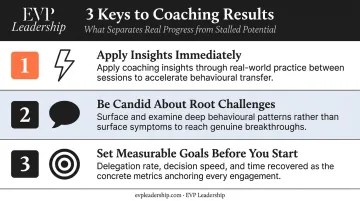
To get real results from a leadership coaching engagement, three things matter more than anything else:
- Apply insights immediately. Leadership coaching produces compounding results when new behaviors are practiced in real decisions and real conversations — not just absorbed during sessions. The conditioning work requires pressure situations, not ideal ones.
- Be candid about root challenges. The most valuable conversations happen when a leader examines the patterns driving their behavior, not just the presenting problem. Candor accelerates the depth and speed of change.
- Set measurable goals before you start. Align on what success looks like in concrete terms — delegation rate, decision speed, team accountability metrics, time recovered from operational work. This keeps the engagement accountable and demonstrates return on investment.
That third point has a practical tool behind it. A research-backed framework from ICF recommends calculating coaching ROI as: (financial impact × confidence level) ÷ coaching cost. It's imperfect, but it forces specificity about what you're expecting coaching to change — which is exactly the right conversation to have upfront.
Choosing the Right Leadership Coach for Your Scaling Business
What to Look For
Not all coaches are suited for scaling businesses. The criteria that matter most:
- Direct experience advising founders and executives navigating growth-stage complexity—not enterprise or clinical coaching backgrounds
- A structured methodology with measurable outcomes, not ongoing conversation alone
- Conditioning focus — builds durable behaviors, not temporary awareness
- Cultural alignment — the relationship has to work; working alliance is one of the strongest predictors of coaching outcomes
Questions to Ask When Evaluating a Coach
Before committing, ask these directly:
- How do you assess where I am before we start?
- What does your process look like over a 90-day engagement?
- How do you define success—and how do you measure it?
- Can you describe leaders at my stage of growth you've worked with?
- What's your approach when a client faces acute pressure mid-engagement?
The answers reveal whether a coach has a real methodology or is selling a relationship.
If those questions lead you toward a conditioning-based, structured approach, EVP Leadership was built for exactly this context. Founded in 2009 and serving thousands of entrepreneurs and executive teams over 35+ years, the firm works specifically with small and mid-size business owners and C-suite executives navigating scaling pressure. Every engagement starts with a complimentary scoping conversation to assess fit and define what a structured program would address for your growth stage.
Frequently Asked Questions
What are the 4 pillars of scaling up?
Verne Harnish's Scaling Up framework identifies four decisions every company must get right: People, Strategy, Execution, and Cash. Leadership capacity is the foundational pillar. Without it, leaders can't build the right team, execute consistently, or make sound financial decisions under pressure.
How does leadership coaching help scale a business?
Coaching helps leaders identify and close the gap between their current behaviors and what the business now demands—improving decision-making speed, delegation clarity, team performance, and resilience under pressure. The result is a leader whose capacity grows in step with the business, rather than constraining it.
What is the difference between leadership coaching and leadership training?
Training transfers information, often in a single session or workshop. Coaching builds behavioral change through ongoing practice, reflection, and accountability—creating habits that hold under pressure rather than insights that fade after the event ends.
When should a business owner hire a leadership coach?
The clearest signals: stalled growth despite operational improvements, team execution problems, decision-making bottlenecks requiring the owner's constant input, or operating in reactive rather than strategic mode. Addressing these patterns earlier shortens the time between recognizing the problem and actually growing past it.
How long does leadership coaching take to show results?
Most leaders need 3 to 6 months to develop and stabilize new behaviors. EVP Leadership's 90-Day PressurePoint System is built around this window, with consistent engagement and real-world application between sessions driving the most durable results.
What should I look for in a leadership coach for scaling?
Look for:
- Relevant experience with scaling businesses
- A structured, measurable methodology
- A conditioning-focused approach that builds lasting habits, not just session-level insights
- Working-style alignment with you as a leader
That last factor matters more than most people expect—the quality of the working relationship is one of the strongest predictors of real behavioral change.