Introduction
Most business owners and executives don't hit a ceiling because they lack ambition. They hit it because they're still operating like individual contributors — managing tasks, firefighting daily problems, reacting to whatever's loudest — while their organization demands something fundamentally different.
That gap between tactical and strategic thinking is expensive. HBR reports that 61% of executives were not prepared for the strategic challenges they faced when appointed to senior roles, and 50–60% failed within the first 18 months. The cost shows up in stalled growth, misaligned teams, and strategies that look good on paper but dissolve under the pressure of day-to-day operations.
This guide covers:
- What strategic leadership actually means and how it differs from operational leadership
- The five defining characteristics of strategic leaders
- The core skills required to lead at a strategic level
- A practical five-step development framework
- Why conditioning matters more than training when the stakes are high
Key Takeaways
- Strategic leadership is future-focused, broad in scope, and change-oriented — not a synonym for managing daily operations
- The five defining characteristics: visionary thinking, decisive accountability, emotional intelligence, adaptability under pressure, and strategic influence
- Strategic leadership is conditioned through deliberate practice, not inherited through personality or title
- Culture-building is a strategic leadership obligation — not an HR function
- Strategic leaders who align teams, build accountability, and develop others drive sustainable organizational performance
What Is Strategic Leadership — And How It Differs from Day-to-Day Leadership
Strategic leadership is the ability to guide an organization toward long-term goals while navigating short-term pressures. It's a mindset and a practice — not just a role or a title on an org chart.
The Center for Creative Leadership defines strategic leadership as "broad, future-focused, and change-oriented." That three-part definition is worth unpacking because it draws a clear line between strategic and operational leadership.
Strategic vs. Operational: The Core Distinction
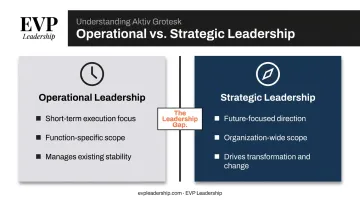
Operational leaders focus on execution within their function — delivering short-term targets, maintaining stability, and managing what already exists.
Strategic leaders operate across a wider scope:
- Broad scope — their decisions ripple across the whole organization, not just one department
- Future-focused — they integrate long-term vision with near-term action simultaneously
- Change-oriented — they drive transformation rather than manage the status quo
In practice, operational leaders are focused on whether today's execution is on track. Strategic leaders are asking a harder question: whether the organization is actually positioned to win over time — and whether today's decisions are moving it there.
Both roles matter. The problem arises when a business needs strategic thinking at the top but the leader is still operating exclusively at the tactical level. That gap widens over time — and by the time it shows up as stalled growth, broken team alignment, or a missed market shift, it's already costly.
Gennifer Baker's C-level consulting work at EVP Leadership is built around closing this gap for small and mid-size business owners — connecting day-to-day operations to long-term goals so organizations grow with intention, not just momentum.
The 5 Key Characteristics of Strategic Leaders
1. Visionary Thinking
Strategic leaders don't just react to the present — they build a credible picture of where the organization needs to go and communicate it in a way that creates collective direction.
This matters more than most leaders realize. McKinsey research shows that organizations communicating a clear and compelling future vision are more than four times as likely to be organizationally healthy compared to those that don't. Vision isn't inspiration theater — it's a performance driver.
The practical challenge: many leaders have a vision but struggle to translate it into something their team can actually act on. Visionary thinking requires both clarity of direction and the communication discipline to make that direction shared.
2. Decisive Accountability
Strategic leaders make confident decisions under ambiguity. They don't wait for perfect information — because in most high-stakes situations, perfect information never arrives.
More importantly, they own the outcomes of those decisions. They establish clear accountability structures so that strategy doesn't slowly dissolve in the grind of operations, and they lead by example rather than issuing mandates from a distance.
Within EVP Leadership's PressurePoint System, this is addressed through two diagnostic dimensions: Decision Integrity (grounding decisions in truth rather than noise and emotion) and Execution Discipline (executing cleanly, consistently, without unnecessary complexity). Together, these prevent the accountability drift that kills otherwise sound strategies.
3. Emotional Intelligence
EI gets labeled a "soft" competency. In strategic leadership, it drives hard results.
Self-awareness, empathy, and emotional regulation under pressure determine how effectively a leader builds trust, navigates conflict, and communicates in ways that people actually act on.
These qualities are especially critical during high-stakes change — acquisitions, restructurings, leadership transitions — where how a leader shows up emotionally directly shapes how the organization responds.
EVP Leadership's Identity Layer addresses this directly, building the emotional capacity and resilience that enables leaders to remain grounded when conditions are difficult and decisions are consequential.
4. Adaptability and Resilience
Strategic leaders treat disruption as information, not failure. They recalibrate without losing momentum.
The distinction that matters: reactive pivoting happens when a leader scrambles to adjust after a crisis hits. Proactive adaptation happens because the leader did the scenario-planning work before the pressure arrived — and built the internal capacity to respond with clarity rather than panic.
DDI's 2025 Global Leadership Forecast identifies "managing change" as one of the top two skill gaps leaders report — which means most organizations are operating without the adaptive capacity the current pace of change demands.
5. Strategic Influence
Strategy fails when leaders can't bring others along. Yet influence gets treated as a personality trait rather than a skill — which is why it's the characteristic most leaders underinvest in.
Strong strategic leaders build coalitions, forge trust-based relationships across the organization, and create the cultural conditions where people execute with purpose — not just compliance.
MIT Sloan research found that the strongest predictor of strategic alignment was managers explaining team priorities in the context of unit and company goals. Influence, practiced that deliberately, is what turns strategy into execution.
Core Skills Every Strategic Leader Must Master
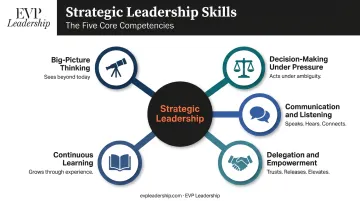
Big-Picture Thinking and Strategic Planning
The ability to zoom out — to see how individual decisions connect to long-term organizational goals — doesn't come naturally to most leaders who've spent years developing functional expertise. It has to be deliberately built.
This means practicing active scenario planning: imagining multiple future states rather than defaulting to what has worked before. Gennifer Baker's strategic planning consulting work with small and mid-size businesses is built on exactly this premise — creating clear, actionable strategies that align operations to long-term goals and prepare organizations to adapt, not just grow.
Effective Decision-Making Under Pressure
Strategic decision-making isn't about making good choices in ideal conditions. It's about making sound decisions when information is incomplete, timelines are compressed, and the stakes are high.
The data here is uncomfortable: HBR estimates that 67% of well-formulated strategies fail due to poor execution — and a significant portion of those execution failures trace back to poor decision-making under pressure. Leaders default to reactive instinct, exhaustion-driven choices, or paralysis.
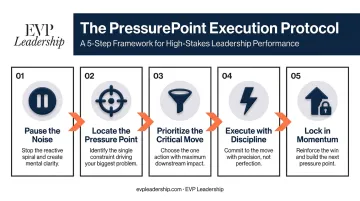
EVP Leadership's crisis leadership intensives address this directly through the PressurePoint System's Execution Layer — a five-step protocol for high-stakes moments:
- Pause the Noise — control the moment before it controls you
- Locate the Pressure Point — identify where things are actually breaking down
- Prioritize the Critical Move — focus on what matters most right now
- Execute with Discipline — clean action, no second-guessing
- Lock in Momentum — turn action into sustained forward progress
Communication and Active Listening
Here's the problem with most strategic communication: frequency isn't the issue. According to MIT Sloan research, only 28% of executives and middle managers responsible for executing strategy could list three strategic priorities. Meanwhile, nearly 90% of middle managers said top leaders communicated strategy frequently enough — but confusion persisted because of too many priorities and weak links between messaging and action.
Communication is not a soft skill. It's a core execution tool. Strategic leaders must articulate vision clearly enough that team members at every level understand their role in achieving it.
Listening carries equal weight. CCL research confirms that employee voice is positively linked to better decision-making and increased innovation. Two things that habit requires:
- Space for dissent — leaders who actively invite pushback generate stronger buy-in and catch blind spots early
- Silence as a signal — when no one challenges a decision, that's not stability; it's information loss
Delegation and Empowerment
A strategic leader who can't delegate stays permanently trapped at the operational level. This is one of the most common presenting problems EVP Leadership encounters with founder-CEOs and small business owners — growth being capped not by market conditions, but by the leader's inability to hand off responsibility and trust the team to carry it.
The fix isn't a delegation skill; it's a delegation system. EVP Leadership's approach treats these as three reinforcing systems — each one supporting the others:
- Delegation protocol — a clean framework for handing off work with clarity
- Accountability operating rhythm — scorecards, 1:1 cadence, and performance conversations
- Execution-discipline framework — ensures delegated work actually lands
Strategic leaders hire and develop for potential, not just current competency. That shift alone changes who you build around — and how fast the organization can scale.
Continuous Learning and Intellectual Curiosity
Continuous learning is a practice, not a personality trait. The leaders who adapt successfully aren't waiting for annual strategy reviews to question their assumptions — they're doing it quarterly, sometimes weekly, when early signals of disruption appear.
The leaders who adapt successfully aren't the ones with the best existing knowledge base. They're the ones who notice early signals of disruption, interrogate their assumptions before circumstances force them to, and remain genuinely open to being wrong. That habit separates leaders who drive change from those who are blindsided by it.
How to Develop Strategic Leadership in 5 Steps
Step 1 — Do the Inner Work First
Strategic leadership starts with self-awareness. Leaders must understand their own decision-making patterns, emotional triggers, and default behaviors under pressure — because those behaviors affect every person on the team.
EVP Leadership's core value is direct: "Who you are at your core determines the health of your leadership." This isn't philosophical — it's structural. The PressurePoint System begins with the Identity Layer, building consistency (acting in alignment with values over time), capacity (handling responsibility, complexity, and pressure), and character (determining how consistency and capacity are used).
Self-awareness comes before strategy work. Character is the foundation; skills are built on top of it.
Step 2 — Define and Document a Clear Vision
A vision that exists only in the leader's head is not an organizational asset — it's a personal ambition.
Strategic leaders translate long-term ambitions into a written, specific, communicable vision. That means knowing where the organization is now, where it needs to go in the next 1–3 years, and what must be true to get there.
A usable vision document covers three things:
- Current state: An honest assessment of where the organization stands today
- Target horizon: A specific, time-bound destination (1–3 years out)
- Enabling conditions: What must change in structure, team, or behavior to get there
Build it collaboratively with key team members so execution buy-in is embedded from the start, not added as an afterthought.
Step 3 — Build Consistent Strategic Habits
Strategy is not an annual offsite event. It's a set of daily and weekly habits.
Effective strategic leaders:
- Block time for forward-thinking (and protect it from operational urgency)
- Hold regular rhythm-of-business conversations that reconnect teams to big-picture goals
- Use scorecards or priority frameworks to maintain alignment between activity and strategy
EVP Leadership's core value applies here directly: "Actionable change starts with small habits practiced consistently over time." This is the difference between conditioning and one-time training. The operating rhythm that emerges from EVP Leadership's engagement work — 1:1 cadences, team operating rhythms, performance conversations — is the infrastructure that makes strategy stick between board meetings.

Step 4 — Condition Yourself to Perform Under Pressure
The real test of strategic leadership shows up when a crisis hits, a plan falls apart, or a key team member exits without warning — not in the board meeting where everything is controlled.
Leaders who've built only theoretical strategy skills crumble in these moments. Leaders who've been conditioned — through repeated exposure, structured feedback, and accountability — respond with clarity and discipline.
This is the core philosophy behind EVP Leadership's 90-Day PressurePoint System. The program doesn't just teach the Execution Layer framework; it conditions leaders through real scenarios until the response becomes instinctive. Under pressure, leaders execute from what they've trained — not what they've read.
Step 5 — Invest in Ongoing Development and Accountability
Strategic leadership development is not a one-time event — and the research reflects this. DDI's 2025 Global Leadership Forecast found that leaders identify "setting strategy" and "managing change" as their two greatest skill gaps, while only 22% of HR teams prioritize developing those skills. That disconnect compounds over time.
Without a consistent cadence of learning, application, and feedback, emerging strategic leaders revert to old behaviors the moment they return to daily operational demands. Accountability structures — whether through coaching, peer groups, or a formal development program — prevent that regression.
The PressurePoint System is designed with sustainability in mind, equipping leaders with frameworks they can run independently after the engagement concludes. EVP Leadership also offers cohort-based leadership development programs for organizations building a leadership bench — not just developing a single executive.
Building a Culture That Supports Strategic Leadership
Even the most capable strategic leader will struggle if the organization's culture works against them. Culture-building is not an HR function — it's a strategic leadership responsibility.
What culture-building looks like in practice:
- Creating psychological safety so good ideas surface organically and honest dialogue is possible. Google's research found that teams with high psychological safety were rated effective twice as often by executives
- Making progress visible through shared metrics, regular cadences, and transparent communication about where the organization stands against its goals
- Measuring and celebrating the right behaviors — because culture follows what leaders measure, reward, and tolerate
Teri Evans' facilitation work at EVP Leadership addresses this directly through executive team development engagements designed to strengthen communication, build trust, establish psychological safety, and help teams perform with clarity and purpose. When culture is treated as a strategic outcome — with defined behaviors, shared metrics, and leadership accountability — it becomes something you can actually manage and improve.
Developing Future Leaders as a Strategic Obligation
The best measure of a strategic leader's effectiveness is what happens when they step back. If the organization continues to execute, decide, and adapt without them in the room, the leadership development has worked.
DDI data is sobering here: only 12% of companies are confident in their leadership bench strength. That gap isn't a recruiting problem. It reflects leaders who performed but never prioritized developing others to perform alongside them. The most effective leaders don't just perform; they develop others to perform.

EVP Leadership's leadership development programs address this through high-potential pipeline programs, intact-team leadership training, and emerging leader cohorts — built for organizations that need to develop leadership capacity across multiple layers, not just at the top.
Frequently Asked Questions
What are the 5 key characteristics of strategic leaders?
The five characteristics are visionary thinking, decisive accountability, emotional intelligence, adaptability and resilience, and strategic influence. Each one can be developed through deliberate practice — none of them require being born with a particular personality type.
What are the 5 steps of leadership development?
The five steps are: do the inner work (self-awareness), define and document a clear vision, build consistent strategic habits, condition yourself to perform under pressure, and invest in ongoing development and accountability. Sequence matters here. Character comes before skills.
What is the difference between strategic leadership and operational leadership?
Operational leadership focuses on day-to-day execution and short-term targets within a specific function. Strategic leadership is broader in scope, future-focused, and change-oriented — it's concerned with where the organization is going and how to position it to get there.
Can strategic leadership skills be learned?
Yes. Strategic leadership is not a fixed personality trait. The core skills can be conditioned through deliberate practice, structured feedback, and consistent habits. That conditioning model is the foundation of EVP Leadership's PressurePoint System.
What is the most important skill for a strategic leader?
There's no single answer, but self-awareness is foundational. Without understanding your own patterns, triggers, and blind spots, other strategic skills — decision-making, communication, adaptability — are built on an unstable base.
How does strategic leadership impact organizational performance?
Strategic leaders drive performance by aligning teams around a shared vision, creating accountability structures, and building cultures where people execute with purpose. Organizations with effective strategic leadership adapt before change forces them to. That's what produces sustainable growth instead of reactive survival.