The market doesn't make this easier. According to ICF's 2025 Global Coaching Study, professional coaching is now a $5.34 billion industry with nearly 123,000 practitioners worldwide—and the field keeps growing. Yet McKinsey found that only 11% of executives strongly agree that their leadership development investments actually achieve and sustain desired results.
Most firms sell content delivery. This guide helps you find a true strategic partner.
You'll get a practical, criteria-driven framework for evaluating leadership consulting firms—what to look for, what to avoid, and what separates a partner who builds lasting capability from a vendor who runs a workshop and disappears.
Key Takeaways
- A leadership consulting partner builds lasting behavioral change—not one-time workshops
- Define your specific leadership goals before evaluating any firm
- Vet candidates on six factors: goals alignment, track record, methodology, credentials, cultural fit, and ROI measurement
- Red flags include cookie-cutter programs, vague outcome promises, and consultants who've never held real leadership responsibility
- The right partner matches your business context—generic enterprise frameworks rarely translate to small or mid-size business realities
What Is a Leadership Consulting Partner?
A leadership consulting partner is an external expert or firm hired to strengthen leadership capacity across an organization. Unlike a one-off trainer, this type of partner typically works through a combination of strategic advising, executive coaching, facilitated development programs, and organizational assessment—across multiple areas simultaneously.
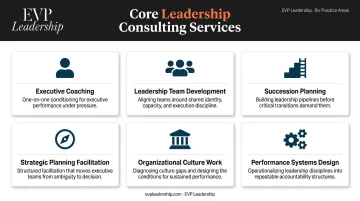
Core Services Leadership Consulting Covers
The spectrum is broader than most buyers expect:
- Executive coaching — 1:1 development for individual leaders
- Leadership team development — building alignment, trust, and decision-making across the C-suite
- Succession planning — identifying and preparing the next layer of leaders
- Strategic planning facilitation — connecting leadership behavior to business direction
- Organizational culture work — shifting how leadership operates at scale
- Performance systems design — accountability, delegation, and operating-rhythm work
Small business owners and executive teams often need a partner who moves across several of these areas, not a specialist confined to one. The right firm can flex.
Leadership Consulting vs. Training: Understanding the Difference
Training is a one-time skill transfer event. Consulting is an ongoing, embedded partnership that reshapes how leaders think, decide, and operate under real-world pressure—not just in a classroom.
McKinsey research shows that adults retain only 10% of what they hear in lectures, compared to nearly two-thirds when learning by doing. The most effective firms don't just teach leadership concepts—they condition leaders, building repeatable habits and frameworks that hold up under real conditions, not just favorable ones.
Key Factors to Consider When Choosing a Leadership Consulting Partner
Selecting the right firm requires moving well beyond surface-level reputation. The six factors below help connect a firm's capabilities to your actual performance goals—reducing the risk of a low-ROI, mismatched engagement.
Factor 1: Start by Defining Your Leadership Goals
Clarity on outcomes must come before any vendor evaluation. Without a defined goal, there's no filter for comparing firms.
Ask your team:
- Are we developing existing leaders, onboarding new ones, or rebuilding leadership culture?
- Is the core issue executive burnout, poor delegation, inconsistent decision-making, or something else?
- What does success look like 12 months from now—and how will we know?
The answers determine which type of firm is the right fit. A firm built for succession planning isn't the same as one built for crisis leadership or founder transition.
Factor 2: Evaluate Track Record and Industry Relevance
Brand recognition and firm size tell you less than you'd think. What matters is whether the firm has produced measurable change in business contexts similar to yours—comparable company size, growth stage, or industry.
For small and mid-size business owners especially, working with a consultant who has spent years advising entrepreneurs and executive teams provides more practical relevance than a firm whose entire portfolio is Fortune 500 engagements.
The challenges of a 40-person founder-led company are structurally different from those of a 40,000-person enterprise.
When vetting firms:
- Ask for case studies with specific business outcomes, not just client logos
- Request testimonials that speak to behavioral change, not just participant satisfaction
- Ask how their prior work maps to your company's size and stage
Factor 3: Assess Their Methodology and Approach
A firm's methodology is the engine behind their results. Ask directly: do they use a structured, proprietary system—or do they improvise program to program?
Generic content looks similar across firms. What separates high-performing consulting partners is a documented, phase-based system with clear deliverables at each stage. Without that structure, results depend too much on who shows up that day—not on the system behind them.
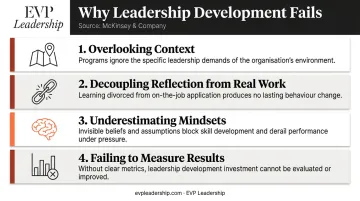
McKinsey identified four common failure modes in leadership development that a rigorous methodology must address:
- Overlooking context
- Decoupling reflection from real work
- Underestimating mindsets
- Failing to measure results
Ask any prospective firm how their methodology handles each of these directly.
Factor 4: Examine the Consulting Team's Credentials and Real-World Experience
A strong methodology only matters if the people delivering it can speak from real experience. Certifications are baseline, not sufficient. The more important question: have the consultants who will actually work with your leaders navigated real organizational complexity themselves?
A consultant who has held P&L responsibility, led teams through crisis, or scaled a business from the inside brings a qualitatively different perspective than one who moved directly from graduate school into advisory work. That gap is felt immediately by senior executives.
When evaluating the team:
- Request individual consultant bios, not just firm credentials
- Ask what leadership roles they held before consulting
- Confirm whether the people delivering the work match the seniority of the leaders being served—not just the partner who sold the engagement
Factor 5: Evaluate Cultural Fit and Communication Style
Even the most credentialed team will struggle to produce change if they can't connect with your people. A consulting partner who clashes with your team's operating norms will struggle to earn the trust needed to drive real behavior shifts—and cultural misalignment is one of the most common, and most avoidable, causes of failed engagements.
Pay close attention in early conversations:
- Does the firm listen more than it pitches?
- Does it ask diagnostic questions before proposing solutions?
- Does it offer honest observations, or only affirming ones?
A partner worth hiring will push back gently, ask uncomfortable questions, and resist the urge to tell you what you want to hear. If they're already doing that before you've signed anything, that's a strong signal.
Factor 6: Understand Their Approach to Measurement and Long-Term Impact
A strong consulting partner defines success criteria upfront, establishes a baseline, and tracks behavioral and performance changes throughout the engagement—not just at the end.
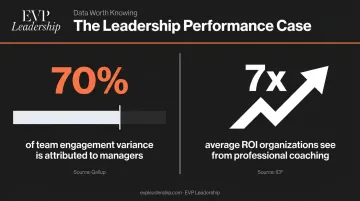
The stakes of getting this wrong are high. Gallup reports that low employee engagement now costs the global economy an estimated $10 trillion in lost productivity annually—and managers account for 70% of the variance in team engagement. When leadership development fails to produce behavioral change, these costs compound.
Ask any prospective firm:
- How do you define success before the engagement begins?
- What baseline assessments do you use?
- How do you demonstrate value to stakeholders after the engagement concludes?
ICF data shows organizations realize an average 7x return on investment from professional coaching—but only when the engagement is structured to produce and measure real outcomes.
Red Flags to Watch For When Evaluating Leadership Consulting Firms
Not every firm that claims to develop leaders actually does. Watch for these warning signs.
Cookie-cutter programs. If a firm presents the same slide deck to every prospect and never asks diagnostic questions, they're selling content delivery—not strategic partnership. Customization is how you know they've actually listened.
Vague outcome language. Press hard on any consultant who can't articulate measurable success criteria, expected behavioral shifts, or what the engagement produces beyond "improved leadership." "You'll be a better leader" isn't a deliverable.
Seniority theater. A recognizable brand or impressive client roster means little if day-to-day delivery gets handed to junior staff. Always ask who will actually be in the room with your leaders—not just who signs the proposal. That gap is where most consulting relationships break down.
How EVP Leadership Can Help
EVP Leadership is a leadership conditioning firm with over 35 years of experience working with C-suite executives and small business owners. Where traditional training vendors deliver content, EVP Leadership builds the conditioning that holds under pressure.
The firm's core thesis is direct: under pressure, leaders don't rise to expectations — they fall back on their conditioning. Most organizations don't struggle with strategy. They struggle with readiness.
The 90-Day PressurePoint System
EVP Leadership's signature engagement is the 90-Day PressurePoint System — a structured, phase-based conditioning protocol built around three layers:
- Identity Layer — builds leaders grounded in consistency, capacity, and character so performance doesn't erode under stress
- Diagnostic Layer — trains leaders to see clearly through six components: Mission Clarity, Force Alignment, Problem Intelligence, Decision Integrity, Execution Discipline, and Momentum Control
- Execution Layer — a five-step pressure protocol: Pause the Noise → Locate the Pressure Point → Prioritize the Critical Move → Execute with Discipline → Lock in Momentum
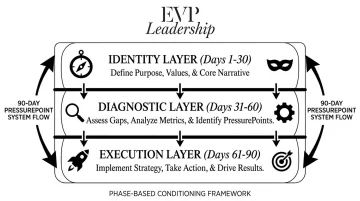
The system is delivered by two practitioners with distinct depth. Founder Gennifer Baker has advised thousands of entrepreneurs and executive teams since 2009, focusing on aligning day-to-day operations to long-term business goals. Leadership Facilitator Teri Evans brings specialized experience across healthcare, education, nonprofit governance, and executive team alignment.
What Clients Gain
- A stronger leadership framework for decision-making and execution under pressure
- Increased clarity and confidence in communication and influence
- A personalized strategy system to drive goals and manage priorities
- Conditioning that holds after the engagement ends — not a workshop they forget in 30 days
- A strategic partnership model where every engagement is scoped to your specific leadership context
Every engagement begins with a complimentary scoping conversation. That conversation surfaces your current pressure points, decision-making gaps, and leadership priorities — so the work is built around what actually needs to change.
Conclusion
The right leadership consulting partner is defined by fit — specifically, whether their methodology, team, and values align with your leadership challenges and long-term goals. Name recognition and price point are secondary to that alignment.
Leadership development is not a one-time event. The firms worth investing in treat every engagement as a long-term relationship, not a deliverable to hand off. At EVP Leadership, that means conditioning leaders to perform consistently under pressure — not just training them through a program and moving on. If you're evaluating partners, start with that distinction: are they building your capacity, or just filling a calendar?
Frequently Asked Questions
What are the 5 C's of consulting?
The 5 C's of consulting commonly refer to Credibility, Communication, Clarity, Commitment, and Client-focus—core competencies that define how effective consultants operate and earn trust. These principles apply across disciplines, from management consulting to leadership development.
What is the difference between leadership coaching and leadership consulting?
Leadership coaching focuses on developing an individual leader's skills and mindset through one-on-one sessions. Leadership consulting addresses broader organizational challenges—strategy, team dynamics, culture, and systems—often working across multiple leaders simultaneously. Most engagements blend both approaches.
How much does a leadership consulting partner typically cost?
Costs vary based on firm size, engagement scope, and program length. Executive coaching sessions average around $244 per hour globally, with rates in North America averaging higher. Full consulting engagements are scoped and priced custom. Focus on expected ROI, not just the upfront number.
How long does a typical leadership consulting engagement last?
Engagements range from focused 90-day interventions to multi-year partnerships. According to SHRM, executive coaching typically lasts six to nine months—long enough for behavioral change to take hold. Shorter programs address specific outcomes; longer ones support culture change or succession planning.
What red flags should I watch for when choosing a leadership consulting firm?
The top warning signs: cookie-cutter programs with no customization, inability to define measurable outcomes, lack of real-world leadership experience among consultants, and poor listening during the initial discovery process. If a firm pitches before it diagnoses, walk away.
How do I measure the ROI of a leadership consulting engagement?
Track pre- and post-assessments of leadership behaviors, employee engagement scores, key talent retention, decision-making speed, and progress against goals set at the outset. The best firms define these metrics before the engagement begins—not after.