Introduction
Most well-designed initiatives don't fail because they lack merit. They fail because they never secured the right executive support at the right time. The proposal gets shelved. The budget disappears. The cross-functional alignment that seemed promising quietly collapses — often before the work even begins.
Getting C-suite buy-in is one of the highest-leverage skills a leader can build. Most leaders approach it wrong.
This article covers why executive sponsorship drives organizational momentum, what most commonly gets in the way, how to tailor your approach to each C-suite role, and which strategies consistently move executives from skepticism to active support.
Whether you're a CHRO seeking investment in leadership development or a COO pitching an operational overhaul, the principles here apply directly.
Key Takeaways
- C-suite buy-in requires alignment, credibility, and timing — not just a compelling deck
- Each executive role has distinct priorities — a one-size-fits-all approach leaves buy-in on the table
- Data builds credibility; narrative creates urgency. Effective buy-in depends on both working together
- Relationships built before the ask outperform cold presentations every time
- Earning the first yes is only half the work — keeping executive trust requires consistent follow-through
Why C-Suite Buy-In Is Critical for Organizational Success
Without executive sponsorship, even well-resourced initiatives stall. Decisions slow down, cross-functional teams drift, and budgets that seemed secure suddenly have competing priorities. The C-suite doesn't just approve ideas — they determine whether those ideas get the resources, attention, and political cover to move.
The numbers are stark. According to Prosci, projects with highly effective executive sponsors are 79% likely to meet their objectives — compared to just 27% for projects with ineffective sponsors. That gap doesn't close with better project management or more budget. It closes with executive alignment.
The cost of misalignment compounds over time. McKinsey research found that fewer than one-third of transformations both improved performance and sustained those gains. Even successful transformations captured only 67% of maximum financial benefits — while others captured just 37%. Funding alone doesn't protect an initiative; executive alignment does.
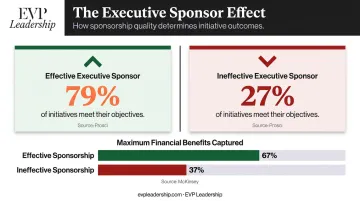
That data points to a single, consistent factor: when executives are genuinely aligned, initiatives survive pressure. When they're not, even well-funded efforts fade.
The mindset shift that matters most is this — getting buy-in isn't about persuading executives to agree with you. It's about demonstrating how your initiative serves what they already care about. Leaders who internalize this distinction stop pitching features and start presenting strategic outcomes. That's what separates leaders who consistently influence executive decisions from those who keep making the same case to the same skeptical room.
Common Barriers to Getting Executive Buy-In
Misaligned Language and Framing
Many leaders default to functional or technical language when presenting to executives. This is a fundamental misread of the audience.
C-suite members think in terms of revenue, risk, competitive position, and strategic priorities — not departmental workflows or operational metrics. Translating ideas into business language is a prerequisite, not a finishing touch. An HR leader who frames a leadership development proposal around "training hours delivered" has already lost the CFO before the second slide.
Lack of Established Credibility
Executives assign far more weight to proposals from people they already trust. DDI's Global Leadership Forecast 2025 found that trust in managers has dropped from 46% to 29% since 2022 — a sharp decline that raises the credibility bar for anyone seeking executive support.
If you haven't built consistent visibility with the C-suite through prior interactions and follow-through, even a strong proposal faces an uphill climb. That deficit is structural, not personal — and it has to be addressed before the formal ask, not during it.
Timing and Organizational Context
A well-crafted pitch presented at the wrong moment will struggle regardless of its merit. Budget freezes, strategic pivots, leadership transitions, and quarter-end pressures all affect executive bandwidth and risk appetite.
Leaders who understand executive calendars, strategic planning cycles, and current organizational pressures know when to advance and when to wait. Reading that context — and choosing your moment deliberately — is as important as the proposal itself.
Understanding What Drives Each C-Suite Role
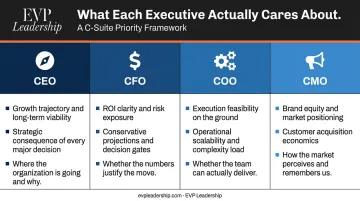
The most common mistake leaders make when seeking buy-in is treating "the C-suite" as a single audience. Each role carries distinct responsibilities, success metrics, and anxieties. Your approach must reflect those differences if you want to be heard.
The CEO
CEOs are operating under reinvention pressure. PwC's Annual Global CEO Survey found that 45% of CEOs in 2024 didn't believe their company would be economically viable in 10 years on its current path. PwC's 2025 survey showed a nearly identical 42%.
That's the lens through which they evaluate everything. When pitching a CEO, connect your initiative directly to growth, market differentiation, or existential risk mitigation. Avoid leading with departmental scope. Lead with strategic consequence and the cost of inaction.
The CFO
CFOs evaluate everything through a risk-adjusted return lens. Vague impact claims lose them quickly. Hard numbers and conservative projections earn confidence.
Quantify your initiative in ROI terms, address financial exposure proactively, and structure your ask around four elements:
- Baseline cost — total investment required
- Forecast benefit — projected return with conservative assumptions
- Implementation risk — what could go wrong and how it's managed
- Decision gate — the criteria for scaling, pausing, or stopping
The COO
COOs care whether a strategy can survive contact with operations. McKinsey's COO research emphasizes balancing near-term productivity with long-term resilience — and testing whether organizations can scale without proportional increases in complexity.
Frame your initiative around how it reduces operational bottlenecks, improves process reliability, or enables growth without adding disproportionate load. The CEO needs to know why this matters strategically and the CFO needs the financial case — but the COO needs to see a credible execution path before they'll commit.
CMO and Other Function-Specific Chiefs
Not every initiative reaches a CEO or CFO first. CMOs focus on brand equity and customer acquisition. CTOs think about technical debt and capability scaling. CHROs weigh talent risk and organizational health.
Before any pitch, research that specific executive's current stated priorities, recent decisions, and active pressures — then let those findings shape how you position your proposal.
Proven Strategies to Secure C-Suite Buy-In
Lead with Business Outcomes, Not Activity Reports
The most common pitch failure is presenting inputs and activities instead of results. Executives don't want to know what you'll do — they want to know what will change.
Consider the difference:
- Activity-focused: "We will implement a leadership development program across three departments."
- Outcome-focused: "We will reduce leadership-driven attrition by equipping team leads to perform under pressure — protecting an estimated $X in replacement costs over 12 months."
The second version speaks the executive's language. The first forces them to do the translation themselves, and most won't bother.
EVP Leadership's PressurePoint System addresses this directly through its Diagnostic Layer, which trains leaders to articulate Mission Clarity (what must be achieved and why it matters now) and Momentum Control (measurable progress on what actually matters). Both components help leaders strip out activity-focused language and lead with strategic outcomes instead.
Use Data and Storytelling Together
Data establishes credibility. Stories create urgency. Neither works as well without the other.
A chart of KPIs rarely moves an executive to act. But pairing those metrics with a specific, realistic scenario — one that makes the risk or opportunity feel immediate and concrete — substantially increases a pitch's persuasiveness.
Two practical ways to build this combination:
- Use a peer organization case study. Find a comparable company that faced the same problem and quantify what happened when they acted (or didn't). Executives trust precedent more than projection.
- Build a "what happens if we don't act" narrative anchored in real data. Walk through the likely 12-month scenario if the initiative is delayed — using your organization's own metrics to make it concrete.
Staying composed and persuasive when the room pushes back takes more than rehearsal. It takes conditioning. EVP Leadership's 90-Day PressurePoint System builds this capacity through its Execution Layer:
- Pause the Noise
- Locate the Pressure Point
- Prioritize the Critical Move
- Execute with Discipline
- Lock in Momentum
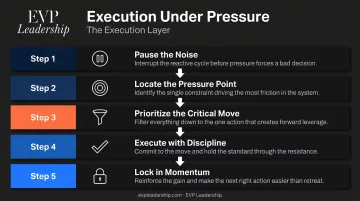
Leaders who've worked through this sequence don't just prepare better pitches — they've built the internal capacity to hold their position clearly under pressure.
Build Credibility Before You Need the Pitch
Leaders who regularly provide executive-relevant insights, surface problems with proposed solutions already attached, and follow through on smaller commitments build a trust reserve that pays dividends when a major initiative needs support.
Three specific behaviors that build pre-pitch credibility:
- Arrive with options, not just problems. Executives notice who says "here's the issue and here are three ways to address it."
- Deliver on small commitments visibly. Do what you said, on time, and confirm when it's done.
- Bring intelligence before they ask. Brief executives on market trends that affect their agenda — before they request it.
The "relationship before the ask" principle is straightforward: scheduling brief, low-stakes touchpoints with C-suite stakeholders before a significant initiative removes the cold-pitch dynamic. When an executive already respects your judgment, your proposal starts from assumed competence — not from zero.
Align to the Organization's Current Strategic Priorities
Initiatives most likely to receive executive buy-in are explicitly anchored to the company's active strategic agenda — not last year's priorities or the leader's functional goals.
Practical ways to stay informed:
- Review strategic planning documents and board-level communications
- Initiate brief, structured one-on-ones with C-suite members to understand their current focus areas — before framing any proposal
- Track recent executive communications, town halls, and all-hands themes for signals about what's being emphasized
If your initiative can't be directly connected to something the C-suite is actively prioritizing, either reframe it so it can — or wait until the timing is right.
Maintaining Executive Trust Beyond the Initial Win
Securing buy-in once is not enough. Executive confidence erodes quickly when leaders go quiet after approval and only resurface when they need something else.
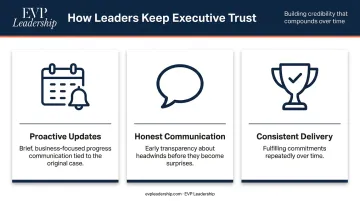
Three behaviors that sustain executive trust after initial approval:
- Deliver proactive progress updates — brief, business-focused, and tied to the original case. Don't wait to be asked.
- Communicate honestly when an initiative faces headwinds. Executives who hear about problems early trust the leader more, not less. Surprises are what damage credibility.
- Consistently deliver on what was committed. This is the most basic trust signal, and the most commonly underestimated.
The deeper shift is moving from "seeking approval" to becoming a strategic partner. Leaders who reliably execute and communicate with transparency earn ongoing access to C-suite conversations — not just one-time audiences. This positions them as trusted advisors rather than functional advocates making occasional pitches.
Leaders who maintain C-suite trust have built their capability through conditioning — not rehearsed it for a specific moment. A strong presentation gets you in the room. What keeps you there is a track record of execution and honest communication, repeated consistently across varying conditions.
Frequently Asked Questions
How do you secure executive buy-in?
Align your initiative to each executive's specific priorities, quantify business outcomes in terms they care about, and build credibility before the formal ask. Pair hard data with a compelling narrative that makes the stakes concrete. Timing matters too — make sure your ask lands within the organization's strategic cycle, not against it.
What are the 7 C's of strategic management?
The 7 C's commonly referenced in practitioner circles are Clarity, Commitment, Communication, Coordination, Collaboration, Continuity, and Change. Executive alignment is where all seven tend to either reinforce each other or unravel first.
What are the most common reasons C-suite buy-in fails?
The most frequent causes are misaligned language (using functional terms instead of business outcomes), poor timing relative to strategic cycles, lack of prior credibility with the executive, and failure to quantify impact in ways the C-suite actually measures.
How do you tailor your message to different C-suite roles?
Each role has distinct priorities:
- CEOs: growth trajectory and organizational viability
- CFOs: ROI, payback period, and downside risk
- COOs: execution feasibility and operational scalability
- CMOs: brand positioning and customer acquisition impact
Tailoring requires researching each executive's current focus before entering any conversation, not just defaulting to a generic business case.
How long does it take to build trust with C-suite executives?
Trust isn't built in a single meeting. It develops through consistent follow-through, sound judgment, and relevant communication across multiple interactions. That process typically spans months, not weeks.
What's the difference between getting buy-in and maintaining it?
Getting buy-in is the initial approval. Maintaining it requires ongoing communication, transparent reporting on progress and problems, and consistent delivery against commitments. Leaders who conflate the two often lose executive support shortly after they gain it.