Introduction
Most professionals assume promotions go to whoever produces the best results. The data tells a different story.
According to research from Coqual, executive presence accounts for 26% of what it takes to get promoted — and within that, communication carries nearly a third of the weight. Technical expertise matters, but it's not what separates leaders who advance from those who plateau.
Influence is not manipulation. Where manipulation exploits, influence earns — through clear communication, genuine understanding of your audience, and credibility built consistently over time. It's a trainable skill, not a personality trait.
What follows are the specific communication shifts, framing strategies, and self-awareness habits executive coaches use to help leaders build lasting workplace influence — the kind that compounds across a career.
Key Takeaways
- Decision-makers promote people who communicate results clearly, not just those who deliver them
- Three specific word-choice shifts can change how senior stakeholders perceive your authority
- Framing your ideas around a stakeholder's priorities is the fastest way to accelerate influence
- Self-awareness and consistency under pressure, not personality, determine long-term influence
- Influence is built through repeated practice, not learned once and applied
Why Workplace Influence Is the Real Driver of Career Advancement
The Promotion Gap Nobody Talks About
Picture two managers at the same company. One delivers consistently strong results but struggles to articulate them to senior leaders — she uses hedged language, buries her recommendations in context, and often leaves meetings without a clear decision.
The other is slightly less technically polished but communicates with clarity and confidence. He frames ideas around what the executive team cares about and leaves every conversation with alignment.
Who gets pulled into the next strategic initiative? Who gets mentioned when a VP role opens up?
This is the influence gap. Most organizations won't name it, but nearly every leadership team feels it.
CCL research on boundary-spanning leadership found that 92% of senior executives said collaborating across organizational boundaries becomes more important as you move from middle to senior management. Only 19% viewed middle managers as effective at it. That gap doesn't close by working harder on deliverables.
Influence Works in Every Direction
The leaders who advance fastest aren't just good at managing up. They build influence across three dimensions:
- Upward — with senior leaders who need brevity, strategic framing, and confidence
- Laterally — with peers who respond to collaboration language and shared goals
- Downward — with direct reports who need coaching questions and clear expectations
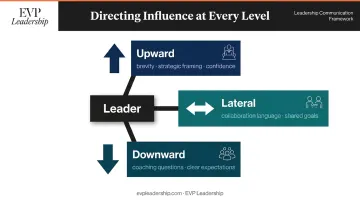
Each direction requires a different approach. Leaders who understand this build careers that compound. Leaders who don't often plateau at the level where technical output stops being the primary currency.
3 Communication Shifts That Make Leaders More Persuasive
These aren't personality upgrades. They're precise, learnable word-choice changes that signal competence, ownership, and credibility.
Shift 1: Lead with Your Bottom Line
Decision-makers are time-constrained. Starting with your conclusion before your supporting evidence signals confidence — it tells the room you trust your own thinking.
The military calls this BLUF — Bottom Line Up Front. It works in boardrooms too.
Instead of: "So I've been looking at the data, and after reviewing the Q3 numbers alongside the vendor proposals, I think there might be an opportunity here..."
Try: "I recommend we move forward with Vendor B. Four reasons: lower total cost, faster implementation, better integration with our current stack, and a stronger support model post-launch."
This structure — recommendation first, evidence second — changes how senior stakeholders experience you. That's not arrogance — it's the kind of clarity that earns a seat at the table.
Shift 2: Replace Weak Verbs with Language of Ownership
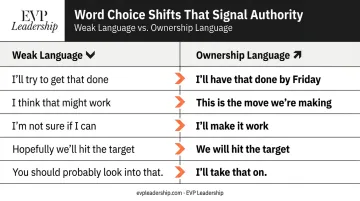
Word choice is not cosmetic. Small substitutions signal either uncertainty or command. Here's a practical reference:
| Weak Language | Ownership Language |
|---|---|
| "I had to handle the client issue" | "I decided to address it directly" |
| "I helped with the project" | "I led the project" |
| "I was involved in the decision" | "I drove that decision" |
| "We kind of pivoted the strategy" | "I recommended we change direction, and the team aligned" |
| "I think I contributed to the outcome" | "My work produced this result" |
A 2023 experimental study found that framing uncertainty externally — "it is uncertain" rather than "I am uncertain" — produced a measurable competence advantage (effect size d = 0.45). The takeaway isn't to hide doubt. It's to separate your personal hesitation from factual complexity.
Shift 3: Anchor Authority in Experience, Not Opinion
"I think we should restructure the team" sounds like a hypothesis. "In my experience, this structure breaks down above 12 people — here's what I'd change and why" sounds like a diagnosis.
With senior stakeholders evaluating whether to trust your judgment, this distinction matters. Replace opinion-signaling openers with credibility anchors:
- "In my experience with similar situations..."
- "The data from Q2 shows..."
- "Based on what I've seen work across three different clients..."
Pick one of these three shifts and practice it deliberately before your next high-stakes conversation. One change, applied consistently, produces measurable responses from colleagues within weeks.
Senior leaders notice the difference between someone who presents opinions and someone who delivers informed positions. Word choice is where that distinction starts.
How to Frame Your Ideas So Decision-Makers Listen and Act
The Audience-Centered Framing Principle
Your idea doesn't succeed on its own merits. It succeeds when the person across the table recognizes it as a solution to something they already care about.
This is audience-centered framing — and it's the single most underused influence skill in professional environments.
Most professionals pitch ideas by describing what the idea is. The more effective move: frame it around what the idea does for the specific person you're talking to.
Weak framing: "This will improve our data processing efficiency."
Audience-centered framing: "This gives you quarterly reports three days earlier — so you have more time before board meetings to make decisions instead of just presenting data."
Same initiative. One lands. One doesn't.
Framing When You're Deferring or Pushing Back
Audience-centered framing doesn't only apply when you're pitching an idea — it holds when you're buying time or pushing back, too.
Weak response: "I'll get back to you on that."
Audience-centered deferral: "I want to give you the most useful answer for your quarterly planning — can I have until Friday to pull the right data?"
The difference: the second response positions you as a strategic partner who's thinking about the stakeholder's goals, not just a resource managing their own workload.
Researching Audience Priorities Before High-Stakes Conversations
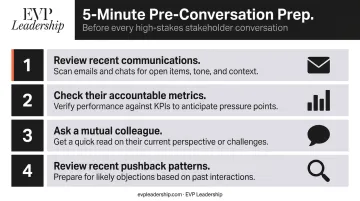
Wharton's research on influencing without authority recommends engaging others through questions to understand their motivations before making your case. In practice, that prep looks like this:
- Review recent communications from the stakeholder — what problems are they flagging repeatedly?
- Check what metrics they're accountable for heading into this quarter
- Ask a mutual colleague what's been on their radar lately
- If they have a direct report relationship to you, what have they pushed back on recently?
Five minutes of prep before a high-stakes conversation often does more for your influence than years of refining your delivery style.
Adapting Your Influence Approach for Different Stakeholders at Work
Influence is not one-size-fits-all. What earns trust with a CFO does not earn trust with a peer who needs to feel heard before they'll align.
With C-suite executives:
- Lead with the bottom line immediately
- Frame everything around strategic priorities and organizational risk
- Be brief — respect their time as a form of credibility
With peers:
- Use collaboration language: "What would make this work for your team?"
- Identify shared goals before making requests
- Avoid positional authority framing — it backfires laterally
With direct reports:
- Ask coaching questions before offering solutions
- Make expectations explicit, not implied
- Consistency here builds the psychological safety that enables better performance
Know Your Own Default First
Before adapting to others, you need to know your starting point. Most professionals have a default style — and that default is often mismatched to at least one of the three stakeholder directions above. Self-awareness is the diagnostic — it shows you exactly where your approach stops landing.
That self-knowledge also shapes how consistent you are across stakeholder directions. Stakeholders form impressions over time, through repeated interactions — and what they notice is whether you show up the same way when the stakes are low as when they're not. Aim to be reliably clear and prepared in every interaction, not just the ones that feel high-visibility.
Why Self-Awareness and Consistency Under Pressure Are the Foundation of Lasting Influence
When Stress Reveals a Different Person
Tactical communication skills matter. But leaders who sustain influence over years share one characteristic that goes deeper than technique: their behavior under pressure looks the same as their behavior on a normal Tuesday.
When pressure reveals a different person — reactive, avoidant, or suddenly less clear — trust erodes quietly, across a series of small moments that stakeholders file away.
A 2022 study published in PMC found that employees who experienced larger discrepancies in leadership behavior between routine and stressful conditions experienced significantly more strain. Inconsistency under pressure isn't just a credibility problem — it's a performance drag on everyone around you.
The Self-Awareness Gap
Here's the problem: HBR research by Tasha Eurich found that 95% of people believe they are self-aware, but only 10–15% actually meet the research criteria. Most leaders genuinely don't know how they come across under stress.
A Korn Ferry Institute study of 6,977 self-assessments across 486 companies found that employees at poorly performing companies had 20% more blind spots than those at financially strong companies. Self-awareness isn't introspective — it directly connects to organizational outcomes.
Knowing your emotional triggers, default reactions under pressure, and communication blind spots is what allows you to manage the moments that most damage credibility: the reactive decision, the passive avoidance, the meeting where you went quiet instead of leading.
Conditioning, Not Just Training
That self-awareness gap is exactly why EVP Leadership's core thesis holds: leaders don't rise to expectations — they fall back on their conditioning.
Most leaders have been trained. They've attended workshops, read the frameworks, nodded at the right principles. But when a board meeting turns adversarial or a key client relationship fractures, they revert to defaults — not to what they learned in a seminar.
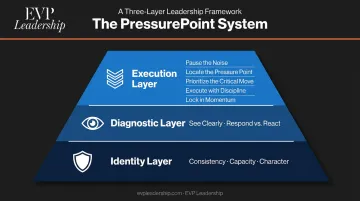
The PressurePoint System is built to address this directly. Each layer targets a different failure point:
- Identity Layer (consistency, capacity, character) — conditions the habits that show up automatically under pressure
- Diagnostic Layer — trains leaders to see clearly and respond rather than react
- Execution Layer — gives leaders a repeatable protocol: Pause the Noise → Locate the Pressure Point → Prioritize the Critical Move → Execute with Discipline → Lock in Momentum
Small, consistent habits practiced over time build the credibility that sustains influence through disruption. That requires honest, ongoing feedback — the kind most leaders don't naturally receive from their professional environment.
How Executive Coaching Develops the Influence Skills Leaders Need
Self-study can surface new techniques. Coaching accelerates something harder to get on your own: an honest account of how you actually come across.
Most leaders receive filtered feedback. Peers soften it. Direct reports avoid it. Senior leaders rarely have time for it. A skilled executive coach creates a confidential environment where real patterns — not polished self-perception — can surface.
What an Influence-Focused Coaching Engagement Looks Like
A structured engagement focused on influence development typically includes:
- Pinpointing specific communication patterns — where you hedge, over-explain, or lose the room — rather than offering general feedback
- Practicing framing and authority language in simulated scenarios before high-stakes conversations
- Debriefing real stakeholder interactions: what happened, what landed, what didn't
- Holding behavioral accountability between sessions, not just within them
That's the distinction EVP Leadership's 90-Day PressurePoint System is built around: conditioning these behaviors, not just teaching them. The goal isn't a leader who remembers to lead with the bottom line when they're calm. It's a leader whose default response under pressure is already the one they'd choose deliberately.
Getting the Most from Coaching
Leaders who gain the most from coaching tend to share three habits:
- Start with a specific goal. Not "become a better communicator" — something precise, like "stop burying my recommendations in context when I'm presenting to the CFO."
- Practice between sessions. Influence habits don't form in the coaching room; they form in the real conversations that follow.
- Treat coaching as a compounding investment. The leaders who advance fastest aren't starting from zero — they come in already performing and use coaching to build on that.
Frequently Asked Questions
What is the difference between influence and manipulation at work?
Influence is built on transparency, genuine value alignment, and understanding what the other person actually needs. Manipulation relies on deception or exploiting psychological vulnerabilities. Every strategy in this article is grounded in the former — building trust through clarity, not engineering agreement through pressure.
How long does it take to become more influential at work?
Small, consistent communication changes can produce noticeable responses within weeks; building a durable professional reputation takes months of honest practice. The leaders who shift fastest focus on one specific behavior change at a time, not a full-scale overhaul.
Can introverts become influential leaders?
Influence is not about personality type or volume. It's about clarity, consistency, and understanding your audience — and introverts frequently excel at all three once they have a practical framework. The leader who prepares thoroughly and frames ideas around stakeholder priorities consistently outpaces louder peers over time.
What communication habits make leaders more persuasive with senior stakeholders?
Lead with your bottom line before your evidence. Frame your ideas around the stakeholder's priorities and pressures, not the idea's internal merits. Replace hedging language with credibility anchors ("in my experience," "the data shows") — these shifts produce the most consistent results with executive audiences.
How does executive coaching help you become more influential at work?
Coaching gives leaders the honest feedback they rarely get from peers — a clear account of how they actually come across, not how they think they do. A skilled coach identifies communication blind spots, builds space for deliberate practice, and creates accountability structures that turn new behaviors into reliable defaults.
What is the most important first step for a leader who wants to build more influence?
Choose one specific communication shift — leading with a bottom-line statement in your next high-stakes meeting is the fastest to implement — and practice it deliberately before reverting to your default pattern. Small, practiced habits compound. Trying to change everything at once typically changes nothing.