Introduction
Leadership today demands more than experience or good judgment in calm conditions. The real test comes when the stakes are highest, the pressure is relentless, and certainty is gone. That's where most leaders find out whether their resilience holds — or was never really tested.
Resilience in leadership isn't the ability to be unaffected by hardship — it's the conditioned capacity to respond to it effectively. According to DDI's research, 71% of leaders report significantly higher stress since moving into their current role, and those experiencing burnout are 3.5x more likely to leave.
That's a performance problem — and it's preventable.
The 8 strategies below aren't personality traits reserved for a select few. They're buildable habits and frameworks any leader can develop through deliberate, consistent practice.
Key Takeaways:
- Resilience is conditioned capacity, not a fixed trait — any leader can build it
- These 8 strategies cover both internal dimensions (emotional, mental) and external ones (physical, social)
- Developing these habits before pressure peaks is what separates sustainable leaders from reactive ones
- Founders and executives face disproportionate pressure; resilience conditioning is a competitive edge
- Consistent small actions compound into durable, high-pressure performance over time
What Resilient Leadership Really Means
Resilient leadership is not simply bouncing back. It's the ability to absorb disruption, recover with clarity, and continue leading forward — while bringing your team along in the process. The leaders who do this consistently extract meaning from adversity and come out with sharper judgment.
The Center for Creative Leadership's CORE Framework identifies four interwoven dimensions that underpin leadership resilience:
- Physical — stamina and the capacity to sustain energy under prolonged pressure
- Mental — cognitive clarity, creativity, and the ability to think clearly when complexity spikes
- Emotional — the ability to recognize and regulate internal reactions, not suppress them
- Social — trust networks that provide honest challenge and genuine support
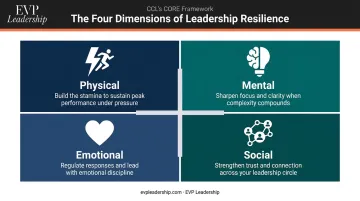
These dimensions don't operate independently — weakness in one erodes the others. A leader running on poor sleep loses emotional control faster; a leader without a trusted sounding board starts making riskier calls alone. The performance cost compounds fast.
The Deloitte 2024 workplace research found that at least 4 in 10 executives report feeling always or often exhausted or stressed. For executives leading small and mid-size businesses without large support structures, that number likely understates the reality. When resilience erodes at the top, execution, culture, and decision quality follow.
8 Strategies to Build Resilience in Leadership
1. Reframe Failure as Data, Not Defeat
Resilient leaders practice cognitive reappraisal — the habit of examining setbacks for useful information rather than treating them as verdicts on their capability. This doesn't happen automatically. It requires a deliberate pause before reacting, followed by a simple but powerful question: What does this tell me?
The goal is to separate outcomes from identity. A failed product launch is information about the market, the timing, or the execution — it is not evidence that the leader lacks ability.
Consider a founder whose new service offering underperforms in its first quarter. A reactive response is to second-guess the entire strategy or absorb the failure personally. A resilient response is to isolate the variables: Was the offer unclear? Did pricing miss the market? Was the team under-resourced? Each answer points toward a better next move.
McKinsey research on growth outperformers found that 83% of high-growth leaders actively encouraged testing new ideas, failing quickly, and learning from results — compared to significantly fewer among their lower-performing peers. Reframing failure is not a soft mindset habit. It's a competitive practice with measurable results.
2. Regulate Your Emotional Response Before It Regulates You
Emotional regulation is not emotional suppression. It's the ability to recognize what's happening internally — and create enough of a gap between trigger and response to choose how you react. Under pressure, that gap is the difference between a grounded decision and a reactive one.
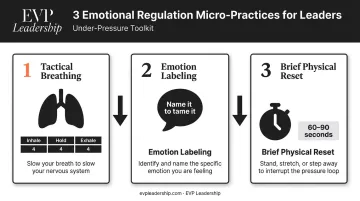
Three micro-practices leaders can use in the moment:
- Tactical breathing — a slow inhale for 4 counts, hold for 4, exhale for 4. Research supports its use in high-stress simulations to improve performance under pressure
- Emotion labeling — naming what you're feeling ("I'm frustrated," "I'm anxious") activates the prefrontal cortex and reduces emotional intensity
- Brief physical reset — stepping away for 60-90 seconds before a high-stakes conversation interrupts the stress loop and creates physiological space
EVP Leadership addresses this directly through the Execution Layer of the PressurePoint System — specifically the first step: Pause the Noise. Before locating the pressure point or prioritizing the critical move, leaders are conditioned to control the moment before it controls them. That pause isn't indecision. It's the foundation of every good decision that follows.
3. Build a Network That Provides Real Accountability
Resilience is not built alone. Leaders who have trusted peers, advisors, and mentors they can be genuinely honest with recover faster from setbacks and make better decisions under stress.
This is different from a professional network built for connection or visibility. An accountability network is built for honest challenge — people who will tell you what you need to hear, not what you want to hear.
A Stanford Graduate School of Business survey found that nearly two-thirds of CEOs did not receive coaching or leadership advice from outside consultants — and nearly 43% cited conflict management as their top personal development concern. Those two data points together reveal a significant gap: leaders who most need external perspective are often operating without it.
Ask yourself honestly:
- Is there someone in your circle who will challenge your thinking directly?
- Do you have peers who've navigated similar pressures and will speak plainly?
- When the pressure peaks, is there anyone you'd actually call?
If the answer is uncertain, that gap is worth closing. Building that network is itself a resilience strategy — one of the highest-leverage moves a leader can make.
4. Prioritize Physical Recovery to Sustain Mental Stamina
For leaders, physical health isn't a wellness side project — it's performance infrastructure. Treat it accordingly.
Sleep deprivation measurably impairs emotional intelligence, empathy, and constructive stress management — precisely the capacities most needed under pressure. A leader carrying chronic sleep debt is not just tired; they're cognitively compromised in the moments that require their sharpest judgment.
CCL's survey of more than 1,500 senior leaders found that 88% believed exercise clearly impacts their performance. The research backs this up — regular aerobic exercise improves working memory, cognitive flexibility, and stress recovery.
Every hour of sleep sacrificed for a late-night decision that could wait until morning is a performance trade-off, not a display of commitment. Leaders who deplete their physical reserves are less equipped to navigate complexity — and less able to model steadiness for their teams when conditions get difficult.
Physical recovery is part of the performance cycle. The leaders who sustain it longest are the ones who treat recovery as a discipline, not a reward.
5. Develop Decision-Making Protocols for High-Pressure Moments
Resilient leaders build their decision-making frameworks before a crisis arrives — so they're not designing their process in the middle of the storm.
McKinsey research found that managers spend 37% of their time on decisions, and 61% of that time is ineffective. Fast decision-makers were twice as likely to make high-quality decisions as slow ones. The differentiator wasn't intelligence — it was having a process.
For small and mid-size business leaders, this is especially critical. Many carry decisions alone, without the advisory layers that larger organizations provide. Without a protocol, high pressure defaults to reactive instinct, exhaustion-driven choices, or paralysis.
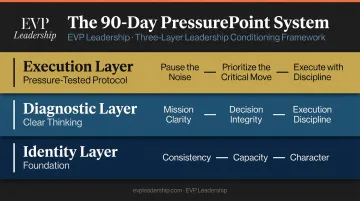
EVP Leadership's Execution Layer provides exactly this structure:
- Pause the Noise — control the moment before it controls you
- Locate the Pressure Point — identify where the situation is actually breaking down
- Prioritize the Critical Move — focus on what matters most right now, not everything
- Execute with Discipline — clean action without unnecessary complexity
- Lock in Momentum — turn action into sustained progress
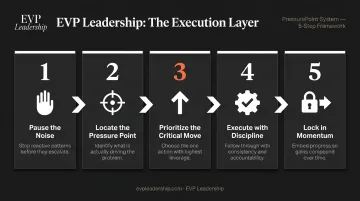
Having this protocol pre-decided means leaders enter high-stakes moments with a map, not a blank page.
6. Anchor Leadership in a Clear Purpose and Values
When disruption hits and clarity disappears, purpose is what keeps a leader oriented toward what actually matters. Leaders who cannot articulate their "why" are the most vulnerable when circumstances shift — because external chaos finds no internal anchor.
DDI's research found that purposeful leaders were 17x more likely to feel energized and 3x more likely to stay compared to those who lacked a strong sense of leadership purpose. Purpose isn't abstract — it has measurable operational effects.
Two practical steps to build and protect that anchor:
- Identify 2-3 core values that are non-negotiable under pressure. These aren't aspirational statements. They're behavioral commitments — how you will act when it would be easier not to.
- Audit alignment regularly. Especially during high-growth or high-stress periods, check whether daily decisions actually reflect those values or quietly drift from them.
Within EVP Leadership's PressurePoint System, this work sits in the Identity Layer under consistency — defined as acting in alignment with your values and expectations over time. Consistency isn't sameness. It's the predictable expression of who you are when pressure tests your character.
7. Practice Adaptive Thinking When Plans Break Down
Adaptive thinking is the habit of staying curious and solution-focused when circumstances change unexpectedly — rather than rigidly defending the original plan or catastrophizing about what went wrong.
Resilient leaders treat uncertainty as a problem-solving challenge, not a threat to their authority. When a plan fails, three reorienting questions shift thinking from loss to agency:
- What changed? — Identify the actual shift, not the emotional interpretation of it
- What do I still control? — Narrow focus to what's actionable right now
- What's the best next move with what I know now? — Commit to forward motion, not perfect information
This approach is directly supported by the PressurePoint Diagnostic Layer's Problem Intelligence component: identify and attack the real problem fast. Leaders who spend energy mourning a failed plan delay the moment they start solving the actual problem in front of them.
Adaptive thinking also operates at the team level. A study in Organizational Behavior and Human Decision Processes found that leader displays of curiosity increased follower psychological safety and encouraged employee voice. A leader's adaptive posture shapes how their entire team responds to uncertainty — not just how the leader navigates it personally.
8. Use Mindfulness and Recovery Practices to Reset Capacity
Mindfulness in a leadership context isn't meditation for its own sake. It's the deliberate practice of detaching from reactivity and returning to a grounded state — so that the next decision, conversation, or challenge starts from a clear baseline, not accumulated stress.
Brief, consistent recovery rituals — even 5-10 minutes of intentional quiet, structured breathing, or reflection — produce measurable improvements in attention, mood, and stress response over time. The key word is consistent. A single session doesn't condition anything. A daily practice does.
Recovery is not a reward for hard work. It is part of the performance cycle — and treating it as optional is itself a performance decision with consequences.
Leaders who don't build in intentional recovery accumulate stress debt. That debt doesn't stay invisible — it shows up as impaired judgment, shortened patience, reactive decisions, and the gradual erosion of presence that teams notice before leaders do.
The EVP Leadership approach addresses this through intentional operating rhythm design — specifically ensuring that high-output periods are balanced with structured recovery, not simply pushed through until something breaks.
Resilience Is Conditioning, Not a One-Time Fix
There's a distinction worth making clearly: training gives leaders information and frameworks. Conditioning builds the habits that hold when pressure peaks.
No serious athlete reads about technique mid-competition. They rely on what they've rehearsed until it becomes automatic. Leadership resilience works exactly the same way — it must be practiced before the crisis, not improvised during it.
This is the core thesis at EVP Leadership: leaders don't rise to expectations — they fall back on their conditioning.
What systematic resilience conditioning looks like in practice:
- Regular reflection rituals embedded in the weekly operating rhythm
- Accountability check-ins that keep habits active, not theoretical
- Pressure-tested decision protocols applied to real situations before they escalate
- Incremental habit-building over a defined time period — not a weekend workshop
EVP Leadership's 90-Day PressurePoint System is built around this conditioning principle. It works through three integrated layers: the Identity Layer (consistency, capacity, character), the Diagnostic Layer (six components for clear thinking and decisive action), and the Execution Layer (a pressure-tested decision protocol for critical moments). Together, these layers build the specific habits and frameworks leaders need to perform consistently — not just when conditions are favorable.
The leaders who build the most durable resilience treat it as an ongoing investment, not a crisis response. Small, consistent actions practiced over time create the compound effect that sustains leadership performance when the stakes are real.
Frequently Asked Questions
Frequently Asked Questions
How do you improve resilience as a leader?
Start by identifying which of the four dimensions — physical, mental, emotional, or social — is weakest, then build targeted habits in that area consistently. Small, repeated actions compound into durable resilience over time; trying to fix everything at once rarely sticks.
What are the 7 C's to build resilience?
The 7 C's framework covers Competence, Confidence, Connection, Character, Contribution, Coping, and Control. Several map directly to the strategies here: connection aligns with accountability networks, character with values anchoring, and coping with emotional regulation.
What is resilient leadership?
Resilient leadership is the ability to navigate adversity, recover with clarity, and keep leading effectively through uncertainty. It goes beyond bouncing back — it includes real growth and the capacity to stabilize a team when conditions deteriorate.
Can resilience in leadership be learned?
Yes. Resilience is a set of learnable behaviors that develop through consistent practice, structured coaching, and deliberate conditioning over time. EVP Leadership's methodology is built entirely on this premise.
How does a leader's resilience affect their team?
A resilient leader directly shapes team culture. Their ability to stay grounded under stress, communicate clearly, and model adaptive thinking creates psychological safety — and increases the team's collective capacity to perform through disruption rather than shut down during it.
What is the difference between resilience training and resilience conditioning?
Training delivers knowledge and frameworks. Conditioning builds the habits leaders can access automatically under pressure — the difference between knowing what to do and actually having it available in the moment when it counts most.