
Introduction
Most leaders know they should lead with purpose. They've read the books, attended the retreats, written out their "why." Then a revenue shortfall hits, a key employee walks out, or a board meeting goes sideways — and they fall back on reactive management, short-term fixes, and survival mode.
The gap between intention and execution is where most leadership development fails. Knowing your purpose doesn't automatically translate to leading from it when the pressure is real.
Purpose-driven leadership coaching is the structured process that closes that gap. It's not inspiration, and it's not a framework you study once and shelve. It's a repeatable, conditioned way of making values-aligned decisions — especially when the stakes are high and old patterns want to take over.
This guide covers what purpose-driven leadership coaching actually is, why the business case holds up under scrutiny, how to build it into practice, and what stands in the way — with direct guidance for small business owners and executives ready to lead differently.
Key Takeaways
- Purpose-driven leadership coaching turns a leader's core "why" into consistent daily behavior — not an occasional aspiration
- Research links purpose-driven leadership to measurably higher innovation, retention, and financial performance
- Core traits like visionary thinking, emotional intelligence, resilience, and authentic communication can all be built through structured coaching
- Implementation follows five pillars: purpose clarity, behavioral alignment, pressure conditioning, accountability, and cultural embedding
- Common challenges like purpose-vs.-profit tension, inauthenticity, and burnout are predictable — and solvable
What Is Purpose-Driven Leadership Coaching?
Purpose-driven leadership connects a leader's core values and "why" to every decision, communication, and team interaction. Task-driven management optimizes for short-term outputs. Purpose-driven leadership optimizes for both — results and the kind of organization those results are building.
Purpose-driven leadership coaching is the structured, guided process that makes that connection reliable. A coach helps a leader uncover their foundational "why," align their behaviors to it, and build the capacity to lead from that foundation under real-world pressure.
How It Differs from General Executive Coaching
Traditional executive coaching often targets skills gaps, career advancement, or specific performance problems. Purpose-driven coaching anchors the entire development process to the leader's identity and values. The result is behavioral change that holds under pressure — not just improved performance in low-stakes moments.
EVP Leadership frames this distinction precisely: their methodology isn't advice-based coaching — it's leadership conditioning. Their core thesis is that leaders don't rise to expectations under pressure; they fall back on their conditioning. That's why the work focuses on building conditioned responses, not transferring knowledge.
What "Leading from Purpose" Looks Like in Practice
Consider two leaders facing the same revenue shortfall:
- Task-driven leader: Immediately cuts headcount, freezes discretionary spending, and demands weekly reporting — without communicating why to the team or considering whether those cuts undermine long-term strategy
- Purpose-driven leader: Pauses before reacting, evaluates cuts against organizational mission, communicates transparently with the team about what's happening and why, and makes decisions aligned with what the company is actually building
Same crisis, same numbers. The difference shows up in team trust, retention, and whether the organization emerges stronger or fractured.
Coaching vs. Training vs. Consulting
| Approach | What It Does | What It Doesn't Do |
|---|---|---|
| Training | Transfers knowledge and skills | Conditions behavior under real pressure |
| Consulting | Delivers external solutions | Builds the leader's internal capacity |
| Coaching | Builds capacity through practice, reflection, and accountability over time | Provide quick answers or one-time fixes |
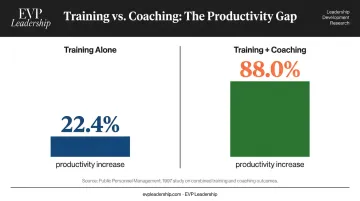
That middle column — what each approach doesn't do — is where most leadership development investments leak. A 1997 study published in Public Personnel Management found that training alone increased productivity by 22.4%, while training combined with executive coaching increased it by 88.0%. Coaching isn't a replacement for training — it's what makes training stick.
Why Purpose-Driven Leadership Coaching Matters for Business Results
Purpose isn't a soft concept. The data treats it as a hard business driver.
Research from the EY Beacon Institute and Harvard Business Review Analytic Services found that 53% of executives at companies with a strong sense of purpose reported success with innovation and transformation — compared with just 19% at companies where purpose was unclear or absent. The same report showed that purposeful companies were more than twice as likely to focus on continuous transformation.
McKinsey's research on workplace purpose surfaces a critical internal gap: 85% of executives say they're living their purpose at work, while only 15% of frontline employees say the same. That gap — between what leaders believe about their culture and what employees actually experience — is exactly what purpose-driven coaching is designed to close.
The Gap Coaching Actually Addresses
Most leaders understand that purpose matters. The problem isn't comprehension — it's execution under pressure.
When a growth target is missed or investor expectations mount, the leader who has only thought about their purpose reverts to reactive management. The leader who has been conditioned to lead from purpose can access that foundation even when the situation is chaotic.
Coaching closes this gap by providing:
- A daily framework for values-aligned decision-making
- External accountability that self-directed efforts can't replicate
- Real-world practice scenarios that build conditioned responses
Why This Matters Specifically for Small Business and Entrepreneurial Leaders
That execution gap hits founders and owner-operators especially hard. Unlike enterprise leaders who can rely on layers of process, small business executives carry the weight of strategic decisions personally — and purpose clarity is what keeps those decisions grounded.
When leaders know their "why," it shows up in the work:
- Faster calls on which opportunities to pursue — and which to decline
- Cleaner hiring decisions rooted in organizational fit, not urgency
- Clearer boundaries around growth that would compromise the business's identity
Scaling without that clarity doesn't just slow things down. It scales the dysfunction instead.
Core Traits of Purpose-Driven Leaders — and What Coaching Develops
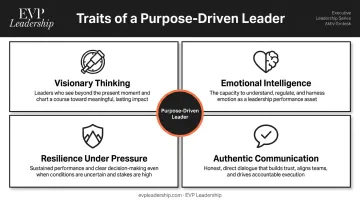
Purpose-driven leaders share four characteristics that consistently separate them from reactive managers. None of these are fixed personality traits. All of them are developable.
The Four Core Traits
- Visionary thinking: Connects daily decisions to the organization's long-term mission rather than optimizing solely for this week's metrics.
- Emotional intelligence: Manages self and team dynamics under pressure. A 2023 review of 104 peer-reviewed articles confirmed that emotionally intelligent leaders improve both individual behaviors and business results.
- Resilience under pressure: Maintains values-aligned behavior during setbacks, when reactive patterns are strongest. EVP Leadership's PressurePoint System builds this through the Identity Layer's "capacity" component — the ability to handle responsibility, complexity, pressure, and growth.
- Authentic communication: Generates trust, not just compliance. This is what closes the McKinsey purpose gap between what executives report experiencing and what frontline employees actually feel.
How Coaching Builds These Differently Than Self-Study
Self-study gives a leader a concept. Coaching builds a conditioned behavior.
Coaching uses real-time scenarios, iterative feedback, and accountability structures to turn each trait from something a leader understands into something they can reliably execute when it's hard. Three capabilities make that shift possible:
- Scenario practice: Replays pressure situations until the right response becomes instinctive
- Iterative feedback: Corrects pattern drift before it becomes default behavior
- Accountability structure: Closes the gap between stated intention and actual performance
EVP Leadership's framework builds each trait through the Identity Layer — consistency, capacity, and character — conditioning leaders to operate from their core even when pressure would otherwise trigger regression.
The Purpose-Driven Leadership Coaching Framework
Effective purpose-driven leadership coaching follows five interconnected pillars. Each builds on the one before it.
Pillar 1 — Clarify the "Why"
The foundational work begins with deep self-reflection: articulating core values, identifying the unique impact the leader wants to have, and connecting that "why" to the organization's mission. Without this clarity, skill-building has no anchor. Leaders can improve on paper while drifting further from what actually matters.
Pillar 2 — Align Values with Behaviors and Decisions
Knowing your values only matters if they show up in your behavior. This pillar converts a leader's stated purpose into observable, daily actions — how they communicate with their team, handle conflict, make strategic calls, and show up in difficult conversations. Intentions are easy. Behavior under pressure is where most leaders struggle.
Pillar 3 — Condition for Performance Under Pressure
Knowing your values isn't the same as being able to access them when a deal falls apart, a key employee quits unexpectedly, or a board conversation goes wrong. Purpose-driven leaders must be conditioned — not just informed — to respond from their values in those moments.
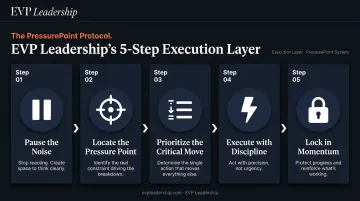
EVP Leadership's 90-Day PressurePoint System addresses exactly this. The Execution Layer walks leaders through a five-step protocol for high-stakes moments: Pause the Noise → Locate the Pressure Point → Prioritize the Critical Move → Execute with Discipline → Lock in Momentum. The first step — pausing before reacting — interrupts the automatic patterns that emerge under stress and creates the space needed to lead from values rather than adrenaline.
Pillar 4 — Build Accountability Structures
Sustainable purpose-driven leadership requires external accountability. Without it, most leaders gradually drift back toward reactive patterns — not because they've abandoned their "why," but because nothing keeps those commitments visible.
Effective coaching engagements build:
- Regular coaching touchpoints tied to specific behavioral commitments
- Measurable milestones that track progress on defined leadership behaviors
- Honest reflection on where behavior and stated purpose diverged — and why
Pillar 5 — Embed Purpose in Team Culture and Operations
A leader's "why" only creates organizational value when it moves beyond the leader's own decision-making into how the team operates. This final pillar extends purpose outward into how the leader communicates vision, what behaviors they recognize and reward, and how organizational systems — hiring, performance conversations, decision-making frameworks — align with the stated mission.
EVP Leadership's Diagnostic Layer supports this through components like Force Alignment (are the right people fully aligned and accountable?) and Mission Clarity (does the team know exactly what must be achieved and why?).
How to Implement Purpose-Driven Leadership Coaching
Step 1 — Start with a Leadership Assessment
Before coaching begins, identify the gap between current behaviors and purpose-driven ideals. A useful assessment surfaces blind spots (the patterns a leader can't see in themselves) and creates a baseline for measuring growth. EVP Leadership's complimentary scoping conversation starts this process, helping identify which challenges are most acute and which engagement structure fits.
Step 2 — Define Your Personal "Why" and Test It Against Real Decisions
Work through core values identification and translate those values into a leadership "why" statement. Then stress-test it: look back at the last ten significant business decisions you made. How many of them visibly reflect your stated values? The gaps reveal where stated purpose and actual behavior have diverged.
Step 3 — Build Consistent Daily Practices
Purpose-driven leadership is built through small, repeated behaviors — the daily habits that compound over time. That means:
- Opening team meetings with a reminder of mission context before discussing tasks
- Pausing before responding to difficult conversations (EVP's "Pause the Noise" step in practice)
- Reviewing decisions weekly against stated values — not just results
- Communicating honestly during uncertainty rather than offering false reassurance

Step 4 — Create Accountability Through Structured Coaching
Self-directed development stalls when pressure spikes. A structured coaching engagement keeps accountability intact when it matters most. When evaluating one, look for:
- A clear protocol and defined milestones, not an open-ended "let's talk" format
- Real-world practice scenarios, not purely theoretical discussion
- A coach who challenges rather than simply affirms
- A design for what happens after the engagement ends — the habits that persist
Common Challenges in Purpose-Driven Leadership Coaching
Challenge 1 — The Purpose-vs.-Profit Tension
Many entrepreneurs fear that focusing on "why" will come at the expense of financial performance. The data doesn't support that fear.
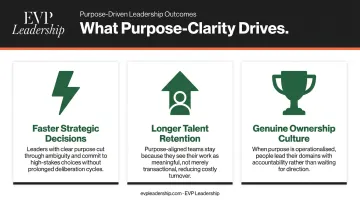
Research from Harvard Business School found that firms with both high purpose and high clarity had measurably higher future accounting and stock-market performance. Purpose isn't competing with profit — it drives sustainable profit. Leaders who know their "why" tend to:
- Make faster, more consistent strategic decisions
- Retain talent longer by creating genuine alignment
- Build teams with real ownership cultures, not just compliance
Challenge 2 — The Authenticity Gap
Stating a "why" without consistent behavior to back it up creates something worse than no stated purpose at all: cynicism. Teams that watch their leader articulate values and then consistently act against them stop believing in anything the leader says.
Coaching addresses this specifically by holding leaders accountable to their stated values in real situations, not just aspirational documents. EVP Leadership's Identity Layer captures this through "character" — defined as what determines how a leader uses their consistency and capacity. Character shows up under pressure, not in mission statements.
Challenge 3 — Burnout Among Mission-Driven Leaders
The leaders most driven by purpose are often most susceptible to burnout. Their sense of personal responsibility is high, their identity is fused with the organization's outcomes, and the boundary between "working" and "existing" becomes blurry.
Research on entrepreneurial burnout has found that emotional demands are central to this dynamic. EVP Leadership's Executive Burnout Recovery work addresses the underlying drivers — over-scope, weak operating rhythm, poor delegation, no recovery cadence — rather than just the symptoms. Recovering from burnout means rebuilding the operating structure around the leader, not just adjusting their mindset.
Frequently Asked Questions
What is purpose-driven leadership coaching?
It's a structured coaching process in which a leader works with a coach to uncover their core "why," align daily behaviors to it, and build the capacity to lead from their values consistently — particularly under pressure. Unlike training or consulting, it builds conditioned responses rather than delivering knowledge to be applied later.
What do the 70/30 and 80/20 rules mean in purpose-driven leadership coaching?
The 70/30 rule means the coachee speaks roughly 70% of the session while the coach listens, questions, and reflects — preventing advice-giving from crowding out discovery. The 80/20 principle directs about 80% of conversation toward desired outcomes and solutions, with only 20% on diagnosing the problem, a balance research links to stronger shifts in self-efficacy and goal pursuit.
What are the 5 P's of leadership in purpose-driven leadership coaching?
The five pillars are Personal Attributes, Position, Purpose, Process, and Product. In purpose-driven coaching, Purpose anchors the other four — how a leader shows up, uses their role, operates, and delivers results should all flow from their defined "why."
How is purpose-driven leadership coaching different from traditional executive coaching?
Traditional executive coaching typically targets skills gaps, performance problems, or career advancement without a values-centered foundation. Purpose-driven coaching anchors all development work to the leader's "why" and organizational mission — so growth is sustainable rather than situational.
How long does purpose-driven leadership coaching take to show results?
Structured 90-day programs like EVP Leadership's PressurePoint System are designed to produce measurable shifts in decision-making, communication, and leadership confidence within that window. Lasting behavior change typically requires sustained practice beyond initial engagement — the 90 days builds the conditioning; the months that follow embed it.