Introduction
Most leaders default to the same playbook under pressure: direct, decide, solve, repeat. It's efficient—until it isn't. When leaders monopolize every decision, team members stop contributing, creativity stalls, and the collective intelligence sitting right across the conference table goes untapped. Facilitative leadership exists to fix that pattern.
According to Gallup's Q12 meta-analysis—spanning 736 studies, 347 organizations, and more than 3.3 million employees—top-half engaged teams more than double their odds of business success compared to bottom-half teams.
Yet Gallup's 2026 report found only 20% of employees worldwide were engaged in 2025—an estimated $10 trillion in lost productivity. Leadership style is a direct driver of that gap.
This article covers what facilitative leadership actually is, how it differs from traditional approaches, what it looks like in practice, and practical steps for building it as a repeatable habit—not a one-time training exercise.
Key Takeaways
- Facilitative leadership guides group thinking rather than directing outcomes, shifting influence from control to enabling participation
- It builds psychological safety, team buy-in, and decision quality through inclusive participation
- Real-world leaders like Satya Nadella and Alan Mulally embedded facilitative practices through repeatable systems
- The style has genuine limitations—especially in crisis moments requiring fast, decisive action
- Lasting change comes from small behaviors practiced consistently, not from workshops
What Is Facilitative Leadership?
Facilitative leadership is a collaborative, process-oriented approach where the leader's primary role is to guide conversations, structure group thinking, and create conditions for others to contribute fully— not to direct outcomes or claim all the answers.
The Harvard Program on Negotiation defines it as empowering followers to make decisions, address conflict, and take responsibility for shared outcomes.
The McCormick Institute frames it as a reciprocal process — working with and through people rather than exercising power over them. That's the core distinction.
What It Isn't
Facilitative leadership is not the same as being passive, indecisive, or perpetually consensus-seeking. Facilitative leaders still provide direction and make decisions. What shifts is how they influence.
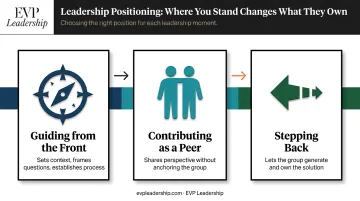
A skilled facilitative leader moves between three positions depending on what the moment requires:
- Guiding from the front — setting context, framing the question, establishing process
- Contributing as a peer — sharing their perspective without it becoming the default answer
- Stepping back — letting the group generate and own the solution
The Skills Involved
Facilitative leadership draws on specific, learnable competencies:
- Structuring group discussions productively
- Ensuring inclusive participation (not just the loudest voices)
- Managing conflict constructively rather than suppressing it
- Summarizing shared agreements and making decision ownership explicit
These are skills, not personality traits. Anyone in an organization—at any level—can develop and apply them in team settings, problem-solving sessions, or one-on-ones.
Key Characteristics of a Facilitative Leader
Asking Better Questions Instead of Giving Answers
The most visible shift in a facilitative leader's behavior is the move from statements to questions. Instead of "Here's what we should do," the facilitative leader opens with "What do we know so far?" or "What assumptions are we making here?"
Open-ended inquiry unlocks group thinking, surfaces assumptions the leader may not even know exist, and signals to the team that their analysis matters. Roger Schwarz's facilitative leadership framework explicitly emphasizes combining advocacy with inquiry and explaining reasoning and intent—so the group understands why questions are being asked, not just what's being asked.
The harder discipline is resisting the urge to fill silence with solutions. Most leaders reach the top by having answers—facilitative leadership asks them to hold the question long enough for the team to actually engage.
Holding Space for Ambiguity
Complex problems rarely resolve cleanly in the first discussion. Facilitative leaders resist the pull toward premature consensus—they keep teams in exploration mode longer, especially in high-stakes situations where the obvious answer is often the incomplete one.
This requires tolerating discomfort, because teams will push for resolution. Facilitative leaders hold that tension by testing assumptions, surfacing what hasn't been said, and asking what perspectives are missing from the room.
Withholding Judgment—Including Positive Judgment
Both criticism and praise steer group dynamics. When a leader responds enthusiastically to one idea, the group picks up the signal and gravitates toward it—often before other ideas have had a fair hearing.
Schwarz defines compassion in facilitative leadership as suspending judgment to appreciate others' perspectives while maintaining accountability. In practice, neutral facilitation looks like:
- Paraphrasing what was said without editorializing
- Asking for the reasoning behind an idea before reacting to it
- Creating space for other voices before the conversation closes
Active and Inclusive Listening
Research from Harvard Business School on leader inclusiveness defines it as words and deeds that invite and appreciate others' contributions. In practice, facilitative leaders:
- Track who has spoken and who hasn't
- Draw out quieter voices explicitly, not just by leaving space
- Prevent vocal individuals from dominating by structuring how input flows
- Clarify roles and process at the start of meetings so no one is waiting to figure out the rules
Building Group Capacity Over Time
Facilitative leaders don't just solve the problem in front of them—they help the team get better at solving problems together. This means building in debriefs, reflecting on how the group worked together (not just what they decided), and treating each meeting as a learning opportunity.
According to a PubMed-indexed meta-analysis, properly conducted debriefs can improve team performance by 20% to 25%. That's the long-term payoff of facilitative leadership: the group becomes more self-sufficient over time, not more dependent on the leader.
Benefits and Limitations of Facilitative Leadership
Advantages
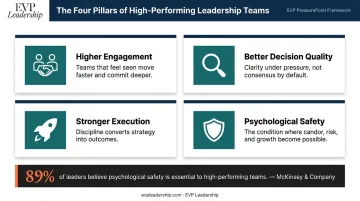
When applied well, facilitative leadership generates:
- Higher engagement — teams who feel genuinely heard show higher commitment, lower turnover, and greater willingness to take ownership
- Better decision quality — diverse input surfaces assumptions and risks that any single decision-maker would miss
- Stronger execution — people implement decisions they helped shape with more energy than decisions handed down from above
- Psychological safety — McKinsey reports that 89% of employees believe psychological safety is essential, yet only 43% of respondents in one survey reported a positive team climate
There's also a "go slow to go fast" dynamic worth understanding. Spending more time upfront building shared understanding and genuine buy-in reduces the friction, confusion, and half-hearted execution that follows top-down mandates. When people own the outcome, speed improves downstream.
Limitations and Challenges
Facilitative leadership is not always the right tool. Honest limitations include:
- Slow decision cycles — when every issue becomes a group conversation, organizations can lose speed and responsiveness
- Consensus quality risk — unstructured consensus can cause teams to converge too quickly, miss hidden assumptions, and produce compromise rather than quality
- Ineffective in crisis — urgent or high-stakes moments often require direct, decisive action, not structured dialogue
- Employee burden — pushing too many decisions onto the team can increase psychological stress and create confusion about accountability
The distinction between facilitative leadership and consensus leadership matters. Facilitating input is not the same as requiring agreement. Skilled leaders facilitate the discussion, clarify the trade-offs, and then decide—by an explicit rule, with clear ownership.
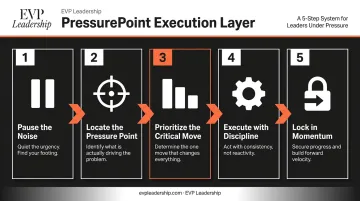
This is where crisis leadership frameworks earn their place. EVP Leadership's PressurePoint System includes an Execution Layer built for high-stakes moments when facilitated consensus would create dangerous delays. The protocol moves in sequence: Pause the Noise, Locate the Pressure Point, Prioritize the Critical Move, Execute with Discipline, Lock in Momentum. It's a structured alternative to both reactive panic and slow-moving group deliberation.
Facilitative Leadership Examples in Action
Satya Nadella at Microsoft
When Nadella became CEO, Fortune documents that he began with a listening tour—meeting managers, surfacing bottom-up concerns, and acting on what he heard before setting direction. Microsoft describes empathy under Nadella as a driver of innovation. The shift wasn't cosmetic; it changed what information reached the top and how decisions got made.
The result was repeatable input structures—not a single leader's intuition, but a process anyone could rely on.
Alan Mulally at Ford
Mulally's weekly Business Plan Review—documented in a McKinsey interview—is the stronger high-stakes example. During Ford's turnaround, Mulally created a recurring cross-functional process that made problems visible across the global leadership team before solutions were proposed. Problems were surfaced, not hidden. Leaders contributed context and expertise before direction was set.
That weekly operating rhythm—not leadership philosophy, but a structured process—is what separated facilitative intent from facilitative execution.
A Small Business Scenario
A business owner running a strategic planning session opens with: "What do we know about why clients aren't renewing?" rather than presenting their own diagnosis. They use structured discussion to surface team insights—identifying patterns no single person had seen—before landing on a direction. The team owns the analysis; the owner owns the decision—and the quality of both goes up.
Best Practices for Developing Facilitative Leadership
Start with One Behavior
Don't try to overhaul your entire leadership style. Pick one facilitative habit and practice it consistently before adding more.
A good starting point: in your next meeting, ask a question before offering an answer. One behavior, repeated under real conditions. This mirrors EVP Leadership's core conditioning philosophy: actionable change starts with small habits practiced consistently over time, not from one-time training events.
Clarify Your Role at the Start of Every Meeting
The group's tendency to wait for the leader's opinion before speaking is a default dynamic, not a fixed one. You can change it by naming your role explicitly:
"My role today is to guide the conversation, not to provide the answer. I want to hear your thinking first."
This one sentence shifts the room's expectations. It gives people permission to contribute before the leader signals a preferred direction.
Create Structured Space for All Voices
Inclusive participation doesn't happen by default. Practical techniques include:
- Round-robin input — each person shares before open discussion begins
- Anonymous idea submissions — collect written ideas before group discussion to reduce social pressure
- Direct invitations — call quieter team members by name: "Before we move on, I'd like to hear from [name]"
- Nominal Group Technique — structured brainstorming where everyone generates ideas independently, then the group discusses and prioritizes them
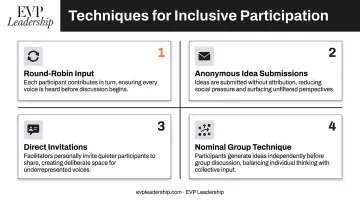
These approaches prevent the loudest voices from setting the frame and surface insights that would otherwise go unheard.
Build In Regular Reflection and Debrief
At the end of significant meetings or projects, ask the team to evaluate not just what was decided, but how they worked together. Questions like:
- What worked well about how we ran this discussion?
- Where did we rush to conclusions?
- Whose input did we underutilize?
Done consistently, this kind of debrief builds facilitative reflexes over time. EVP Leadership's work with executive teams — including Teri Evans's facilitation practice across healthcare, education, and nonprofit settings — is grounded in exactly this approach: repeated reflection in real conditions develops lasting leadership capacity, not just situational skill.
Frequently Asked Questions
What is the facilitative leadership theory?
Facilitative leadership theory holds that effectiveness comes from empowering others and guiding group process, not from top-down authority. Internal commitment produces better execution than compliance—so the leader's job is to create conditions where genuine commitment can form.
What are the 5 principles of facilitation?
The core principles typically cited are: active participation, inclusive process design, neutrality and non-judgment, structured dialogue, and shared ownership of outcomes. Together, they ensure all voices contribute and that decisions carry genuine buy-in—not just agreement in the room.
What is an example of facilitative leadership?
A leader opens a strategy session by asking the team to identify root causes of a problem before anyone proposes solutions. They guide a structured discussion, surface multiple perspectives, and help the group reach a shared decision—instead of arriving with a pre-set answer and steering the room toward it.
How is facilitative leadership different from traditional leadership?
Traditional leadership relies on authority and top-down decision-making; the leader sets direction and others execute. Facilitative leadership prioritizes group input and guides process instead of dictating outcomes. The leader shifts from being the source of answers to the architect of the conversation.
What are the limitations of facilitative leadership?
It can slow decision-making, risk producing consensus-driven compromises over higher-quality options, and is poorly suited to crisis or time-sensitive situations that require direct, decisive action. Overuse without clear decision rules creates confusion about who actually owns outcomes.
Can facilitative leadership work in high-pressure situations?
Facilitative leaders adjust their approach under pressure—using more directive interventions when speed and clarity matter most. The foundational habits of listening, asking good questions, and building team trust actually improve sustained performance under pressure, even when the immediate moment requires a more decisive hand.