What Is a Leadership Coaching Framework — And Why Most Leaders Skip It
Picture this: a key hire is underperforming, a team is missing targets, and the pressure is building. Most leaders respond the same way — they jump in, offer advice, fix the problem, and push harder. It feels decisive. It rarely works.
That reactive pattern is exactly where leadership development breaks down. Without a structured approach, coaching becomes ad hoc, inconsistent, and easy to skip when things get busy.
A leadership coaching framework changes that. It provides the repeatable structure that turns informal conversations into genuine development — for the leader doing the coaching and the people being coached.
That's the premise behind everything that follows: leaders don't rise to expectations — they fall back on their conditioning. A framework doesn't just improve a single coaching conversation. It's how consistent leadership behavior gets built over time.
Key Takeaways
- A leadership coaching framework provides structure for developing leaders systematically, not reactively.
- The 6 core principles shift leaders from advice-givers to growth-enablers — a fundamental change in how leadership gets practiced daily.
- Effective frameworks balance psychological safety with productive challenge.
- Best practices prioritize consistency and self-awareness over one-time interventions.
- The right framework matches your leadership context — because what works in a Fortune 500 enterprise rarely fits a founder-led business.
What Is a Leadership Coaching Framework?
A leadership coaching framework is a structured set of principles, steps, or models that guide how a leader facilitates growth in others — or how they themselves receive and apply coaching. It's not a script. It's a repeatable process that ensures consistency and intention in every leadership development conversation.
Three related terms often get confused:
| Term | What It Is |
|---|---|
| Coaching Framework | The overarching structure guiding how coaching is conducted and what principles drive it |
| Coaching Model | A specific approach used within a framework (e.g., GROW, OSKAR, CLEAR) |
| Coaching Style | The behavioral approach the coach brings to conversations — directive, facilitative, collaborative |
These are related but distinct. A framework is the structure; a model is one tool within it, and a style is how the coach shows up.
Why Small Business Owners and Executives Specifically Need This
According to an ICF/HCI report, 82% of organizations use managers and leaders as their primary coaching resource — yet 51% of those managers have fewer than 30 hours of informal training, and 22% have no training at all. Leaders are coaching constantly without realizing it. Giving that informal coaching a structure improves what it produces.
A 2023 workplace coaching meta-analysis found a moderate aggregate effect across organizational outcomes (g = 0.43), with skill-based outcomes reaching g = 0.72. For small business owners and executives coaching their teams without formal support, that gap in outcomes is almost entirely explained by missing structure — not missing effort.
Popular Leadership Coaching Framework Models
Several established models give leaders a starting point:
- GROW (Goal, Reality, Options, Will) — Best for goal-setting conversations and clear performance gaps where the path forward is relatively defined.
- OSKAR (Outcome, Scale, Know-how, Affirm, Review) — Suited for complex or stuck situations where a solution-focused lens helps unblock progress.
- CLEAR (Contract, Listen, Explore, Action, Review) — Built for trust-first environments where the coaching relationship itself needs careful attention before the work begins.
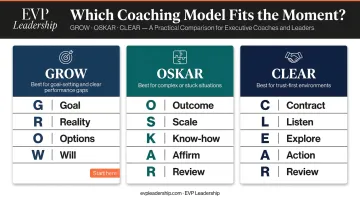
Each model offers useful scaffolding. A model gives you a sequence to follow. The 6 principles in the next section determine whether any model actually produces growth.
Some frameworks go further than models by addressing how leaders perform when pressure peaks. EVP Leadership's 90-Day PressurePoint System, for example, is designed for business leaders who need to perform consistently under sustained pressure. Conditioning-based frameworks like this go beyond one-time training: they build the habits that hold in critical moments, across 90 days of structured practice.
6 Core Principles of an Effective Leadership Coaching Framework
Principle 1 — Create Psychological Safety AND Productive Challenge
The most common mistake leaders make when coaching is choosing one over the other. Too much safety without challenge creates stagnation. Too much challenge without support erodes trust and shuts people down.
The balance looks like this in practice: maintain a nonjudgmental posture — no criticism of the person, no defensiveness about their answers — while still asking questions that stretch their thinking. Research supports both sides of this equation.
Edmondson's foundational study of 51 work teams found that psychological safety enables learning behavior, which drives team performance. Locke and Latham's 35-year goal-setting review found that specific, difficult goals consistently outperform "do your best" goals, with effect sizes ranging from d = 0.52 to 0.82.
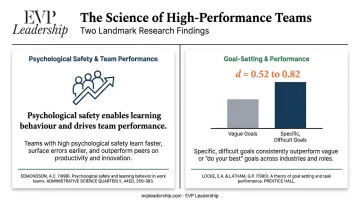
Safety creates the conditions. Challenge creates the growth. The leaders who hold both simultaneously are the ones people actually develop under.
Principle 2 — Work Within the Coachee's Agenda
The most effective coaching conversations are driven by what the person being coached wants to work on, not what the leader thinks they should fix.
This is the coaching vs. managing distinction in practice. Managing addresses what the business needs right now. Coaching develops what the person needs to grow. Both are legitimate — but conflating them in the same conversation confuses the purpose and undermines both.
When a leader shifts into coaching mode, the agenda belongs to the coachee. The ICF Core Competencies define this explicitly: effective coaching means partnering with the client to identify what they want to accomplish in the session, not what the leader has diagnosed as the problem.
There are times to be directive. But if a leader consistently owns the agenda, they're managing. Coaching requires giving that control back.
Principle 3 — Facilitate and Collaborate, Don't Lecture
For experienced leaders, this is the hardest shift. Expertise becomes a liability in a coaching conversation when it replaces the coachee's thinking with the coach's answers.
The tool that replaces advice is the right question. Active listening and open-ended inquiry do more to unlock a coachee's thinking than any answer a leader can hand them. Three questions worth keeping in your toolkit:
- "What's the real challenge here for you?"
- "What have you already tried, and what did you learn from it?"
- "What would need to be true for this to work?"
These questions don't give answers. They generate thinking. That's the point — a coaching conversation that produces the coachee's own insight will stick far longer than advice handed down from above.
Principle 4 — Advocate Self-Awareness (in Both Directions)
Effective coaching develops the coachee's awareness of their strengths and blind spots. But it also requires the leader-coach to understand how their own behavior, biases, and reactions shape the coaching relationship.
The gap here is substantial. Research by Tasha Eurich found that 95% of people believe they are self-aware, but only 10–15% meet the research definition. Self-aware leaders are more confident, make sounder decisions, and build stronger relationships — but getting there requires honest examination, not just intention.
For the leader-coach, this means asking: Am I listening, or waiting to talk? Am I challenged by this person's resistance, or curious about it? Am I coaching their agenda, or mine? That dual awareness is a prerequisite for developing others.
Principle 5 — Promote Learning From Experience
Self-awareness only becomes development when it's connected to real experience. The Center for Creative Leadership's 70-20-10 model attributes 70% of leadership development to challenging assignments, 20% to developmental relationships, and only 10% to formal coursework and training — which means most growth has already happened, or is happening right now, in the work itself.
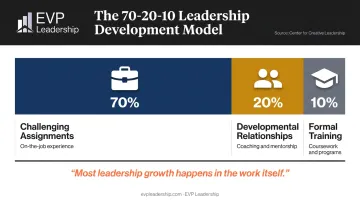
The coach's job is to help the coachee extract meaning from what they've already lived — not just prepare them for hypothetical futures. What did the difficult quarter teach you? What did you notice about your behavior during that conflict? What would you do differently next time?
This connects directly to EVP Leadership's core conviction: actionable change starts with small habits practiced consistently over time. The leader-coach who helps someone pull a lesson out of a real experience creates more durable development than any workshop could deliver.
Principle 6 — Model the Leadership You Coach
This is the most demanding principle and the most powerful. If a leader coaches on trust but doesn't demonstrate it, or coaches on presence while visibly distracted in every conversation, the coaching loses credibility faster than it gains it.
Walking the talk in practical terms means:
- Showing up prepared and on time for coaching conversations
- Acknowledging your own mistakes and development edges openly
- Following through on commitments made during coaching sessions
- Asking for feedback on your own leadership behavior
This isn't a one-time commitment. It's ongoing self-development that has to run parallel to the coaching work you do with others.
Best Practices for Applying a Leadership Coaching Framework
Start With Structure, Not Improvisation
The biggest reason leadership coaching fails in small businesses is that it happens ad hoc — reactive, inconsistent, agenda-less. Before adding nuance, establish a repeatable process:
- A consistent time and format for coaching conversations
- A clear opening (what are we working on today?) and closing (what's the commitment before we meet again?)
- A simple method for tracking what was discussed and what was committed to
Get the structure right first. Everything else builds on it.
Separate Coaching Conversations From Management Conversations
Mixing these roles in the same conversation confuses direct reports and weakens both. One practical signal that works: "I'd like to take a coaching approach to this — meaning I'm going to ask you questions more than give you answers. Is that okay?"
It signals intent, sets expectations, and invites buy-in — making the shift from manager to coach explicit rather than assumed.
Make Progress Measurable
Coaching conversations that feel good but produce no observable change are common. Avoiding that requires tying each coaching engagement to one or two specific, observable development outcomes with a defined review point.
Without clear answers to these questions, progress stays invisible — and invisible progress rarely gets sustained:
- What does success look like in 60 days?
- What behavior should be visible, and to whom?
- In what specific context should that behavior show up?
Condition, Don't Just Train
EVP Leadership draws a clear distinction: training gives leaders information. Conditioning builds the reflexes that hold under pressure.
Applying a coaching framework once, in a good quarter, when things are calm is training. Applying it consistently — across pressure, setbacks, and competing demands — is conditioning. That's what creates leaders who perform when it actually counts.
EVP Leadership's 90-Day PressurePoint System is built on this logic — conditioning leaders across Identity, Diagnostic, and Execution layers so that the behaviors being developed become automatic under real pressure, not just accessible in calm moments.
Involve Stakeholders at Key Points
Coaching doesn't happen in a vacuum. Colleagues, managers, and direct reports observe whether the behaviors being developed are actually showing up in practice. Leaders can create informal support loops by sharing one or two coaching goals with trusted people who can offer real-time feedback.
This doesn't require a formal 360 process. A simple ask — "I'm working on delegating more effectively. Would you flag it if you notice me taking things back?" — creates an accountability structure that extends the coaching into everyday work.
How to Choose the Right Leadership Coaching Framework for Your Business
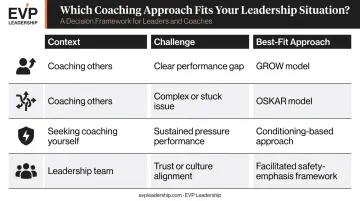
Framework selection comes down to two variables: the leader's context and the nature of the challenge. Getting this match right is what separates a coaching engagement that produces lasting change from one that produces good conversations.
| Context | Challenge | Best-Fit Approach |
|---|---|---|
| Coaching others | Clear performance gap or goal | GROW model within a structured framework |
| Coaching others | Complex, stuck, or systemic issue | OSKAR model within a structured framework |
| Seeking coaching yourself | Sustained performance under pressure | Conditioning-based approach (e.g., 90-Day PressurePoint System) |
| Leadership team development | Trust, alignment, or culture | Facilitated framework with psychological safety emphasis |
Red Flags That Signal You Need More Than a Model
A model alone isn't enough when you observe:
- Consistent lack of follow-through between sessions
- Leaders reverting to old behaviors under stress or in high-stakes moments
- Coaching conversations that feel productive but never reach root issues
- No visible behavior change after multiple sessions
These patterns signal that accountability needs to be built into the framework itself — not assumed.
A Simple Self-Assessment
Identify one high-stakes leadership challenge you're currently navigating. Then ask:
- Does my current development approach have structure — or is it improvised when time allows?
- Is it consistent, even during hard weeks when pressure is highest?
- Can I point to specific evidence of progress, or does improvement feel vague?
If any answer is no, that gap is exactly where a well-matched framework does its work.
Frequently Asked Questions
What is the best definition of leadership?
Leadership is the ongoing practice of influencing, developing, and guiding others toward meaningful goals. The most effective leaders treat it as a discipline conditioned over time — something earned through consistent practice, not inherited through title or personality.
What are 5 qualities of a good leader?
Self-awareness, the ability to challenge and support others simultaneously, clear communication, accountability, and the resilience to model consistent behavior under pressure. None of these are fixed traits. Each one is built through repeated exposure, honest feedback, and sustained conditioning over time.
What are the 4 types of leadership?
The four most recognized styles are directive, democratic, transformational, and servant leadership. Coaching frameworks can be adapted across all four — the principles remain consistent even as the style shifts.
What is the difference between leadership training and leadership coaching?
Training delivers knowledge or skills in a structured format. Coaching uses questions, reflection, and accountability to develop capacity from within. Durable results come when both work together as part of a sustained conditioning approach — not as one-off events.
What is a leadership coaching framework?
A leadership coaching framework is a structured set of principles and processes that guides how coaching conversations are conducted, how development goals are set, and how progress is tracked. It's the repeatable system that makes coaching consistent — not a single session or informal check-in.
How do I know if a leadership coaching framework is working?
Look for three things: the coachee is taking ownership of their development (not waiting to be told what to do), behavior change is visible in real work situations (not just in coaching conversations), and the quality and depth of coaching conversations improve over time.