Introduction
Many capable leaders hit a wall. Not because they lack intelligence or drive, but because their leadership is built on effort rather than infrastructure. They make decisions by gut feel, solve problems their teams could handle, push through exhaustion, and wonder why their performance is inconsistent when stakes are high.
The gap isn't talent — it's structure.
Sustainable leadership — in the context of running a business — isn't about carbon footprints or ESG frameworks. It's about building the systems, habits, and capacity to lead effectively through complexity and pressure, not just once, but consistently over time.
This post covers five concrete examples of what sustainable leadership looks like in practice — the observable behaviors and systems that allow small and mid-size business leaders to perform at a high level, repeatedly, without burning out in the process.
Key Takeaways
- Sustainable leadership is built on systems and conditioning, not willpower or heroic individual effort
- Decision-making frameworks, team independence, and energy management are core structural elements of leadership performance — not optional soft skills
- Only 13% of employees strongly agree their leaders communicate effectively — consistent messaging is a leadership system
- Conditioning outlasts training: small habits practiced consistently over time create durable performance
- Start with your highest-leverage gap, build one system at a time, and track results over 60–90 days
What Is Sustainable Leadership?
Sustainable leadership is a leadership approach built for the long game. It prioritizes consistency, adaptability, and systemic thinking over short-term wins or individual heroics.
For business owners and executives, it means building the capacity to lead effectively through growth, complexity, and pressure without hitting a wall — or handing off problems the organization should be solving itself.
What It Isn't
Two misconceptions come up constantly:
- Charisma gets conflated with sustainable leadership. It can open doors, but it doesn't create repeatable organizational performance.
- Working harder gets mistaken for the solution. Most leaders who struggle with sustainability are already overextended. The gap is structural, not motivational.
What distinguishes sustainable leaders is that they invest in their leadership infrastructure — the systems, habits, and capacity that make high performance repeatable regardless of circumstances.
That infrastructure is what gets tested under pressure. EVP Leadership's core thesis captures it directly: leaders don't rise to expectations under pressure — they fall back on their conditioning. The question isn't how inspired you are on a good day; it's how well you perform when conditions aren't ideal.
The five examples below show what that conditioning looks like in practice.
5 Examples of Sustainable Leadership in Practice
These aren't abstract principles. They're observable, learnable behaviors practiced by leaders who have built organizations that grow without requiring the leader to be everywhere at once.
Example 1: Building Decision-Making Systems That Hold Up Under Pressure
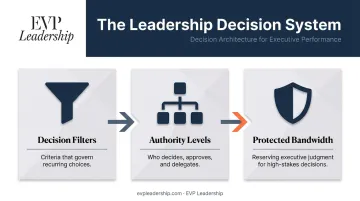
Sustainable leaders don't make high-stakes decisions on the fly. They operate from pre-established frameworks that clarify criteria, priorities, and tradeoffs before pressure hits.
In practice, this looks like:
- Documented decision filters — criteria that define how recurring choices get made
- Defined authority levels — clarity on who decides, who approves, and what can be delegated
- Protected bandwidth — reserving executive judgment for decisions that genuinely require it
The research supports the need for this structure. McKinsey reports executives spend roughly 40% of their time making decisions, and much of that time is viewed as poorly used. Without a decision system, leaders default to reactive, inconsistent choices that erode team trust and drain cognitive bandwidth.
Within EVP Leadership's PressurePoint System, this is addressed through the Decision Integrity diagnostic dimension — which assesses whether decisions are grounded in truth or distorted by noise and emotion.
When Decision Integrity is identified as a pressure point, the work focuses on conditioning leaders to maintain clear, fact-based decision-making even in high-pressure environments where reactive instinct or exhaustion can compromise judgment.
The practical payoff: faster decisions, greater team confidence, and a leader who isn't the bottleneck every time a fork in the road appears.
Example 2: Developing Teams That Can Operate Without the Leader Present
One of the most visible signs of unsustainable leadership is a team that grinds to a halt the moment the leader steps away.
Gallup's analysis of Inc. 500 CEOs found that CEOs with high delegator talent achieved an average three-year growth rate of 1,751% — 112 percentage points higher than those with limited delegator talent. The data isn't subtle: the leader's ability to build team independence is a direct growth multiplier.
What sustainable leaders build:
- Clear role definitions tied to outcomes, not just task lists
- Coaching conversations that develop independent problem-solving, not dependency
- Authority structures where decisions move down the organization by design
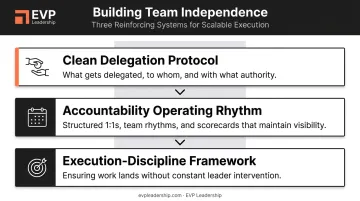
EVP Leadership's Delegation, Accountability & Operating Discipline work addresses this directly. The engagement delivers three reinforcing systems:
- A clean delegation protocol — defining what gets delegated, to whom, with what authority, and against what success criteria
- An accountability operating rhythm — structured 1:1 cadences, team rhythms, and scorecards that keep delegated work moving
- An execution-discipline framework drawn from the PressurePoint System to ensure work lands without constant leader intervention
The outcome: the leader gets time back, the team owns more responsibility, and decisions move down the organization. When growth accelerates or a difficult season hits, the organization continues to function — because the leader built a team capable of carrying it.
Example 3: Managing Leadership Energy, Not Just Time
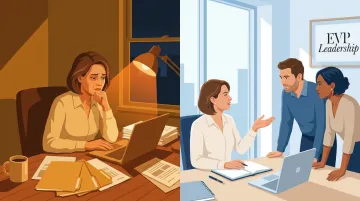
Time management is necessary but not sufficient. A calendar can be perfectly organized and a leader can still be running on empty.
Schwartz and McCarthy's foundational HBR research established that the core performance constraint for leaders isn't only time — it's energy across physical, emotional, mental, and relational domains. Sustainable leaders manage all four with the same discipline they apply to their schedules.
The pressure on small business owners is real. Ramsey Solutions' survey of 1,004 small business owners found 42% experienced burnout in the past year.
Energy management in practice looks like:
- Protecting genuine recovery time (not just "lighter" days)
- Identifying and reducing energy drains — unresolved conflicts, low-ROI obligations, unnecessary meetings
- Building routines that sustain composure and focus under sustained pressure
EVP Leadership's executive burnout recovery and resilience work treats this as a conditioning issue, not a symptom-management problem. The PressurePoint System's Identity Layer defines capacity as "the ability to handle responsibility, complexity, pressure, and growth" — and the work focuses on building and restoring that capacity deliberately.
Common underlying drivers the engagement addresses include over-scope, weak operating rhythm, poor delegation, no recovery cadence, and unclear priorities.
Leaders who neglect their energy eventually make worse decisions and create a tense culture around them. Leaders who manage capacity set the tone for a high-functioning, resilient team.
Example 4: Communicating with Clarity and Consistent Influence
Sustainable leaders earn influence not through charisma alone, but through consistently clear, aligned communication. People always know what the leader stands for, what the priorities are, and what's expected.
The current baseline tells the story of how rare this is: only 13% of employees strongly agree their organization's leadership communicates effectively. That gap costs organizations in execution speed, trust, and alignment.
What consistent communication looks like:
- A clear organizational narrative, repeated deliberately — not just stated once
- Priorities communicated explicitly and often, not assumed
- Style adjusted for different audiences without the core message shifting
Within the PressurePoint System, Mission Clarity — "Do we know exactly what must be achieved, and why it matters now?" — functions as the diagnostic foundation for this work. When mission clarity breaks down, communication becomes fragmented and the organization loses alignment. When it's strong, teams execute with confidence because direction is clear.
The failure mode this prevents matters at scale. Inconsistent communication — mixed signals, shifting priorities, or a leader who says one thing and does another — erodes organizational trust faster than almost anything else. Consistent messaging isn't a personality trait; it's a leadership system that can be built and maintained.
Example 5: Aligning Daily Operations to Long-Term Strategic Goals
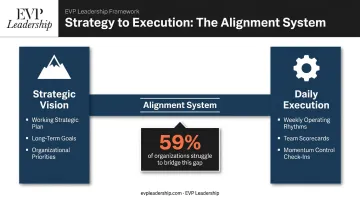
Many leaders can articulate a strong long-term vision. Far fewer have a working system that connects that vision to what happens in Monday's team meeting.
The gap is well-documented: research cited by Brightline found 59% of senior executives admit their organizations struggle to bridge the gap between strategy design and delivery, with organizations failing to meet an average of 20% of strategic objectives due to poor implementation.
What strategic alignment looks like in practice:
- A working strategic plan reviewed regularly — not filed and forgotten
- A prioritization system that filters incoming demands against long-term goals
- Team operating rhythms that keep strategy visible and actionable week to week
Gennifer Baker's C-level consulting work at EVP Leadership centers on this challenge — aligning day-to-day operations to long-term business goals so organizations are prepared not just to grow, but to adapt. The work involves operating-rhythm design, scorecards, and executive team alignment, building the operational links between strategic intent and daily execution.
The PressurePoint System's Momentum Control dimension reinforces this by asking: "Are we making measurable progress on what actually matters?" That question, asked consistently, is what keeps organizations pointed in the right direction even during rapid change.
Without this alignment, leaders and teams spend enormous energy on activity that doesn't compound toward goals that matter. The system corrects for that drift before it costs months of momentum.
Key Strategies for Building Sustainable Leadership Over Time
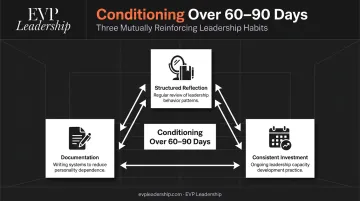
The five examples above share one common thread: they're all built through deliberate conditioning, not isolated training events.
EVP Leadership's core thesis — that leaders fall back on their conditioning, not their intentions — means this work can't be front-loaded into a single event. It's repeated, practiced, and measured over time.
Research on habit formation supports this directly: Lally et al. found the median time to reach automaticity for a new behavior was 66 days, with significant variation depending on behavior complexity. A 60–90 day conditioning window isn't arbitrary; it's the minimum viable timeline for meaningful change.
Three strategic habits that reinforce all five examples:
- Structured reflection — regular, honest review of leadership behavior, not just business results
- Documentation — writing systems and decisions down so leadership becomes less personality-dependent over time
- Consistent investment — treating leadership capacity development as ongoing, not a one-time event
Accountability accelerates all three. Leaders who track their own behaviors — or work with a coach who does — hold their consistency through disruption, growth phases, and organizational complexity. That structure is what separates conditioning from intention.
How to Develop Sustainable Leadership in Your Organization
Sustainable leadership is a practice, not a destination.
Start by auditing your current systems with honest answers to these questions:
- Where are decisions bottlenecked at the top?
- Where does team performance drop without your direct oversight?
- Where is your communication most inconsistent?
Those are your entry points. Once you know where the gaps are, work through them in sequence rather than all at once.
Build it in stages:
- Identify the area of greatest leverage — for most small business owners, it's decision-making or team independence
- Build one system at a time — attempting five simultaneous changes produces none
- Measure behavior change over 60–90 days before adding the next layer
- Repeat the cycle — each layer you lock in makes the next one easier to build
For leaders who want a guided framework, EVP Leadership's 90-Day PressurePoint System is a conditioning program designed for small and mid-size business owners. It works through the systems covered in this post — decision integrity, team independence, energy management, communication clarity, and strategic alignment — in a sequenced engagement built for leaders who need to grow without burning out in the process.
Conclusion
Sustainable leadership is built, not inherited. The leaders who perform consistently under pressure aren't the ones with the best circumstances — they're the ones who've built systems that hold when circumstances get hard.
The five examples in this post represent what that looks like in practice: decision-making frameworks that hold under pressure, teams capable of operating independently, energy managed as a resource, communication that earns trust, and daily operations anchored to long-term goals.
Here's a direct challenge: identify the one area from the five examples where your leadership is most fragile right now. Then commit to building one system in the next 90 days.
For leaders ready to act on that, EVP Leadership works with small business owners and executives through the 90-day PressurePoint System — a structured conditioning program built around decision integrity, execution discipline, and leadership capacity. Contact EVP Leadership to start the conversation.
Frequently Asked Questions
What is the meaning of sustainable leadership?
Sustainable leadership is the practice of building leadership capacity, systems, and habits that allow a leader and their organization to perform consistently over time, regardless of conditions. Unlike short-term, personality-driven leadership, it emphasizes repeatable processes and organizational health that don't depend on one person's energy or presence.
What are the 5 P's of sustainability?
The UN 2030 Agenda frames sustainable development around People, Planet, Prosperity, Peace, and Partnership. In business leadership contexts, a common adaptation substitutes Profit and Purpose — reorienting the framework around team well-being, financial health, long-term purpose, stakeholder trust, and collaborative growth.
What are the 5 C's of leadership?
There's no single universally accepted version. One well-cited framework — Jim Weese's 5C Leader model — includes Credibility, Contagious Enthusiasm, Compelling Vision, Charismatic Communication, and Culture Building.
How do you develop sustainable leadership?
Sustainable leadership is developed through deliberate conditioning: building decision-making systems, developing team independence, managing energy, and aligning daily actions to long-term goals — practiced consistently over time. A 60–90 day structured conditioning period is the minimum effective window for meaningful behavioral change; one-off training events rarely produce lasting results.
What is the difference between sustainable leadership and traditional leadership?
Traditional leadership often focuses on short-term results, individual performance, and reactive decision-making. Sustainable leadership prioritizes systemic thinking, repeatable processes, and long-term organizational health — building structures that function even when the leader isn't directly involved, rather than depending entirely on one person's presence, judgment, or energy.