Introduction
Picture this: it's 6 a.m. on a Tuesday and your operations director just texted that your largest supplier went dark overnight. No warning. By 8 a.m., your board wants answers, your team is looking to you for direction, and your biggest client is already calling.
Most executives have a crisis management plan sitting in a folder somewhere. Very few have conditioned themselves to actually execute it when their nervous system is in overdrive and every decision feels like it carries existential weight.
The distance between having a plan and being able to lead through one is exactly what crisis management coaching addresses. As EVP Leadership's guiding principle puts it: under pressure, leaders don't rise to expectations — they fall back on their conditioning.
This guide covers what crisis management coaching is, why executives face unique leadership challenges during crises, the five core principles it builds, and what the coaching process actually looks like in practice.
Key Takeaways
- Crisis management coaching builds conditioned responses — so executives perform under real pressure, not just on paper.
- Executives face compounded challenges: decision fatigue, stakeholder scrutiny, and emotional isolation that standard training doesn't address.
- Effective coaching develops five capacities: clarity, decisive action, communication, emotional resilience, and strategic foresight.
- Proactive coaching — before a crisis — is measurably more effective than reactive support after one begins.
- The right coach brings structured methodology and real business acumen, not just emotional support.
What Is Crisis Management Coaching for Executives?
Crisis management coaching is a personalized, structured process that builds an executive's capacity to lead effectively during high-stakes, high-pressure events. It's not general leadership coaching, and it's not traditional crisis management training.
Here's the critical distinction:
- Crisis management = reactive processes and plans (protocols, playbooks, communication trees)
- Crisis leadership = proactive, values-driven response executed in real time under pressure
- Crisis management coaching = the work that conditions a leader to execute their plan when conditions are at their worst
That last point matters more than most executives expect. Having a plan doesn't mean you can execute it when you're sleep-deprived, facing board pressure, and making calls with 40% of the information you'd want.
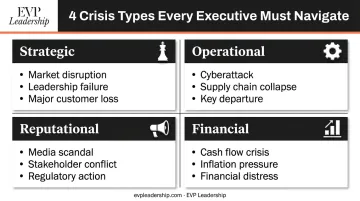
The Four Crisis Types Executives Encounter
| Crisis Type | Examples |
|---|---|
| Strategic | Market disruption, leadership failure, major customer loss |
| Operational | Cyberattack, supply chain collapse, key employee departure |
| Reputational | Media scandal, stakeholder conflict, regulatory action |
| Financial | Cash flow crisis, inflation pressure, financial distress |
Every one of these scenarios tests the leader, not just the plan. According to PwC's Global Crisis Survey, 69% of senior leaders had experienced at least one corporate crisis in the prior five years — which means crisis leadership isn't an edge case. It's a core executive competency.
Why Executives Face Unique Crisis Leadership Challenges
The executive's seat during a crisis is unlike any other position in an organization. Their decisions are reviewed in real time, their tone sets the mood across the entire organization, and their credibility is on the line with every public statement.
The Cognitive Burden Is Real
Executives must make high-stakes calls with incomplete information, under time pressure, while managing simultaneous demands from boards, employees, clients, and sometimes media. McKinsey research found executives spend nearly 40% of their time on decisions — and believe much of that time is poorly used. Add crisis pressure to that baseline, and decision quality degrades fast.
This is decision fatigue in practice. Peer-reviewed research defines it as impaired decision-making capacity that accumulates after repeated decision acts — reducing both the rate and quality of choices over time. The longer a crisis runs, the worse this gets without structured support.
Key pressures compounding that cognitive load:
- Simultaneous stakeholder demands (boards, employees, clients, media) with no natural pause
- Real-time scrutiny of every decision — with zero room for visible uncertainty
- No break from the decision queue, even when energy and judgment are depleted
The Isolation Problem
Most executives can't fully process their fear, doubt, or uncertainty with their own teams. They're expected to project calm while absorbing the brunt of the pressure.
Stanford GSB research found that roughly two-thirds of CEOs did not receive outside leadership advice, while nearly 100% said they enjoyed and valued receiving coaching and leadership input. The sounding-board role of a crisis coach is not a luxury — it fills a gap that most executives cannot fill internally.
The Small Business Owner Multiplier
For founders and owner-operators, the stakes are compounded. The business's survival is often tied directly to their personal finances and their identity. There's no corporate safety net, no enterprise communications team, no deep bench of senior leaders to absorb the pressure.
That gap shows up in three ways:
- No financial buffer — personal assets are often tied to business survival
- No communications infrastructure — there's no PR team drafting statements at midnight
- No leadership bench — the pressure has nowhere to distribute
NFIB's May 2025 data put the Small Business Uncertainty Index at 91, well above its historical average of 68, with 70% of owners reporting supply chain disruption. That's not a hypothetical pressure — it's the current operating environment.
Key Principles of Crisis Management Coaching for Executives
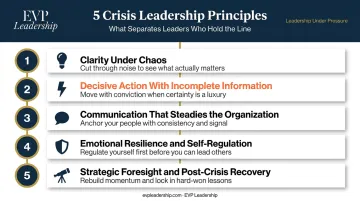
Principle 1 — Clarity Under Chaos
The first casualty in any crisis is clarity. Information is incomplete, noise is everywhere, and reactive instinct wants to take over.
Crisis coaching builds the capacity to cut through that noise quickly — using structured reflection exercises, scenario planning, and pre-mortem analysis to create what EVP Leadership calls Problem Intelligence: the ability to identify and attack the real problem fast, not the surface symptoms.
Principle 2 — Decisive Action With Incomplete Information
Waiting for certainty in a crisis is itself a decision — usually the wrong one. Effective crisis coaching trains executives to act on the best available information using structured decision thresholds.
Research on crisis decision-making describes this as bounded rationality: experienced leaders use situation assessment and pattern recognition rather than exhaustive option comparison. Through scenario rehearsal, coaching conditions these patterns deliberately — so the response becomes reflexive rather than effortful.
The practical mechanisms coaching uses to build this capacity include:
- Structured decision thresholds — pre-defined criteria for when to act despite uncertainty
- Scenario rehearsal — repeated simulation of high-stakes conditions to build pattern recognition
- Situation assessment frameworks — rapid triage tools that separate signal from noise
Principle 3 — Communication That Steadies the Organization
How an executive communicates during a crisis either preserves trust or erodes it — fast.
A study of 439 employees published in the Public Relations Review found that transparent internal communication is positively associated with organizational trust, with trust mediating employee openness to change. Crisis coaching develops an executive's ability to communicate with transparency, empathy, and authority — delivering consistent messaging that reduces uncertainty rather than amplifying it.
Employees won't stay aligned with a leader they don't trust. Coaching builds that trust through how a message is delivered under scrutiny — not just the words chosen.
Principle 4 — Emotional Resilience and Self-Regulation
Composure is not a personality trait. It's a trainable leadership behavior.
Peer-reviewed research confirms that emotion-regulation tendencies measurably affect leadership performance in high-stakes domains. A 2023 review of 104 studies reinforces this — emotional intelligence is consistently linked to leadership effectiveness and team functioning.
Coaching builds this capacity through the Identity Layer of EVP Leadership's PressurePoint System — specifically the capacity component: developing the ability to handle responsibility, complexity, and pressure at increasing levels without degrading performance.
Principle 5 — Strategic Foresight and Post-Crisis Recovery
The executives who come out stronger from a crisis don't just survive it — they learn from it systematically.
PwC's crisis research compared organizations that emerged stronger from their worst crisis against those that did not, and preparation and learning were the distinguishing factors. Great crisis coaching doesn't stop at managing the immediate event. It trains leaders to convert the experience into organizational learning, strategic recalibration, and systems that reduce the damage from the next disruption.
What Crisis Management Coaching Actually Looks Like in Practice
The Engagement Structure
EVP Leadership's crisis leadership engagements are intensive, on-demand, and confidential — typically delivered over a focused 30 to 90-day window. The engagement includes:
- High-frequency coaching contact — not monthly check-ins, but real-time access when decisions are live
- Real-time decision support — available in-person and virtually
- Leadership team alignment work — crisis leadership is a whole-system response, not just an individual performance
- Execution-discipline structure — using the PressurePoint System's Execution and Diagnostic Layers
For proactive conditioning, the 90-Day PressurePoint System builds the same crisis-ready habits before pressure arrives — scenario rehearsal, decision frameworks, and structured accountability that create reflexive leadership responses.
The Coaching vs. Training Distinction
The distinction that shapes every EVP Leadership engagement:
| Training | Conditioning | |
|---|---|---|
| What it does | Transfers knowledge | Builds behavior |
| Under pressure | You recall what to do | You respond without having to think |
EVP Leadership's framing is direct: most leaders haven't been conditioned to think clearly, stay focused in complexity, or execute with discipline when it matters most. They've been trained, but not prepared for real pressure.
Reading about swimming doesn't prepare you for open water. Scenario rehearsal, real-time feedback, and deliberate practice do.
What Clients Leave With
A structured crisis coaching engagement produces:
- A stronger decision-making framework that operates under pressure, not just in calm conditions
- Increased confidence and clarity in stakeholder communication
- A personalized crisis leadership protocol the executive can use and build on independently
- Restored emotional capacity and decision-making clarity
- Leadership team alignment that sustains beyond the immediate crisis
Leading Through Crisis: Before, During, and After
Proactive Preparation (Before a Crisis)
The best time to build crisis leadership capacity is before you need it. Athletes don't train for the first time on game day — and executives shouldn't either.
Proactive coaching builds decision-making frameworks, emotional resilience, and scenario-tested responses while the stakes are low enough to practice safely. Given that 69% of executives have experienced a crisis in the past five years, preparation is a probability-based discipline, not a precaution.
During the Crisis
During an active crisis, the coach's role shifts to real-time decision support — a structured thought partner who helps the executive apply the Execution Layer framework:
- Pause the Noise
- Locate the Pressure Point
- Prioritize the Critical Move
- Execute with Discipline
- Lock in Momentum
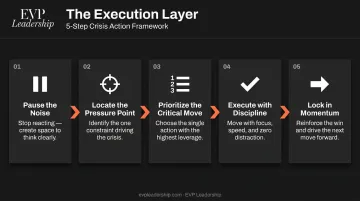
The coach also serves as an accountability anchor. That means helping the executive avoid reactive panic, course-correct communication in real time, and hold strategic perspective when the pressure to act emotionally is highest.
Post-Crisis Recovery and Learning
Post-crisis debriefing is one of the most neglected phases in leadership development. Done well, it turns a high-pressure event into a documented playbook for next time.
This phase captures what worked, what failed, what leadership behaviors held up under pressure and which ones didn't — and translates those lessons into updated protocols and organizational systems. A 2025 study analyzing 24 crisis management evaluations concluded that evaluations must lead to actionable recommendations that are actually implemented. The debrief is where the experience stops being a cost and starts building capacity.
How to Choose the Right Crisis Management Coach
What to Look For
- Verifiable C-level experience — the coach should have worked with executives under real organizational pressure, not just in classroom simulations
- Structured methodology — open-ended conversations have their place, but crisis coaching requires a framework that creates conditioned behavior, not just reflection
- Business strategy acumen — crisis leadership requires strategic thinking, not just emotional support. A coach without business depth will be underprepared for the operational, financial, and stakeholder complexity involved
- Conditioning philosophy — look for coaches who build behavioral capacity through deliberate practice, not those who deliver a playbook and move on
Those criteria aren't abstract. EVP Leadership's work with C-suite executives and small business owners is built on exactly this foundation — Gennifer Baker's 30+ years in business strategy informs every crisis engagement, ensuring clients get strategic depth alongside coaching support.
Red Flags to Watch For
- Generic programs with no customization to your industry or organizational context
- Coaches unfamiliar with business strategy, operations, or financial pressure
- Focus only on reactive crisis response with no proactive conditioning component
- No clear methodology — just supportive conversation
Questions to Ask a Potential Crisis Coach
- What structured framework do you use, and how is it adapted to my specific situation?
- How have you worked with executives in operationally complex or financially pressured situations?
- What does your crisis engagement look like — how often do we meet, and how do you provide real-time support during active events?
- How do you distinguish coaching from training, and what evidence do you have that your approach builds lasting behavioral change?
Frequently Asked Questions
What are the key principles of crisis management for executives?
The five core principles are: clarity under chaos, decisive action with incomplete information, transparent communication that preserves trust, emotional resilience and self-regulation, and strategic foresight that converts crises into organizational learning. All five are conditioned capabilities built through deliberate practice — not fixed personality traits.
What is the 70/30 rule in executive coaching?
The 70/30 rule refers to the coachee doing 70% of the talking and reflection while the coach facilitates 30%. This structure ensures executives build their own thinking capacity rather than becoming dependent on the coach's direction — critical for developing autonomous crisis leadership responses.
How is crisis management coaching different from crisis management training?
Training transfers knowledge and frameworks; coaching builds conditioned behavior through personalized practice, accountability, and real-time feedback. A trained leader has to recall what they learned. A conditioned leader responds instinctively — because under pressure, leaders fall back on conditioning, not on what they've read.
When should an executive seek crisis management coaching?
The ideal time is before a crisis — when skills can be built without live pressure. That said, coaching is also valuable during an active crisis for real-time decision support, and in the recovery phase for structured post-crisis learning and protocol development.
How long does crisis management coaching for executives typically take?
It depends on the goal. Proactive programs like the 90-Day PressurePoint System run three months; active crisis engagements typically run 30 to 90 days with high-frequency contact. The right structure depends on whether you're building capacity before a crisis or managing one now.
What skills does crisis management coaching build in executives?
Decision-making under uncertainty, stakeholder communication under scrutiny, emotional regulation and composure, strategic foresight, post-crisis learning, and the ability to lead teams with clarity and calm when information is incomplete and stakes are high.