Introduction
Executives and small business owners make hundreds of decisions weekly — and the quality of those decisions, not simply the volume of effort, determines whether a business scales or stalls. According to McKinsey research, 61% of executives say at least half of their decision-making time is ineffective. That's not a time management problem — it's a process one.
Most leaders operating in high-pressure environments default to instinct — not because they've chosen to, but because nobody conditioned them to do anything else. When the pressure rises, they fall back on untrained patterns: reactive, inconsistent, and increasingly costly as the business grows.
Decision-making is a core leadership skill, yet most development programs treat it as something leaders absorb through experience rather than build through deliberate practice. The cost of that assumption compounds over time. What follows is a practical look at how executive coaching sharpens decision-making — the mechanisms, the outcomes, and what stays broken when leaders never develop a structured process.
Key Takeaways
- Executive coaching builds conditioned decision-making reflexes, not just better tools or frameworks
- Poor habits — including cognitive bias and fear-driven avoidance — are learnable patterns that structured coaching can replace
- The real value appears in operational metrics: faster execution, fewer reversals, stronger team alignment
- Conditioning deepens through consistent engagement — single interventions don't build durable habits
- Leaders who build repeatable decision frameworks can delegate with confidence and scale without becoming the bottleneck
What Is Executive Coaching for Decision-Making?
Executive coaching is a personalized, structured process where a coach works one-on-one with a leader to surface limiting thought patterns, build stronger frameworks, and develop repeatable decision-making habits. The purpose is to build a leader's capacity to find better answers — consistently, and independently.
This type of coaching applies most directly to leaders who face high-stakes, time-sensitive, or complex decisions on a regular basis:
- Founder-CEOs managing growth and the transition from operator to strategic leader
- Owner-operators navigating resource constraints and delegation breakdowns
- C-suite executives aligning teams around competing priorities in fast-moving conditions
- Small and mid-size business owners whose decision-making process is the operational bottleneck
The end goal is not a leader who attends coaching sessions. It's a leader who makes faster, clearer, more consistently sound decisions whether a coach is present or not.
EVP Leadership's PressurePoint System frames this precisely: the 90-day engagement is designed to produce "a sustainable approach you can continue beyond coaching." The conditioning itself is what carries forward — the relationship with the coach is just the vehicle.
Decision Integrity as a Diagnostic Starting Point
EVP Leadership's Diagnostic Layer includes Decision Integrity as one of six core components, defined by a single question: Are decisions grounded in truth — or distorted by noise and emotion?
That framing matters. It positions decision-making coaching not as skill acquisition but as pattern correction — identifying where a leader's judgment is being distorted, and conditioning a cleaner process to replace it.
Key Advantages of Executive Coaching on Decision-Making
The advantages below are grounded in observable, measurable outcomes — not abstract benefits like "becoming more strategic." Each one connects to how decisions actually get made: under pressure, with incomplete information, and with real consequences.
Advantage 1: Structured Clarity Under Pressure
Reactive decision-making under pressure carries a steep organizational cost. McKinsey estimates that inefficient decision-making costs a typical Fortune 500 company approximately $250 million annually in wasted management time — roughly 530,000 manager days. For smaller businesses, the cost isn't measured in those numbers, but the pattern is identical: delayed decisions, rework, team confusion, and execution failures that compound over time.
Executive coaching addresses this directly. Through structured scenario work, reflective questioning, and accountability check-ins, coaches train leaders to replace ad hoc responses with a deliberate process — pause, clarify the actual decision being made, assess options, and commit. Over time, that sequence stops being effortful and becomes conditioned.
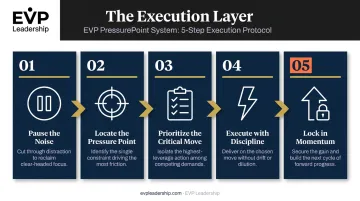
EVP Leadership's Execution Layer builds exactly this:
- Pause the Noise — control the moment before it controls you
- Locate the Pressure Point — identify where the situation is actually breaking down
- Prioritize the Critical Move: what matters most right now, not everything at once
- Execute with Discipline: clean action, without excess complexity
- Lock in Momentum — turn action into sustained progress
The result isn't just faster decisions. It's cleaner decisions that stick — reducing the cycle time between identifying a problem and taking coordinated action.
KPIs most affected: decision cycle time, execution speed, rate of decision reversals, team alignment scores
When it matters most: high-growth phases, crisis response, rapid market shifts, and any period where a leader is managing multiple competing priorities simultaneously
Advantage 2: Emotional Intelligence and Bias Reduction
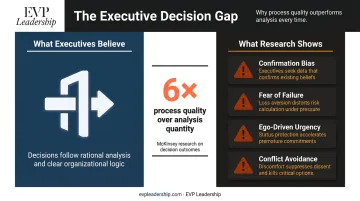
Most executives believe their decisions are rational. McKinsey's behavioral strategy research tells a different story: decision process quality is 6 times more important than analysis quantity in explaining decision outcomes, and only 28% of executives rate their company's strategic decisions as generally good.
The gap isn't information. It's the emotional and cognitive patterns — confirmation bias, fear of failure, ego-driven urgency, avoidance of conflict — that distort what leaders believe are rational calls.
Executive coaching surfaces these patterns through structured self-awareness work and guided reflection on past decisions. When a leader traces a poor outcome back to the thought pattern that drove it, something shifts. That retrospective work becomes predictive — a leader who has caught themselves avoiding a difficult personnel decision once is better equipped to catch it the second time.
The organizational stakes are real. Research on authentic leadership behaviors found that relational transparency and balanced processing significantly predict employee engagement — meaning the way a leader decides, not just what they decide, affects whether teams follow through.
When a leader's judgment is visibly distorted by ego or anxiety, teams sense the inconsistency even when they cannot name it. Trust erodes. Execution follows.
EVP Leadership's Identity Layer addresses this at the root. Emotional capacity — the ability to handle responsibility, complexity, and pressure — is treated as a trainable capability, not a fixed trait. Building that capacity means leaders develop the self-regulation to check their emotional state before committing to a high-stakes call, rather than discovering the distortion in hindsight.
KPIs most affected: quality of decisions over time, team trust indicators, rate of escalated conflicts resulting from leadership decisions
When it matters most: personnel decisions, major financial commitments, high-conflict situations, and any decision where a leader's personal stake in the outcome is high
Advantage 3: Consistent, Repeatable Decision Frameworks That Scale
A leader who makes decisions inconsistently — even good decisions — creates organizational unpredictability. Teams cannot anticipate what criteria matter, how options will be weighed, or when to escalate. The result is hesitation, redundant escalations, and a bottleneck that lives entirely in one person's judgment.
Research on leader behavioral integrity found that consistency between stated values and actual behavior correlated with coworker support at r = 0.55 and performance at r = 0.27. Consistency isn't just a soft leadership virtue — it's a performance variable.
Executive coaching builds a personal decision-making system over time. Not a rigid formula, but a reliable process for how a leader gathers input, weighs options, assesses risk, and commits — one that works across different decision types and can be modeled by direct reports.
This matters differently for different leaders:
- Founders and owner-operators who have historically been the sole decision-maker often have no documented process at all. The system lives in their head, which caps the organization's ability to scale. EVP Leadership's Delegation, Accountability & Operating Discipline work specifically targets this pattern — delivering "a clean delegation protocol that defines what gets delegated, to whom, with what authority, against what accountability."
- Scaling executives hit an inflection point where informal control fractures under growth. HBR's research on fast-growing companies describes this as a decision-making breaking point where structured empowerment becomes a survival requirement.
The PressurePoint System's three-layer architecture — Identity, Diagnostic, Execution — builds this personalized framework over a 90-day engagement. The outcome is a decision-making process aligned to the leader's values and organizational context, not a generic framework pulled from a book.
KPIs most affected: leadership consistency ratings, team autonomy and delegation success, bottleneck reduction, time-to-decision across the organization
When it matters most: scaling businesses, leadership transitions, building second-tier management, and organizations where the founder has historically been the sole decision-maker
What Happens When Executive Decision-Making Is Left Uncoached
Without structured development, decision-making patterns don't stay neutral — they calcify. Instinct becomes habit. Habit under pressure becomes the organization's default operating mode.
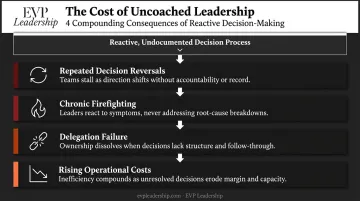
The compounding consequences are predictable:
- Repeated decision reversals that drain team energy and create execution confusion
- Chronic firefighting that keeps leaders in tactical mode and out of strategic leadership
- Delegation failure because the decision-making process lives entirely in one person's head and cannot be transferred
- Rising operational costs from delayed decisions, missed opportunities, and downstream rework following poor calls made under pressure
EVP Leadership observes this pattern consistently across leaders who arrive without prior structured development: communication breakdowns, lack of accountability, low ownership culture, inconsistent performance, and burnout at the top. These aren't separate problems — they're downstream effects of a reactive, undocumented decision-making process.
External research confirms how widespread this is. Bain's Founder Mentality research found that 85% of executives identify internal obstacles as the primary barriers to growth — not market conditions, not competition. The bottleneck is internal. And in small and mid-size businesses, the most common internal bottleneck is a leader whose decision-making process cannot scale beyond themselves.
Most leaders who struggle with decision-making aren't lacking information or capability. They're falling back on untrained, unexamined patterns under pressure — patterns that have never been examined, let alone conditioned. Without deliberate conditioning, those patterns don't self-correct. They compound.
How to Get the Most from Executive Coaching for Decision-Making
Coaching delivers the most measurable improvement when leaders enter the process with a specific decision context in mind — not a generic self-improvement goal. Leaders who bring real, current business decisions to their coaching sessions close the gap between insight and application faster than those treating it as reflective development work.
Three conditions determine whether coaching compounds in value:
- Consistent engagement over a defined period — not sporadic, low-frequency sessions that allow patterns to reset between conversations
- Regular review of decisions made between sessions — using real-world outcomes as coaching material rather than hypothetical scenarios
- A commitment to acting on what surfaces — insight that isn't applied doesn't change behavior
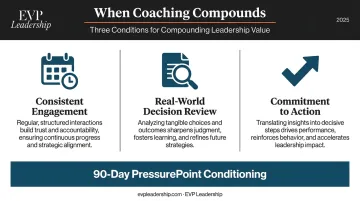
EVP Leadership's 90-Day PressurePoint System is structured around this principle. Conditioning requires repetition over a focused time period — 90 days of consistent, structured work builds reflexes that open-ended, low-frequency development cannot.
That repetition produces a specific outcome: a leader who has internalized a decision-making process that holds up under pressure without external support. EVP Leadership describes this explicitly as "a sustainable approach you can continue beyond coaching" — the conditioning is designed to outlast the engagement.
For leaders navigating high-stakes decisions with inconsistent results, the practical starting point is examining whether their current decision-making patterns were ever deliberately built — or simply formed under pressure without a framework to hold them.
Conclusion
Decision-making is a conditioned skill — not an innate trait. Leaders who train it systematically through structured coaching and honest accountability get measurably different results: faster decisions, cleaner execution, stronger team alignment, and the organizational capacity to scale beyond one person's judgment. Those who leave it unaddressed face the opposite — bottlenecked operations, execution confusion, and teams that can't plan with confidence.
Done right, executive coaching builds leadership that holds under pressure because the decision-making process has been conditioned, not just discussed. For founders, CEOs, and executive teams navigating complex decisions with inconsistent results, a structured 90-day conditioning engagement is where that change starts.
Frequently Asked Questions
What system do executives use for strategic decision-making?
High-performing executives use a structured framework: clarify the actual problem, assess options against long-term goals, evaluate risk, and commit with clear accountability. Executive coaching helps leaders build and internalize a version of this system suited to their specific context — not a generic model that ignores their values or operating environment.
How does executive coaching improve decision-making skills?
Coaching improves decision-making by surfacing the thought patterns, emotional triggers, and cognitive biases that distort judgment under pressure — and then replacing them with deliberate, practiced processes through real-world application and structured accountability. The mechanism is behavioral conditioning, not just awareness building.
What is the difference between executive coaching and leadership coaching?
Executive coaching is designed specifically for senior leaders facing high-stakes strategic challenges — including decision-making under pressure, organizational influence, and performance in complex environments. Leadership coaching can apply to professionals at any level who are building foundational leadership capabilities, and tends to be less focused on the pressure-specific contexts that define executive decision-making.
How long does it take to see results from executive coaching?
Meaningful improvements typically become visible within a focused 90-day engagement when coaching is consistent and applied to real decisions — not hypothetical scenarios. The habits built during that period compound significantly in the months that follow.
Can executive coaching help with decisions made under pressure?
Pressure-specific decision-making is one of the areas where coaching has the clearest impact. It builds conditioned responses — not just theoretical frameworks — so that when leaders face high-stakes moments, they fall back on practiced process rather than reactive instinct.
What are the signs that a leader needs help with decision-making?
Key indicators include frequent decision reversals, chronic firefighting instead of strategic leadership, difficulty delegating, team confusion around priorities, and a pattern of decisions that are sound in isolation but inconsistent in execution. These behaviors signal a reactive, undocumented process — one that only gets worse as the business grows.