That's the gap executive coaching models are designed to close. They give leaders and coaches a shared framework for moving from confusion to clarity, from awareness to committed action. And the right model makes a meaningful difference — not just in what a leader knows, but in how they behave when it counts.
This article breaks down five of the most effective executive coaching models in use today, how to apply them, and how to choose the right one for your specific challenge.
Key Takeaways
- Executive coaching models give coaching a defined structure — moving leaders toward specific outcomes rather than open-ended conversation.
- The five most effective models for leaders are GROW, CLEAR, OSKAR, STEPPA, and Action-Centered Leadership (ACL).
- Each model addresses a distinct leadership challenge: goal clarity, behavioral change, problem fixation, emotional barriers, or team performance.
- Experienced coaches blend models based on real-time needs rather than rigidly applying one approach.
- Knowing a model isn't enough; lasting change demands consistent practice, feedback, and real accountability.
What Is an Executive Coaching Model (and Why Leaders Need One)
An executive coaching model is a structured framework that gives both coach and leader a clear process for moving from the current state to a desired outcome. Without that structure, coaching sessions can drift — producing good conversation but limited behavioral change.
This is where executive coaching differs fundamentally from leadership training. Training is typically generic and knowledge-based: here's what good leaders do. Coaching is personalized, future-focused, and behavioral: here's what you specifically need to do differently, and here's how we'll track it.
The distinction matters for results. A 2023 meta-analysis of executive coaching studies found that coaching produced stronger effects on observable behavioral outcomes than on attitudes or personal characteristics — which means structured coaching, applied consistently, actually changes how leaders act under pressure, not just how they think about leadership.
The coaching industry reflects this growing demand. According to the ICF's 2025 Global Coaching Study, the field now generates $5.34 billion USD in annual revenue with nearly 123,000 coach practitioners worldwide — a 17% revenue increase since the prior study period. That growth is inseparable from a broader shift toward structured, model-driven engagements that produce measurable behavioral change.
The five models below represent the most widely used frameworks in executive coaching. Knowing multiple models allows leaders and coaches to match the right approach to the right challenge — a practical advantage that shapes the quality of every engagement.
5 Executive Coaching Models for Leaders
The GROW Model
Developed by Sir John Whitmore, Alan Fine, and Graham Alexander in the late 1980s, GROW is one of the most widely used executive coaching frameworks in the world. Its four stages are straightforward:
| Stage | Question It Answers |
|---|---|
| Goal | What do you want to achieve? |
| Reality | Where are you now relative to that goal? |
| Options | What could you do to close the gap? |
| Will / Way Forward | What will you commit to, and by when? |
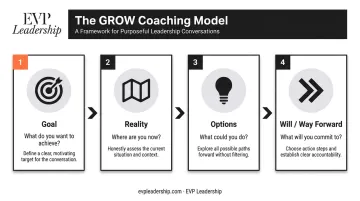
The model's power is in its sequence. Leaders often skip directly from goal to action without honestly assessing their current reality or exploring all available options. GROW forces that discipline.
Best for: Leaders who need clarity on a specific goal, are stuck between where they are and where they want to be, or need a structured frame for performance improvement conversations.
Why it works for small business owners: GROW is simple enough to apply independently between coaching sessions. That repeatability supports consistent habit formation — the kind that produces lasting change, not just insight. At EVP Leadership, that distinction between knowing and conditioning sits at the core of how the firm approaches leadership development.
The CLEAR Model
Developed by Peter Hawkins in the mid-1980s, CLEAR was designed for multi-session engagements aimed at transformational change — not just short-term goal-setting. The five stages are:
- Contract — Define shared outcomes and mutual expectations upfront
- Listen — Deeply understand the leader's experience, not just their stated problem
- Explore — Challenge assumptions and examine the situation from new angles
- Action — Identify concrete steps with clear ownership
- Review — Measure what's working and recalibrate the engagement based on results
What separates CLEAR from other models is where it places emphasis. Contracting at the start ensures both coach and leader are aligned on what success looks like. Review at the end creates structured accountability that survives beyond any single session.
Best for: Senior executives and C-suite leaders navigating organizational change, leadership transitions, or complex team dynamics — particularly those working within a sustained coaching engagement where deep behavioral shifts are the goal, not tactical adjustments.
The OSKAR Model
Developed by Paul Z. Jackson and Mark McKergow around 2000, OSKAR is a solution-focused model that deliberately redirects leaders away from problem diagnosis and toward actionable progress. The five stages:
- Outcome — What does the desired future look like?
- Scaling — On a 1–10 scale, where are you now relative to that outcome?
- Know-how and Resources — What's already working that can be built on?
- Affirm and Action — Acknowledge strengths, then define the next concrete step
- Review — Track movement against the scale score and adjust the plan
The Scaling step is particularly useful in practice. Asking a leader to place themselves on a 1–10 scale creates an immediate, measurable baseline — it moves the conversation from vague frustration to specific, quantifiable progress.
Best for: Leaders who tend to over-analyze problems, get stuck in blame cycles, or repeatedly diagnose issues without moving toward solutions. OSKAR reorients thinking toward what's already working and what specific steps close the gap.
The STEPPA Model
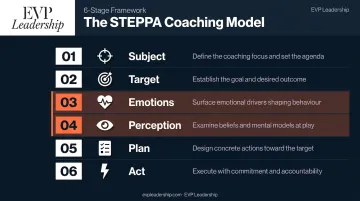
Developed by Dr. Angus McLeod in 2003, STEPPA is unique because it treats emotions as central to the coaching process — not as distractions to manage, but as drivers of behavior that must be acknowledged and redirected. The stages:
- Subject — Identify the focus area
- Target — Define the desired outcome
- Emotions — Surface the feelings attached to the challenge
- Perception — Zoom out and re-examine the situation from a different vantage point
- Plan — Build a concrete path forward
- Act — Commit to specific action
The Emotions and Perception steps are where STEPPA diverges from every other model on this list. A leader dealing with a team conflict may intellectually know the right move — but if fear of confrontation is driving their behavior, logic alone won't unlock a different approach. STEPPA surfaces that emotional layer first.
Best for: Leaders in high-pressure situations, experiencing burnout, navigating interpersonal conflict, or suffering from decision fatigue. It's also well-suited for group and team coaching settings where emotional dynamics are shaping collective performance.
EVP Leadership's Identity Layer within the PressurePoint System addresses similar terrain — building the emotional capacity and resilience that allows leaders to perform consistently under pressure, not just when conditions are favorable.
The Action-Centered Leadership (ACL) Model
Developed by John Adair in 1973, ACL operates differently from the other four models. Rather than structuring a coaching conversation, it functions as a leadership diagnostic — a way to assess where a leader's attention is misallocated. The three overlapping areas:
- Task Achievement — Are we delivering on objectives?
- Team Formation and Management — Is the team functioning, aligned, and developing?
- Individual Development — Are the people doing the work growing in capability?
The insight behind ACL is that these three demands are mutually dependent. A leader who fixates on task delivery at the expense of team health will eventually find both suffer. One who prioritizes harmony without accountability will stall execution.
ACL helps coaches and leaders identify which area is underdeveloped — and where a targeted shift in attention will produce the greatest return on leadership investment.
Best for: Executives and business owners managing teams at scale who need to develop not just their own leadership but the leadership capacity of those around them. ACL is particularly relevant for leaders building systems and structures for sustainable growth — the same terrain EVP Leadership's delegation, accountability, and operating discipline work covers directly.
Key Strategies to Apply Executive Coaching Models Effectively
Knowing a model is not the same as applying it under pressure. When a difficult conversation erupts or a time-sensitive decision lands on your desk, there's no mental space to consult a framework. Conditioning the model into instinctive behavior is the actual objective — the same way athletes don't just learn plays, they rehearse them until execution is automatic.
This is the core distinction EVP Leadership makes between training and conditioning: training builds knowledge, conditioning builds instinct. Their tagline — leaders don't rise to expectations, they fall back on their conditioning — captures exactly why model familiarity isn't enough.
Three Strategies That Actually Work
1. Pair models with structured feedback
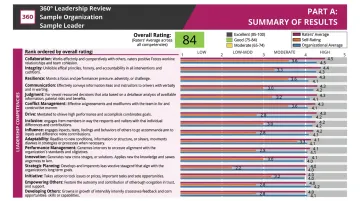
Research on 1,361 senior managers found that those who worked with an executive coach after receiving multisource feedback were more likely to set specific goals, seek improvement input, and show improved ratings from direct reports and supervisors one year later. Feedback tools like 360-degree assessments, DiSC, or Hogan profiles help identify which model aligns with a leader's current challenge — and provide a measurable baseline for tracking behavioral progress.
2. Use reflection as a regular practice
Don't reserve model application for formal coaching sessions. The leaders who build lasting behavioral change make structured reflection a weekly practice — reviewing decisions, identifying which pressures triggered old patterns, and noting where the framework held or broke down.
3. Build accountability into the engagement design
Intentions don't drive change. Commitments with deadlines and structured review cycles do. Regardless of which model is used, leaders need specific, time-bound action commitments revisited consistently. EVP Leadership structures this through an accountability operating rhythm — 1:1 cadences, scorecards, and performance conversations — not as an afterthought, but as a core part of how engagements are designed.
How to Choose the Right Executive Coaching Model for You
No single model fits every challenge. Here's a simple decision framework:
| Leadership Challenge | Best-Fit Model |
|---|---|
| Need clarity on a goal or next step | GROW |
| Navigating multi-session behavioral change | CLEAR |
| Stuck in problem analysis or blame cycles | OSKAR |
| Emotional patterns are blocking action | STEPPA |
| Team performance and leadership balance | ACL |
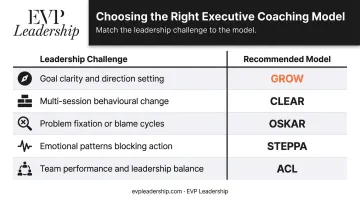
A few practical notes on using this table:
- Blend frameworks as needed. The best outcomes come from leaders and coaches who understand multiple models and shift approaches based on what's actually happening — not what the framework prescribes.
- Let context drive the choice. Stage of business, team size, and whether coaching is individual or group-based all influence which model produces results.
- Prioritize fit over familiarity. Matching model to challenge matters more than defaulting to the most popular framework.
Before committing to any approach, a structured intake conversation — like the complimentary scoping call EVP Leadership uses to open every engagement — helps identify which model fits a leader's actual situation.
Conclusion
Executive coaching models aren't theoretical constructs. They're structured paths from where a leader is now to where they need to be — and the right model, applied consistently over time, produces observable behavioral change, not just better thinking about leadership.
The five models covered here each address a different dimension of the challenge:
- GROW for goal clarity and action commitment
- CLEAR for transformational behavioral change over time
- OSKAR for breaking problem fixation and building momentum
- STEPPA for surfacing the emotional patterns that drive decisions
- ACL for diagnosing and balancing task, team, and individual demands
Knowing when to use each one is a leadership skill in itself. Selecting the right model is the starting point — but selection without repetition doesn't produce leaders who hold up under pressure.
The leaders who perform consistently aren't those who attended the most training. They're those who conditioned the behaviors and decision disciplines into instinct — so those patterns don't collapse when stakes are highest. EVP Leadership's 90-Day PressurePoint System is built on that principle: not exposure to frameworks, but systematic conditioning of the behaviors, instincts, and operating disciplines that define how a leader performs when it counts. A complimentary scoping conversation is how every engagement starts — and where we identify exactly which pressures are limiting performance right now.
Frequently Asked Questions
What are the 5 coaching techniques?
The five most widely used executive coaching frameworks are GROW (goal-focused), CLEAR (transformational multi-session change), OSKAR (solution-focused), STEPPA (emotion-driven), and Action-Centered Leadership (task, team, and individual balance). Each is suited to different leadership challenges and contexts.
What is the GROW model in executive coaching?
GROW stands for Goal, Reality, Options, and Will/Way Forward — a four-stage framework that moves a leader from defining what they want to committing to a concrete action plan. Coaches return to it repeatedly because the structure is simple, transferable, and works across a wide range of leadership challenges.
How do I know which executive coaching model is right for me?
The right model depends on your specific challenge — whether that's goal clarity, a deep behavioral shift, emotional barriers, or team performance. Experienced coaches typically blend multiple frameworks rather than applying one rigidly. A scoping conversation with a qualified coach is the most reliable way to identify the right fit.
What is the difference between executive coaching and leadership coaching?
Executive coaching is tailored specifically to senior-level leaders and focuses on organizational outcomes, strategic influence, and high-stakes decision-making. Leadership coaching applies more broadly across levels and tends to address skill development, communication, and team dynamics without the same organizational-performance focus.
How long does it take for executive coaching to show results?
Early benefits like increased clarity and confidence can appear within the first few sessions. Lasting behavioral change typically requires a sustained engagement — most leaders need six months to a year before meaningful shifts become consistent. EVP Leadership's 90-Day PressurePoint System is designed to compress that timeline through structured conditioning rather than periodic conversation.
Can executive coaching models be used without a formal coach?
The models can be applied as self-reflection tools, and leaders who understand them deeply will use them informally between sessions. Their full impact, though, comes through a structured coaching relationship — the outside perspective, expert challenge, and built-in accountability that a skilled coach provides are difficult to replicate alone.