Every executive and business owner has been there. The racing heart, the narrowed focus, the sense that your best thinking has gone offline at exactly the wrong moment. This is not a character flaw. It's biology.
Here's what most leadership development gets wrong: calm under pressure is treated as a personality trait — something you either have or you don't. The research says otherwise. Staying composed in high-stakes moments is a conditioned skill, built through deliberate practice over time.
This article breaks down what pressure actually does to your brain, why some leaders perform better under it than others, and five evidence-backed strategies you can start using immediately. More importantly, it explains the difference between knowing these techniques and reliably executing them when it counts.
Key Takeaways
- Calm under pressure is a conditioned response, not a fixed trait — stress inoculation research confirms it can be trained at any age
- Acute stress physically impairs the prefrontal cortex, which is why critical thinking degrades at the worst possible moments
- Techniques like controlled breathing, cognitive reappraisal, and stress inoculation produce measurable performance improvements
- Reactive leadership is contagious — a leader's emotional state directly shapes how their team thinks, decides, and performs
- Lasting composure requires systematic conditioning — not one-off coping tools applied in the moment
What Pressure Actually Does to Your Brain and Body
The Fight-or-Flight Hijack
When your brain perceives a threat (whether a predator or a hostile acquisition offer) the amygdala fires first. It triggers a cascade of stress hormones including cortisol and adrenaline, elevating heart rate, sharpening immediate sensory focus, and preparing the body for fast physical action.
The problem for leaders is what happens next. Research by Amy Arnsten at Yale shows that under acute stress, the amygdala activates stress pathways that strengthen threat-detection while simultaneously impairing prefrontal cortex function — the region responsible for rational thinking, working memory, complex decision-making, and impulse control.
A meta-analysis by Shields and colleagues confirmed that acute stress measurably impairs both working memory and cognitive flexibility.
Under pressure, leaders think less clearly. That's not a character flaw — it's neuroscience.
Attention Narrows at the Wrong Moment
Pressure doesn't just slow thinking. It redirects attention. Eysenck's Attentional Control Theory explains that anxiety shifts focus away from goal-directed processing toward stimulus-driven reactivity — meaning attention gravitates toward internal worry and irrelevant external distractions rather than the task at hand.
In a board meeting or high-stakes negotiation, this looks like fixating on one critical comment instead of reading the room, or getting caught in self-doubt when you need to be listening.
Challenge vs. Threat: The Fork in the Road
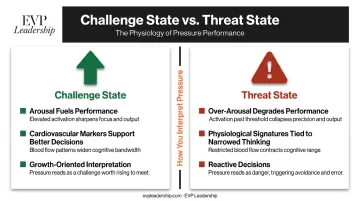
Not all arousal is the same. Research on challenge and threat states shows a measurable physiological difference between interpreting pressure as a challenge ("I am prepared for this") versus a threat ("I might fail here").
The two states produce distinct outcomes:
- Challenge state: arousal that fuels performance, with cardiovascular markers associated with better decision quality
- Threat state: over-arousal that degrades performance, with physiological signatures tied to narrowed thinking and reactive decisions
The physical symptoms — racing heart, shallow breathing, muscle tension — are not signs of failure. They signal that the situation matters. The goal is not to eliminate them. It's to regulate them so they work for you instead of against you.
Why Calm Is a Conditioned Skill, Not a Personality Trait
The "Naturally Calm" Myth
Some leaders appear unflappable in a crisis. It's easy to assume they're wired that way. The research disagrees.
Applied psychology and neuroscience consistently show that high performers are not neurologically different — they've been exposed to stress more deliberately and learned to regulate their responses. Stress Inoculation Training (SIT), developed by psychologist Donald Meichenbaum, is foundational evidence. Calm under pressure is a trainable, four-phase skill:
- Identifying your stress reactions
- Acquiring specific coping skills
- Restructuring how you interpret pressure situations
- Applying those skills under progressively challenging conditions
Neuroplasticity and the Nervous System
Repeated exposure to manageable stress — combined with intentional regulation — physically rewires neural pathways. The nervous system learns that pressure does not automatically lead to failure. Over time, the stress response becomes less catastrophic because it has been conditioned through repetition.
This is why EVP Leadership's 90-Day PressurePoint System is built as a conditioning program rather than a training program. Their core philosophy — leaders don't rise to expectations, they fall back on their conditioning — reflects exactly what neuroscience confirms: knowledge acquired in a low-stakes classroom rarely transfers reliably into a high-stakes moment.
Regulation vs. Suppression
Psychologist James Gross's work on emotion regulation draws a distinction every leader can use. Suppression — bottling up an emotional response — is associated with worse outcomes for wellbeing, relationships, and performance. Reappraisal — consciously shifting how you interpret a situation — is associated with significantly better outcomes across all three.
High-performing leaders still feel fear, frustration, and doubt in pressure situations. The difference is they don't get commanded by those feelings. They notice them, name them, and continue executing.
That gap — between feeling something and acting on it — is what researchers call decentering, a trainable skill from mindfulness and Acceptance and Commitment Therapy research, where leaders observe their thoughts and emotions as passing events rather than directives. Recognizing "I'm feeling panicked right now" is entirely different from letting that panic dictate your next move.
5 Science-Backed Strategies Leaders Use to Stay Calm Under Pressure
1. Physiological Reset: Controlled Breathing
Slow, deliberate breathing activates the parasympathetic nervous system and directly counteracts the fight-or-flight response. Research on diaphragmatic breathing shows measurable effects on attention, negative affect, and cortisol response.
Box breathing (equal inhale, hold, exhale, and hold — typically 4 counts each) is a practical, well-documented technique. Even two or three intentional breath cycles before responding in a high-stakes moment can reduce physiological arousal and create the pause needed to re-engage clearer thinking.
This is also the foundation of EVP Leadership's "Pause the Noise" principle — the first step in the PressurePoint Execution Layer. That pause is what keeps the prefrontal cortex in charge when stress is pushing for an automatic reaction.
2. Cognitive Reappraisal: Reframe Threat as Challenge
Cognitive reappraisal is the practice of consciously reinterpreting a stressful situation's meaning. Instead of "this could destroy me," the shift is toward "this is a hard problem I am equipped to solve."
A 2024 meta-analysis of randomized controlled trials found that stress-arousal reappraisal interventions produced a statistically significant improvement in task performance (d = 0.23, p < 0.001). That's not a subtle effect — it's measurable output improvement from a mindset shift.
In practice, when pressure spikes, ask: "What do I know? What can I control right now?" These two questions redirect attention from threat to agency.
3. Stress Inoculation: Train in Uncomfortable Conditions
Exposure to controlled, escalating pressure in training reduces the nervous system's reactivity when real pressure arrives. The logic is straightforward: the more familiar discomfort feels, the less the brain registers it as a threat.
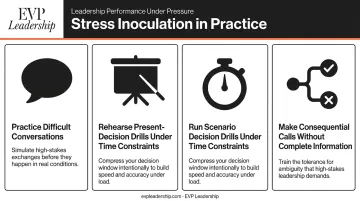
For leaders, this means deliberately:
- Practicing difficult conversations before they happen
- Rehearsing high-stakes presentations in front of critics rather than supporters
- Running scenario-based decision drills under time constraints
- Making consequential calls without complete information — on purpose
This is the structural backbone of SIT and the reason EVP Leadership's PressurePoint System incorporates real pressure scenarios throughout the 90 days, not just during dedicated "stress practice" sessions.
4. Detached Awareness: Observe Without Obeying
When a difficult emotion rises during a board meeting or negotiation, the instinct is to act from it — to defend, to deflect, to escalate. Detached awareness interrupts that reflex.
The technique: name the emotion internally without acting on it. "I'm feeling defensive right now." That act of labeling creates a brief but critical separation between the feeling and the response.
Research on affect labeling shows it engages neural regulation mechanisms in healthy adults. Even a few seconds of that pause is enough to re-engage the prefrontal cortex.
In EVP Leadership's framework, this is what "Locate the Pressure Point" requires — seeing clearly before acting, even when everything in the body is pushing for immediate reaction.
5. Pre-Performance Visualization
Mental rehearsal of high-pressure scenarios activates many of the same neurological pathways as actual physical experience. Motor imagery research demonstrates overlapping brain activation between imagined and real performance, effectively pre-conditioning the nervous system before the actual event.
In practice, this means taking focused time before a critical meeting or difficult announcement to mentally walk through the scenario — including the hard moments — and rehearse a composed, values-aligned response. Not imagining it going perfectly. Rehearsing staying steady when it gets difficult.
The Hidden Cost of Reactive Leadership
Reactive leadership is not just a personal performance issue. It has compounding organizational consequences.
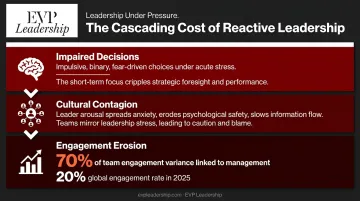
Acute stress impairs valuation, risk-taking, and learning pathways — consistently in the wrong direction. The decisions that come out of that state tend to be impulsive, binary, and fear-driven. That's the first cost.
The second is cultural. Research on emotional contagion in organizational settings confirms that leader mood directly affects group members' moods, group affective tone, and team processes. A leader who escalates under pressure spreads that arousal through the team — creating a culture of anxiety that undermines psychological safety, slows information flow, and erodes collective performance.
The third cost shows up in the data. Gallup reports that 70% of the variance in team engagement is attributable to management. Global employee engagement fell to 20% in 2025. Reactive leadership is a direct driver of that erosion.
The leaders EVP Leadership works with often arrive managing acute situations — key employee loss, financial distress, sudden growth strain — where reactive patterns are already extracting a visible toll.
The Diagnostic Layer of the PressurePoint System is designed for exactly those moments. It helps leaders identify whether the underlying pressure comes from a Mission Clarity breakdown, a Decision Integrity problem, or an Execution Discipline gap — so they're solving the actual constraint, not reacting to symptoms.
Composed leadership produces clearer communication, more decisive action, and measurably higher team confidence. Staying calm under pressure is a trainable performance capacity — and one of the highest-leverage investments a leader can make.
Building Lasting Calm: From One-Off Tactics to Leadership Conditioning
Most leaders have heard of box breathing. Many have read about visualization. Some have tried journaling their stress triggers. And most of those leaders still make reactive decisions in high-stakes moments.
Why? Because there's a critical difference between knowing a technique and having conditioned it.
Knowledge is what you access in a low-stakes moment. Conditioning is what activates automatically when the pressure is high and the cognitive load is maxed.
Automaticity research confirms that practiced skills become faster, more efficient, and require far less cognitive load — which is exactly what a leader needs when their prefrontal cortex is fighting for bandwidth.
What Systematic Conditioning Actually Looks Like
A conditioning approach is not a weekend workshop or a single coaching conversation. It involves:
- Structured, progressive exposure to increasingly difficult scenarios
- Regular self-reflection and after-action review following high-pressure moments
- Built-in accountability that creates consistent practice over time
- Duration sufficient for behavioral change, not just intellectual understanding
EVP Leadership's 90-Day PressurePoint System is built on this model. Its three-layer architecture — Identity (who you are under pressure), Diagnostic (how you see clearly when stakes are high), and Execution (the protocol that runs when the moment arrives) — is designed to move leaders from reactive patterns to conditioned composure through systematic practice.
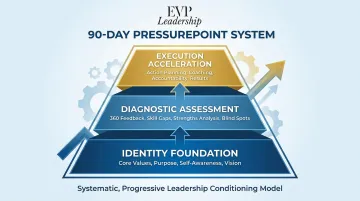
Calm under pressure isn't a personality trait. It's a trained response — and the only variable is whether you've put in the reps before the moment demands it.
Frequently Asked Questions
What skills do you need to work under pressure?
The core skills are emotional regulation, cognitive reappraisal, and focused attention under distraction — plus the ability to activate physiological calm through techniques like controlled breathing. Adaptability matters too: the ability to adjust when conditions shift mid-execution. None of these are fixed traits.
Is staying calm under pressure a skill or a personality trait?
Research in applied psychology and neuroscience consistently shows it's a trained, conditioned response. Stress Inoculation Training demonstrates that calm under pressure can be systematically developed through progressive stress exposure and skill-building — regardless of baseline temperament.
Why do leaders make poor decisions under pressure?
Acute stress impairs the prefrontal cortex (the brain's center for rational analysis and impulse control) while amplifying the amygdala's threat-detection function. Attention narrows, and choices become emotionally reactive rather than considered.
What is the fastest way to calm yourself under pressure?
Controlled breathing (specifically box breathing) is the most immediately accessible tool. It directly activates the parasympathetic nervous system, counteracting the fight-or-flight response within seconds, and creates enough of a pause to re-engage clearer thinking.
Can staying calm under pressure be learned as an adult?
Yes. Neuroplasticity means the brain can adapt through deliberate experience at any age. Conditioning doesn't require youth — it requires consistency and structured repetition. The nervous system adapts from repeated, managed stress exposure at any stage of life.
How does staying calm under pressure affect leadership effectiveness?
Composed leaders make better decisions and communicate with more clarity — both of which directly shape team safety and performance. Reactive leadership, by contrast, is empirically contagious: it degrades psychological safety and measurably reduces engagement across the organization.