Introduction
Many small business owners and executives have the certificates to prove they've done the work. Workshops attended. Online courses completed. Leadership books annotated in the margins. And yet, when a difficult conversation needs to happen, when a key hire leaves at the worst moment, or when a critical decision can't wait — something breaks down.
The problem is a conditioning gap, not a knowledge gap.
Research on training transfer has long shown that a fraction of training expenditure actually translates into lasting job performance. Leaders leave workshops energized, return to their desks, and default back to the same patterns under pressure. That's not a training quality problem. It's what happens when knowledge accumulates without the conditioning to apply it under pressure.
This article breaks down what leadership capacity actually means and what it actually takes to build it.
Key Takeaways
- Leadership capacity is the internal ability to remain steady and make clear decisions as pressure and complexity increase.
- Training builds awareness — conditioning builds the automatic responses that take over when stakes are highest.
- Emotional regulation, self-awareness, and resilience are built through consistent practice, not classroom instruction.
- Psychological safety is a prerequisite for the honest self-reflection capacity development demands.
- Meaningful behavioral change requires weeks to months of repeated, structured practice to take hold.
What Leadership Capacity Really Means
Capability vs. Capacity
Most leadership development conversations focus on capability — communication frameworks, feedback models, strategic planning tools. Capability answers the question what can this leader do? Capacity answers a different question: what can this leader hold when conditions get hard?
A leader might know every principle of difficult conversations and still freeze when the moment arrives. That's not a knowledge gap. That's a capacity gap — the difference between understanding a concept in a calm setting and executing it under genuine stress.
EVP Leadership defines capacity precisely this way: the internal ability to handle responsibility, complexity, pressure, and growth. It's the infrastructure that holds skills together when pressure arrives.
The Three Internal Dimensions
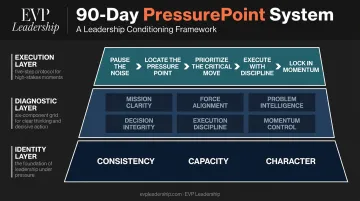
Within EVP Leadership's PressurePoint System, leadership capacity is anchored in three core dimensions that form the Identity Layer:
- Consistency — showing up aligned with your values and standards every day, not just when conditions are favorable
- Capacity — the bandwidth to carry increasing responsibility without fracturing under the load
- Character — how you deploy that consistency and capacity; grounded in integrity, humility, and accountability
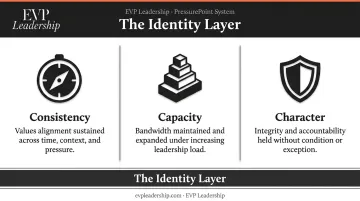
Together, these aren't personality traits you either have or don't — they're conditionable, built through deliberate practice, real-world challenge, and honest reflection.
That conditionability is what makes capacity development so consequential for leaders operating without a safety net.
Why This Matters Most for Small Business Owners
In a large organization, there's buffer. When a senior leader makes a reactive decision or avoids a hard conversation, layers of management absorb some of the impact.
Small business owners and founders don't have that buffer. Decisions touch livelihoods, culture, and survival directly.
When capacity is underdeveloped, pressure shows up as avoidance, reactive decision-making, or the kind of slow burn that leads to executive burnout. Deloitte's 2022 survey of C-suite executives found that nearly 70% were considering leaving their roles for ones that better support well-being — a signal that speaks not just to wellness, but to capacity under sustained pressure.
Why Traditional Leadership Training Falls Short
The Transfer Problem
Training is designed for calm, reflective settings. It delivers information, frameworks, and conceptual clarity. What it doesn't — and structurally can't — do is replicate the conditions under which a leader's capacity is actually tested.
The foundational research on this is sobering. Baldwin and Ford's landmark review found that not more than 10% of training expenditures resulted in actual job transfer — meaning the vast majority of what's learned in a training environment never consistently shows up in real behavior. More recent work by Blume et al. confirms that transfer depends heavily on motivation, individual traits, and the work environment itself — not just program quality.
This isn't an indictment of training. It's a structural limitation. Training tells leaders what to do. It doesn't build the conditioned responses that take over when the stakes are real and the pressure is high.
EVP Leadership's core thesis captures this directly: leaders don't rise to their expectations — they fall back on their conditioning.
The Episodic Nature of Most Programs
A two-day offsite creates a spike of awareness. Without what comes after — repetition, integration, consistent practice — that awareness fades. The forgetting curve is real: research replicating Ebbinghaus's original findings confirms that unrehearsed memory declines rapidly before leveling off. Habit formation research shows automaticity averages 66 days, with a range of 18 to 254 depending on the person and behavior. A single learning event can't compete with that timeline.
What Training Leaves Untouched
Most training programs focus on tactics: how to give feedback, run a difficult conversation, delegate effectively, or communicate under conflict. Useful skills — but they operate on behavior, not on the identity-level defaults that drive behavior when pressure hits.
What training typically doesn't reach:
- A leader's self-awareness under stress — where they go when things go sideways
- Emotional regulation in high-stakes moments — not suppressing emotion, but processing it
- The ability to hold complexity without forcing premature decisions
- Identity-level beliefs about failure, authority, and vulnerability that shape behavior before logic has a chance to intervene
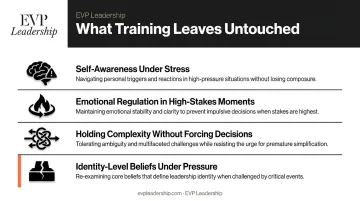
Knowing the right move and making it under pressure are two different things. These are the gaps that determine whether a leader's toolkit gets used — or gets bypassed by years of conditioned default responses.
The Internal Work Training Cannot Teach
Emotional Regulation
Staying calm while others are reactive is a practiced skill, not a matter of temperament. A 2018 cross-cultural meta-analysis found that leader emotional intelligence significantly predicts subordinate task performance and organizational citizenship behavior — beyond cognitive ability and personality traits. A separate study found that emotion suppression is negatively associated with leadership performance, while cognitive reappraisal is positively linked to it.
Emotional regulation means processing feelings, not suppressing them. Leaders who develop this skill stay in the driver's seat rather than being driven by the moment. That capacity is built through consistent practice over time, not through awareness alone.
EVP Leadership's PressurePoint System addresses this through deliberate work on emotional capacity and emotional resilience as conditionable leadership skills — not fixed traits. The organization's core belief: the ability to handle responsibility, complexity, pressure, and growth requires emotional capacity, and that capacity can be developed.
Self-Awareness Under Pressure
Research by Tasha Eurich found that 95% of people believe they are self-aware, but only 10–15% actually are. Among leaders, self-ratings are often inflated compared to how others perceive them, which is exactly why 360-degree tools exist.
Self-awareness for capacity development isn't about general self-knowledge. The relevant question is narrower: what are your default patterns under pressure? What triggers avoidance, what produces overcontrol, where do you go when criticized? This level of self-knowledge develops through structured reflection, honest feedback, and coaching — not through skills training.
Resilience as a Built Capacity
Resilience is frequently described as a personality trait, something certain people have and others lack. That framing is the problem.
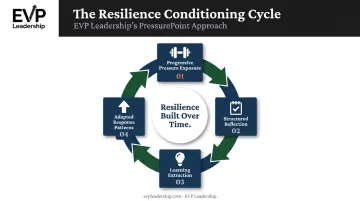
Resilience grows when leaders encounter real pressure, are supported in processing it, and extract learning from the experience rather than simply surviving it. Most training environments skip that step entirely. Leaders come away understanding resilience conceptually without ever building it through habit and repeated exposure.
EVP Leadership's conditioning approach treats resilience the way a strength coach treats athletic performance: developed through progressive exposure to increasing stress, with structured reflection built into every cycle. A leader's habits of response, emotional defaults, and tolerance for complexity shape the health of everything they lead. Conditioning reshapes those patterns deliberately, not by accident.
What Actually Builds Leadership Capacity
Executive Coaching That Goes Below the Surface
Not all coaching builds capacity. Coaching that helps leaders execute tasks better — stay organized, communicate more clearly, manage their calendar — is useful but limited. Capacity-building coaching targets something deeper: how a leader thinks, responds, and shows up when conditions are hardest.
A 2023 meta-analysis of 20 randomized controlled trials found executive coaching produced a weighted effect size of 0.43 on individual outcomes, with stronger effects for behavioral change than for attitudes alone. This makes coaching the most researched bridge between insight and durable behavior change available to leaders.
EVP Leadership's coaching engagements are built on this distinction — not advice and accountability, but conditioning that reshapes how leaders hold pressure, make decisions, and sustain performance over time.
Stretch Assignments With Structured Debriefing
Exposure to increasingly complex, unfamiliar situations builds the muscles training can only describe. The challenge alone isn't what creates growth. Structured reflection afterward is — turning a difficult experience into a learning point that actually changes future behavior.
Without intentional debriefing, hard experiences either reinforce existing patterns or simply become stress memories. With it, they become the raw material of capacity development.
What effective debriefing covers:
- What the leader did, decided, or avoided — and why
- Where existing patterns showed up under pressure
- What a different response would have produced
- What the leader will do differently next time
Habit-Based Conditioning
The most durable capacity changes come from small, consistent practices repeated over weeks and months — not from one-time interventions. Habit formation research shows this clearly: automaticity develops over months, and distributed practice outperforms massed learning events in long-term retention.
EVP Leadership's 90-Day PressurePoint System works this way. Rather than delivering knowledge in a concentrated event, it conditions leaders through three structured, progressive frameworks:
- Identity Layer — consistency, capacity, and character under pressure
- Diagnostic Layer — six components for clear thinking and decisive action
- Execution Layer — a five-step protocol for high-stakes moments
The result is leaders who perform reliably when it counts, not just when conditions are favorable.
Creating the Conditions for Capacity to Grow
Individual capacity development doesn't happen in a vacuum. The organizational environment either enables it or quietly prevents it.
Psychological Safety as a Prerequisite
Edmondson's foundational research links psychological safety with learning behavior in work teams. A 2017 meta-analysis extended this, connecting psychological safety to both task performance and organizational citizenship behavior. Psychological safety is the condition that makes honest self-examination possible — without it, leaders manage appearances instead of developing capacity.
Leaders who fear judgment won't examine their blind spots. Teri Evans, EVP Leadership's Leadership Facilitator, grounds her team development work precisely here — building psychological safety, strengthening communication, and creating environments where growth isn't punished.
Learning Culture vs. Performance-Only Culture
In performance-only cultures, mistakes are hidden rather than examined. Leaders spend energy protecting their image rather than developing their capacity. A learning culture does the opposite — it normalizes:
- Honest feedback as a routine practice, not an annual event
- Self-assessment as a leadership habit, not a performance trigger
- Growth as an ongoing discipline, not a periodic program
That distinction shapes whether development sticks in daily work or evaporates when the offsite ends.
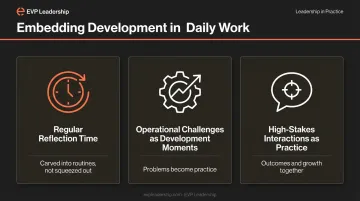
Embedding Development in Daily Work
Leadership development embedded in daily operations looks different from an annual offsite. It includes:
- Regular reflection time carved into leadership routines, not squeezed out by urgency
- Real operational challenges treated as development moments, not just problems to solve
- High-stakes interactions approached as practice opportunities, not just outcomes to manage
Actionable change starts with small habits practiced consistently over time — the core principle behind EVP Leadership's 90-day structure. The framework creates the container; the daily repetition builds the capacity.
Frequently Asked Questions
What does developing leadership capacity mean?
Developing leadership capacity means building the internal ability to remain steady, make clear decisions, and guide others under pressure. It requires cultivating habits, self-awareness, emotional regulation, and resilience — not just acquiring knowledge about how leadership works.
What are the 3 C's of leadership?
In EVP Leadership's PressurePoint System, the 3 C's are Consistency (acting in alignment with your values over time), Capacity (the ability to handle responsibility, complexity, pressure, and growth), and Character (which determines how you use your consistency and capacity). All three are internal capacities that must be built through deliberate conditioning.
Why is leadership training often not enough on its own?
Training builds knowledge and awareness but doesn't change how a leader responds under real pressure. Durable behavior change requires consistent conditioning — repeated practice over time that rewires default responses. One-time instruction can't replicate that.
How does leadership capacity differ from leadership skills?
Leadership skills are the tools a leader uses — communication frameworks, feedback models, decision-making processes. Leadership capacity is the internal foundation that determines whether those tools work when conditions are difficult, stressful, or ambiguous. Skills without capacity break down under pressure.
How long does it take to develop real leadership capacity?
Capacity development is ongoing, but structured conditioning over 90 days or more produces measurable changes in how leaders think, respond, and perform under pressure. Meaningful change requires consistent practice across months — not a single training event.
What role does working under pressure play in leadership capacity development?
Pressure isn't just a test of capacity — it's one of the primary conditions that builds it. When leaders face high-stakes situations with the right structure and support to reflect and learn from the experience, pressure becomes development. Without that structure, it's just stress.