Introduction
Most small businesses don't stall because of market conditions or a lack of capital. They stall because leadership hasn't scaled with the business.
The problem is capacity, not competence. The owner still works hard. The team still shows up. But growth creates new demands, and the leadership infrastructure wasn't built to handle them. Decisions slow down, delegation breaks down, and the person at the top becomes the single point of failure.
Gallup research shows that managers account for at least 70% of the variance in team employee engagement — which means leadership quality isn't a soft factor. It's a primary driver of operational performance.
This guide covers what leadership capacity actually is, why it's the real ceiling on business growth, how to honestly assess where your organization stands, and how to build it in a way that sticks.
Key Takeaways
- Leadership capacity is the sustained ability to handle increasing responsibility, complexity, and pressure — not just the possession of skills
- Training delivers knowledge; conditioning builds the capacity to use it when stakes are highest
- Assessment must come before development — you can't close gaps you haven't located
- When capacity grows across multiple leaders, the whole organization becomes more resilient
- Small businesses can build real capacity without enterprise-level resources — consistency and strategy matter more than budget
What Is Leadership Capacity?
Leadership capacity is the ability to handle responsibility, complexity, pressure, and growth — not in ideal conditions, but consistently, over time, when reality doesn't cooperate.
The definition matters because it separates capacity from skills. Skills are tools. A leader might know how to run a difficult conversation, build a strategic plan, or delegate a project — but knowing how to do something and actually doing it well under pressure are entirely different things.
Skills vs. Capacity: The Key Distinction
Skills are what a leader knows how to do. Capacity is the reservoir that determines how well those skills actually perform when the stakes are high, the information is incomplete, and the margin for error is gone.
A leader with strong skills but low capacity performs well in stable, predictable conditions — and falls apart when those conditions change. A leader with high capacity uses their skills consistently, even when overwhelmed.
That gap — between knowing and consistently doing — is what EVP Leadership was built to close. The firm's core thesis: leaders don't rise to expectations — they fall back on their conditioning. Most leaders have been trained. Fewer have been conditioned to perform when it counts.
Training vs. Conditioning
This is where most leadership development efforts fall short:
- Training is an event — a workshop, a course, a retreat. It transfers knowledge.
- Conditioning is a sustained practice — repeated behaviors that become automatic responses under pressure.
One-time training adds information. Conditioning changes how a leader actually responds when complexity spikes, when team conflict surfaces, when a critical decision can't wait for more data. That behavioral change requires repetition, reinforcement, and real-world application — not a single intervention.
Why Leadership Capacity Is the Real Driver of Business Growth
The Leadership Bottleneck Principle
Organizations grow as fast as their leaders can scale. When leadership capacity is limited, the business hits a predictable ceiling: the owner or top executive becomes the approval point for every significant decision, delegation stops working, and team performance erodes.
This pattern is well-documented. A Productivity Institute review found that SME owner-managers consistently struggle with reactive operational focus, reluctance to delegate, and peer isolation that limits learning.
The outcome is a business that can't function without its leader present — not just slower growth, but structural dependency on one person.
Leadership Quality and Team Performance
The numbers behind this connection are worth understanding:
- Gallup's Q12 Meta-Analysis — covering more than 100,000 teams — found that highly engaged teams show 23% higher profitability, 51% lower turnover, and 18% higher sales productivity
- One in two employees have left a job specifically to get away from a manager
- Only 18% of people in management roles demonstrate a high level of talent for managing others
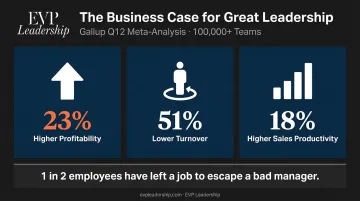
These numbers make the case directly: the manager in the room is one of the most consequential variables in whether a team performs or stalls.
The Compounding Effect of Distributed Capacity
When capacity grows only at the top, the business gains one stronger leader. When capacity grows across multiple people, the business gains something different entirely: resilience.
Teams stop depending on one person to make every call. Middle leaders handle complexity without escalating constantly. The organization can pursue larger opportunities without burning out the people running it. This compounding effect is the difference between a business with a strong founder and a business that can scale.
Key Components of Leadership Capacity
Strategic Decision-Making Under Pressure
Sound decision-making under uncertainty isn't just a skill: it's a capacity that must be conditioned. Small business owners operating at or beyond their limits tend to make reactive decisions: quick calls based on urgency rather than clarity, driven by exhaustion rather than strategy.
Building this capacity requires more than better frameworks or more information. It requires conditioning leaders to pause before reacting, locate the actual pressure point, and prioritize the critical move rather than trying to address everything at once.
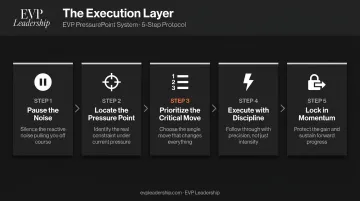
EVP Leadership's Execution Layer addresses this directly: a five-step protocol (Pause the Noise → Locate the Pressure Point → Prioritize the Critical Move → Execute with Discipline → Lock in Momentum) designed to create automatic responses in high-pressure moments rather than reactive improvisation.
Emotional Intelligence and Resilience
Emotional capacity in leadership is the ability to manage your own responses under stress, remain present and effective during difficulty, and support your team through it without losing focus or composure.
This is trainable, not a fixed personality trait. A 2019 meta-analysis of 58 studies on EI training found a moderate positive training effect, with effectiveness influenced by practice, feedback, and modeling. EVP Leadership's position aligns with that research: consistency as a leader is a conditioned skill, not a personality characteristic.
Building emotional resilience involves developing the habits that allow leaders to recover faster, stay grounded under competing demands, and avoid the burnout cycle that is common in owner-operators who carry too much without adequate support structures.
Communication and Influence
Communication capacity is the ability to deliver clear, aligned messaging consistently — to your team, your clients, and your stakeholders — even when circumstances are complex or changing fast.
What matters is whether your message lands with the same clarity and intention under pressure that it does in calm conditions. Misaligned messaging during high-stakes periods creates confusion, erodes trust, and stalls execution. Building this capacity means conditioning leaders to communicate with precision even when their own clarity is challenged.
Signs that communication capacity needs development:
- Messages land differently under pressure than in calm conditions
- Team members execute inconsistently or ask for repeated clarification
- Stakeholder trust erodes during periods of change or uncertainty
- Leaders over-communicate reactively rather than with intention
Systems Thinking and Operational Alignment
Strong leaders connect daily decisions to long-term strategy. They can see how their actions ripple through the organization, and they build structures that don't require their constant involvement.
This is the opposite of the reactive, operationally focused pattern common in small business leaders. Developing systems thinking means leaders stop solving every problem themselves and start designing the conditions where their teams solve problems well.
Developing Other Leaders
A leader's true capacity ceiling is often determined by whether they can grow other leaders. If the entire organization depends on one person's judgment, that person's capacity becomes the company's capacity.
DDI's Global Leadership Forecast 2025 found that organizations with a strong leadership bench are 2.8x more likely to outperform financially. Yet only 20% of HR leaders report having leaders ready to fill critical roles. The gap is structural, and it's one of the most common vulnerabilities in small and mid-size businesses.
How to Assess Your Organization's Leadership Capacity
Before development can happen, you need an honest baseline. Without one, you're investing in growth without knowing where the actual constraints are.
Conduct a Leadership Demand vs. Capacity Analysis
Map the current demands on each leader against their current capacity to handle those demands. Consider:
- Volume of decisions they're responsible for
- Complexity of their responsibilities relative to their experience
- Team size and the quality of support structures around them
- How frequently they're operating beyond a sustainable threshold
Where leaders are consistently over-capacity, you'll typically find the company's culture, morale, and performance problems concentrated. That's not coincidence. Those are symptoms.
Use 360-Degree Feedback and Self-Assessment
Structured 360-degree feedback — gathered from peers, direct reports, and supervisors — gives leaders a realistic picture of how their capacity is perceived versus how it actually performs. Self-assessment alone is unreliable; people consistently overestimate their performance under pressure.
Look for patterns that reveal capacity limits, not isolated skill gaps:
- Feedback clustering around decision-making under stress
- Inconsistency between low-stakes and high-stakes performance
- Communication breakdowns that surface specifically during high-demand periods
Identify Organizational vs. Individual Gaps
Not all gaps are the same type:
- Individual gaps — a specific leader needs to build emotional resilience, sharpen decision-making under pressure, or develop strategic thinking
- Organizational gaps — the company lacks succession pipelines, leadership development isn't embedded in operations, or no formal accountability structures exist
Individual gaps are addressed through targeted development. Organizational gaps require structural solutions. Treating an organizational gap as an individual development problem won't fix it.
Document Findings to Create a Development Baseline
Assessment findings only have value if they're documented and referenced. Without a clear starting point, there's no way to measure whether capacity is actually growing — or whether you're simply adding more weight to an already strained system.
How to Build Leadership Capacity: A Practical Framework
Real capacity is built through repeated, structured practice over time — not a single training event. EVP Leadership's core belief captures it: leaders don't rise to expectations — they fall back on their conditioning.
Start With Consistent, Small Habits
Leadership capacity is built incrementally. High-leverage habits compound into measurably stronger capacity over 30–90 days. Three habits create early traction:
- Briefly review decisions and their outcomes daily or weekly — what worked, what didn't
- Evaluate one significant decision each week: what drove it, what information was missing, what you'd do differently
- Hold regular 1:1s with direct reports focused on outcomes, not activity
None of these require major structural changes. The key is consistency.
Build a Structured, Phased Development Plan
A phased approach creates accountability and makes progress measurable:
- Weeks 1–30: Assessment and clarity — establish baseline, identify priority gaps, align on development goals
- Weeks 31–60: Active conditioning and skill application — structured practice with real-world application and feedback loops
- Weeks 61–90: Integration and independent execution — leaders apply conditioned behaviors independently; measure against baseline
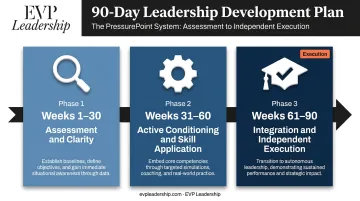
Structured timelines matter because they prevent development from becoming indefinitely deferred during operational busy periods.
Condition for Pressure, Not Just Performance
Leaders must be developed in conditions that simulate real pressure — not just low-stakes practice environments. This is the design principle behind EVP Leadership's 90-Day PressurePoint System: conditioning small and mid-size business leaders to perform consistently under pressure through a battle-tested protocol built for critical moments.
The system's Execution Layer is built to become automatic — not a conscious checklist:
- Pause the Noise
- Locate the Pressure Point
- Prioritize the Critical Move
- Execute with Discipline
- Lock in Momentum
Build a Leadership Pipeline Across the Organization
Move beyond developing only the top leader:
- Identify high-potential individuals at multiple levels
- Create structured pathways for increasing responsibility
- Design feedback loops that support their development over time
- Build manager and director-level programs that develop the next layer of leadership before it's urgently needed
EVP Leadership offers high-potential leadership pipeline programs specifically designed for organizations at this stage — from small businesses building their first leadership team to scaling mid-size businesses developing their second tier.
Measure and Iterate
Track development with clear indicators:
- Decision quality over time
- Delegation frequency and effectiveness
- Team performance and engagement scores
- Employee retention trends
- Career progression within the organization
ATD research found that nearly 79% of organizations that provide leadership development to all employees experience improved organizational culture, and 68% of learners report better job performance. Measurement makes those outcomes visible and actionable.
Common Barriers to Building Leadership Capacity
Most of the barriers below aren't caused by lack of effort. They're caused by how leadership development gets framed — and funded.
Treating Development as a One-Time Event
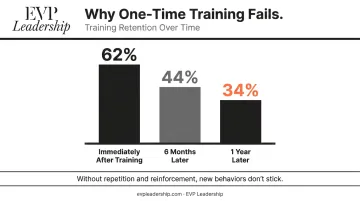
A single workshop or retreat rarely produces lasting behavioral change. That's not a design flaw — it's biology. Research on training transfer shows that trainees applied 62% of training content immediately after completing it, 44% six months later, and only 34% after one year. Without repetition and reinforcement, new leadership behaviors don't stick. Leadership has to be conditioned, not just taught.
Lack of Accountability Structures
Leaders — especially small business owners — consistently deprioritize development when operations get busy. Without a structured accountability mechanism (a coach, a peer group, a defined protocol), development stalls in direct proportion to how much it's actually needed. Accountability isn't optional when building capacity. It's load-bearing.
Underinvestment Driven by Short-Term Thinking
Small businesses frequently treat leadership development as a discretionary expense rather than operational infrastructure. That framing is the problem. Just as a business must invest in systems to scale, it must invest in the leaders running those systems — or growth will remain constrained by the people at the top, regardless of market conditions or capital available.
Gallup estimates that disengaged employees cost the global economy $8.8 trillion annually. The cost of underinvestment in leadership is measurable, not theoretical.
Frequently Asked Questions
What is the difference between leadership capacity and leadership skills?
Skills are specific tools and behaviors — how to run a meeting, how to delegate a task, how to give feedback. Capacity is the sustained ability to deploy those tools effectively under increasing demands, pressure, and complexity over time. Skills get you to proficiency; capacity determines whether that proficiency holds when the stakes are high.
How do I know if my organization has a leadership capacity problem?
Common signals: growth has stalled without a clear external cause, the owner or top executive is a bottleneck for decisions, delegation is inconsistent or repeatedly breaks down, or key leaders are consistently burned out and overwhelmed. If any of those patterns are chronic, they're pointing to a capacity issue.
How long does it take to build leadership capacity?
Meaningful shifts typically require 90 or more days of consistent, structured conditioning. That's a starting point, not a finish line — ongoing development is more effective than any fixed endpoint because capacity erodes without reinforcement.
Can small businesses build leadership capacity without a large budget?
Yes. Capacity is built through targeted coaching, structured accountability, and consistent daily habits — not by replicating enterprise-level programs. The key variables are consistency and strategic focus, not the scale of investment.
What is the difference between leadership training and leadership conditioning?
Training is exposure to concepts and skills — it adds knowledge. Conditioning is the repeated practice of those skills under real pressure until they become automatic. The difference matters most when stakes are high: trained leaders rely on what they've learned; conditioned leaders rely on what they've practiced.
How do I build leadership capacity across my team, not just in myself?
Identify high-potential individuals at multiple levels and give them structured opportunities to lead with progressively increasing responsibility. Build feedback loops into that process so development compounds over time — and capacity distributes across the organization rather than concentrating in one person.