Introduction
Most founders who build companies to 10 employees do so by being everywhere — making decisions, solving problems, keeping momentum alive through sheer presence. That same behavior, left unchecked, becomes the single biggest constraint on reaching 100.
The challenge isn't strategy or funding. It's whether the leader at the top can evolve as fast as the business demands — under sustained pressure, with more complexity, more people, and higher stakes than ever before.
Research from the Startup Genome project found that 74% of high-growth internet startups failed due to premature scaling — not bad ideas, but leaders and organizations that outran their own readiness.
What follows are the leadership principles that separate founders who scale successfully from those who become the ceiling on their own company's growth — and what it takes to build that capacity before the pressure exposes the gap.
Key Takeaways
- Leadership must evolve at every growth stage — what works at 5 people creates bottlenecks at 50
- Effective delegation assigns ownership and accountability, not just tasks
- Culture and decision frameworks must function without the founder's constant presence
- The 80/20 rule means protecting your attention for the 20% of decisions that drive 80% of results
- Scaling leaders build new capacity through conditioning — and that capacity compounds over time
Why Leadership Must Evolve as Your Startup Scales
The founder who thrives at zero-to-one — scrappy, hands-on, willing to touch everything — often becomes the constraint at 40 people, then again at 80. That's not a character flaw. The skills that build a company and the skills that scale one are genuinely different, and most founders never get the signal that the switch needs to happen.
Noam Wasserman's HBR analysis of 212 startups found that most founders surrendered leadership roles as their companies matured — not because they failed, but because the leadership demands of later stages required a different operating mode entirely.
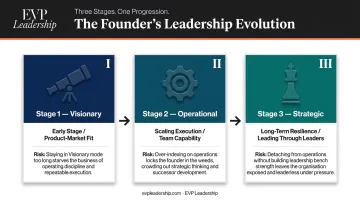
Three Modes Every Scaling Founder Must Navigate
Founders need to shift fluidly between three modes as the business grows:
- Visionary — early stage, finding product-market fit, setting direction
- Operational — scaling execution, building team capability and rhythm
- Strategic — building for long-term resilience, leading through leaders
Getting locked into one mode creates a growth ceiling. The founder who stays in visionary mode at 40 people has no operating engine. The one who stays operational at 80 people has no strategic altitude.
Warning Signs Leadership Hasn't Kept Pace
Watch for these signals:
- Routine decisions still escalate to the founder for approval
- Teams stall without constant input or direction
- Company values feel diluted as headcount grows
- Key initiatives sit idle with no visible bottleneck — just waiting
Each of those signals points to the same root cause: the leadership architecture hasn't kept pace with the business. Fixing the team won't solve a structural problem.
EVP Leadership's core thesis captures this directly: leaders don't rise to expectations under pressure — they fall back on their conditioning. Leadership evolution is a process of building new habits, decision frameworks, and tolerance for increasing complexity — not a one-time mindset shift.
Top Leadership Principles for Scaling Startups
These aren't theoretical ideals. They're the operational principles that separate founders who scale their leadership alongside their business from those who become its ceiling.
Principle 1: Focus on a Small Number of High-Impact Initiatives
Early startup teams are already stretched. Running 8–10 simultaneous priorities doesn't signal ambition — it signals diluted output and organizational confusion.
Every active initiative needs the same three elements:
- One clear owner with real authority
- A measurable outcome, not just an activity
- Real stakes attached to success or failure
Google's OKR framework recommends three to five Key Results per Objective — and those results must describe outcomes, not activities. The same logic applies to how a scaling founder allocates organizational attention. Fewer initiatives, done with full resources and clear accountability, will consistently outperform a sprawling list of things in motion.
Principle 2: Delegate for Outcomes, Not Tasks
Task-based delegation sounds like: "Here's what I need you to do." Outcome-based delegation sounds like: "Here's what success looks like — figure out how to get there."
The difference matters enormously at scale. Task delegation keeps the founder in the loop on every step. Outcome delegation builds genuine accountability and distributes leadership capacity across the organization.
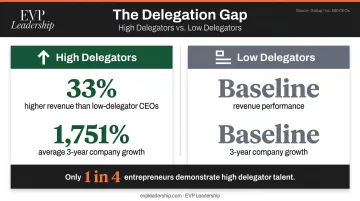
Gallup research on Inc. 500 CEOs found that high-delegator leaders generated 33% higher revenue and 1,751% average three-year growth compared to low-delegator counterparts. Yet only 1 in 4 entrepreneurs demonstrate high delegator talent.
EVP Leadership's Delegation, Accountability & Operating Discipline engagements treat this as a connected operating system — not an isolated skill. The work delivers a clean delegation protocol, an accountability rhythm, and an execution-discipline framework that ensures delegated work actually lands.
Principle 3: Apply the 80/20 Rule to Leadership Decisions
The Pareto Principle — roughly 20% of causes driving 80% of effects — isn't a productivity hack. For scaling leaders, it's a survival framework.
Your job isn't to give equal attention to every problem. It's to identify the vital few decisions, priorities, and relationships that drive the majority of outcomes — and protect your time accordingly.
Common misapplications to avoid:
- Treating every decision as equally important
- Allowing low-stakes approvals to consume disproportionate founder bandwidth
- Optimizing processes that don't sit in the critical 20%
McKinsey found that 61% of decision-making time is used ineffectively in organizations — and that fast, high-quality decision-makers are twice as likely to outperform peers. The 80/20 rule isn't about doing less. It's about doing the right things.
Principle 4: Align Incentives Before Assuming Motivation
People perform in the direction they're rewarded — not in the direction they're told. Scaling leaders who rely on inspiration and instruction without aligning incentives will consistently be disappointed by the gap between what they expect and what they get.
Incentives don't have to mean equity (though equity matters). They include:
- Growth opportunities and expanded responsibility
- Visibility and recognition tied to specific outcomes
- Career path clarity linked to business performance
The diagnostic is straightforward: does the path that benefits the team member also benefit the business? If those paths diverge, performance will follow incentives — not the vision on the wall.
Principle 5: Design Decision Frameworks That Outlast You
As an organization scales, the founder can't be the decision-maker for everything. The solution isn't to delegate randomly. It's to build shared decision logic — frameworks that allow teams to resolve routine decisions independently, with confidence.
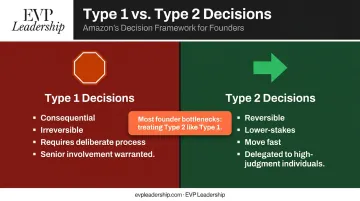
A practical starting point is Amazon's Type 1/Type 2 distinction from Jeff Bezos's 2016 shareholder letter:
- Type 1 decisions are consequential and irreversible — they warrant deliberate process and senior involvement.
- Type 2 decisions are reversible and lower-stakes — they should move fast, made by high-judgment individuals closest to the work.
Most founder bottlenecks are caused by treating Type 2 decisions like Type 1. McKinsey found that organizations with delegated decision authority plus a coaching culture are 3.9 times more likely to outperform peers.
EVP Leadership's PressurePoint System builds this capacity through the Diagnostic Layer's Decision Integrity component — conditioning leaders to ground decisions in truth rather than noise and emotion, particularly under the pressure that comes with rapid growth.
Principle 6: Condition Your Leadership, Don't Just Train It
Training gives leaders knowledge and frameworks. Conditioning builds the reflexes, emotional capacity, and habits to use them consistently when pressure is high.
EVP Leadership's distinction here is blunt: most leaders have been trained, but not prepared for real pressure. The PressurePoint System — a 90-day leadership conditioning engagement — works through three integrated layers:
| Layer | Focus |
|---|---|
| Identity Layer | Builds consistency, capacity, and character — the foundation for showing up aligned regardless of circumstance |
| Diagnostic Layer | Six components that develop clear thinking and decisive action under pressure |
| Execution Layer | A five-step protocol for moving from pressure to disciplined action |
The Diagnostic Layer covers six components: Mission Clarity, Force Alignment, Problem Intelligence, Decision Integrity, Execution Discipline, and Momentum Control.
The Execution Layer runs a repeatable sequence: Pause the Noise → Locate the Pressure Point → Prioritize the Critical Move → Execute with Discipline → Lock in Momentum.
For founders navigating scale, the system directly addresses the patterns that show up most often: executive burnout, poor delegation habits, inconsistent performance, decision paralysis, and the absence of operating structure. The goal isn't transformation — it's conditioning leaders to perform and hold strong under pressure, consistently.
The Founder Bottleneck: Moving from Executor to Strategic Leader
The founder bottleneck follows a consistent pattern. Early on, deep involvement is a competitive advantage — the founder's speed and judgment are the company's engine. Then the team grows, and that same involvement becomes the constraint.
Approvals sit in one inbox. Decisions that belong at the manager level surface to the founder instead. Execution slows not from resource gaps, but because everything waits on one person.
What the Shift Actually Requires
Moving from executor to strategic leader means changing what you do — not how much. The work shifts from making every decision and solving every problem to building context, removing blockers, and creating the conditions your team needs to move with clarity and speed.
This includes monitoring progress without controlling execution — one of the harder behavioral shifts for founders who built the company through direct involvement.
That behavioral shift is harder than it sounds, partly because it's an identity challenge as much as an operational one. EVP Leadership's Founder Leadership Coaching addresses this directly — working through the identity-fusion patterns that make letting go difficult, pairing that work with delegation and accountability system design, and conditioning founders through the operator-to-leader shift rather than simply advising them through it.
The clearest sign the shift has taken hold: the business runs at full capacity for an extended period without the founder in every room. The systems hold. The people carry it forward.
Building Culture and Systems That Scale Beyond You
Culture doesn't preserve itself through growth. It dilutes. The informal values and behavioral norms that develop naturally at 8 people become invisible — and then inconsistent — by 30.
Embedding Culture Before It Dilutes
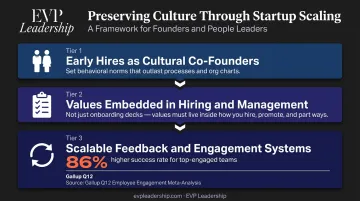
Stanford GSB research confirms that startups must deliberately preserve culture while balancing increasing needs for structure and hierarchy as they grow. The practical approach:
- Treat early hires as cultural co-founders who set behavioral norms for everyone who follows
- Embed values explicitly in hiring criteria, not just in onboarding decks
- Make cultural standards part of management behavior, not just HR documentation
Gallup's Q12 meta-analysis — covering more than 100,000 teams — found that teams in the top half of employee engagement have an 86% higher success rate within their organizations. Culture, expressed through engagement and meaningful work, drives measurable performance differences.
What Scalable Systems Actually Look Like
Sustaining that cultural performance requires systems — structures that replace founder-level involvement with process-level intelligence:
- Swap approval loops for guardrails — clear parameters within which teams decide independently
- Use dashboards that surface what matters without requiring a meeting
- Build feedback loops that catch issues early and resolve them at the right level, before they reach the founder
This is where leadership team alignment becomes critical. EVP Leadership's Teri Evans works with executive teams on exactly this challenge — strengthening communication, building psychological safety, and helping leadership teams perform with clarity as organizations scale. The underlying question she addresses: do your team dynamics hold culture together under growth pressure, or quietly fracture it?
Conclusion
Scaling a startup demands more from a founder's leadership than it does from their original instincts. Distributed authority, sound decision frameworks, and systems that keep decisions moving without the founder in every room — these aren't nice-to-haves. They're the structural requirements of sustained growth.
The principles outlined here are practical. Founders who build them into how they lead keep pace with their business. Those who don't eventually find their own habits and instincts are what slow it down.
Knowing the principles is one thing. Building them into your leadership operating system — under real growth pressure, with real organizational complexity — is another challenge entirely.
If you're navigating this transition — managing growth, rebuilding how you lead, or working through a bottleneck that's starting to slow the business — EVP Leadership works with founders and executive teams as a true strategic partner. The 90-Day PressurePoint System is built for exactly this kind of pressure. Start with a complimentary scoping conversation to explore what that partnership could look like for your specific stage and situation.
Frequently Asked Questions
What are the top leadership principles for scaling startups?
The most essential principles are focusing on high-leverage priorities, delegating for outcomes rather than tasks, aligning incentives with business goals, building scalable decision frameworks, and conditioning leadership capacity under pressure. Across all of them, the constant is this: leadership must evolve at each growth stage, not just be applied harder.
What is the 80/20 rule for startups?
In a startup context, roughly 20% of decisions, initiatives, or customer segments drive 80% of results. Scaling leaders must identify that 20%, protect their attention for it, and build systems that handle everything else.
When should a startup founder stop doing everything themselves?
The shift should begin before it feels necessary — ideally as soon as a team is in place. Waiting until the founder is visibly overwhelmed means the bottleneck has already formed and growth is already being constrained. Earlier delegation builds the team's capacity in parallel with the business's growth.
How do you build a leadership team that can scale without the founder?
Hire for leadership potential and values alignment, not just skill. Embed your standards into onboarding and management practice, distribute decision authority clearly, and develop managers who can lead at the level the business needs — not just perform as strong individual contributors.
What is the difference between leading a 10-person team and a 50-person team?
At 10 people, direct communication and founder visibility are natural and effective. At 50, alignment travels through managers — and leadership becomes about setting context, standards, and systems rather than direct involvement in execution. The communication channel fundamentally changes.
How can executive coaching help startup founders scale their leadership?
Coaching helps founders identify the leadership gaps most likely to constrain growth, build decision-making habits and frameworks that hold under pressure, and develop the emotional capacity to lead through complexity. At EVP Leadership, that work is structured through the PressurePoint System — a 90-day conditioning program built for exactly this transition.