
That's because scaling isn't primarily a strategy problem. It's a leadership capacity problem. The business has outgrown the operating system running it — and that operating system is you.
This guide covers what executive coaching for business scaling actually is, where leaders get stuck across the four pillars of growth, how coaching creates measurable performance change, and what separates a coach worth hiring from one who simply charges by the hour.
Key Takeaways
- The founder is often the bottleneck — scaling requires developing leadership capacity, not just refining tactics
- The four pillars of scaling (People, Strategy, Execution, Cash) collapse without a leader who can think clearly and decide decisively across all of them
- Coaching builds your internal operating system for thinking, prioritizing, and leading under pressure
- Where consulting provides answers, coaching builds your capacity to find and act on the right ones consistently
- A PwC-conducted ICF study found companies reported a median 700% ROI from coaching engagements
What Executive Coaching for Business Scaling Actually Is
Executive coaching is a structured, confidential partnership focused on improving how a leader processes information, makes high-stakes decisions, and performs under sustained pressure. Three comparisons clarify what it is — and isn't.
- Therapy addresses healing from past trauma or mental health challenges — coaching is future-oriented and action-focused
- Mentorship shares wisdom and experience from someone who has walked the path — coaching helps you build your own path
- Consulting diagnoses your business and prescribes solutions — coaching develops your capacity to diagnose and solve
That third distinction is the one scaling leaders need to internalize. A consultant solves your current problem. A coach builds your ability to solve the next ten. For a business that needs to grow without becoming permanently dependent on outside intervention, that difference determines whether growth is durable or just borrowed.
The Internal Operating System
For scaling-stage leaders specifically, executive coaching targets the internal operating system — the habits, frameworks, and reflexes that determine how you show up when complexity, pressure, and growth compound at the same time.
You can hire great people, build a solid product, and still watch the business plateau because the person making the decisions hasn't developed the capacity those decisions now require. Closing that gap — before the business outgrows the leader running it — is the core work of executive coaching.
The 4 Scaling Pillars and Why Leaders Get Stuck
Verne Harnish's Scaling Up (2014, Gazelles Inc.) identifies four decisions every scaling company must get right: People, Strategy, Execution, and Cash. Growth stalls not because founders lack ambition, but because they cannot develop their leadership capacity across all four simultaneously.
People: The Right People in the Right Seats
As a business scales, the leadership team must grow in capacity alongside it. For founders, that means moving from doing every critical function yourself to hiring, developing, and genuinely trusting a leadership layer beneath you.
This transition is harder than it sounds. It requires working through three distinct pressure points:
- Fear of losing control — what happens when someone else makes the call?
- Identity disruption — if you're no longer the expert, who are you as a leader?
- Skill gaps in people development — building leaders, not just capable individual contributors
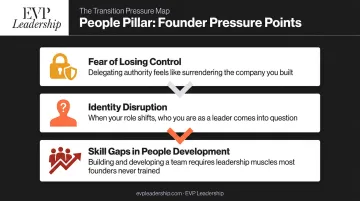
Coaching works at all three levels: the emotional resistance, the identity shift, and the practical capability to develop others.
Strategy: Clarity Over General Direction
Most growing businesses operate on vague strategy — a general direction rather than a clear, differentiated positioning. The founder knows the destination but hasn't made the deliberate choices that separate scalable businesses from ones that plateau.
Coaching creates structured space to step off the operational treadmill and make those choices. Without that space, strategy defaults to whatever the most recent crisis demanded — and reactive decisions compound over time into a business that's busy but not building.
Execution: Systems That Don't Depend on You
Execution at scale requires documented systems and accountability structures that operate without the founder's direct involvement. Most founders resist this — not because they don't know it's necessary, but because systemizing feels like surrendering control, and control is often deeply tied to identity.
Coaching addresses both sides: the practical work of building those systems, and the harder work of releasing the need to be the single point of approval for everything that matters.
Cash: Financial Fluency, Not Just Financial Reports
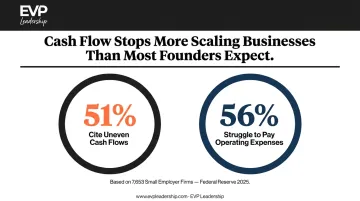
Cash flow stops more scaling businesses than most founders expect. The Federal Reserve's 2025 Report on Employer Firms, based on a survey of 7,653 small employer firms, found 51% cited uneven cash flows and 56% cited paying operating expenses as active financial challenges.
Coaching develops financial fluency — not to replace a CFO, but to ensure every growth decision is made with cash visibility. A leader who doesn't understand their cash position is making strategic bets in the dark.
How Executive Coaching Drives Scalable Business Growth
Outside Perspective on Blind Spots
Operating inside a business every day creates visibility gaps. Patterns, bottlenecks, and assumptions become invisible — not because the founder is unobservant, but because proximity eliminates perspective.
A common example: a founder who kept hiring execution-level talent but couldn't break through a growth ceiling. From the outside, the pattern was clear — every key decision still ran through them, making delegation structurally impossible regardless of who was hired. The founder couldn't see it because the bottleneck was them. A coach surfaces these constraints before they become crises.
Accountability Architecture
There's a wide gap between having a plan and being held accountable to executing it. Most small business growth plans fail not in the planning room but in the gap between quarterly intention and daily prioritization.
Coaching converts vague annual goals into defined quarterly priorities with accountability checkpoints. That structure is what most founders skip — not because they don't value it, but because they're too busy running the business to govern it.
Common accountability gaps coaching addresses:
- Quarterly priorities that drift without structured review
- High-value projects deprioritized by daily operational noise
- Commitments made to the team but never tracked to completion
- Decision bottlenecks that no one names out loud
The Operator-to-Strategist Transition
This is the central scaling shift: moving from doing the work to leading the work.
It's also one of the most psychologically difficult transitions a founder makes. The competence that built the business — deep functional expertise, hands-on problem solving, personal accountability for outcomes — becomes a liability when the business needs the leader to let go and create capacity in others.
Research from Noam Wasserman's work on founder transitions found that in a study of 212 American startups, fewer than 25% of founder-CEOs led their companies to IPO — largely because the leadership demands of a scaling company outpace the founder's willingness or ability to evolve the role.
Coaching gives founders both a structured path through this transition and the sustained accountability to make it stick — not a one-time correction, but a conditioned shift in how they lead.
Decision Quality Under Pressure
That leadership transition lands leaders directly into a new challenge: scaling businesses generate a constant stream of high-stakes, time-pressured decisions. Without a structured decision-making approach, leaders default to pattern recognition and gut instinct — which works fine until the patterns change and the gut hasn't caught up.
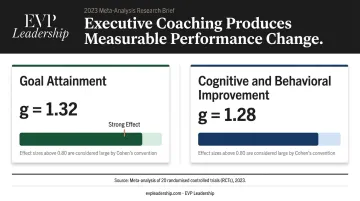
A 2023 meta-analysis of 20 randomized controlled trials found executive coaching produced strong effects on goal attainment (effect size g = 1.32) and cognitive/behavioral activities including goal strategy and openness to new approaches (g = 1.28). These aren't soft improvements — they represent measurable changes in how leaders think and act under pressure.
Mindset and Resilience as Performance Infrastructure
Scaling amplifies stress over long periods, not just during acute crises. A leader who is chronically reactive, depleted, or running on adrenaline transmits that state through every interaction — affecting team performance, decision quality, and organizational culture in ways that compound quietly over time.
Coaching helps leaders recognize their own stress responses, reduce reactivity, and maintain consistent leadership presence. That consistency isn't a soft skill — it's the operating foundation everything else runs on.
Conditioning vs. Training: The Missing Piece in Scaling Leadership
Why Knowledge Isn't Enough
There's a critical difference between training and conditioning. Training tells you what to do. Conditioning ensures you actually do it when it counts — under pressure, at speed, with real stakes on the line.
Think of the difference between an athlete who has read the playbook and one who has run the same play 500 times in practice. When the fourth quarter arrives with two minutes left, the first athlete thinks about what to do. The second one just does it.
Leadership under scaling pressure works the same way. A business growing fast creates compressed timelines, compounding complexity, and sustained emotional load simultaneously. In those moments, leaders fall back on conditioning — the habits and frameworks they've practiced consistently — not the content from the last workshop they attended.
As EVP Leadership frames it: Leaders don't rise to expectations — they fall back on conditioning. Most leaders have been trained extensively. Few have been conditioned to perform. A 2009 study by Schwabe and Wolf confirms why: stress promotes habit behavior at the expense of goal-directed thinking — meaning under pressure, practiced behavioral routines override deliberate conscious recall.
The 90-Day PressurePoint System
EVP Leadership's 90-Day PressurePoint System is a structured conditioning program designed specifically for small and mid-size business leaders navigating scaling pressure. Unlike generalized coaching, it works across three distinct layers.
Identity Layer Builds the foundational leadership anchor across three elements: consistency (acting in alignment with your values over time), capacity (handling increasing responsibility, complexity, and pressure), and character (how you apply both when it actually counts).
Diagnostic Layer Trains leaders to see clearly and act decisively through six components: Mission Clarity, Force Alignment, Problem Intelligence, Decision Integrity, Execution Discipline, and Momentum Control. This layer directly addresses the pattern most scaling leaders fall into — solving visible symptoms while the real constraint stays hidden.
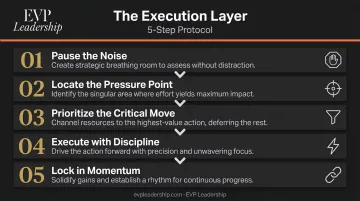
Execution Layer A proven protocol for high-stakes moments:
- Pause the Noise — Control the moment before it controls you
- Locate the Pressure Point — Identify where the situation is actually breaking down
- Prioritize the Critical Move — Focus on what matters most, not everything at once
- Execute with Discipline — Clean action without excess complexity
- Lock in Momentum — Turn decisive action into sustained progress
The 90-day structure isn't arbitrary. Lally et al.'s research on habit formation found an average of 66 days for behavioral automaticity to develop through consistent repetition. The system is built around that reality: actionable change starts with small habits practiced consistently until they hold under pressure.
How to Choose the Right Executive Coach for Scaling Your Business
Stage and Context Matter More Than Credentials Alone
An impressive corporate resume doesn't automatically translate to fluency with the pressures a scaling founder faces — the cash tension, the people complexity, the identity shift, the decision fatigue. Prioritize coaches who understand small and mid-size business dynamics specifically.
Three questions worth asking any prospective coach:
- Have you worked with founders or CEOs at my specific revenue stage and business complexity — and what did that work address?
- How do you distinguish what the business needs from what I need as a leader — and how does your methodology address both?
- What does measurable progress look like in your engagements, and how do you track it?
Look for Structure and Measurable Outcomes
Effective coaching for scaling leaders isn't open-ended conversation. It brings a defined framework, clear milestones, and a method for tracking progress. Business owners need ROI, not just reflection — and strong coaches build that accountability into the engagement design from day one.
When evaluating structure, look for:
- A defined methodology with named phases or milestones (not just recurring conversations)
- Clear success criteria agreed upon before the engagement begins
- A tracking mechanism — qualitative or quantitative — the coach can speak to specifically
ICF credential levels (Associate, Professional, and Master Certified Coach) provide a baseline for professional standards. Credentials matter, but they're a floor, not a ceiling. The real differentiator is whether the coach has conditioned leaders through actual scaling-stage complexity — not just logged hours.
Red Flags to Watch For
- Coaches who position themselves as having all the answers (that's consulting, not coaching)
- No documented experience with scaling-stage businesses or founder transitions specifically
- One-size-fits-all programs with no customization to your actual stage, challenges, or goals
- Inability to articulate how they measure progress or define success in an engagement
- Reluctance to be challenged or challenged back
The coaching relationship must allow for honest disagreement in both directions. A coach who only validates your thinking isn't an outside perspective — they're a mirror with a monthly retainer. The best engagements, like EVP Leadership's 90-day PressurePoint work, are built on the premise that productive friction and structured accountability matter more than comfort.
Frequently Asked Questions
What are the 4 pillars of scaling up a business?
The four pillars — People, Strategy, Execution, and Cash — come from Verne Harnish's Scaling Up framework. Growth stalls when a leader can't develop capacity across all four simultaneously. Executive coaching addresses the leadership constraints that make working on any one of them harder than it needs to be.
What are common coaching rules like the 80/20 and 70/30 rules in executive coaching?
The 80/20 rule means the coach speaks roughly 20% of the time; the other 80% belongs to the leader's thinking, discovery, and articulation. The 70/30 rule means sessions are approximately 70% driven by the leader's agenda and 30% by coach-guided challenge and accountability.
How is executive coaching different from business consulting?
Consultants diagnose your business and prescribe solutions. Coaches develop your capacity to diagnose and solve. The distinction matters because consulting can create dependency — every new problem requires a new engagement. Coaching builds the internal capability to handle what scaling keeps throwing at you.
How long does executive coaching for business scaling typically take?
Structured programs typically run 90 days to 12 months depending on scope and goals. Conditioning-based frameworks like EVP Leadership's 90-Day PressurePoint System are built to produce measurable shifts in leadership performance within a defined timeframe, prioritizing durable behavior change over quick fixes.
What are the signs that a business leader needs executive coaching to scale?
Key indicators:
- The founder is the primary decision bottleneck
- Growth has plateaued despite sustained effort
- The team won't execute without direct oversight
- Reactive decision-making and chronic stress have replaced intentional leadership
If any of those describe your current reality, the constraint is leadership capacity. That's the work.