Executive coaching is often framed around personal development — confidence, communication, self-awareness. Those things matter. But the most measurable impact shows up when coaching is applied to strategic alignment: ensuring a leader's daily decisions, team behaviors, and organizational priorities all pull in the same direction.
This article breaks down the specific, operational benefits of executive coaching when it's focused on strategic alignment — and what it costs organizations when that alignment is absent.
Key Takeaways
- Strategic alignment coaching ties a leader's daily behavior directly to long-term goals — not just mindset.
- Core benefits include sharper decision-making, stronger team alignment, and consistent execution when pressure is highest.
- Misalignment shows up as reactive firefighting, inconsistent results, and an inability to delegate or scale.
- The value compounds — coaching builds habits that outlast the engagement itself.
- Small and mid-size business owners benefit most — misalignment hits faster and harder without structural buffers.
What Is Executive Coaching for Strategic Alignment?
Strategic alignment coaching is a structured working relationship that helps leaders identify where their decisions, behaviors, and communication are disconnected from their stated organizational strategy — and build the habits to close that gap.
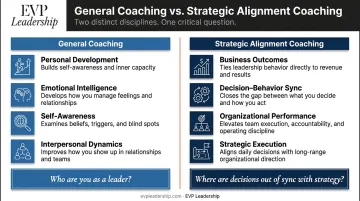
This is distinct from general leadership coaching. General coaching often centers on personal development: emotional intelligence, self-awareness, interpersonal dynamics. Those qualities support leadership, but they don't automatically translate into organizational performance.
Strategic alignment coaching is explicitly tied to business outcomes. The goal is a leader whose confidence drives a team and organization moving in one coordinated direction.
The difference shows up in the questions each approach asks:
- General coaching asks: Who are you as a leader? What holds you back?
- Strategic alignment coaching asks: Where are your decisions and behavior out of sync with the strategy you've committed to — and what does that cost the organization?
EVP Leadership's PressurePoint System reflects this directly. The Diagnostic Layer opens with operational questions: "Do we know exactly what must be achieved — and why it matters now?" (Mission Clarity) and "Are decisions grounded in truth — or distorted by noise and emotion?" (Decision Integrity). These aren't personal-growth prompts. They're designed to pinpoint exactly where leadership behavior and strategic intent have diverged.
The Identity Layer — built on consistency, capacity, and character — establishes the internal foundation first. But the end goal is always external: a leader who shows up aligned with their standards every day, and an organization that operates accordingly.
Key Benefits of Executive Coaching for Strategic Alignment
The benefits below aren't abstract qualities. They're observable outcomes that affect growth, profitability, and the sustainability of the business over time.
Benefit 1: Sharper, Strategy-Filtered Decision-Making
Executive coaching installs a repeatable framework for decision-making. Instead of responding to whatever feels most urgent, leaders start filtering choices through their strategic priorities.
Coaches work with leaders to define their core objectives, then build decision criteria around them. When competing priorities arise — and they always do — the leader has a tested protocol rather than relying on instinct or whoever is loudest in the room.
The need for this is real. A McKinsey survey of 1,259 executives found that 57% of C-level executives said most of their decision-making time is used ineffectively, and only 20% said their organizations excel at decision-making. The gap isn't about time management. It points to a missing decision framework.
Reactive decisions, made individually and reasonably, collectively move an organization away from its goals. Cleaner decisions mean:
- Fewer resource misallocations
- Faster execution on the right priorities
- Reduced organizational confusion about what actually matters
KPIs most affected: Decision turnaround time, resource allocation accuracy, strategic goal attainment rate, leadership performance in high-stakes moments.
This benefit matters most during rapid growth, market disruption, or restructuring — when decision volume spikes and the cost of misalignment compounds fast.
Benefit 2: Organizational Alignment Between Leadership Behavior and Business Goals
When a leader communicates strategy consistently, models the right priorities through their own actions, and holds their team accountable to shared goals, the entire organization starts moving in one direction. Coaching creates this — not through inspiration, but through systematic behavior change.
Coaches surface the gaps between what leaders say their priorities are and how they actually spend time, allocate resources, and communicate with their teams. Then they build corrective habits around those gaps.
The stakes are measurable. Gallup's research shows managers account for 70% of the variance in team-level employee engagement. Highly engaged teams post 23% higher profitability, while turnover in low-engagement teams runs 18% to 43% higher.
The root cause is often invisible to the leader experiencing it. When teams see behavior that contradicts stated priorities — resources flowing one direction while stated goals point another — trust erodes quietly, and discretionary effort follows.
Diagnosing that pattern requires a structured lens. The Force Alignment diagnostic within EVP Leadership's PressurePoint System asks directly: "Do we have the right people, fully aligned and accountable?" It's a deliberately blunt question — because the answer often reveals that alignment problems aren't about the team. They're about what the leader is modeling.
KPIs most affected: Employee engagement scores, team goal attainment, internal communication clarity, retention rates, operational throughput.
This benefit is especially high-impact for growing businesses where the leadership team has expanded or where the original founder is no longer the sole decision-maker. At that stage, alignment has to become a system — it can't run on one person's personality.
Benefit 3: Consistent Execution Under Pressure
Strategic plans fail not because they're poorly designed. They fail because leaders revert to reactive habits when pressure peaks — abandoning priorities, changing direction mid-execution, or making exceptions that quietly erode the strategy until it's unrecognizable.
Coaching addresses this by conditioning leaders to hold their strategic posture even under pressure. That's a meaningfully different approach than training. As EVP Leadership puts it: "Under pressure, leaders don't rise to expectations — they fall back on their conditioning."
The data on execution gaps is stark. A PMI study of senior executives globally found that only 56% of strategic initiatives were successfully implemented over a three-year period, and 61% of firms struggled to bridge the gap between strategy formulation and day-to-day implementation. The strategies existed. Execution didn't hold.
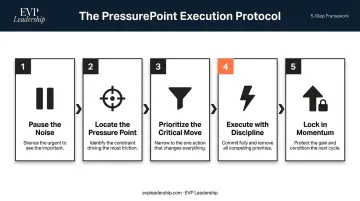
EVP Leadership's PressurePoint System builds execution consistency through a five-step protocol designed for exactly these moments:
- Pause the Noise — control the moment before it controls you
- Locate the Pressure Point — identify where the situation is actually breaking down
- Prioritize the Critical Move — focus on what matters most right now, not everything
- Execute with Discipline — clean action, no excess complexity
- Lock in Momentum — turn action into sustained progress
The goal is to condition leaders to think clearly and act strategically inside pressure — until those responses are automatic, not effortful.
KPIs most affected: Strategy execution rate, project completion consistency, leadership performance under pressure, operational stability during change.
This matters most for entrepreneurs and small business owners who must simultaneously lead, operate, and grow. That combination creates persistent pressure where strategic alignment is most easily lost — and most expensive when it goes.
What Happens When Strategic Alignment Is Missing
Before investing in coaching, recognize what misalignment actually looks like at the operational level. Most leaders experience these as separate problems — when they're typically one root cause.
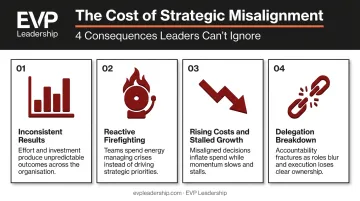
Common consequences of strategic misalignment:
- Inconsistent results — teams hit some goals but not others, and the leader can't explain why performance varies from quarter to quarter
- Reactive firefighting consumes the leader's time on urgent but low-priority issues because there's no shared system for triage, delegation, or strategic prioritization
- Rising costs and stalled growth — resource misallocation increases as decisions are made without a consistent strategic filter, eroding margins without an obvious source
- Delegation breaks down because the team lacks a clear, internalized understanding of priorities — so every decision flows back to the top
The delegation breakdown carries a measurable cost. The same McKinsey survey cited earlier found that organizations using coaching behaviors and safe-to-fail environments were 3.9x more likely to excel at delegated decisions. When leaders can't hand off effectively, the root cause is almost always structural — a misalignment problem, not a personality one.
How to Get the Most Value from Executive Coaching for Strategic Alignment
Executive coaching for strategic alignment delivers its highest return when it's treated as a conditioning process, not a consultation. Awareness alone doesn't move organizations. What moves them is applied habit — repeated, structured, and tied to real pressure.
Every EVP Leadership engagement starts with a complimentary scoping conversation — mapping a leader's specific strategic priorities to an engagement structure built around them, not a generic framework applied across the board.
Conclusion
Executive coaching for strategic alignment produces a compounding effect. Decision habits sharpen over time, team alignment deepens as the leader's behavior becomes more consistent, and organizational culture begins to reinforce the strategy rather than drift from it.
Sharper decisions, aligned teams, and consistent execution under pressure are meaningful outcomes. But they're most meaningful when coaching is sustained long enough for the habits to become automatic rather than deliberate.
For small business owners and entrepreneurs carrying both the vision and the operational weight of their organizations, strategic alignment is the foundation — not a refinement applied after the basics are in place. When a leader's behavior and the organization's priorities are connected, growth moves in a coherent direction. When they're not, pressure exposes the gap. That connection is what sustained coaching builds — and what conditioning makes durable.
Frequently Asked Questions
What is strategic alignment in the context of executive coaching?
Strategic alignment means a leader's daily decisions, behaviors, and team communication consistently reinforce the organization's long-term goals. Executive coaching helps identify and close the gaps between intended strategy and actual leadership behavior — which are often wider than the leader realizes.
How is executive coaching for strategic alignment different from general leadership coaching?
General leadership coaching often focuses on personal development: self-awareness, emotional intelligence, communication style. Strategic alignment coaching ties the leader's growth directly to business outcomes — goal attainment, execution consistency, team performance, and operational clarity.
What are the signs that a leader or organization lacks strategic alignment?
Common indicators include reactive decision-making, inconsistent team results quarter over quarter, difficulty delegating effectively, and a visible gap between stated priorities and how time and resources are actually spent.
How long does it take to see results from executive coaching focused on strategic alignment?
Initial shifts in decision clarity and communication consistency can emerge within 30–60 days of structured coaching. Deeper organizational alignment — where team behavior and culture reflect the strategy — typically develops over 90 days or more of consistent practice.
Can executive coaching for strategic alignment benefit small business owners, not just large corporations?
Small business owners often benefit most because they carry both strategic and operational responsibility simultaneously. Misalignment in their leadership has a faster and more direct impact on performance than in larger organizations, where structural layers can buffer the effects temporarily.
What is the ROI of executive coaching for organizational alignment?
The ICF's Global Coaching Client Study reported a median ROI of 344% among clients reporting a financial benefit. Measurable returns span improved goal attainment, reduced operational waste, stronger retention, and increased profitability — and those returns compound as aligned leadership habits are sustained over time.