Introduction
Picture this: your business has doubled in revenue over three years. You've added headcount, expanded into new markets, and the pipeline looks strong. But decisions are taking twice as long. Your best managers are burning out. And you — the founder or CEO — are still being pulled into problems that shouldn't require your attention.
The business scaled. The leadership didn't.
This gap is more common than most leaders want to admit. According to DDI's Global Leadership Forecast 2025, 77% of CHROs lack confidence in their bench strength for critical roles. That's not a talent problem — it's a structural one.
Scalable leadership development isn't about booking a workshop or sending managers to a two-day retreat. It's about building the infrastructure — systems, behaviors, and decision-making capacity — that holds up as complexity increases. Organizations that treat it as an afterthought hit a ceiling. Those that build it intentionally keep moving.
This article covers why leadership development must be treated as a system, where most organizations go wrong, and practical strategies that actually transfer to performance.
Key Takeaways
- Leadership development works only when treated as a system, not a single event
- One-time training rarely produces lasting behavioral change under real pressure
- Succession planning and bench strength are structural requirements for scaling, not HR extras
- Conditioning leaders — building habits and reflexes over time — outperforms skills-based training
- Effective programs measure behavior change and business outcomes — not just attendance
Why Scalable Leadership Development Can No Longer Be an Afterthought
The Pipeline Gap Is a Growth Risk
The DDI statistic above tells part of the story. Here's the rest: 40% of stressed-out leaders have considered leaving their roles entirely to protect their wellbeing. Trust in immediate managers has dropped to 29% — a 37% decline since 2022. And Gallup's research on manager impact shows that 70% of the variance in team engagement traces directly to the manager.
For growing organizations, these numbers represent real operational risk. Leadership quality isn't a culture initiative — it's a performance variable.
What Leadership Demands Now
The role of leadership has changed in small and mid-size businesses. As organizations flatten, more people are expected to influence decisions, set direction for their teams, and operate with strategic clarity — often without formal authority or title.
Deloitte's 2023 Human Capital Trends report noted that leadership is no longer contingent on position or hierarchy; leaders are anyone who mobilizes others toward results. That shift means development programs built around senior executives — or worse, built for Fortune 500 structures — don't serve the actual population that needs developing.
What Happens When Leadership Doesn't Scale
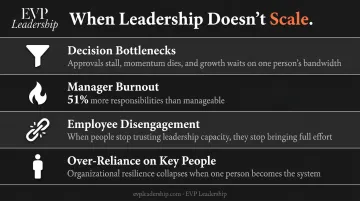
When leadership capacity doesn't keep pace with organizational growth, the gaps show up fast. The symptoms are consistent:
- Decision bottlenecks — everything routes to the same two or three people
- Manager burnout — Gartner found managers now juggle 51% more responsibilities than they can handle
- Employee disengagement — which ties directly to manager quality
- Over-reliance on key people — creating single points of failure that threaten continuity
None of these are personality problems. They're structural — and they don't resolve on their own as the organization gets larger. They compound.
The Hidden Cost of One-Time Leadership Training
Why Workshops Don't Stick
The issue with single-event training isn't the content — it's the format. Attending a session and consuming information doesn't build capability. CIPD has made this point plainly: learning and development only creates value when newly acquired knowledge and skills are applied in real work soon afterward. Without that application, the Ebbinghaus forgetting curve takes over, and retention decays quickly.
Most organizations know this intuitively. Few have built anything to address it.
The Event Mentality Problem
When organizations treat leadership development as an event, the downstream effects are predictable:
- Programs run independently of performance reviews and succession planning
- There's no accountability structure to reinforce what was learned
- Leaders return to their roles, face real pressure, and revert to old behaviors
- The investment produces no measurable change
Only 27% of companies report having a framework to measure training success — which means the majority are spending without knowing whether anything changed. ATD's 2025 research reinforces this: 93% of organizations collect participant satisfaction data, but far fewer measure whether behavior actually shifted.
That's the gap EVP Leadership's conditioning-based approach is built to close. The firm's core premise is direct: leaders are conditioned, not just trained. Under pressure, they don't rise to expectations — they fall back on whatever was reinforced.
Leadership Drag
When programs exist in isolation — disconnected from strategy, succession, and day-to-day accountability — organizations experience a pattern EVP Leadership calls leadership drag: duplicated development efforts, no measurable ROI, and leaders who perform well in a training environment but fold under real-world pressure. The financial cost is visible in the program budget. The real cost is the performance gap that never closes.
Core Strategies for Scaling Leadership Development That Actually Works
Scaling leadership development doesn't require a massive L&D infrastructure. It requires intentional design. These strategies apply whether you're leading a 12-person team through rapid growth or stabilizing an executive team after a founder transition.
Align Development to Business Strategy First
The most common program failure isn't poor facilitation — it's misalignment. Development designed around generic competency frameworks rarely addresses what a specific business actually needs to grow.
Start by asking: what leadership capabilities does our strategy require right now? A business preparing to double headcount needs different leadership behaviors than one navigating a founder transition or entering a new market. Generic frameworks can't answer that question.
Once you've identified the capabilities, integrate development into existing talent processes:
- Tie competencies to promotion criteria
- Link program progress to performance reviews
- Build succession planning into the same conversation as development planning
When development is woven into how the organization already operates, it reinforces itself without requiring a separate "program" to sustain it. EVP Leadership's custom program design starts here — every engagement is scoped to the client's industry, leadership team profile, and stage of growth before any curriculum is built.
Use Real Work as the Development Vehicle
The 70-20-10 model, developed through more than 30 years of Lessons of Experience research at the Center for Creative Leadership, describes how executives actually learn:
- 70% through challenging on-the-job experiences and assignments
- 20% through developmental relationships and coaching
- 10% through formal training and coursework
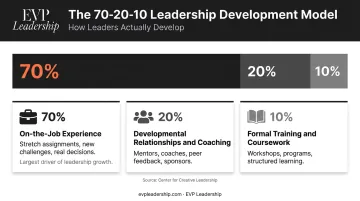
The model is a design principle, not a prescription — but the core insight holds: most development happens through real work, not classrooms. Organizations can deliberately design for this by assigning stretch projects, cross-functional responsibilities, and leadership roles ahead of formal promotion.
Peer cohorts and small group formats extend this further. When leaders work through real challenges together in a structured setting, they build shared context, surface patterns faster, and develop consistency across the team — without one-on-one coaching for every person.
Build In Practice and Feedback at Scale
New skills don't transfer without practice in real situations. Methods that create safe environments for this include:
- Role plays and scenario-based discussions — simulate high-stakes decisions before leaders face them live
- Peer feedback loops — structured peer input creates accountability and surfaces blind spots
- Regular check-ins — short, frequent accountability touchpoints reinforce application better than longer, infrequent reviews
- Facilitated debriefs — processing real experiences in a group format accelerates learning across the cohort
Together, these methods build the repetition and accountability that make leadership development stick — not just in formal settings, but in the daily decisions leaders make under pressure.
Building a Leadership Pipeline: Bench Strength for Sustainable Growth
Why Succession Planning Is a Structural Safeguard
Bench strength isn't about having names on a succession chart. It's about knowing the people on that chart are actually ready. SHRM research found that only 21% of HR professionals report having a formal succession plan — meaning the majority of organizations are one unexpected departure away from a leadership crisis.
The operational consequences are real. Korn Ferry reports that 50% of CEO successions were unplanned — up from 43% in 2023. When leadership transitions are reactive rather than prepared, growth doesn't just slow. It stops.
DDI's research makes the case plainly: companies with high-quality succession planning significantly outperform industry peers financially and achieve higher internal promotion success rates.
A Three-Part Framework for Building Bench Strength
- Identify who your potential leaders are — at every level, not just the top tier
- Assess their current gaps honestly — not based on current performance, but on readiness for the next level
- Invest in their development before a vacancy forces your hand
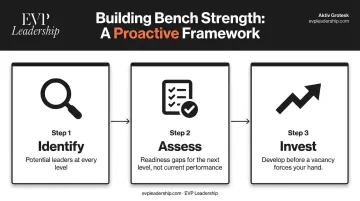
This is proactive leadership work, not HR administration. EVP Leadership integrates succession planning directly into its C-level consulting engagements, treating it as a strategic priority alongside growth planning and operational design rather than a separate administrative task.
Develop Leaders Before You Need Them
The most common bench-strength mistake is waiting until a promotion to start developing someone for the role. By then, you're already behind.
Tiered development paths address this directly by preparing people for the next level before they reach it. EVP Leadership's high-potential leadership pipeline programs are built for this: developing the leadership capacity emerging leaders will need before the organization depends on them to have it.
The "leader as teacher" mindset takes this a step further. When senior leaders actively develop those below them, development stops being outsourced to an external program and becomes embedded in how the business operates. That looks like:
- Deliberate stretch assignments that build capability under real conditions
- Structured feedback tied to the specific demands of the next role
- Clear expectations that signal what leadership readiness actually requires
Leadership Conditioning: The Difference Between Surviving and Scaling
Training vs. Conditioning
Training transfers knowledge. Conditioning changes how a leader performs — under the kind of pressure that scaling always creates.
Most leaders have been trained. Few have been conditioned. The difference shows up when complexity peaks: the trained leader reverts to reactive instinct, exhaustion-driven choices, or paralysis. The conditioned leader brings structure, clarity, and decisive action precisely when the organization needs it most.
EVP Leadership's core tagline captures this: leaders don't rise to expectations — they fall back on their conditioning.
Emotional Capacity as a Foundation
Resilience and emotional capacity aren't personality traits. They're trainable — through consistent, structured practice over time.
Leaders who understand their own thought patterns make better decisions under complexity. The Identity Layer at the core of EVP Leadership's 90-Day PressurePoint System addresses this directly through three pillars:
- Consistency — leaders who act in alignment with their values under pressure, not just in stable conditions
- Capacity — the ability to carry increasing levels of responsibility without breaking down
- Character — ensuring that as influence grows, it's used with integrity
This isn't soft skills work. It's foundational infrastructure for performance.
What Conditioning Looks Like in Practice
A conditioning-based approach involves:
- Small habits practiced repeatedly in real situations — not absorbed in a classroom
- Structured accountability checkpoints that reinforce application between sessions
- A defined protocol for high-stakes moments, practiced until it becomes reflexive
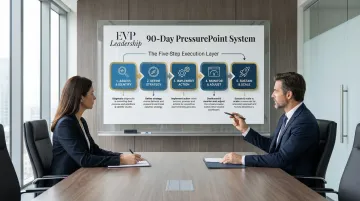
EVP Leadership's 90-Day PressurePoint System is built on this philosophy. The Execution Layer walks leaders through five steps: Pause the Noise, Locate the Pressure Point, Prioritize the Critical Move, Execute with Discipline, and Lock in Momentum. This isn't a framework to memorize. It's a set of reflexes built through repeated practice — so leaders can execute it under real pressure, not just describe it.
The long-term advantage: conditioned leaders don't destabilize when growth creates complexity. Teams execute with less hand-holding. Decisions stop bottlenecking at the top. That's the compounding effect of conditioning — and it scales with the organization.
How to Measure the Impact of Your Leadership Development Investment
Move Beyond Participation Metrics
Most organizations measure the wrong things. Completion rates, attendance numbers, and post-session satisfaction scores are output metrics — they confirm people participated, not that anything changed. They say nothing about whether behavior shifted back on the job.
ATD's 2025 research found that 93% of organizations collect participant satisfaction data, but only a fraction measure actual behavior change or business outcomes. Measuring attendance while expecting performance gains is like reviewing a budget without ever looking at actual spend — the data exists, but it's answering the wrong question.
A Three-Level Measurement Framework
Kirkpatrick's four-level model (Reaction, Learning, Behavior, Results) provides a practical structure — extended further by the Phillips ROI Methodology, which adds a fifth level for financial return. For most growing organizations, a simpler three-level approach is manageable:
| Level | What to Measure |
|---|---|
| Individual | Behavior change, decision quality, communication effectiveness |
| Team | Engagement scores, collaboration, accountability follow-through |
| Organizational | Pipeline readiness, leadership retention, profitability trends |
The organizational level is where programs prove their value — and where most companies stop measuring too soon. That gap is exactly why feedback loops matter.
Build a Feedback Loop Into the Program
Development programs need regular review. What was relevant 18 months ago may not address what the organization needs today. Build feedback mechanisms in from the start — not as an afterthought — and schedule a formal program review against current business priorities at least annually.
Practical feedback mechanisms to include:
- Post-program behavioral check-ins at 30, 60, and 90 days with direct managers
- Peer observation prompts tied to specific leadership competencies from the program
- Quarterly data pulls on the team- and org-level metrics from your measurement framework
- Annual curriculum audits comparing program content against current strategic priorities
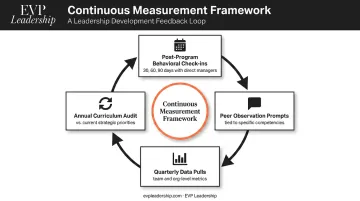
When measurement is built in from day one, programs stay relevant — and the organization always knows whether the investment is still working.
Frequently Asked Questions
What is the 70-20-10 rule for leadership development?
The 70-20-10 model, developed at the Center for Creative Leadership, holds that roughly 70% of leadership development happens through on-the-job experience, 20% through coaching and mentoring relationships, and 10% through formal training. Treat it as a design principle, not a formula — and let it shift how your organization allocates development investment toward real-work experience.
What does a leadership development coach do?
A leadership development coach helps leaders identify growth gaps, build self-awareness, and develop the decision-making habits needed to perform under pressure. Effective coaching addresses the mindsets driving behavior — not just the behaviors themselves — which is why it produces more durable results than skills training alone.
How much do leadership coaches charge per hour?
According to the ICF's 2023 Global Coaching Study, the average fee per coaching session was $244 in 2022, with geographic ranges from $114 to $277 per hour. Premium executive coaching programs can run higher, and structured multi-month engagements typically deliver stronger ROI than one-off hourly sessions because they build lasting behavioral change rather than isolated conversations.
What is the difference between leadership training and leadership coaching?
Training delivers knowledge and skills in a structured format — typically a session or program with defined content. Coaching is an ongoing, personalized process focused on applying skills under real conditions, with accountability built in. The result: coaching tends to produce more durable behavioral change because it meets leaders inside actual challenges, not simulated ones.
How do you measure the success of a leadership development program?
Measure success at three levels: individual behavior change and decision quality, team performance and engagement, and organizational outcomes including pipeline readiness and retention. Participation rates and completion data tell you what happened — not whether anything changed.
How can small businesses scale leadership development on a limited budget?
Use real work as the primary development vehicle. Stretch assignments, peer learning, and facilitated debriefs cost far less than formal programs and typically produce more durable results. When investing in structured coaching, choose multi-month engagements over one-off workshops — they build lasting behavioral change rather than resetting the clock each time.