
This isn't a discipline problem. It's a structural one.
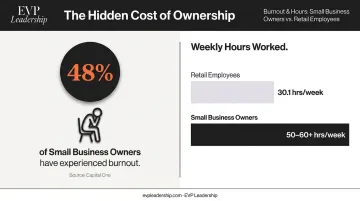
According to a Capital One survey, 48% of small business owners were currently experiencing or had recently experienced burnout. Meanwhile, the Bureau of Labor Statistics reports retail trade employees average 30.1 hours per week—while a substantial share of small business owners work 50 or 60+ hours weekly. That gap doesn't close on its own.
The 7 strategies below aren't quick fixes. They're the kind of habits that build lasting capacity—what EVP Leadership calls conditioning rather than training. Because sustainable performance isn't something you find after a long weekend. It's something you build deliberately, over time.
Key Takeaways
- Burnout in retail is a systems failure, not a personal one—and it requires structural fixes, not willpower
- Non-negotiable boundaries and scheduled downtime must be treated as store policy, not aspirations
- Delegation and documented processes are what separate owner-dependent businesses from scalable ones
- Physical recovery is a performance input, not a reward for finishing work
- External accountability—not scheduling tweaks—is what creates lasting change for most owners
Why Retail Business Owners Face a Unique Burnout Risk
The Store Doesn't Switch Off When You Do
Most business types allow for some degree of separation between owner and operation. Retail rarely does. Physical presence is expected during peak hours. Foot traffic is unpredictable. Scheduling gaps default to the owner filling in. POS alerts and staffing emergencies don't respect dinner time.
Main Street America's 2025 survey of 1,587 businesses found that 52% had only one or two full-time employees and 53% relied on unpaid help from family or friends. With that kind of staffing reality, boundaries feel not just difficult but irresponsible.
They're not. They're necessary, but only if the business is built to support them.
The Identity Trap
Many retail owners don't just run their store. They are their store—at least in their own minds. The business becomes tied to self-worth in a way that makes taking a day off feel like abandonment. Missing a busy Saturday feels like failure.
This identity fusion accelerates burnout rather than preventing it. EVP Leadership, which has worked with founders and small business owners since 2009, identifies "identity fused to the business" as one of the primary drivers of executive burnout. The underlying problem: owners confuse constant presence with consistent leadership. They're not the same thing.
What Depletion Does to Decision-Making
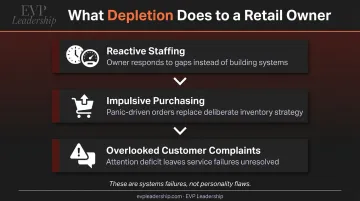
A depleted owner doesn't just feel bad. They lead worse. Research published in PMC confirms that stress directly affects decision-making processes including valuation, learning, and risk-taking. The downstream effects show up as:
- Reactive staffing decisions made under pressure rather than strategy
- Impulsive purchasing driven by urgency rather than planning
- Overlooked customer complaints that compound over time
These aren't personality flaws. They're the predictable output of a chronically overloaded brain.
This is also the distinction Michael Gerber made famous in The E-Myth Revisited: working in the business (on the floor, managing daily tasks) versus working on the business (strategy, systems, growth). Most retail owners get stuck in the first mode permanently—and it's not sustainable.
Reclaim Your Time: Strategies 1, 2, and 3
Strategy 1: Set Non-Negotiable Work Boundaries
"Setting boundaries" sounds simple. For retail owners, it requires deliberate architecture.
The goal isn't just deciding when to go home—it's building a store operation that doesn't require your constant presence to function. Start here:
- Define your hard stop on three to four days per week and protect it the same way you protect store hours
- Assign a trusted manager as the after-hours point of contact for urgencies—you shouldn't be the default
- Establish a technology curfew: a specific time after which you don't check POS alerts, scheduling apps, or work email
Research supports the value of that last habit. A study published in Computers in Human Behavior found that checking email less frequently reduced daily stress—and lower daily stress predicted greater overall well-being.
The objection is always the same: What if something goes wrong? That question is worth sitting with. Because if the answer is always "only I can handle it," the real problem is the lack of a trained backup, not the boundary itself.
Strategy 2: Prioritize High-Impact Tasks Using the 80/20 Principle
The Pareto Principle—the idea that roughly 20% of inputs drive 80% of outcomes—applies directly to how retail owners spend their time. Not all tasks are equal, but most calendars don't reflect that.
Ask yourself honestly: which activities actually move the business forward?
- Vendor relationship management
- Staff development and retention
- Financial performance review
- Marketing and customer acquisition strategy
These are high-leverage. Opening the store, answering routine customer questions, and restocking shelves are not—at least not when you're the one doing them every time.
The weekly priority audit: Before each week begins, identify the three tasks that only you should handle—the ones that genuinely require your judgment or relationships. Block time for those first. Let reactive tasks fill whatever remains.
The discipline here is simple: know what must get done this week, and verify your time is actually going there.
Strategy 3: Schedule Downtime as a Business Obligation
Unscheduled downtime doesn't happen. Ask any retail owner who's tried to "find time" for a vacation in the last three years.
Rest isn't the reward for finishing work—it's a required input for sustainable performance. Recovery research identifies psychological detachment from work, relaxation, and personal mastery as the key mechanisms that restore capacity between high-demand periods. Without them, output degrades even when hours stay constant.
Practical starting points:
- One half-day completely offline per week
- One full personal day per quarter (minimum)
- One evening per week reserved for relationships—not networking, actual relationships
Structure is what makes recovery real. EVP Leadership builds this into their Executive Burnout Recovery engagements explicitly: a missing recovery cadence is identified as a root cause of burnout, and redesigning the operating rhythm to protect that time is a core deliverable, not an add-on.
Build a Business That Doesn't Need You Present 24/7: Strategies 4 and 5
Strategy 4: Delegate Strategically and Develop Your Team's Capacity
The reluctance to delegate is one of the most costly habits retail owners carry. It's usually rooted in a genuine belief that no one else will do it quite right—which may even be true initially. But the cost of holding everything yourself is higher than the cost of an imperfect handoff.
Reframe delegation as investing in team capacity, not giving up control.
A practical starting point:
- List five recurring tasks you currently handle that a trained team member could own within 30 days
- Document the process—even a simple checklist is enough
- Walk through it once with the employee, then let them execute
- Check in without taking over
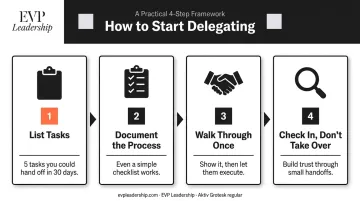
Trust is built through repeated small handoffs, not one dramatic act of letting go. Every time you step back and let someone handle something, you're building the operational muscle that eventually frees you.
The vacation test: Can your store function for one full week without you present? If not, the business is owner-dependent in a way that guarantees long-term burnout. Work toward passing that test as a concrete, measurable goal — it's one of the clearest indicators that delegation is working.
Strategy 5: Build Operational Systems and Document Your Processes
Lasting work-life balance in retail is largely a systems problem, not a willpower problem.
When opening and closing procedures, inventory management, staff onboarding, and customer issue resolution are documented and standardized, the business stops depending on the owner's constant judgment. As Strategic Finance/IMA notes, standard operating procedures give small businesses the structure and consistency they need to function without constant improvisation.
Start small: Identify two or three processes that currently live only in your head. Write them down as simple, repeatable checklists. Common starting points for retail owners include:
- Opening and closing routines (so any trained staff member can run the shift)
- Customer return and complaint resolution steps
- Inventory reorder triggers and supplier contact protocols
- New hire orientation checklist for the first two weeks
Documented systems also protect the business when the unexpected hits — staff turnover, ownership transitions, or any situation that requires you to step away on short notice.
Protect Your Energy: Strategies 6 and 7
Strategy 6: Treat Your Physical and Mental Health as a Business Asset
A depleted owner is the single biggest operational risk in any small retail business. This isn't a wellness observation—it's a leadership performance fact.
Sleep deprivation impairs attention, working memory, and decision-making. A 2024 systematic review found that acute physical activity has a measurable positive effect on cognitive task performance. When you're not sleeping or moving, you're making worse decisions with higher effort. The business pays that cost.
Three low-barrier habits worth conditioning:
- 20–30 minutes of daily movement before the store opens (a walk counts)
- A consistent sleep boundary—not a goal, a non-negotiable
- One non-work social connection per week—someone outside the business
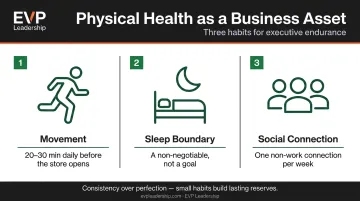
Perfection isn't the point. Consistency over time is. Small habits, practiced repeatedly, build the reserves that sustain performance when pressure peaks.
Strategy 7: Invest in Leadership Support and Accountability
Most retail owners try to solve burnout alone—through a schedule change, a long weekend, or sheer determination. It works temporarily. Then the patterns return, because the underlying systems haven't changed.
The owners who build lasting balance typically have external accountability: someone who helps them see the structural issues they're too close to notice. A mentor, a peer group, or a leadership coach who asks the questions that never come up in daily operations.
Gennifer Baker, Founder of EVP Leadership, brings more than 30 years of experience in business strategy and leadership—and since 2009, the firm has advised thousands of entrepreneurs and executive teams on exactly these challenges. The 90-Day PressurePoint System is a structured conditioning engagement that addresses the root causes of executive burnout: over-scope, weak operating rhythm, poor delegation, no recovery cadence, and identity fused to the business.
By the end of the engagement, clients typically have a redesigned operating rhythm, a working delegation protocol, and a resilience system they can sustain independently. For retail owners ready to make structural change, a complimentary scoping conversation with EVP Leadership is the practical first step.
How to Know If You're Already Burning Out
Retail owners are skilled at rationalizing warning signs. It's just the holiday season. This is what owning a business feels like. Once things slow down...
They rarely slow down on their own.
Common burnout warning signs specific to retail owners:
- Chronic exhaustion that a full night's sleep doesn't fix
- Declining service quality—snapping at staff, overlooking customer complaints
- Loss of enthusiasm for the business you built
- Difficulty making routine decisions that used to feel automatic
- Persistent physical symptoms: headaches, insomnia, recurring illness
The WHO defines burnout as resulting from chronic workplace stress that has not been successfully managed—characterized by exhaustion, cynicism, and reduced efficacy. A bad week ends. Burnout sets in when there's no recovery between weeks.
A simple self-check: At the end of each week, rate your energy, motivation, and decision clarity on a scale of 1 to 10. A sustained score below 5 is a signal—not to push harder, but to act on the strategies above, or to seek outside support before the business pays the price.
That self-check takes two minutes. Catching burnout early—before it shows up in your margins, your team, or your health—is one of the most practical things a retail owner can do.
Frequently Asked Questions
How do you manage work-life balance as a retail business owner?
Balance in retail requires intentional systems, not just effort. The core levers are delegating recurring tasks, documenting processes, and scheduling personal time with the same non-negotiable commitment you give store hours.
What is the 80/20 rule for work-life balance?
The 80/20 rule means identifying the ~20% of activities that drive 80% of your results—things like team development and financial review—then protecting time for those and delegating the rest. Use it as a prioritization lens, not a fixed rule.
What is the 8/8/8 rule for life?
The 8/8/8 rule divides the 24-hour day into three equal parts: 8 hours of work, 8 hours of sleep, and 8 hours of personal time. For retail owners, daily reality rarely allows for perfect thirds—but the framework is useful as an aspirational guide for identifying which third is being chronically under-resourced.
What are the warning signs of burnout in a retail business owner?
Key signs include persistent exhaustion that rest doesn't resolve, declining decision-making quality, increased irritability with staff or customers, loss of passion for the business, and physical symptoms like insomnia or recurring headaches. These often appear gradually and are easy to rationalize as normal pressure.
Can retail business owners really take a vacation without everything falling apart?
Yes—but only if documented processes, a trained team, and delegated decision-making authority are already in place. Taking a week away without the business collapsing is the clearest signal that you've built something sustainable rather than something owner-dependent.