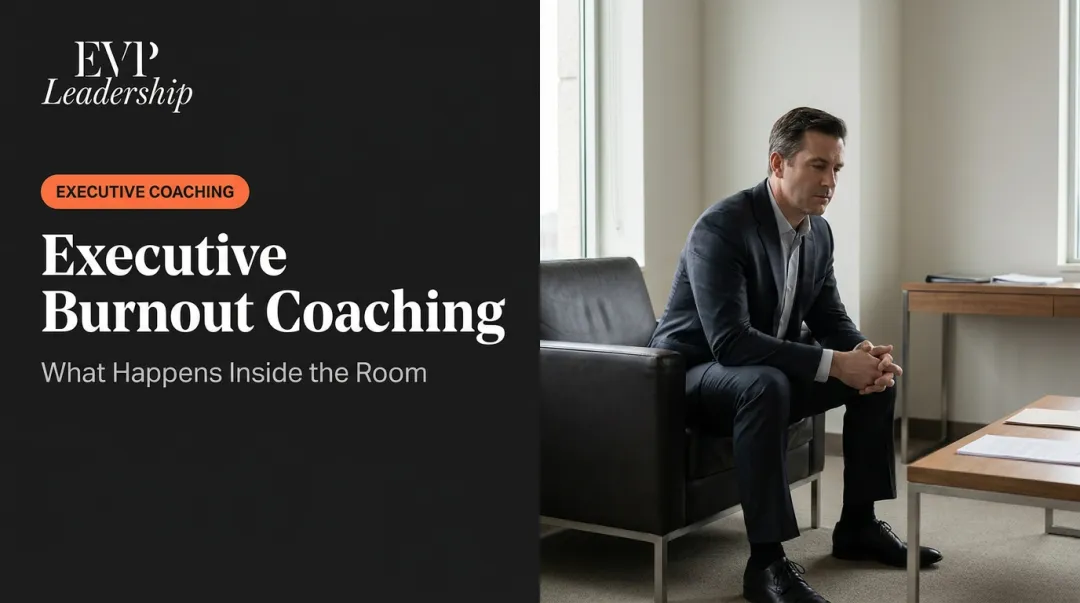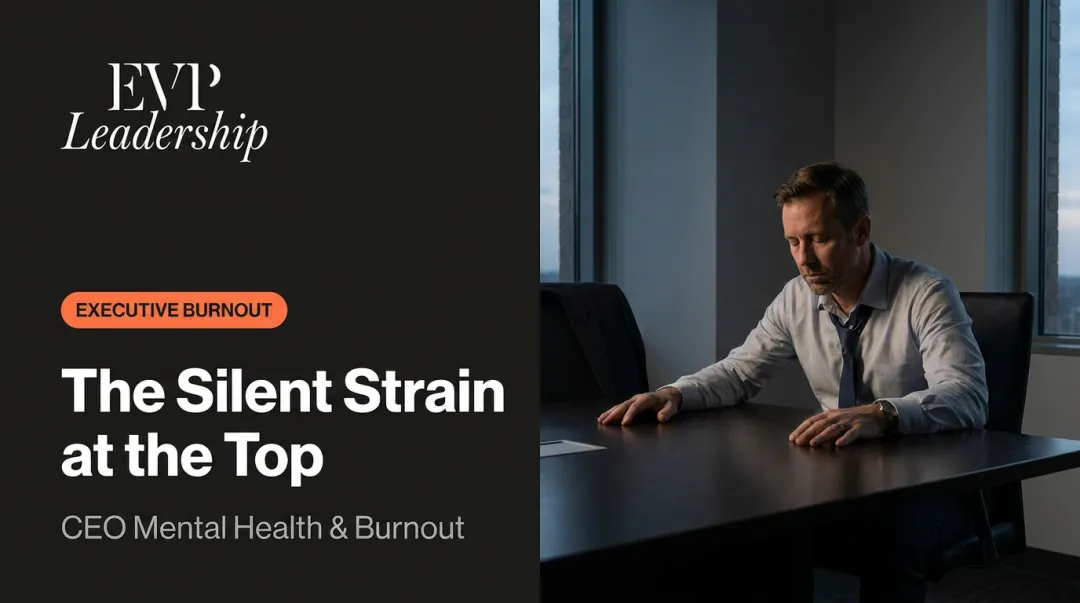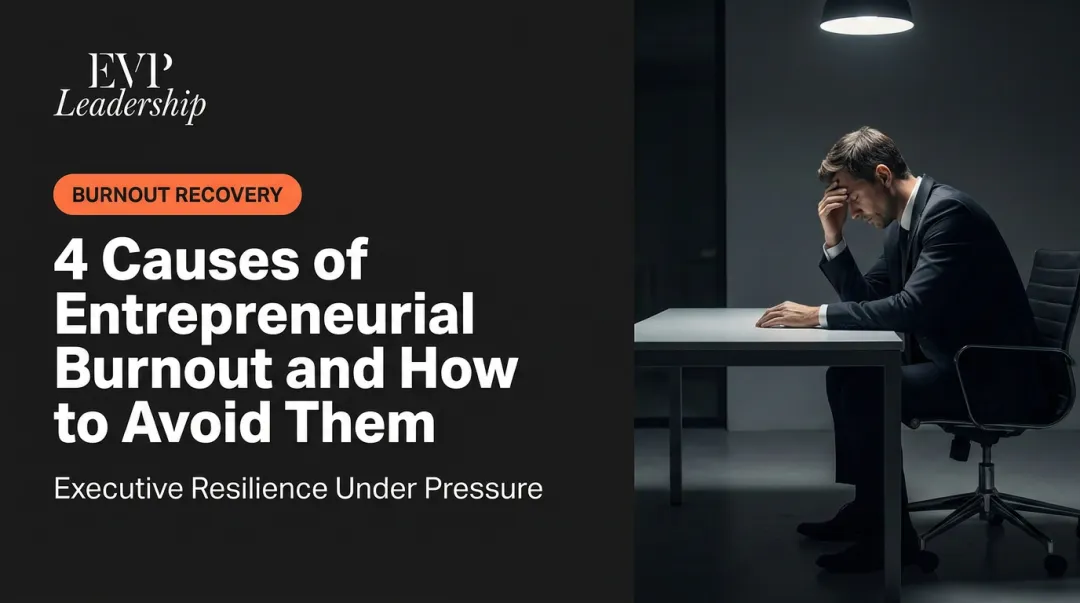
What's important to understand upfront: leadership burnout is not a character flaw or a sign you're not cut out for the role. It's a systemic response to chronic, unmanaged stress. And the leaders most at risk are often the ones who care the most.
This article covers what leadership burnout actually is, what drives it, how to recognize the early signals, and the specific prevention strategies that allow leaders to perform sustainably over the long term — without running themselves into the ground.
Key Takeaways
- The World Health Organization classifies burnout as an occupational syndrome caused by chronic, unmanaged workplace stress — not a personal failure
- Common root causes include chronic overload, isolation, work-life imbalance, and internalized impossible standards
- Early warning signs like decision fatigue and emotional withdrawal appear long before full burnout sets in
- Burned-out leaders are 3.5x more likely to leave their organization, creating serious continuity risk for small businesses
- Sustainable prevention requires structured systems, not willpower or a long weekend
What Is Leadership Burnout and What Causes It
The World Health Organization classifies burnout as an occupational syndrome resulting from chronic workplace stress that has not been successfully managed. It is characterized by three dimensions:
- Energy depletion and exhaustion — feeling physically and emotionally spent
- Increased mental distance from the job — cynicism, negativism, or detachment
- Reduced professional efficacy — a declining sense of competence and accomplishment
For leaders specifically, burnout rarely comes from one bad month. It accumulates from compounding pressures that intensify over time — particularly for small business owners and entrepreneurs who lack the organizational infrastructure that larger companies use to absorb the load.
Chronic Overload and Time Scarcity
Leaders are responsible for their own high-output work and the cognitive and emotional weight of everyone around them. The math rarely works out. According to DDI's Global Leadership Forecast, only 30% of leaders feel they have sufficient time to do their job well, and 71% say their stress has increased since stepping into their current role.
For owner-operators, this problem is more acute — there's no HR department, no deputy to absorb overflow, and no organizational buffer when things get heavy.
Isolation and Lack of Support
The "lonely at the top" dynamic is real. Leaders are expected to project confidence and maintain composure, which makes it difficult to admit when they're struggling. Without mentors, peers who understand the context, or trusted advisors outside the organization, stress accumulates internally with no outlet — and that sustained internal pressure accelerates burnout faster than the workload itself.
Work-Life Imbalance and Unrealistic Expectations
Leadership culture normalizes overwork. Checking emails at 10 pm, skipping vacations, treating constant availability as a commitment signal — leadership culture rewards these behaviors until they break down. Deloitte reports that 73% of C-suite leaders say they are unable to take time off and disconnect.
Several forces compound this simultaneously:
- No hard stop: Remote and hybrid work removes the commute that once marked the end of the day — the workday expands to fill whatever space is available
- Pressure from every direction: Boards, investors, and market demands push from above; teams, clients, and vendors push from below
- The performance tax: Maintaining the appearance of control while privately struggling burns through emotional reserves quickly
When leaders can't acknowledge — even to themselves — that they're stretched too thin, the gap between what they project and what they feel becomes its own source of exhaustion.
Warning Signs You're Heading Toward Burnout
Burnout doesn't arrive overnight. It builds slowly, which is why recognizing the early indicators matters — the sooner you catch drift, the easier the correction.
The most common warning signs leaders should watch for:
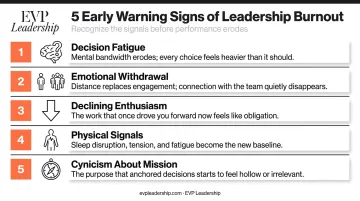
- Persistent decision fatigue — simple decisions feel harder than they should; you're second-guessing things you'd normally handle instinctively
- Emotional withdrawal — reduced patience with the team, shorter responses, less curiosity about what's happening around you
- Declining enthusiasm — work that once felt meaningful starts feeling like obligation
- Physical signals — disrupted sleep, chronic low energy, headaches, or getting sick more frequently
- Cynicism about the mission — a growing sense of "what's the point" toward goals that previously motivated you
Leaders are often the last to spot burnout in themselves. The same traits that made you effective — high standards, deep responsibility, relentless drive — are exactly what keep you pushing past the signals. More than half of managers (53%) report feeling burned out, according to Harvard Business Review. Many didn't see it coming.
A simple weekly practice helps: spend 10 minutes reviewing what drained you versus what restored you, and whether any of the warning signs above were present. That gap — between what drains you and what you're actually doing about it — is where burnout takes hold.
What Happens When Leadership Burnout Goes Unchecked
The cost of unaddressed burnout extends well beyond the leader. It compounds across the organization.
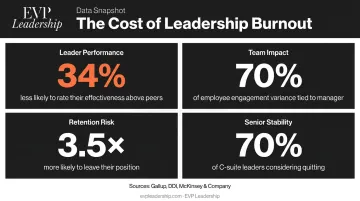
On leader performance: Burned-out leaders are 34% less likely to rate their effectiveness above their peers and half as likely to be engaged in their roles as leaders who are not burned out, according to DDI research.
On teams: Gallup estimates that managers account for at least 70% of the variance in employee engagement scores. A leader operating in a depleted state communicates less effectively, makes slower decisions, and becomes a bottleneck rather than an enabler — and that ripples directly into team performance and morale.
On retention: DDI data shows burned-out leaders are 3.5x more likely to leave their position to protect their well-being. For small businesses, losing a key leader or owner-operator doesn't just create a vacancy — it can threaten operational continuity entirely.
On senior leadership stability: Nearly 70% of C-suite leaders have seriously considered quitting for a role that better supports their well-being. When the majority of senior leaders are weighing an exit, retention stops being an HR problem — it becomes a continuity risk.
How to Prevent Burnout as a Leader
Burnout prevention is not about working less or pushing through with more discipline. It requires building deliberate systems that make sustainable performance possible. For small business owners especially, this means making structured decisions about where time and energy actually go — not just hoping things balance out.
Master Delegation Before Overload Sets In
Delegation is consistently identified as the single most powerful skill for preventing leadership burnout. DDI states it is five times more impactful than any other burnout mitigation skill — and yet, based on assessments of more than 70,000 manager candidates, only 19% are strong at it.
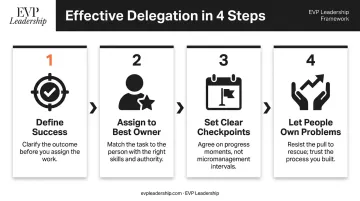
Effective delegation is not about offloading tasks. It means:
- Define what success looks like, not just what needs to be done
- Assign work based on who can own it best, not who's available
- Establish clear checkpoints rather than assuming work is on track
- Let people work through problems rather than stepping back in
Most leaders were promoted for their individual output. The shift to enabling others is a learned skill, not an instinct — and it rarely sticks unless delegation, accountability, and operating discipline are built as one connected system. When one breaks down, the others tend to follow.
Set and Enforce Non-Negotiable Boundaries
Boundaries are not a luxury. They are a structural requirement for sustained performance.
Practical boundary systems that work:
- A consolidated master calendar that includes both professional and personal commitments, so overcommitment is visible before it happens
- Designated offline hours that are non-negotiable, not just aspirational
- Explicit communication policies that set response time expectations rather than implying constant availability
- Modeling disconnection — when leaders visibly step away, teams feel permission to do the same
Hybrid and remote leaders face particular risk here. DDI reports burnout rates of 57% for hybrid leaders and 56% for remote leaders, compared to 52% for in-person leaders. Without the natural boundary of leaving the office, the workday expands by default, and the cumulative effect compounds quickly.
Build a Support Network and Accountability System
Isolation is one of the most reliable accelerants of leadership burnout. Combating it requires intentional action — it doesn't resolve on its own.
What this looks like in practice:
- Peer relationships with other leaders who face similar pressures and can offer perspective without filtering for appearances
- Mentors or advisors outside the organization who can challenge your thinking and hold a longer view
- Structured accountability through executive coaching or a formal leadership program that creates both a support structure and a space to process the real pressures of leadership
EVP Leadership's 90-Day PressurePoint System is built for small business owners and executives who need to develop the operating discipline to handle sustained pressure before burnout takes hold. Rather than managing surface symptoms, it targets the underlying drivers: over-scope, weak operating rhythm, poor delegation, no recovery cadence, and unclear priorities.
The program is delivered in individual, executive team, or leadership team formats — building the systems leaders need to perform sustainably over the long term.
Conduct Regular Self-Assessments to Catch Drift Early
The leaders who catch burnout earliest are the ones who make honest self-assessment a habit, not a reaction.
A weekly self-check-in doesn't require much time. Ask:
- What drained my energy this week, and what restored it?
- Which commitments felt purposeful versus purely obligatory?
- Were any of the warning signs from this article present?
- Am I still connected to why I'm doing this?
That last question matters more than most leaders expect. Research consistently shows that purpose-anchored leaders — those connected to their organizational mission, personal values, and long-term goals — carry more resilience under pressure than those focused only on immediate demands. Losing clarity on the "why" is often the first sign burnout is already building.
Long-Term Habits for Sustaining Leadership Without Burning Out
Prevention isn't a one-time decision. It's built through consistent habits that compound over time. That's the foundation of EVP Leadership's core thesis: leaders don't rise to expectations, they fall back on their conditioning.
The habits that create lasting resilience:
- Sleep is a performance variable, not a lifestyle preference. Cognitive function, emotional regulation, and decision quality all degrade with insufficient sleep. That's a leadership competency issue.
- Schedule physical movement — don't assume it'll happen. The CDC confirms regular physical activity supports thinking, learning, and judgment, which directly affects decision quality under pressure.
- Protect your most important work with dedicated calendar time. Without a fixed slot, high-priority work gets squeezed out by urgent but less important demands.
- Set realistic goals and track progress, not just final outcomes. Unrealistic targets drive chronic stress. Recognizing milestones along the way is part of what makes sustained performance possible.
- Your capacity to think clearly and decide well is your organization's most critical resource. Protecting it is operational discipline, not self-indulgence.
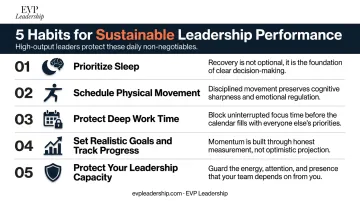
Leaders who sustain high performance over years aren't the ones who push hardest. They're the ones who have built the conditioning to hold up when pressure is highest. That conditioning is deliberate — and it starts with treating your leadership capacity as seriously as any other resource your business depends on.
Frequently Asked Questions
What is leadership burnout?
Leadership burnout is the WHO-recognized occupational syndrome caused by chronic, unmanaged workplace stress. It is characterized by exhaustion, increasing cynicism or detachment toward the job, and reduced professional effectiveness — and it is distinct from ordinary stress in that it builds over time without resolution.
What are the most common warning signs of burnout in leaders?
Key early indicators include persistent decision fatigue, emotional withdrawal from the team, declining enthusiasm for previously meaningful work, disrupted sleep, and growing cynicism about the organization's direction. Leaders often miss these signals because the same drive that makes them effective keeps them pushing past the warning signs.
How does leadership burnout affect an organization?
Burned-out leaders make slower, lower-quality decisions, communicate less effectively, and become bottlenecks rather than enablers. Team engagement drops, turnover risk rises — and those problems compound because the person responsible for setting direction is operating from a depleted state.
What is the difference between stress and burnout for leaders?
Stress is typically acute and short-term — even motivating in small doses. Burnout is chronic and cumulative, marked by disengagement, exhaustion, and a persistent sense of reduced efficacy. Left unmanaged, stress doesn't stay stress.
Can a leader recover from burnout?
Yes, burnout is recoverable — but rest alone rarely gets the job done. Recovery requires identifying root causes, rebuilding sustainable operating systems, and often seeking outside support through structured coaching or a leadership program designed to restore capacity rather than just manage symptoms.
How can small business owners specifically prevent burnout?
Entrepreneurs and small business owners often lack the support structures — HR, deputies, buffers — that distribute pressure in larger organizations. That gap makes proactive habits like delegation, boundary-setting, and outside accountability core operating requirements, not afterthoughts.