Introduction
It's midnight. You're checking emails for the third time since dinner, you haven't eaten a real meal since Tuesday, and somehow the to-do list is longer than it was yesterday. You tell yourself this is what building something requires.
It isn't. This is burnout in its early stages, wearing the costume of hustle culture success.
Small business owners face burnout differently than employees or corporate executives. According to a 2022 Capital One survey of 1,295 small business owners, 48% had experienced burnout in the past month — not the past year, the past month.
The pressures are structural, not personal. And they compound in ways most business owners don't recognize until the damage is already significant.
This article covers what makes owner burnout distinct, how to recognize it before it becomes a crisis, practical strategies for recovery, and how to build the kind of leadership foundation that stops burnout from recurring.
Key Takeaways
- Burnout for small business owners is a leadership performance problem, not just a personal wellness issue
- Warning signs are physical, cognitive, and operational — and often dismissed for months
- Root causes are structural: overextension, identity fusion, and lack of strategic clarity
- Recovery requires both immediate relief and lasting structural change
- Prevention through consistent leadership conditioning beats repeated recovery cycles every time
Why Small Business Owner Burnout Is Different
The Identity Problem
Employees clock out. Owners rarely do — and it's not just about hours. When your name is on the business, your sense of self is often tangled up in its performance. A slow quarter doesn't just threaten revenue; it feels like a personal verdict. That's what makes disengaging so difficult. Slowing down feels like abandonment, not strategy.
EVP Leadership's work with founders identifies "identity fused to the business" as one of the primary underlying drivers of executive burnout — distinct from generic workplace stress, and significantly harder to address through generic wellness advice.
Structural Isolation
There's no manager to absorb the pressure with you. No HR department to flag when you're running on empty. No peer at exactly the same level who carries the same weight of final decision-making. A Ramsey Solutions survey found that 56% of small business owners feel alone when solving problems and making decisions — more than half the people who face the hardest leadership challenges do so without a comparable peer in sight.
That structural reality creates conditions most leadership frameworks don't account for:
- No one to escalate to when the pressure spikes
- No built-in check on your own declining performance
- No peer who holds the same level of accountability you do
The Compounding Loop
Owner burnout operates differently than employee burnout because the feedback loop has no exit. When your performance drops, the business suffers. When the business suffers, your stress climbs — and your performance drops further. Employees can step back from specific responsibilities. Owners often can't hand the wheel to anyone, so the loop tightens until something breaks.
Catching it early isn't a matter of self-care. It's a leadership decision with direct business consequences.
Warning Signs You're Approaching Burnout
Most owners miss the early signals because they're conditioned to push through discomfort. These are the signs worth taking seriously:
Physical and Cognitive Signals
- Persistent fatigue that a full night's sleep doesn't fix
- Disrupted sleep patterns — either difficulty falling asleep or waking at 3am with a running mental list
- Frequent illness, tension headaches, or physical tension that doesn't resolve
- Mental fog — difficulty concentrating on tasks that used to feel effortless
- Second-guessing decisions that once came naturally
- Increasingly reactive thinking: putting out fires instead of planning ahead
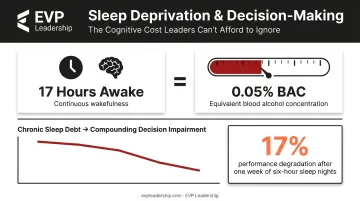
The cognitive impact is more than inconvenient. Research cited by NIOSH found that being awake for 17 hours produces cognitive and motor impairments equivalent to a 0.05% blood alcohol concentration — a level at which measurable impairment is well-established. Owners running on chronic sleep debt aren't just tired — they're making decisions in a demonstrably compromised state.
Emotional and Behavioral Red Flags
- Growing cynicism about the business or your clients — from someone who used to care deeply
- Irritability with team members that's out of proportion to the situation
- Emotional detachment from work that used to feel meaningful
- Withdrawing from relationships outside the business
For owners specifically, the behavioral signals look like this:
- Working longer hours while output actually declines
- Inability to delegate even when capable help is available
- Postponing strategic thinking indefinitely in favor of daily firefighting
- Dreading tasks that once felt rewarding
The Performance Paradox
Burned-out owners often respond to declining performance the same way: work harder. Longer hours, more effort, fewer breaks. This feels like discipline but functions as acceleration — you're driving faster toward the wall.
Research from Balderton found 83% of founders felt diminishing returns from simply putting in more hours once they crossed a certain threshold. At that point, the problem isn't effort — it's the operating model that effort is being poured into.
The Root Causes Driving Small Business Owner Burnout
Structural Overextension
The most common root cause is an unsustainable operating structure. Many small business owners function simultaneously as operator, strategist, salesperson, and administrator. No single person can sustain all four roles indefinitely without systems and a capable team distributing the load.
EVP Leadership refers to this as the "founder-bottleneck pattern" — a structural problem rooted in how the business was built, not who's running it. Without clear delegation protocols and accountability systems, every decision, every execution task, every client call routes back to the owner.
The Absence of Strategic Clarity
When everything feels equally urgent, decision fatigue accumulates fast. Without a clear strategic framework defining what actually matters most, owners spend enormous mental energy triaging instead of executing with intention.
EVP Leadership's PressurePoint System addresses this directly through Mission Clarity — "knowing exactly what must be achieved and why it matters now." Owners who lack this foundational reference point default to reactive decision-making, burning through mental bandwidth on problems that shouldn't reach them at all.
Identity-Business Fusion
When self-worth is tied entirely to business performance, every setback becomes a personal failure. Every slow month triggers existential anxiety. Rest feels like giving up.
This psychological pattern is a direct burnout accelerant — and it's particularly hard to address because it doesn't show up on a spreadsheet. It shows up as:
- The inability to mentally leave work at the end of the day
- Difficulty celebrating wins because the next problem is already visible
- A grinding internal pressure that never quite turns off

Unlike structural problems, there's no org chart fix for this one.
Practical Strategies to Navigate and Recover from Burnout
Immediate Recovery Actions
First: acknowledge it without judgment. Many owners push through symptoms for months — sometimes years — because admitting burnout feels like admitting failure. Recognizing it early is a strategic advantage. You can't address a problem you won't name.
Second: create a genuine pause. A deliberate interruption of the stress cycle is different from avoidance. Practically, this might look like:
- A real day off where you don't check in
- Blocking protected hours where you are unavailable
- A short trip that creates physical distance from the office environment
Breaking the cycle long enough to see clearly is the point. EVP Leadership's PressurePoint System opens with "Pause the Noise" for exactly this reason — control the moment before the moment controls you. Applied to burnout recovery, this step creates the space required to move from reactive to intentional.
Structural Business Solutions
Immediate relief buys time. What prevents recurrence is structural change.
Delegation: Conduct a task audit — not theoretical, but honest. What requires your judgment? What are you holding onto out of habit or preference for control? Distributing cognitive load is one of the highest-leverage moves a burned-out owner can make.
EVP Leadership's delegation work defines what gets delegated, to whom, with what authority, and against what success criteria — a clean operating protocol, not a vague handoff.
Operational boundaries: Define work hours. Create response protocols that establish real separation between business and personal time. Owners who have no boundary between business time and personal time never fully recover, because the stress cycle never closes. Treat it as an operating discipline, not a wellness perk.
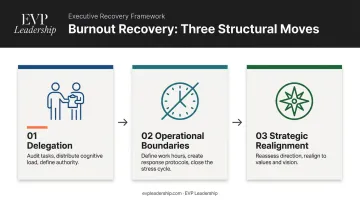
Strategic realignment: Use the recovery period to assess whether your current operations still reflect why you started this business. Burnout is often partially caused by pursuing growth in directions that no longer align with your values or vision. Misaligned direction drains resources — that's a strategy problem, not a mindset problem.
Lifestyle and Wellbeing Habits
These aren't wellness tips. They're maintenance for the asset that runs everything else.
- Sleep: Chronic sleep deprivation measurably impairs decision quality. Protect it accordingly.
- Physical movement: Consistently linked to stress recovery and cognitive restoration.
- Nutrition: Skipped meals and poor eating compound the physiological stress load.
- Mindfulness or reflection practices: Even 10 minutes of structured reflection daily interrupts the reactive thought spiral.
These habits protect your performance capacity. That's the reason they belong in a business recovery plan.
Building Long-Term Burnout Resilience Through Leadership Conditioning
Most burnout advice focuses on recovery — what to do after you've hit the wall. The stronger investment is preventing the accumulation in the first place.
Operational Systems as a Foundation
Businesses that run on clear processes, defined accountability structures, and strategic planning frameworks give owners a stable operating foundation. Instead of holding everything in your head, the business structure carries the load.
EVP Leadership's 90-Day PressurePoint System is built to create exactly this kind of foundation — across three layers: Identity, Diagnostic, and Execution. The Diagnostic Layer alone targets six pressure points that, left unaddressed, drive chronic overload:
- Mission Clarity — aligns daily decisions to a defined purpose
- Force Alignment — ensures people and resources point in the same direction
- Problem Intelligence — sharpens how owners identify and prioritize real problems
- Decision Integrity — reduces second-guessing and decision fatigue
- Execution Discipline — builds follow-through as a structural habit
- Momentum Control — prevents progress from stalling under pressure

The Role of a Support Network
Peer entrepreneurs, mentors, and business advisors provide something most owners are missing: perspective from someone who understands the weight of ownership. Owners who regularly engage with advisors make faster, more confident decisions — and spend less energy second-guessing themselves in isolation.
The goal isn't to outsource your thinking. It's to break the isolation that amplifies every pressure you're already carrying.
The Conditioning Mindset
EVP Leadership's core philosophy draws a sharp distinction between training and conditioning. Training gives you information. Conditioning builds capacity. Under pressure, leaders don't rise to expectations — they fall back on what they've practiced.
This applies directly to burnout resilience. A leader who has consistently built reflection habits, proactive planning rhythms, and strategic check-ins doesn't collapse under pressure the way a leader who hasn't will. The habits aren't glamorous, but practiced consistently they change how much pressure you can carry — and how fast you recover when it spikes:
- Weekly reflection to process what's working and what isn't
- Scheduled planning blocks that protect strategic thinking from daily noise
- Regular strategic reviews to keep priorities from drifting
Actionable change doesn't come from annual retreats or transformation events. It comes from small habits practiced consistently — over weeks and months, not days.
Frequently Asked Questions
How do you deal with burnout as a small business owner?
The two-stage approach: first, acknowledge it and create a genuine pause to break the immediate stress cycle. Then make structural changes — build delegation protocols, set operational boundaries, and establish systems that distribute cognitive load. Rest alone doesn't fix what structure created.
What are the 7 signs of burnout?
There's no official seven-sign framework. The World Health Organization defines burnout through three dimensions: exhaustion, cynicism, and reduced professional efficacy. Common lists add fatigue, cognitive fog, irritability, physical symptoms, declining performance, and social withdrawal. For business owners, two more frequently appear: inability to delegate and chronic reactive-only decision-making.
What is the 42% rule for burnout?
The 42% rule holds that the brain and body need roughly 42% of a 24-hour day — about 10 hours — for rest and recovery. It's a wellness framework, not a clinical standard. For small business owners, the practical implication is straightforward: chronically shortchanging sleep and downtime creates a performance debt that compounds.
What is the difference between stress and burnout?
Stress is typically short-term, tied to specific pressures, and resolves when the pressure eases. Burnout is chronic — it's the accumulation of sustained stress without adequate recovery, leading to exhaustion, cynicism, and lost motivation that doesn't resolve with a good weekend. Burnout often arrives quietly — which is exactly why it's easy to miss until the damage is done.
How long does it take to recover from burnout?
Timelines vary by severity, but recovery is typically measured in months, not weeks. The more important variable is whether you address root causes or only rest — without structural changes to the conditions that created burnout, symptoms tend to return regardless of how much time you take off.