Introduction
The traits that make founders effective — relentless drive, deep ownership, and passion for what they've built — are the same traits that put them at disproportionate risk for burnout. That's not irony. It's a predictable leadership challenge.
Entrepreneurial burnout isn't about being weak or working too hard on the wrong day. According to a 2025 Sifted survey of 138 founders, 54% experienced burnout in the prior 12 months, with 83% reporting high stress and 75% reporting anxiety. For people running businesses without the institutional safety nets that corporate employees take for granted, these numbers are the norm, not the exception.
The good news: burnout has identifiable causes, and identifiable causes can be addressed with the right discipline.
This article breaks down the four primary drivers of entrepreneurial burnout, the warning signs that precede a full episode, and the specific habits that prevent it — approached as a leadership discipline, not a wellness checklist.
Key Takeaways
- Entrepreneurial burnout has four distinct root causes — and each one is preventable.
- Burnout isn't a personal failing — it's a predictable outcome of unsustainable leadership patterns.
- Warning signs appear well before full burnout; catching them early is far less costly than recovering from them.
- Prevention requires structural changes to how you lead and operate.
- Long-term resilience is built through consistent practice — it can be developed at any stage of leadership.
What Is Entrepreneurial Burnout?
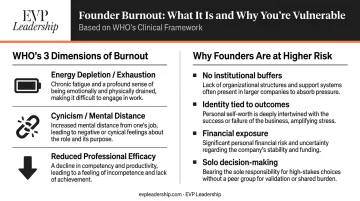
The WHO classifies burnout in ICD-11 as an occupational phenomenon resulting from chronic workplace stress that hasn't been successfully managed. It has three dimensions:
- Energy depletion or exhaustion
- Increased mental distance from work, or cynicism
- Reduced professional efficacy
This is distinct from ordinary stress, which is responsive to rest and typically short-term. Burnout persists even after recovery time, because it reflects a structural breakdown in capacity — not just accumulated fatigue.
Entrepreneurs are disproportionately at risk. Unlike employees, they face compounding pressures with little structural protection:
- Shoulder every consequential decision alone
- Tie personal finances directly to business outcomes
- Wrap their identity around whether the business succeeds
- Lack the institutional buffers — HR, peer accountability, clear work/life separation — that employees have access to
EVP Leadership frames this clearly: burnout is a systemic breakdown in leadership capacity driven by over-scope, weak operating rhythm, poor delegation, no recovery cadence, unclear priorities, and identity fused to the business. It's a predictable endpoint of unsustainable leadership patterns — not a bad week.
Burnout rarely announces itself. It accumulates — and the four causes below are where it typically starts.
4 Common Causes of Entrepreneurial Burnout
Burnout almost never has a single cause. It compounds. Understanding which of these four drivers applies to your situation is where meaningful prevention begins.
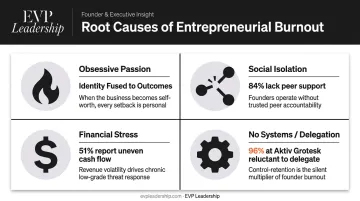
Obsessive Passion
Passion is why most people start businesses. But research from Vallerand's Dualistic Model of Passion identifies two distinct types: harmonious passion, which is autonomous and flexible, and obsessive passion, which is controlled, rigid, and tied to external validation.
Entrepreneurship creates conditions where obsessive passion is easy to develop. When the business is your identity, your income, and your purpose simultaneously, stepping away feels threatening. The founder checking revenue dashboards at midnight, unable to enjoy a weekend without anxiety, measuring self-worth entirely through outcomes — that's obsessive passion in operation.
The result is emotional drainage even when doing work you genuinely love. It's not the hours that exhaust you — it's the inability to separate from them.
Signs you've tipped toward obsessive passion:
- You feel guilty during time off
- Business setbacks feel like personal failures
- You struggle to be present in non-work contexts
- Your mood is directly correlated with daily business metrics
The shift required is developing a flexible relationship with work, one where your identity as a leader isn't contingent on what the business produces today.
Social Isolation
Entrepreneurship is structurally lonely. Employees share their frustrations with colleagues, vent to their manager, or commiserate over lunch. Founders carry the weight of decisions, failures, and uncertainties largely alone.
A 2024 Balderton Capital survey of 128 founders and CEOs found that 84% said strong support networks are essential for peak performance — but only 33% often turned to investors for professional support. Most founders rely on a partner or spouse, not a peer who understands the pressure from the inside.
That gap matters beyond emotional wellbeing. Isolation narrows perspective — when there's no trusted peer to reality-check a decision, small problems can feel existential. A major deal falling through becomes catastrophic in the echo chamber of solo leadership.
The distorted thinking that follows leads to worse decisions under pressure.
The isolation compounds over time: less creative thinking, reduced motivation, and a shrinking capacity to see situations clearly. A peer-reviewed study found that entrepreneur loneliness increases business exit intentions through reduced entrepreneurial passion — meaning isolation doesn't just feel bad, it threatens the business itself.
Chronic Uncertainty and Financial Stress
Salaried employees go home at 5 p.m. and stop worrying about whether payroll will clear. Founders don't get that switch. The Federal Reserve's 2025 Report on Employer Firms found that 51% of small employer firms reported uneven cash flows and 56% had difficulty paying operating expenses.
This isn't background noise. When the brain is continuously scanning for financial threat — missed payroll, a lost client, a down quarter — it cannot shift into the restorative or creative modes required to lead effectively. Stress impairs decision-making, increases risk aversion in situations that call for boldness, and increases risk-taking in situations that call for caution.
Founders often treat risk tolerance as a badge of honor, which means they underestimate the toll that chronic uncertainty takes. Balderton's 2024 research found 42% of founders said personal financial stress sometimes distracted them from running the business — and 27% said it directly affected business decisions.
Financial stress at that scale doesn't stay contained to the balance sheet. It shapes how founders read risk, prioritize decisions, and show up for their teams — and it responds to structural solutions, not willpower.
Overworking Without Systems or Delegation
Long hours alone don't cause burnout. Long hours without systems, boundaries, or recovery time do.
A 2020 QuickBooks survey of over 1,000 small business owners found they spent an average of 31 hours per week on day-to-day operations, and 96% were reluctant to delegate or let go of operational control. The same survey found 65% believed the business would be better positioned for long-term growth if they could step back — yet they couldn't.
This is the founder-bottleneck pattern: work flows back to the founder regardless of team size, because the delegation infrastructure doesn't exist. No documented processes, no defined accountability, no clear handoffs. So the founder does what needs doing — every time.
The issue isn't willingness. It's the absence of systems that make delegation reliable. Without documented processes and clear accountability, handing something off doesn't free up capacity — it creates a boomerang. The work comes back the moment something goes wrong.
Warning Signs You're Approaching Burnout
Burnout doesn't announce itself loudly. Most entrepreneurs dismiss early symptoms as normal stress — and by the time the pattern is undeniable, significant damage has already been done.
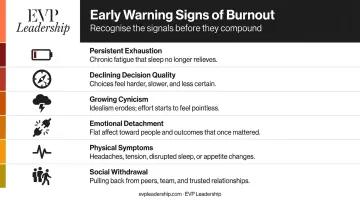
Key early warning signs:
- Persistent exhaustion that rest doesn't fix — sleeping more but recovering less
- Declining decision quality — second-guessing, avoidance, increased reactivity
- Growing cynicism — resentment toward work, team members, or clients that wasn't there before
- Emotional detachment — going through the motions without engagement or care
- Physical symptoms — recurring illness, sleep disruption, tension headaches
- Social withdrawal — pulling back from relationships and support systems
These signs are measurable. They're also correctable — but only when you catch them early.
Left unaddressed, they compound into reduced creativity, declining revenue, poor hiring and retention decisions, and damaged relationships. Burnout is a leadership performance issue — and the earlier it gets treated as one, the less it costs the business.
How to Avoid Entrepreneurial Burnout
Prevention means building the structural and behavioral habits that make sustained high performance possible — and treating your own sustainability as a strategic priority, not an afterthought.
Shift from Obsessive to Harmonious Passion
The antidote to obsessive passion isn't stepping back from the business — it's developing a flexible relationship with it. That means separating your identity from daily outcomes, reconnecting with intrinsic motivators beyond metrics, and building space for the rest of your life to exist.
Practical steps:
- Schedule at least one full day per week with no business activity — and protect it
- Build interests outside work that give you energy rather than just distract you
- Practice noticing when your mood tracks too closely with business results, and interrupt the pattern
The Identity Layer of EVP Leadership's PressurePoint System addresses this directly — developing leaders anchored in consistency, capacity, and character rather than business performance, so self-worth isn't tied to a dashboard number.
Build a Support Network Intentionally
Isolation doesn't fix itself. Community has to be sought out deliberately, because the natural pull of entrepreneurship is toward solitary problem-solving.
A small, trusted circle of fellow founders can dramatically reduce the psychological weight of leadership. Not because they have answers, but because they understand the pressure from the inside.
Options worth pursuing:
- Mastermind or peer advisory groups (even informal ones)
- A mentor with direct founder experience — not just business experience
- Scheduled monthly check-ins with one or two peers who will give honest feedback
The key is regularity. A network you only reach for in crisis isn't a support structure — it's a last resort. Build the habit of connection before you need it.
Plan for Uncertainty Rather Than React to It
Uncertainty is permanent in entrepreneurship. The goal isn't to eliminate it; it's to reduce the cognitive load it creates through preparation.
- Build a cash reserve that covers at least three months of operating expenses
- Create contingency plans for your top three likely disruptions
- Diversify revenue streams where your model allows
Beyond financial planning, interrupt the stress cycle before it compounds. The PressurePoint System's "Pause the Noise" step is designed as exactly this kind of repeatable intervention — giving you a way to control the moment before the moment controls you.
Whether through physical exercise, journaling, or structured reflection, a deliberate pause breaks the reactive loop that chronic uncertainty reinforces.
Build Systems That Allow Real Delegation
Delegation without systems fails. Tasks come back to the founder because there's no infrastructure to hold them elsewhere.
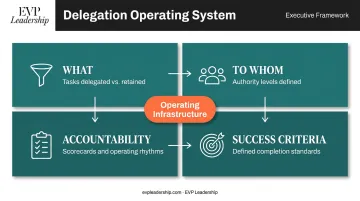
EVP Leadership's Delegation, Accountability & Operating Discipline engagements treat these three elements as a connected operating system — one that answers:
- What gets delegated, and what stays with you
- To whom, with what authority level
- Against what accountability — scorecards, operating rhythms, performance conversations
- By what success criteria — so "done" means something specific
Once that infrastructure exists, real delegation becomes possible. And once real delegation is in place, working hour limits become enforceable — because there's no longer a structural reason for work to land back on your desk at 10 p.m.
Building Long-Term Burnout Resilience as a Leader
Avoiding burnout isn't a one-time fix. It's an ongoing practice of conditioning.
EVP Leadership's core philosophy puts it directly: leaders don't rise to expectations — they fall back on conditioning. Under real pressure, your response reflects how you've been prepared — not what you intend to do. Burnout prevention works the same way.
Balderton's research reinforces why this matters operationally: 88% of surveyed founders agreed that excessive stress leads to poor decision-making, and 83% acknowledged diminishing returns from excessive hours. Sustainability isn't a soft concern — it's a performance variable.
Long-term resilience habits:
- Run quarterly self-assessments on your energy, decision quality, emotional reserves, and whether your role still matches what the business needs from you
- Document systems and processes so the business doesn't depend entirely on your presence
- Protect weekly recovery time — not just annual vacations, but recurring blocks where the business runs without you
For founders who want to build these habits with a structured framework, EVP Leadership's 90-Day PressurePoint System works through the underlying drivers of burnout — not just the symptoms — with a clear progression and built-in accountability.
The four causes covered in this guide — unclear priorities, poor delegation, isolation, and unsustainable pace — don't resolve themselves. But leaders who treat self-awareness as a practiced discipline catch the warning signs earlier, before they compound into full burnout.
Frequently Asked Questions
What is the 42% rule for burnout?
From Emily and Amelia Nagoski's 2019 book Burnout: The Secret to Unlocking the Stress Cycle, the 42% rule suggests roughly 10 hours of every 24 should go toward rest and recovery — sleep, movement, and stress-reducing connection. The core principle holds regardless of the exact percentage: recovery must be deliberate and protected, not whatever's left after work.
What are the 7 signs of burnout?
The WHO and Maslach Burnout Inventory point to three core dimensions — exhaustion, depersonalization, and reduced personal accomplishment — that surface practically as persistent fatigue, declining performance, social withdrawal, sleep disruption, difficulty concentrating, growing resentment, and emotional disconnection from work you once cared about.
What is the biggest killer of the entrepreneurial mindset?
Chronic burnout — particularly the combination of isolation and obsessive passion — erodes the curiosity, resilience, and creative thinking that define entrepreneurial thinking. The insidious part is that it happens gradually, often before the founder recognizes what's being lost. By the time decision-making and creativity are visibly impaired, the depletion has been building for months.
Can entrepreneurial burnout be prevented, or is it inevitable?
Burnout is not inevitable — it's predictable and preventable with the right systems, boundaries, and support structures. But prevention requires proactive effort; it doesn't happen by default. Waiting for symptoms to appear before making structural changes is the most common and costly mistake founders make.
How does burnout affect business performance?
Burnout impairs the functions leaders rely on most: decision-making quality, creative problem-solving, team communication, and execution discipline. Downstream effects include declining revenue, missed opportunities, higher team turnover, and reactive decisions that damage culture or client relationships.
What is the difference between stress and burnout for entrepreneurs?
Stress is typically short-term and responsive to rest — it fades when the pressure reduces. Burnout is chronic depletion that persists even after recovery periods, because it reflects structural problems that rest alone can't solve. Fixing burnout requires changing the underlying operating conditions: how work is structured, how delegation functions, how recovery is protected, and how identity is separated from outcomes.