Introduction
Every business leader faces a version of the same strategic question: do you build around what your organization does best, or around what the market actually needs?
That question shapes how you hire, where you invest, what you build, and which opportunities you pursue. It's a leadership orientation — not just a planning exercise.
The tension between inside-out and outside-in strategy is real, and choosing the wrong orientation for your context can cost you both growth and relevance. Research from George Day and Christine Moorman shows that these two orientations reflect fundamentally different starting points—not just different planning styles.
This article breaks down both approaches and gives you a practical framework for choosing the orientation that fits your current stage, market position, and leadership context.
Key Takeaways
- Inside-out strategy starts with core competencies and asks: "Where can we win with what we have?"
- Outside-in strategy starts with market needs and asks: "What must we build to deliver value here?"
- Neither is universally superior—your stage, how fast your market moves, and the problem you're solving all determine which lens to lead with
- High-performing organizations blend both—but clarity comes from choosing which one drives the decision
- The clearest warning sign: you keep building things your market doesn't buy, use, or ask for
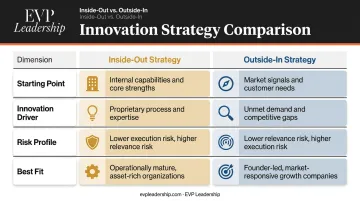
Inside-Out vs. Outside-In Strategy: Quick Comparison
Before diving into each approach, here's how they differ at the fundamental level:
| Dimension | Inside-Out | Outside-In |
|---|---|---|
| Starting Point | Internal strengths, capabilities, culture | Customer needs, market trends, competitive gaps |
| Innovation Driver | R&D, leadership vision, proprietary assets | Customer feedback, unmet demand, market signals |
| Risk Profile | Becoming disconnected from evolving customer needs | Overextending beyond current organizational capacity |
| Best Fit | Stable markets, strong differentiation, early brand building | Fast-changing markets, growth plateaus, relevance gaps |
Neither approach is inherently superior — the right choice depends on where your business stands right now. The sections below break down each strategy so you can identify which orientation fits your current stage and pressure points.
What Is Inside-Out Strategy?
Inside-out strategy begins with an honest audit of what your organization actually does well—capabilities, culture, resources, institutional knowledge—and then asks: where can those assets create a lasting competitive advantage?
This approach is grounded in the Resource-Based View of strategy, developed by Jay Barney, which argues that sustained competitive advantage comes from internal resources that are valuable, rare, and difficult for competitors to replicate. In practical terms, the core questions leaders ask are:
- What are we uniquely capable of?
- What do we believe in strongly enough to build a business around?
- What do we have that competitors would struggle to copy?
The Case for Inside-Out
The benefits are concrete and compounding over time:
- Strategic clarity — decisions align to a clear, consistent identity
- Disciplined resource allocation — investment flows toward genuine strengths
- Deep expertise — the organization gets better at what it already does well
- Authentic brand culture — the message reflects genuine belief, not just market positioning
Prahalad and Hamel's core competence framework makes this point directly—core competencies should contribute significantly to perceived customer benefits and be difficult for competitors to imitate. When those conditions exist, building from the inside out is a rational choice.
Where Inside-Out Breaks Down
The risk is drift. Organizations that build entirely inward can lose track of shifting customer needs—a pattern Toyota experienced acutely during the 2009–2010 recall crisis, when Akio Toyoda acknowledged that rapid growth had confused the company's priorities. Over 9 million vehicles were recalled globally, and the crisis was traced in part to deviation from the lean organizational principles that had made Toyota exceptional.
Internal metrics can become a substitute for market feedback. When that happens, the gap between what you build and what buyers actually want widens—gradually, then all at once.
Where Inside-Out Fits Best
- Companies with strong proprietary capabilities or specialized expertise
- Early-stage businesses establishing a differentiated identity
- Organizations in stable or slow-changing industries
- Leaders with deep customer instinct built from years of direct market exposure
Luxury goods and design-led technology are classic inside-out categories. The value proposition is built on craft, heritage, or a specific creative vision—not on polling customers about what they want next.
What Is Outside-In Strategy?
Outside-in strategy reverses the starting point. Instead of asking what you're good at, you start by asking what the market actually needs—and then determine what internal capabilities must be built, acquired, or restructured to meet that demand.
Day and Moorman define this orientation as starting with the market when designing strategy, rather than being constrained by existing capabilities. The primary questions are:
- Where is demand growing?
- What problems are customers trying to solve that no one has addressed well?
- What are competitors missing?
The Case for Outside-In
The advantages show up in fast-moving markets: stronger product-market fit, higher relevance, reduced risk of building solutions no one values, and better responsiveness when customer expectations shift. In categories where the competitive landscape moves faster than traditional planning cycles, outside-in thinking is what keeps organizations ahead of that curve.
Tesco's strategy shift beginning in 1995—centered on using customer data to shape every aspect of their offer—is one of the clearest retail examples. By anchoring decisions in what actual customers wanted, Tesco gained significant market share through a period when most traditional grocers were still operating on internal assumptions.
Where Outside-In Breaks Down
Slater and Narver draw a useful distinction between being "customer-led" and being genuinely "market-oriented." Customer-led thinking focused narrowly on expressed needs can actually become a liability. Bower and Christensen documented this pattern in their research on disruptive technologies: well-managed companies failed precisely because they listened too closely to existing customers and over-invested in current demand—missing disruptive shifts entirely.
Without a stable internal foundation, outside-in organizations risk:
- Constant pivoting that exhausts the team and dilutes the brand
- Capability gaps when market demands outpace what the organization can actually deliver
- Strategic incoherence when every external signal triggers a new initiative
Where Outside-In Fits Best
- Businesses in rapidly evolving markets or high-disruption categories
- Companies expanding into new customer segments
- Organizations that have hit a growth plateau despite doing their core work well
- Leaders who need to re-establish relevance after a meaningful market shift
Inside-Out vs. Outside-In: Which Approach Works Best for Your Business?
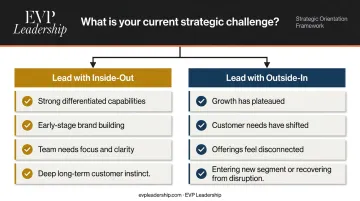
There is no universal answer. The better question is: what is your current strategic challenge?
Situational Guidance
Lead with inside-out when:
- Your organization has strong, differentiated capabilities and operates in a relatively stable market
- You're an early-stage business building a clear brand identity
- Your team needs focus and clarity around what you uniquely offer
- You have developed customer instinct from deep, long-term market exposure
Lead with outside-in when:
- Growth has plateaued despite executing your core work well
- Customer needs or competitive dynamics have shifted noticeably
- Your offerings feel disconnected from what buyers currently value
- You're entering a new segment or recovering from a market disruption
The Hybrid Reality
Most effective business leaders don't commit exclusively to one orientation—they use inside-out thinking to define what they stand for and outside-in thinking to stay relevant. A 2015 meta-analysis published in Industrial Marketing Management examined the combined effects of both orientations and found that neither alone produces superior outcomes—the interaction between them matters.
The discipline is knowing which lens to lead with at any given moment, and building the organizational habit of toggling between them as conditions change.
The Leadership Dimension
Choosing a strategic orientation isn't only an analytical decision — it's a leadership conditioning challenge.
Research by Tasha Eurich in the Harvard Business Review shows that leaders with higher self-awareness make better decisions, build stronger relationships, and communicate more effectively. Leaders who operate primarily from one strategic orientation without awareness of its blind spots tend to make reactive decisions under pressure—defaulting to whatever they know best rather than what the situation requires.
That pattern shows up consistently in Gennifer Baker's strategic planning work with founders and executives at EVP Leadership. The problem she sees isn't leaders choosing the wrong framework — it's leaders who haven't been conditioned to stress-test their assumptions from both directions before pressure forces the issue.
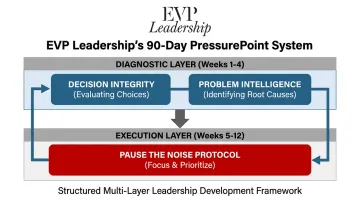
EVP Leadership's 90-Day PressurePoint System addresses this directly. Two components of the Diagnostic Layer — Decision Integrity and Problem Intelligence — train leaders to ground decisions in reality rather than instinct or familiar assumptions. The Execution Layer's "Pause the Noise" protocol interrupts reactive strategic decisions before they compound. The result is leaders who can apply both orientations with deliberate judgment, not just reach for the one that feels comfortable.
Real-World Examples in Business Strategy
Apple: Inside-Out Done Right
Simon Sinek's 2009 TEDx talk on the Golden Circle used Apple as the clearest example of inside-out strategy in action. Apple communicates from belief and purpose before product—starting with why they exist, then how they build, then what they make. This sequencing isn't marketing. It's a reflection of how the company makes decisions internally.
Harvard Business Review's 2020 analysis of Apple's organizational design reinforces this: Apple organizes around functional expertise rather than business units, with leaders expected to have deep domain knowledge and immersion in details. The result is a company that generates sustained, premium customer loyalty—not because it asks customers what they want next, but because it has conditioned itself to understand what customers will value before they can articulate it.
Key takeaway: Inside-out works powerfully when paired with genuine customer instinct, not as a substitute for it.
Tesco: Outside-In and Its Limits
Tesco's outside-in transformation beginning in 1995 built around customer data is one of retail's most cited strategic shifts. By understanding actual buying behavior and using it to shape product range, pricing, and store experience, Tesco gained significant competitive ground through the late 1990s and 2000s.
The story doesn't end there. By 2014, Kantar data reported by The Guardian showed Tesco's market share had fallen to 28.7%, down from a peak of 31.8% in October 2007. Pressure from Aldi and Lidl, internal operational complexity, and a loss of strategic focus revealed that outside-in orientation requires continuous maintenance—not just an initial commitment.
Key takeaway: Outside-in thinking isn't a one-time repositioning. It requires ongoing investment in market intelligence and the internal discipline to act on what you learn.
The Sustained Advantage Pattern
Companies that hold competitive advantage over time aren't locked into one orientation. Amazon's official Leadership Principles state it plainly: "Leaders start with the customer and work backwards." Amazon's ability to execute on that principle, though, comes from extreme internal capability-building and operational discipline. The outside-in compass only works because of the inside-out engine behind it.
The pattern across durable competitive advantages looks like this:
- Customer orientation sets the direction — what to solve, what to build toward
- Internal capability determines execution quality — whether you can actually deliver
- Deliberate switching between both lenses prevents blind spots that either approach alone creates
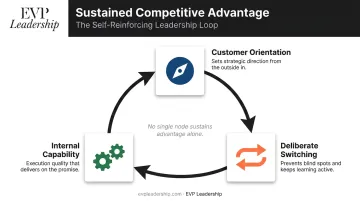
The leaders who sustain this aren't smarter. They've built the habit of using both lenses on purpose, especially when one feels more natural than the other.
Conclusion
Inside-out and outside-in are complementary orientations. Which one deserves more attention right now depends on your current challenge, not your default preference.
Two diagnostic questions help clarify which orientation deserves more attention right now:
- "Are we losing relevance because we've stopped listening to the market?" — that's an outside-in signal
- "Are we losing focus because we've stopped leading with what we do best?" — that's an inside-out signal
Strategic effectiveness is ultimately a leadership capacity issue. The ability to read which orientation a situation demands — and execute on it under pressure — isn't a planning skill. It's a conditioned one. Leaders who develop that capacity don't just make better strategic decisions. They build organizations that hold their footing when the environment shifts.
Frequently Asked Questions
What are the 4 perspectives of strategy?
The four perspectives come from Kaplan and Norton's Balanced Scorecard framework: financial, customer, internal business process, and learning/growth. Outside-in thinking maps most directly to the customer perspective; inside-out thinking aligns with internal process and learning/growth.
What are the 5 P's of strategic planning?
Mintzberg's 5 P's are Plan, Ploy, Pattern, Position, and Perspective. Outside-in strategy aligns most closely with Position — how the organization relates to its external environment. Inside-out aligns with Perspective and Pattern, which reflect organizational worldview and consistent behavioral tendencies.
Can a business use both inside-out and outside-in strategies simultaneously?
Yes—and most effective organizations do. Inside-out thinking defines core identity and competitive advantage; outside-in thinking keeps that identity aligned with what the market currently values. The discipline is in knowing which one to lead with at any given decision point.
What is an example of an outside-in strategy in business?
Amazon is the clearest example. Their leadership principles explicitly state that leaders "start with the customer and work backwards." Jeff Bezos's 1997 shareholder letter used "Obsess Over Customers" as a strategic heading when the company had just over $147 million in revenue — a customer-first orientation that has shaped every major business model decision since.
When is inside-out strategy the better choice for a small business?
Inside-out is often the stronger starting point when a small business has a clear, differentiated founder capability, is in early brand-building mode, or operates in a niche where depth of expertise is the primary competitive advantage.
What are the 4 types of SBU?
From the BCG Growth-Share Matrix: Stars, Cash Cows, Question Marks, and Dogs. Inside-out orientation suits Cash Cows and Stars with established capabilities; outside-in thinking is more relevant for Question Marks navigating uncertain, high-growth markets.