Passion without preparation creates organizational risk. Unclear decision-making, weak financial oversight, disengaged board members, and missed fundraising goals are all downstream consequences of inadequate board leadership training.
This guide covers what nonprofit board training is, why it matters, the core topics every program should include, how to structure one that actually works, and how to build continuous board leadership capacity over time.
Key Takeaways
- Board training is a foundational governance responsibility — it protects mission integrity and reduces the risk of structural failure
- Every board member carries three legal duties: Duty of Care, Duty of Loyalty, and Duty of Obedience
- Fundraising is consistently the lowest-rated board performance area — training directly addresses this gap
- Effective programs combine initial onboarding with ongoing, embedded development
- Training lands when it's built around real decisions the board will actually face — not hypothetical scenarios
What Is Nonprofit Board Leadership Training?
Nonprofit board leadership training is structured, targeted education that equips board members with the governance, financial, fundraising, and strategic oversight skills needed to fulfill their fiduciary responsibilities. Effective training builds board members' capacity to make confident, mission-aligned decisions under pressure — not just recognize what the governing documents say.
There are two primary forms:
- Initial onboarding (orientation): Foundational knowledge for new members — governance structure, financial basics, mission context, and role clarity
- Ongoing development: Continuous skill-building for all members that adapts to the organization's changing needs and keeps the full board sharp
According to BoardSource, 85.3% of organizations have some orientation process for new board members. Orientation is a starting point, not a finish line. The most effective boards invest in ongoing development with the same intentionality they bring to initial onboarding.
Why Nonprofit Board Training Is Critical to Organizational Success
Professional Expertise Doesn't Equal Governance Readiness
A board member can be a skilled attorney, financial executive, or healthcare leader and still struggle in a governance role. Subject-matter expertise doesn't automatically translate to effective board decision-making, financial oversight, or fiduciary responsibility. The skills required are different — and they need to be developed intentionally.
The Three Legal Duties Every Board Member Carries
The National Council of Nonprofits outlines three core legal duties that apply to every nonprofit board member:
- Duty of Care: Be informed, participate actively, ask questions, and exercise independent judgment in every governance decision
- Duty of Loyalty: Act in the organization's best interests — not personal interests — and address conflicts proactively
- Duty of Obedience: Ensure the organization adheres to its mission, governing documents, and applicable law
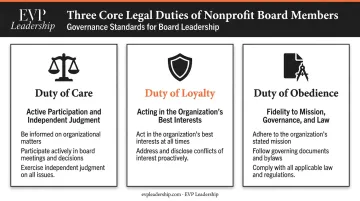
Training helps board members understand these duties conceptually and apply them consistently. Without it, well-intentioned members can inadvertently expose the organization to legal and reputational risk.
The Fundraising Gap
Fundraising is the area where boards most consistently underperform. BoardSource's Leading with Intent report found that 48% of chief executives and 50% of board chairs graded board fundraising as below average or failing — and 76% of chief executives said boards don't spend enough time on fundraising activities.
Research from the Nonprofit Research Collaborative found that organizations with engaged boards were more likely to meet their fundraising goals (60% vs. 53%) and more likely to increase fundraising results (55% vs. 43%). Trained board members become confident ambassadors and fundraisers — a direct return on the investment in development.
Leadership Conditioning, Not Just Compliance
Governance knowledge is necessary, but it's not the whole picture. Effective board leadership is conditioned over time — board members need to make sound decisions in high-stakes moments, navigate conflict with clarity, and sustain that capacity across their full term of service. Most organizations check the onboarding box and move on, which is exactly where board performance starts to erode.
Core Topics Every Nonprofit Board Leadership Training Program Should Cover
A complete training program should be customized to the organization's mission and stage of development. Still, certain competencies are non-negotiable.
Governance and Board Structure
- Board roles and responsibilities — what each member is accountable for
- How decisions are made and approved
- The board-executive director relationship: where oversight ends and management begins
- Parliamentary procedures (such as Robert's Rules of Order) for running effective meetings
Financial Oversight and Fiduciary Responsibilities
BoardSource data shows 96.6% of boards approve the annual budget and 85.1% receive Form 990 before filing — but knowing what's expected and knowing how to evaluate what you're seeing are different skills. Training should cover:
- Reading and interpreting financial statements
- Understanding internal controls and fraud risk
- Participating in annual budget approval and audit review
- Asking the right questions of auditors and finance staff
Strategic Planning and Mission Alignment
Board members need more than familiarity with the strategic plan. Training should connect each member's role to long-term goals across:
- Resource allocation decisions and trade-offs
- Stakeholder engagement and community positioning
- Tracking progress against mission-driven priorities
- Translating strategy into governance-level oversight
Fundraising Expectations and Skills
This includes both sides of the fundraising equation:
- Giving expectations: Personal contribution requirements, give/get policies, and the case for 100% board participation (BoardSource's standard for fundraising boards)
- Practical skills: How to ask for a gift, how to identify and cultivate prospects, and how to serve as a credible community ambassador for the mission
Legal, Ethical, and Compliance Responsibilities
96% of boards have a written conflict-of-interest policy and 90% have an annual disclosure process, per BoardSource. Training moves board members from awareness to active application. Topics include:
- Confidentiality obligations
- Conflict of interest identification and disclosure
- Accurate financial reporting requirements
- Regulatory compliance and Form 990 oversight
How to Structure a Nonprofit Board Training Program
Set Expectations Before Recruitment
Board members should know their time commitment, financial giving expectations, and primary responsibilities before they accept a seat. Surprises after the first meeting create disengagement — and disengagement is hard to reverse.
Build a Real Onboarding Process
A well-structured orientation covers more than governance documents. It should include:
- Review of bylaws and governance structure — not just distribution, but discussion
- Introduction to programs, finances, and strategic priorities
- Mentor pairing — connecting new members with a veteran board member for the first year
- Personal mission messaging — helping each new member develop their elevator pitch for the organization's work
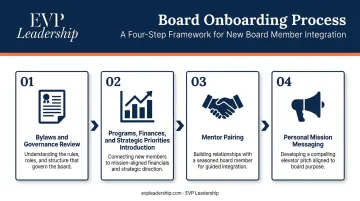
The National Council of Nonprofits recommends approaching orientation in smaller segments rather than one overwhelming session. This approach accelerates the learning curve and improves early engagement.
Embed Development in Regular Board Meetings
Short, focused training segments at each meeting — 15 to 20 minutes on a specific governance topic, financial concept, or fundraising skill — accomplish several things at once:
- Keep knowledge current without waiting for annual events
- Prevent disengagement between retreats or workshops
- Normalize continuous learning for every board member, not just new ones
Use Annual Retreats for Deeper Work
An annual board retreat creates dedicated space for skill-building that doesn't fit in a regular meeting cycle. Effective retreat agendas typically include strategic alignment work, team cohesion activities, scenario-based governance exercises, and a formal self-assessment of the board's collective performance.
BoardSource data shows that only 32.3% of chief executives reported their board conducted a formal written self-assessment in the prior year — and 42.2% of board chairs said no self-assessment had ever been performed. A retreat structure is a natural place to close that gap.
Consider Working with an Outside Facilitator
Organizations that bring in an external leadership consultant gain something internal staff rarely can provide: distance. That distance makes honest self-evaluation possible and difficult conversations productive.
Teri Evans, Leadership Facilitator at EVP Leadership, works with nonprofit boards on governance facilitation, communication, trust-building, and leadership team alignment. Engagements are available in half-day, full-day, and multi-day formats — in-person or virtually — depending on where the board needs the most work.
Internal staff often know the content. What they lack is the neutrality to push a board toward harder truths. That's where an outside facilitator earns their place.
Onboarding vs. Ongoing: Building Board Leadership Capacity Over Time
Onboarding sets the foundation. It should not be treated as the finish line.
The Stanford nonprofit board survey found that 48% of directors did not believe fellow board members were very engaged in board work — and 65% did not perceive their colleagues as very experienced. These aren't onboarding failures. They're ongoing development failures.
What sustained board development looks like in practice:
- Annual fundraising and solicitation training — refreshed as campaigns, strategies, and prospect pools change
- Governance refreshers — particularly when bylaws change, leadership transitions occur, or the organization enters a new strategic phase
- Scenario-based learning — working through simulated governance crises, ethical dilemmas, or high-stakes decisions before they happen in real life
- Recognition and reinforcement — acknowledging board member contributions publicly to sustain motivation over the long arc of service
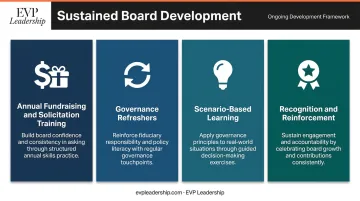
The boards that outperform over time aren't the ones that started with the best onboarding. They're the ones that never stopped developing. Sustained capacity — built through consistent practice, not periodic events — is what separates a board that's merely present from one that leads.
Best Practices for Running Effective Nonprofit Board Training
Keep sessions specific and action-oriented. Generic governance overviews produce limited results. Tie each training segment to a concrete skill, real decision, or scenario the board will actually face. Specificity drives retention.
Written resources, in-person workshops, virtual sessions, and peer mentorship all serve different purposes and accommodate different learning styles. Mix formats deliberately — don't default to a single delivery method. CAPLAW's governance case studies — designed for board members and nonprofit managers — are a useful example of scenario-based material that connects governance principles to real situations.
Measure and adjust. Establish a feedback loop:
- Formal board self-evaluations (at least annually)
- Post-session surveys after training segments
- Tracking participation metrics like meeting attendance and fundraising involvement
- Qualitative check-ins on decision-making quality and governance confidence
Without evaluation, training stagnates. Organizations that build in regular review cycles catch gaps early — and give boards the feedback they need to lead with more confidence over time.
Frequently Asked Questions
What topics should be covered in nonprofit board member training?
Core categories include governance and board structure, financial oversight and fiduciary responsibilities, strategic planning, fundraising skills, and legal/ethical compliance. The strongest programs customize these to the organization's mission, size, and stage — not every board needs the same depth in every area.
How often should nonprofit board training take place?
Best practice includes a full orientation for new members, brief development segments embedded in regular board meetings (15–20 minutes per meeting), and at least one annual in-depth session — such as a retreat — dedicated to deeper skill-building and board self-evaluation.
What is the difference between board orientation and ongoing board training?
Orientation is a one-time onboarding process covering foundational knowledge for new members. Ongoing training is continuous development for all members — it builds skills incrementally, adapts to organizational changes, and prevents the disengagement and governance blind spots that emerge when boards stop learning.
What are the three duties of a nonprofit board member?
The Duty of Care (making informed, active decisions), the Duty of Loyalty (prioritizing the organization's mission over personal interests), and the Duty of Obedience (ensuring the organization follows its mission, governing documents, and applicable law).
Should nonprofit organizations hire outside consultants to deliver board training?
Outside consultants bring objectivity and the distance to facilitate honest conversations that internal staff often can't. This is especially useful during governance transitions, leadership conflicts, or when the board needs an outside perspective on its own performance gaps — situations where an internal facilitator is too close to be effective.
How do you measure whether nonprofit board training is effective?
Through formal board self-evaluations, tracking engagement metrics like attendance and fundraising participation, post-session feedback surveys, and observing improvements in decision-making quality and governance outcomes over time.