Introduction
Most leaders know they need to grow. The harder problem is knowing what to work on — and whether the coaching they invest in will actually change anything.
Without clear goals from the start, coaching becomes a recurring calendar appointment instead of a structured growth process. Sessions feel productive. Then the urgent takes over, old patterns resume, and nothing actually shifts.
According to the International Coaching Federation, 87% of respondents agree that executive coaching delivers high ROI. But perception and results are two different things. The leaders who actually capture that return share one common discipline: they enter coaching with specific, measurable targets — before the first session starts.
This article covers what executive coaching goals actually are, the five highest-impact goal categories that drive real leadership growth, how to structure goals across short- and long-term timeframes, and how to set and measure them so progress is visible — not just felt.
Key Takeaways
- Vague leadership aspirations don't produce change — specific, co-created goals do
- The five core coaching goal categories are strategic clarity, executive presence, resilience, accountability, and team development
- Short-term goals (weeks to 3 months) build momentum; long-term goals (6–12+ months) drive lasting transformation
- Both timelines are necessary — neither works well without the other
- 90-day coaching cycles create enough structure to see progress without losing focus
- Baseline measurement set before coaching begins is what makes progress visible
What Are Executive Coaching Goals and Why Do They Matter?
Executive coaching goals are specific, intentional targets that give the coaching engagement direction. They answer the question: what, exactly, are we here to change?
That's different from a vague aspiration like "be a better leader" — which sounds meaningful but leaves both you and the coach with no way to measure progress. Goals are also different from strategy. Goals define the what. Strategy is the how.
Why Goal Clarity Is Non-Negotiable
Research consistently shows that specific goals outperform vague "do your best" directives. A 2021 systematic review applying Goal Setting Theory confirmed this across performance contexts.
In executive coaching specifically, a large-scale study found that the goal and task dimensions of the coaching relationship were stronger predictors of coaching effectiveness than the relationship bond itself.
Without defined objectives:
- Progress is impossible to measure
- Sessions drift toward conversation rather than development
- It becomes difficult to justify the investment to yourself or your organization
- The coaching engagement ends without clear evidence of what changed
Two Levels Every Coaching Goal Should Address
Effective executive coaching goals operate at two connected levels:
- Personal development — your behaviors, mindset, emotional capacity, and decision-making
- Organizational impact — team performance, retention, decision quality, and culture
The best goals connect both. A goal around improving delegation isn't just about your comfort level with letting go — it directly affects your team's ownership, your company's scalability, and your own sustainability as a leader.
Core Executive Coaching Goals for Leadership Growth
Five goal categories appear consistently across executive coaching engagements, regardless of industry or organizational size. The shape of each goal varies by leader — but the categories hold.
Strategic Clarity and Decision-Making
Many executives enter coaching feeling reactive. They're pulled between too many priorities with no reliable framework for deciding what actually matters today versus what can wait.
McKinsey research found that managers spend an average of 37% of their time on decisions — and more than half of that time is spent ineffectively. At scale, that pattern quietly erodes the leader's capacity for the work that actually moves the organization forward.
Coaching in this area focuses on:
- Developing a consistent, values-aligned decision-making process
- Moving from reactive firefighting to proactive prioritization
- Protecting time for high-leverage thinking
- Delegating or deferring decisions that don't require the leader's judgment
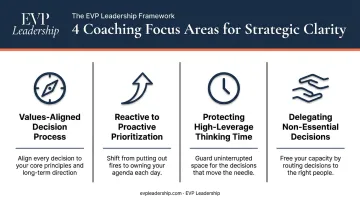
Progress looks like this: the leader stops being the bottleneck on every decision and starts operating from a clear framework for what earns their attention and what doesn't.
Executive Presence and Communication
This goal focuses on developing the capacity to communicate with clarity, authority, and influence — in high-stakes presentations, in difficult feedback conversations, and in the everyday interactions that shape team culture.
Presence is a discipline, not a personality trait. It's about intentionality and consistency: knowing what you want to communicate and delivering it in a way that lands.
Coaching in this area focuses on:
- Speaking with authority in high-stakes settings without over-preparing or hedging
- Delivering feedback that's direct, specific, and heard — not deflected
- Reading the room and adjusting communication style without losing the message
- Building consistency between what leaders say and how they show up day-to-day
When leaders communicate with greater clarity and confidence, teams gain direction, trust increases, and alignment follows. A team that doesn't know what the leader expects can't perform to that standard.
Resilience and Performance Under Pressure
This is one of the most underestimated coaching goals — and one of the most consequential.
Deloitte found that 75% of C-suite executives were seriously considering leaving their roles for positions that better supported their well-being. That's not a wellness problem — that's a capacity problem. Leaders who haven't built the internal reserves to perform under sustained pressure eventually hit a wall.
EVP Leadership's core philosophy addresses this directly: leadership performance under pressure is conditioned, not innate. Under pressure, leaders don't rise to their expectations — they fall back on their conditioning. Most leaders have been trained, but not prepared for real pressure.
Coaching in this area focuses on:
- Identifying stress triggers and their impact on decision quality
- Building recovery habits and sustainable operating rhythms
- Developing emotional regulation strategies
- Stress-testing decision-making in simulated high-pressure scenarios
The goal isn't just survival — it's consistent performance when the stakes are highest.
Accountability and Execution Discipline
Many leaders are excellent planners. The problem is follow-through. Not because of laziness, but because the urgent constantly displaces the important — and without deliberate systems, that pattern repeats indefinitely.
This coaching goal focuses on building accountability as a structural feature of how the leader operates — not an external enforcement mechanism. Coaching in this area focuses on:
- Establishing clear delegation protocols so decisions reach the right level
- Creating consistent operating rhythms that keep priorities visible
- Building scorecards that surface progress and drift before they become problems
- Closing the gap between what the leader commits to and what actually gets done
A leader who holds themselves accountable sets the standard for the entire organization. Teams watch what leaders do, not just what they say.
Team Development and Organizational Influence
For founders, small business owners, and executives who've grown their organizations from the ground up, this goal demands a fundamental identity shift — from doing to leading.
Gallup research on entrepreneur CEOs found that only one in four had high levels of delegator talent. Yet CEOs with strong delegation skills achieved average three-year revenue growth 33% higher than those with limited delegation ability.
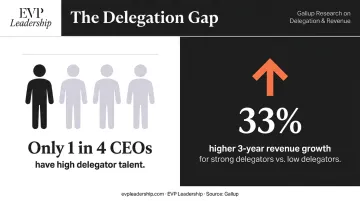
The transition from individual contributor to true executive leader means developing the capacity to build, develop, and retain a high-performing team — rather than carrying the organization personally. Coaching goals here typically include:
- Clearer expectations and accountability structures for direct reports
- Stronger coaching conversations with the team
- Improved cross-functional alignment
- Breaking the founder-bottleneck pattern
Short-Term vs. Long-Term Executive Coaching Goals
A well-structured coaching engagement works both timeframes simultaneously — because short-term wins and long-term transformation depend on each other.
Short-Term Goals (Weeks to 3 Months)
Short-term goals address immediate friction points, build foundational habits, and generate early wins that sustain momentum. Examples include:
- Refining a delegation system for a specific function
- Improving how weekly team meetings are structured and run
- Managing one identified stress trigger more effectively
- Establishing a daily decision-making rhythm
These aren't small goals. They're the leading indicators that tell you whether you're on track for deeper, longer-term change.
Long-Term Goals (6–12+ Months)
Long-term goals target behavioral transformation and systemic change. Examples include:
- Building a leadership pipeline that reduces organizational dependency on the founder
- Driving measurable cultural change around accountability and ownership
- Performing consistently at full capacity under sustained organizational pressure
- Developing cross-functional alignment at the executive team level
Both timeframes are necessary. The short-term work builds the habits and self-awareness that make long-term behavioral change actually stick.
Why 90-Day Goal Sprints Work
The 90-day structure strikes the right balance: long enough to see real behavioral progress, short enough to stay focused and adjust quickly. EVP Leadership's 90-Day PressurePoint System is built around this rhythm — breaking a coaching engagement into focused cycles that create the progression from foundational work to full-capacity performance.
One caution: don't set only long-term goals without near-term checkpoints. Without near-term milestones, goals lose urgency and sessions become directionless. Short-term wins are the feedback mechanism that tells you the long-term work is on track.
How to Set Executive Coaching Goals That Stick
Start with the SMART Framework
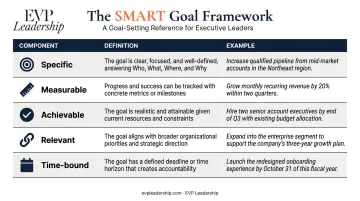
SMART gives vague leadership ambitions a structure that actually travels into action:
| Component | Definition | Example |
|---|---|---|
| Specific | Clear and unambiguous | "Improve delegation of operational decisions" not "delegate more" |
| Measurable | Has a defined indicator of progress | "Team handles 80% of weekly ops decisions without escalation" |
| Achievable | Realistic within the timeframe and context | Scoped to current team capacity |
| Relevant | Connected to organizational priorities | Tied to a scale goal or revenue target |
| Time-bound | Has a deadline or review point | Assessed at the 90-day mark |
Surface Your Real Gaps First
Before setting goals, surface your actual gaps — not the comfortable ones. Tools like 360-degree feedback and behavioral assessments help identify blind spots that self-reflection alone often misses.
Research shows that combining 360-degree feedback with coaching can increase leadership effectiveness by up to 60%, based on direct-report and peer input. That baseline data also becomes the foundation for measuring progress later.
Co-Create Goals with Your Coach
The most effective coaching goals aren't assigned by the coach or dictated by the organization — they're built collaboratively. When a leader has genuine ownership of a goal, the motivation to pursue it is intrinsic, not compliance-driven.
Organizational priorities should be part of that conversation. Goals that align personal development with business outcomes tend to earn organizational support — and deliver results that outlast the coaching relationship.
Keep the Active Goal List Short
Once those goals are built collaboratively, the next question is how many to hold at once. Two to three core goals per 90-day cycle outperforms eight loosely defined aspirations. Depth of progress on fewer goals produces lasting behavioral change — scattered effort across many produces activity without change.
EVP Leadership's PressurePoint System structures this explicitly — each 90-day engagement uses the Diagnostic Layer (six dimensions including Mission Clarity, Decision Integrity, and Execution Discipline) to identify where performance is actually breaking down, then focuses conditioning work on those specific pressure points rather than trying to develop everything at once.
Tracking Progress: How to Measure Your Coaching Goals
Establish a Baseline Before You Begin
Measurement starts before the first coaching session — not after. Establish where you are now on the behaviors and outcomes you want to change. This could include:
- 360 feedback scores from direct reports and peers
- Self-assessment ratings on specific leadership behaviors
- Team engagement data or productivity metrics
- Performance outcomes tied to your goals (decision speed, delegation rate, retention)
Without a baseline, progress becomes a feeling rather than a fact.
Build a Regular Review Rhythm
Research on goal monitoring confirms that tracking progress consistently improves goal attainment — with stronger effects when progress is recorded, not just discussed. A practical rhythm:
- Monthly check-ins that compare current behavior against the baseline
- Mid-cycle reviews that allow for goal refinement based on what's emerging
- End-of-cycle assessments that measure both behavioral change and organizational impact
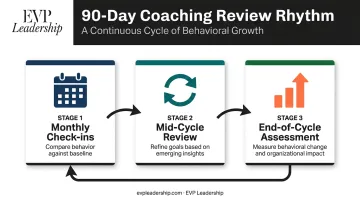
Knowing when to review is only half the equation. You also need to know what evidence to collect.
Use Both Quantitative and Qualitative Evidence
Quantitative data shows what changed. Qualitative signals reveal whether those changes are holding under pressure.
Quantitative indicators:
- Performance scores and team productivity metrics
- Retention rates and engagement survey results
- Decision speed and escalation frequency
Qualitative signals:
- How the leader experiences decision-making under pressure
- Feedback from direct reports on clarity and direction
- Observed shifts in communication style and team trust
Both types of evidence matter. A leader who scores higher on a 360 but still dreads high-stakes conversations hasn't fully arrived. A leader who feels transformed but can't show any change in team behavior may be experiencing insight without behavior change. The goal is alignment between the two — measurable change in behavior, backed by genuine shifts in how you lead.
Frequently Asked Questions
What are the goals of leadership coaching?
The aim of leadership coaching is to connect personal development directly to business outcomes — improving both the leader's effectiveness and the organization's performance. Goals typically focus on strategic thinking, executive presence, communication, resilience, and accountability.
How do you set SMART goals for executive coaching?
In executive coaching, the best SMART goals are co-created by the leader, the coach, and organizational stakeholders. That process ensures the goal addresses a real gap, fits within organizational priorities, and carries genuine ownership from the leader.
What is the difference between short-term and long-term executive coaching goals?
Short-term goals (weeks to 3 months) address immediate friction points and build momentum. Long-term goals (6–12+ months) target deeper behavioral transformation and systemic organizational change. Short-term wins serve as leading indicators that the longer-term work is on track.
How long does it take to achieve executive coaching goals?
Early improvements in clarity and focus often appear within the first few sessions. Deeper behavioral shifts typically take 3–6 months of consistent work.
How do you measure progress toward executive coaching goals?
Establish baseline metrics before coaching begins. Then conduct regular progress reviews using a combination of quantitative data (performance scores, team metrics, retention) and qualitative feedback (360 input, direct-report observations, self-assessment).
What should I expect in my first executive coaching session?
The first session typically involves a discovery or scoping conversation to surface key challenges, leadership gaps, and aspirations. That's followed by a collaborative goal-setting discussion that sets the direction for the full engagement — ensuring goals address real gaps .