The problem is that most pricing guides treat executive coaching as a single market. They don't address the sliding scale options, group formats, funder-supported programs, and sector-specific pricing dynamics that actually define what nonprofits pay.
This article breaks down realistic cost ranges for nonprofit executive coaching, what drives prices up or down, what a well-structured engagement includes, and how to find and fund the right fit for your organization.
Key Takeaways
- Nonprofit executive coaching typically runs $2,500–$5,000 for a basic 6-month engagement and $20,000–$40,000+ for annual programs
- Coach experience, engagement scope, and organizational budget size drive cost more than hourly rate alone
- Many coaches offer sliding scale pricing based on annual operating budget, but you have to ask
- Group and cohort coaching formats can cut per-person costs significantly while adding peer-learning value
- Choosing on price alone, or defaulting to informal arrangements, consistently produces weak outcomes
How Much Does Executive Coaching Cost for Nonprofits?
There is no fixed price for nonprofit executive coaching. Cost varies based on the coach's experience, the engagement's length and format, and your organization's size — but nonprofits do have access to a distinct pricing landscape that differs meaningfully from the corporate market.
When this isn't well understood, organizations tend to either underbudget for a meaningful engagement or default to informal arrangements that lack structure and accountability.
Typical Cost Ranges
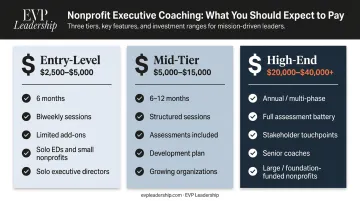
Most nonprofit coaching engagements fall into one of three tiers:
| Tier | Typical Cost | What's Included | Best Fit |
|---|---|---|---|
| Entry-level (6 months) | $2,500–$5,000 | Biweekly sessions, limited add-ons | Solo EDs, small nonprofits |
| Mid-tier (6–12 months) | $5,000–$15,000 | Structured sessions, assessments, development plan | Growing organizations |
| High-end (annual/multi-phase) | $20,000–$40,000+ | Full assessment battery, stakeholder touchpoints, senior coaches | Large nonprofits, foundation-funded |
The Executive Directors Leadership Institute at Executive Service Corps Southern California illustrates what mid-range looks like in practice: a 9-month cohort program with over 40 hours of personalized coaching for $3,000–$4,000, structured partly through program design funding. On the more accessible end, CNPC offers sliding-scale individual coaching (6 sessions) starting at $300 for organizations with operating budgets under $250K.
Hourly Rates as a Reference Point
Most serious coaching engagements are sold as packages, not by the hour — but hourly rates offer a useful benchmark.
- General market average: $244/hour (2022 ICF data via Forbes)
- Nonprofit-sector historical benchmark: mean $121/hour, ranging $20–$325/hour (CompassPoint, 2010)
- Senior credentialed coaches often charge well above market average; newer coaches charge below it
The per-hour figure is misleading on its own. Quality coaches invest significant time in preparation, progress tracking, and between-session support, none of which appears on a per-session invoice. Total engagement cost is the more useful budgeting figure.
Key Factors That Affect Nonprofit Executive Coaching Rates
Pricing depends on a combination of the coach's background, the engagement's scope, and dynamics specific to the nonprofit sector.
Coach Experience and Credentials
Coaches with formal credentials — particularly ICF certifications — and demonstrated experience in the nonprofit context typically charge more. The credential tiers matter:
- ACC (Associate Certified Coach): 100+ coaching hours, 60 hours of education
- PCC (Professional Certified Coach): 500+ coaching hours, 125 hours of education
- MCC (Master Certified Coach): 2,500+ coaching hours, 200 hours of education
This premium often reflects genuine value. Nonprofit leaders navigate challenges — all-volunteer boards, mission-driven team dynamics, constrained budgets — that don't map neatly onto frameworks built for corporate contexts. When evaluating coaches, ask specifically how they've worked with nonprofit leaders before — credential level alone doesn't tell you that.
Organization Size and Ability to Pay
Many coaches use sliding scale pricing tied to annual operating budget. CNPC's nonprofit coaching program, for example, structures its individual coaching fees explicitly by budget tier: $300 for organizations under $250K, $400 for those under $500K, and $600 for organizations above $500K. Team coaching is similarly tiered at $500–$1,100.
Tiered pricing is more common than it appears publicly. Ask directly.
Who Is Paying
Three common payment structures exist in the nonprofit world:
- Organization pays — from a professional development or leadership line item in the operating budget
- Board or funder sponsors — a board member, foundation, or funder covers costs as a leadership investment
- Executive director self-pays — some coaches offer a professional courtesy discount when the individual is paying out of pocket, recognizing the sector's typical compensation gap
Individual vs. Group Coaching
Group and cohort formats designed for nonprofit leaders can cut per-person cost significantly while adding a peer-learning dimension that individual coaching can't replicate.
EVP Leadership, for example, offers multi-month cohort programs specifically designed for nonprofit boards and leadership groups, covering decision-making, delegation, accountability, and leadership presence — scoped to the organization's stage. For nonprofits that can't sustain the cost of individual coaching, this format is worth serious consideration.
Engagement Scope and Length
Scope is a stronger cost driver than hourly rate. A focused 90-day engagement costs far less than a 12-month comprehensive program — and the right answer depends entirely on what challenge you're trying to address.
EVP Leadership's 90-Day PressurePoint System is a defined-scope leadership conditioning engagement that builds specific capabilities across three structured layers — Identity, Diagnostic, and Execution — within a fixed timeframe. That structure lets organizations budget predictably and evaluate outcomes at the 90-day mark rather than committing to open-ended arrangements.
Match scope to the actual problem, not to what feels most serious or most affordable.
What Is Actually Included in a Nonprofit Executive Coaching Engagement?
Total coaching cost goes well beyond session time — and knowing what a complete engagement includes is how you tell genuine value from a bare-bones quote.
Sessions and Cadence
A standard coaching engagement typically looks like:
| Element | Typical Structure |
|---|---|
| Frequency | Biweekly (most common) or monthly |
| Session length | 60 minutes per session |
| Format | Virtual (most common) or in-person |
| Duration | 6–12 months; 90-day focused engagements also available |
Shorter, one-off arrangements exist but tend to produce weaker results. Sustained behavioral change requires time and repetition.
Discovery, Assessment, and Coaching Plan
Engagements begin with a structured intake — sometimes a 360-degree feedback survey or behavioral assessment — that informs a defined coaching plan with specific goals.
Common assessment tools include DiSC, Hogan, EQ-i 2.0, and the Leadership Circle Profile. These tools are often bundled into mid-tier and high-end packages; in lower-tier arrangements, they may be billed separately. Ask before comparing quotes.
EVP Leadership's PressurePoint System incorporates a Diagnostic Layer that functions as an embedded framework — covering Mission Clarity, Force Alignment, Problem Intelligence, Decision Integrity, Execution Discipline, and Momentum Control — as an integrated part of the engagement rather than a standalone assessment add-on.
Between-Session Support and Accountability
What happens between sessions often separates surface-level coaching from real development. Better coaches:
- Review session notes and track progress before each call
- Adjust the plan as the engagement evolves
- Offer email check-ins or asynchronous support between sessions
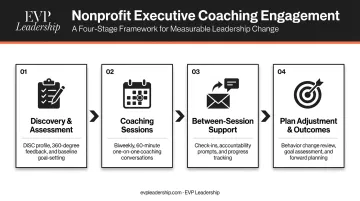
This between-session work is part of what justifies higher rates — and what makes the difference between a one-time insight and lasting behavior change.
What Is Usually Not Included
Common add-ons that may be billed separately:
- Formal psychometric assessments (if not bundled)
- Stakeholder interviews or 360-degree feedback administration
- Board-facing reports or written deliverables
- Additional sessions beyond the agreed package
Ask every prospective coach to itemize inclusions before you compare quotes — the true cost only becomes clear once you see the full picture.
How to Budget and Fund Executive Coaching as a Nonprofit
Most nonprofit leaders underestimate how many funding pathways exist for executive coaching — and several require no operating budget at all.
Funding Sources to Explore
- Allocate from the professional development or leadership line item in the annual operating budget
- Request board sponsorship — individual members or the full board may invest directly in the executive director's capacity
- Pursue foundation grants: The W.K. Kellogg Foundation has partnered with the Center for Creative Leadership to fund personalized coaching for nonprofit leaders through its Community Leadership Network. The We Raise Foundation offers Emerging Leader Grants with $5,000 specifically for leadership development.
- Pay out of pocket and request reimbursement as a professional development expense
Making the Case for a Defined-Scope Engagement
A time-bound, clearly scoped engagement is far easier to fund than an open-ended arrangement. It lets you:
- Forecast total cost with confidence
- Present specific expected outcomes to a board or funder
- Evaluate ROI at a defined endpoint
This is one reason programs like EVP Leadership's 90-Day PressurePoint System fit well within nonprofit funding structures. The fixed timeframe and defined deliverables translate directly into a fundable proposal rather than an open-ended consulting retainer.
Negotiating and Right-Sizing the Investment
Be transparent with prospective coaches about your budget. Most will negotiate by reducing scope, suggesting a group format, or offering a payment plan. Sliding scale pricing is common in the nonprofit coaching world but rarely advertised.
EVP Leadership offers complimentary scoping conversations that give nonprofit leaders a structured way to define scope and investment level before committing.
What Nonprofits Often Get Wrong About Coaching Costs
Most nonprofits lose money on coaching not by overspending, but by choosing the wrong approach for the wrong reasons.
Treating Coaching as Overhead
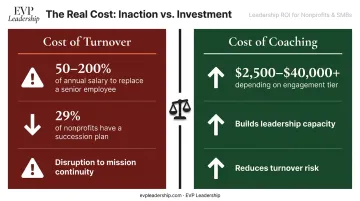
Treating leadership development as administrative waste — rather than organizational investment — is one of the most expensive habits in the nonprofit sector. The numbers make the case: SHRM estimates that replacing a senior employee costs 50% to 200% of annual salary, and only 29% of nonprofits have a written succession plan. Executive director turnover is both costly and disruptive. Coaching that builds a leader's capacity directly reduces that risk.
Choosing Free or Informal Coaching
Pro-bono and informal mentorship have real value, but they rarely replicate the accountability, structure, and depth of a paid engagement. A paid coaching relationship creates mutual commitment: the coach invests preparation time, the leader shows up differently when something is at stake. Without that structure, results tend to match the investment.
Focusing on Hourly Rate Instead of Total Engagement Value
Comparing coaches by hourly rate ignores the variables that actually determine outcomes:
- What's included in the engagement (and what isn't)
- How experienced the coach is with nonprofit-specific dynamics
- Whether the scope matches the actual challenge you're trying to solve
A lower hourly rate in a poorly scoped or poorly matched engagement often costs more in the long run — through slow progress or simply not addressing the right problem.
Frequently Asked Questions
What is the hourly rate for an executive coach?
General market average is around $244/hour (2022 ICF data), while nonprofit-focused coaches historically charge less. Most serious engagements are sold as packages, not by the hour — the hourly figure is more useful for rough benchmarking than actual budgeting.
What are the 70/30 and 80/20 rules in coaching?
These ratios describe speaking balance in a session: the coach talks roughly 20–30% of the time while the client reflects and speaks 70–80%. The structure is intentional — client-centered conversation is what produces self-awareness and lasting behavior change.
Do nonprofits get discounted executive coaching rates?
Many coaches do offer sliding scale pricing or nonprofit discounts based on organizational budget size or individual self-pay situations. These rates are rarely advertised publicly — you need to ask directly during your initial conversation with a prospective coach.
What is typically included in a nonprofit executive coaching package?
Most packages include recurring sessions over 6–12 months, a discovery or assessment phase, and a defined coaching plan. Higher-tier engagements add 360-degree feedback tools and stakeholder touchpoints. Confirm every inclusion line-item before comparing quotes across coaches.
How do nonprofits typically pay for executive coaching?
Organizational professional development budgets, board or funder sponsorship, and individual self-pay with reimbursement are the most common pathways. Foundation grants designated for leadership development remain underused — worth a direct conversation with current funders.
Is group coaching a good option for nonprofits with limited budgets?
Group and cohort formats can reduce per-person cost while adding peer-learning benefits that individual coaching can't replicate. For organizations that can't sustain the cost of individual executive coaching, a well-structured group program is a practical option that often delivers stronger team cohesion alongside the cost savings.