Introduction
When a key hire quits, a major client escalates, or the market shifts overnight, leaders don't rise to the occasion. They fall back on their conditioning. It's simply how performance under pressure works.
EVP Leadership's core thesis is built on exactly this reality: leaders who haven't been deliberately conditioned for pressure will default to reactive patterns — hoarding decisions, going silent, or pushing through without reflection. The teams around them follow suit.
Adaptive leadership offers a different path. It's a learnable approach that builds team resilience not through crisis response, but through consistent daily practices that condition both leaders and teams to absorb disruption without losing cohesion or performance.
This article covers what adaptive leadership is and why it produces resilience at the team level. It also details the specific practices leaders can embed now — and the mistakes that undermine even well-intentioned efforts.
Key Takeaways
- Adaptive leadership addresses complex, evolving challenges that can't be solved with existing procedures alone
- Team resilience is shaped more by leadership behavior than by individual personality traits
- Psychological safety is the foundation, linked to a 46% reduction in change fatigue according to Gartner research
- Distributing decision-making and modeling recovery are the most underused resilience practices
- Resilience is a conditioning outcome: built through repeated habits, not activated in emergencies
What Is Adaptive Leadership?
Adaptive leadership is a framework pioneered by Harvard Kennedy School's Ronald Heifetz over more than 40 years. At its simplest, it defines leadership as the practice of mobilizing people to accomplish adaptive change — not through positional authority, but through collective problem-solving.
The framework's most practical distinction is between two types of challenges:
| Challenge Type | Characteristics | Example |
|---|---|---|
| Technical | Known solution, existing expertise applies | Software system failure |
| Adaptive | Requires changes in thinking, values, or behavior | Team culture breakdown during rapid growth |
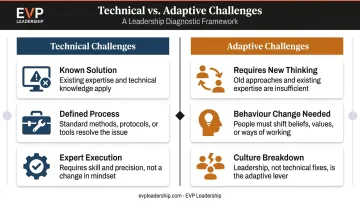
Most leaders default to technical responses — issuing directives, bringing in experts, fixing the process. That works when the problem is technical. When the problem is adaptive (a culture breakdown, a team losing trust in leadership, a fundamental shift in how the business needs to operate), technical responses don't just fail. They often make things worse.
How This Differs From Traditional Leadership
Traditional leadership runs on hierarchy, expertise, and control. Adaptive leadership runs on flexibility, distributed problem-solving, and honest diagnosis. The distinction isn't about abandoning structure — it's about accurately reading what type of problem you're facing before deciding how to respond.
A common misconception: adaptive leadership means constant change or endless accommodation. It doesn't. It means knowing when to flex and when to hold firm, and having the discipline to do both on purpose.
For founders and owner-operators, this is especially high-stakes. When one person absorbs every hard call, the team never builds adaptive capacity of its own. That's precisely what adaptive leadership practice is designed to fix.
The Link Between Adaptive Leadership and Team Resilience
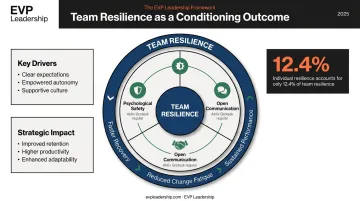
Team resilience isn't the sum of how tough individual team members are. A 2022 quantitative study of emergency healthcare teams found that individual resilience explained only 12.4% of the variance in team resilience — meaning the vast majority of a team's resilience comes from somewhere else: the shared environment, processes, and leadership behaviors that shape how the group functions under pressure.
What Leaders Actually Control
Adaptive leaders build the conditions that make collective resilience possible:
- Psychological safety — people speak up, flag problems early, and engage with difficulty rather than avoiding it
- Open communication — information flows in all directions, not just top-down
- Shared ownership — problems belong to the team, not just to leadership
When these conditions exist, teams don't freeze in a crisis. They respond. Google's Project Aristotle, which studied 180 teams across engineering and sales, found that psychological safety was the single most important factor in team effectiveness — more predictive than who was on the team.
The Cost of Getting This Wrong
Non-adaptive leadership creates brittleness. Gallup's 2024 "Great Detachment" analysis found that employee connection to company mission fell from 38% in 2021 to 30% in 2024 — and improving that connection can produce a 32% reduction in turnover. When leaders withhold information, make every decision centrally, and treat pressure as something to endure rather than navigate together, team resilience erodes well before anyone labels it a crisis.
That's the core argument behind EVP Leadership's approach: resilience is a conditioning outcome, not a fixed trait. Consistency under pressure is a skill leaders build through deliberate practice — and the conditions they create for their teams are where that building begins.
Adaptive Leadership Practices That Build Team Resilience
Distinguish Between Adaptive and Technical Challenges in Real Time
The first step is accurate diagnosis. Before responding to any challenge, ask two questions:
- Does solving this require a process fix, or a change in how people think and work?
- Has this type of problem been solved before with existing expertise, or does it require new behavior from the team?
If the answer to both is "existing fix," it's technical — assign it and move on. If the problem keeps recurring despite process fixes, or if it involves trust, culture, or alignment, it's adaptive — and it needs a different kind of leadership response.
Create Psychological Safety as a Daily Practice
Psychological safety isn't a culture initiative you launch once. It's a pattern of behavior repeated in every meeting and interaction. Specific behaviors that build it:
- Acknowledge uncertainty out loud — "I don't have a clear answer yet, and here's how we're thinking about it"
- Ask for dissenting views — "What are we missing? Who sees this differently?"
- Respond to mistakes with curiosity — "What happened, and what does it tell us?" rather than "Who's responsible?"
The operational impact is measurable. When managers create psychologically safe environments, Gartner research shows it can produce up to a 46% reduction in change fatigue.
Distribute Decision-Making and Leadership Responsibility
One of the most common resilience failures in small businesses is the founder bottleneck — where the leader is the sole decision point for everything significant. When that person is overwhelmed, traveling, or burned out, the team stalls.
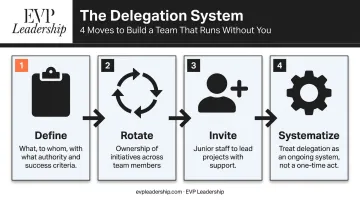
Distributing decision-making requires structure, not just intention:
- Define what gets delegated, to whom, with what authority, and against what success criteria
- Rotate ownership of initiatives to build team members' problem-solving capacity
- Invite junior staff to lead specific projects — with support, not abandonment
Treating delegation as a system — not a one-time act — is how decisions move down the organization, the team owns more, and the leader gets capacity back.
Communicate with Transparency, Especially in Uncertainty
The biggest source of team stress during disruption is rarely the problem itself — it's the absence of information about it. When people don't know what's happening, they fill the gap with anxiety.
Adaptive leaders communicate proactively, even when they don't have complete answers. A practical habit: brief, regular "state of play" check-ins that share:
- What we know
- What we don't know yet
- What decisions are being made and why
This isn't about over-communicating. It's about removing the ambiguity that drives disengagement.
Model Recovery and Reflection, Not Just Performance
When leaders openly debrief after challenges — including failures — they normalize adaptive thinking for everyone on the team. Amy Edmondson's research on team learning makes this link explicit: after-action reviews only produce learning when people can discuss failure without fear of blame.
That kind of environment doesn't emerge from a policy. It's built through repeated behavior at the leader level.
In practice, this means:
- After a difficult period, ask the team: "What did we learn? What would we do differently?"
- Share your own growth edges — "Here's what I'd handle differently next time"
- Distinguish recoverable mistakes from systemic failures, and treat them accordingly
Leaders who debrief publicly — not just privately — create a team that learns faster and recovers more consistently than one driven by performance pressure alone.
How to Build a Resilience-Ready Team Culture
Individual practices compound into culture when they are consistent, visible, and reinforced over time. Three markers of a resilience-ready team:
- Challenges are framed as learning events — not threats to avoid or assign blame for
- Internal trust networks are strong — people know who to go to, and they go there
- Adaptive behaviors are recognized — not just results, but how problems were approached
Culture also requires leaders who are developed systematically. EVP Leadership's 90-Day PressurePoint System is built around exactly this: conditioning leaders through three reinforcing layers (Identity, Diagnostic, and Execution) so that adaptive behaviors become habitual rather than situational.
Teri Evans' facilitated team development engagements — executive offsites, alignment workshops, and conflict-resolution facilitation — address the team-level foundations: communication, trust, and psychological safety.
Why Development Approach Matters
McKinsey research finds that leadership programs overemphasizing classroom learning and underemphasizing practical application produce limited behavioral change. ATD reinforces this: development requires ongoing reinforcement and recalibration, not a single event.
EVP Leadership's conditioning philosophy is built on this foundation: "Actionable change starts with small habits practiced consistently over time."
Common Mistakes Leaders Make When Trying to Build Resilience
Mistake 1: Confusing resilience with toughness. Suppressing stress doesn't eliminate it. Research on emotional labor shows that surface acting — faking or masking emotions — increases emotional exhaustion over time. True resilience includes emotional regulation, recovery time, and psychological safety. Endurance alone isn't the standard.
Mistake 2: Treating resilience as an individual responsibility. Telling team members to "be more resilient" without changing leadership behaviors or organizational conditions targets the wrong level. Team resilience is an emergent property — it forms through leadership, structure, and culture working together. Pushing adaptation down to individuals, without structural support from the top, doesn't produce it.
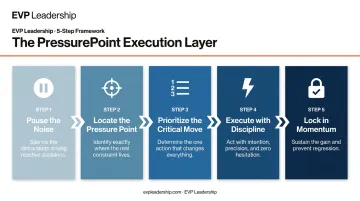
Mistake 3: Waiting for a crisis to build resilience. McKinsey's research on organizational resilience finds that resilience is built through shared beliefs, routines, and capacity before disruption occurs — not activated after the fact. That distinction matters for how leaders should design their development work. EVP Leadership's PressurePoint System Execution Layer — Pause the Noise → Locate the Pressure Point → Prioritize the Critical Move → Execute with Discipline → Lock in Momentum — is built to be practiced in everyday operational contexts, not reserved for emergencies. Repetition in low-stakes moments is what makes it conditioning rather than crisis response.
Frequently Asked Questions
What is the difference between adaptive leadership and traditional leadership?
The core distinction is how each handles complex, non-routine challenges. Traditional models apply existing solutions through hierarchy and top-down control. Adaptive leadership mobilizes people to change how they think and work — through collaboration, transparency, and distributed problem-solving.
How does psychological safety contribute to team resilience?
Psychological safety allows team members to voice concerns, take risks, and engage openly with problems without fear of blame or reprisal. This directly strengthens collective adaptive capacity — teams that feel safe to speak up identify problems earlier and respond to disruption more effectively.
Can small business leaders practice adaptive leadership with limited resources?
Yes. The core practices — transparent communication, distributed decision-making, regular reflection — require behavior change, not budget. As EVP Leadership's philosophy puts it: "You don't need to revamp your entire corporate structure to create a positive transformation." Consistent small habits produce durable results.
What are the signs that a team lacks resilience?
Watch for avoidance of difficult conversations, elevated stress during routine change, low initiative, increased turnover, and over-reliance on the leader for every decision. These patterns signal that the team hasn't been conditioned to absorb pressure — it's been structured to depend on the leader to absorb it instead.
How long does it take to build team resilience through adaptive leadership?
Resilience is a conditioning outcome, not a one-time fix. Early practices like psychological safety and transparent communication produce visible shifts within weeks. Sustained behavioral change — the kind that holds under real pressure — typically takes months of consistent practice, which is why EVP Leadership's core engagement runs 90 days.
Is adaptive leadership the same as being flexible or easygoing?
No. Adaptive leadership requires discipline and clear purpose. It means accurately diagnosing what type of challenge you're facing and responding appropriately — which sometimes means holding firm rather than accommodating. Adaptive leaders make hard decisions with full awareness of what the situation actually demands.