

According to BARC research, 58% of companies base at least half of their regular business decisions on gut feel rather than data. In leadership, that habit is particularly costly—because a misread team problem doesn't just persist, it compounds.
This article walks through a practical framework for running a leadership diagnostic: what it is, what you need before you start, three core methods for gathering evidence, how to interpret what you find, and the mistakes that derail most leaders before they reach a useful conclusion.
Key Takeaways
- A leadership diagnostic examines the full team system, including the leader's own behaviors and blind spots — not just individual performance.
- Three core methods — structured observation, direct feedback collection, and performance data review — each reveal different layers of the problem.
- Psychological safety must exist before feedback collection; without it, the data you gather will be incomplete.
- Collecting diagnostic data without acting on it damages trust more than running no diagnostic at all.
- The goal is understanding what needs to change in how you lead — and making those changes a consistent practice.
What Is a Leadership Diagnostic (and Why Most Leaders Skip It)
A leadership diagnostic is a deliberate, structured assessment of how well a team is functioning—examining communication patterns, performance alignment, engagement levels, and leadership effectiveness as an interconnected system, not a collection of isolated problems.
This is not the same as a performance review. A performance review evaluates what an individual has produced. A diagnostic evaluates the entire leadership-team system—including how the leader's own decisions, communication habits, and blind spots shape the environment everyone else operates in.
HBR research found that 75% of cross-department teams are dysfunctional due to coordination, motivation, and competition problems—not individual incompetence. That's a system problem, and it requires a system-level diagnosis.
Why Leaders Skip It
- They're reactive—focused on the immediate fire, not the pattern producing fires
- They trust their gut, especially when they've been with the team a long time
- They assume they already know what's wrong and want a fast solution
- They're concerned about what a diagnostic might reveal about their own contribution
Skipping the diagnostic doesn't eliminate the problem—it just delays the real one. Leaders end up treating symptoms: blaming a team member when the real issue is unclear expectations, or pushing harder on execution when the actual gap is motivation or misalignment. The fix gets applied to the wrong problem, and the cycle continues.
What You Need Before Running a Leadership Diagnostic
A diagnostic requires three preconditions: psychological safety on the team, honest access to performance data, and a leader who is genuinely willing to have their own assumptions challenged—not just looking to confirm what they already believe.
Inputs to Gather in Advance
Before you begin, collect the following:
- Recent output data — deliverables, goal completion rates, missed deadlines over the past 60–90 days
- Existing survey results — any engagement, pulse, or satisfaction survey data you have on hand
- Conflict and bottleneck notes — recurring friction points, escalation patterns, or process breakdowns
- Turnover and absenteeism trends — who has left, when, and under what circumstances
- Your own written observations — what you've noticed about team dynamics over the past 30–90 days
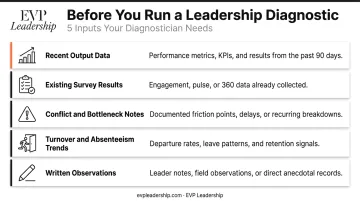
Written observations matter more than most leaders expect. Memory is selective; writing forces specificity.
Mindset Requirements
Gathering the right data only gets you halfway. What you do with it depends entirely on the mindset you bring into the process.
The GWU Team Leadership framework is clear on this: leaders should observe behavior before inferring meaning. Rushing to interpretation before the data is in produces faulty diagnoses that feel confident.
Enter the process as an observer first, not a judge. That means deliberately setting aside prior conclusions and actively looking for evidence that contradicts what you assume is true, not just evidence that confirms it.
If you're deeply embedded in the team's dysfunction, an outside perspective is worth considering seriously. Internal proximity — being too close to the system — is one of the most common barriers to accurate diagnosis. What feels obvious from inside the team often looks entirely different to someone who isn't carrying the same assumptions. It's a pattern EVP Leadership sees consistently across consulting engagements with founders and executive teams.
How to Run a Leadership Diagnostic: Three Core Methods
No single method gives you the full picture. The most accurate diagnostic combines at least two of the three methods below, chosen based on the type and severity of the performance gap you're diagnosing.
Here's how each one works.
Method 1: Structured Observation
Observe your team in natural working conditions—meetings, collaborative sessions, informal interactions—without intervening. The goal is behavioral data, collected before you assign meaning to it.
What to watch for:
- Who speaks, and who consistently stays silent
- Whether conflict surfaces openly or gets buried
- How decisions actually get made versus how you think they get made
- Whether energy rises or drops at specific moments
- Gaps between what people say in the meeting and what they do afterward
How to run it:
- Choose 2–3 representative interactions to observe over the next two weeks
- Take raw notes on behaviors only—no motivations, no judgments in the moment
- After each session, identify patterns: what repeated, what surprised you, what contradicted your assumptions
Best use: Detecting cultural and communication dynamics that people won't report directly. Limitation: Requires real discipline to observe without reacting, and one observer always carries some bias—cross-check with other methods.
Method 2: Direct Feedback Collection
Structured 1-on-1 conversations and anonymous surveys surface perceptions, morale, and clarity gaps that observation alone won't reveal.
What to measure:
- Whether team members can clearly articulate their goals and how success is defined
- Whether they feel safe raising concerns without consequences
- Whether leadership follows through on what it says—or just says it
- Where each person sees the biggest blockers to their own performance
How to run it:
- Design 4–6 open-ended questions focused on clarity, trust, and obstacles—avoid yes/no formats
- Conduct 1-on-1s in a setting where the employee feels genuinely safe; use anonymous surveys when trust is already low
- Look across responses for recurring themes, not outlier complaints
A 2025 SAGE study found employees were significantly more willing to speak up in anonymous conditions than non-anonymous ones. That's not a flaw in the method—it's diagnostic information in itself. Low willingness to speak up on record tells you something important about the team's trust level.
Best use: Morale, trust, and communication breakdowns. Limitation: Data quality depends entirely on how safe people feel. If trust is already compromised, anonymous formats aren't optional—they're necessary.
Method 3: Performance Data Review
Analyzing hard performance indicators identifies where execution is breaking down—missed deadlines, output quality trends, goal completion rates, and leading indicators like rework rates or escalating complaints.
What to look for:
- Which goals are consistently missed versus consistently met
- Whether slowdowns cluster around specific team members, processes, or decision points
- Whether performance dipped following specific leadership changes, restructuring, or organizational shifts
How to run it:
- Pull 60–90 days of performance data across the team
- Map slowdowns or failures against team structure and leadership decisions during that period
- Identify whether the issue is a capability gap (skill), a process gap (how work flows), a clarity gap (understanding of goals), or a motivation gap (engagement and ownership)—each requires a different response
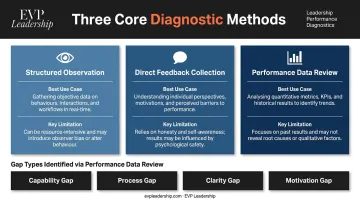
Best use: Quantifying impact and tracking change over time. Limitation: Data shows what is happening, not why. It must be paired with qualitative methods to generate a complete picture.
How to Interpret Your Findings
What leaders do with diagnostic data is where improvement either happens or stalls. Selectively accepting only the comfortable findings produces the same outcome as skipping the diagnostic entirely.
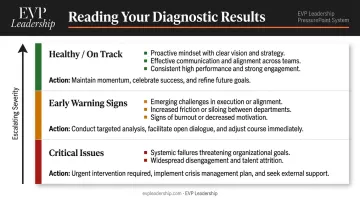
Results typically fall into one of three categories. Here's how to read each one and what to do next.
Healthy — On Track
Your team is functioning well when:
- Goals are understood and consistently met
- Communication is direct and constructive, not avoided
- Conflict surfaces and gets resolved rather than buried
- Team members can clearly articulate how their work connects to the larger mission
Action: Reinforce deliberately. Name what's working, protect it, and build on it. High-functioning teams erode quietly when leaders take their performance for granted.
Early Warning Signs
Watch for these signals—they're not crises yet, but they will become one without a specific response:
- Mild dips in output quality over consecutive weeks
- Recurring friction between two or three individuals that isn't getting addressed
- Ambiguity about priorities surfacing repeatedly in 1-on-1s
- Small decisions consistently escalating to leadership when they shouldn't be
Action: Address the specific root cause, not the symptom. A blanket "let's all communicate better" response to a recurring friction issue changes nothing. The fix must be tied to the specific gap the diagnostic identified.
Critical Issues
Red flags requiring immediate leadership intervention:
- Significant output breakdown across the team
- Widespread disengagement—Gallup's 2026 State of the Global Workplace report found only 20% of employees worldwide were engaged in 2025, costing the global economy roughly $10 trillion in lost productivity
- Active distrust of leadership, visible in withdrawn behavior, anonymous survey results, or attrition signals
- Persistent misalignment between what leadership believes is happening and what the data actually shows
Action: This level typically requires structural changes, a reset of team norms, and in many cases, outside facilitation to move from diagnosis to recovery. The work here isn't just identifying what broke—it's building an actionable path forward. EVP Leadership's executive consulting engagements are designed for exactly this stage, pairing accurate diagnosis with a structured plan to address root causes.
Across all three signal levels, a team's performance issues are rarely entirely the team's fault. Leaders must include themselves as a potential root cause when interpreting results. That's not self-blame — it's what honest diagnosis requires.
Common Mistakes Leaders Make When Diagnosing Team Performance
Diagnosing Based on Instinct or Recency Bias
The most recent or most vocal problem feels urgent and real—but it may not represent the actual pattern. Pull data across at least 60–90 days before drawing conclusions.
Filtering for Confirmation Rather Than Truth
Leaders who believe they already know the problem unconsciously prioritize evidence that confirms it. Actively look for signals that contradict your assumption. If you can't find any, that's a sign you're not looking hard enough.
Collecting Data and Not Acting on It
Gallup is direct on this point: when leaders solicit feedback but fail to act on results, engagement declines and turnover increases. The team shared honest input and watched nothing change—that breaks trust in a way that's very hard to repair.
Communicating what you found and what will change is as important as the assessment itself.
Best Practices for Running a Leadership Diagnostic That Actually Works
Build psychological safety before you collect data. If team members fear repercussions for honest input, your diagnostic data will be incomplete or misleading. In the one to two weeks before feedback collection, signal that honesty is genuinely welcome — acknowledge past moments where candor was discouraged, and be specific about how feedback will be used.
Psychological safety isn't declared. It's earned through evidence.
Treat the diagnostic as a recurring practice, not a one-time event. Gallup recommends an initial full team-health benchmark survey, followed by assessments every six months, with monthly or quarterly pulse surveys for narrower issue checks. Strong leaders maintain visibility into team health as a standing practice — not a crisis response.
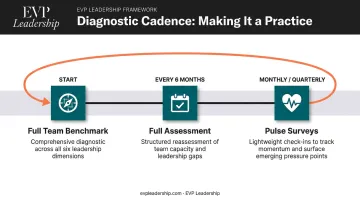
Use findings to build a conditioning system, not a checklist. The goal isn't to patch the current problem and move on. It's to identify what must change in how you lead — consistently, over time.
EVP Leadership's 90-Day PressurePoint System is built on exactly this principle: structured diagnostic insights that condition leaders to perform under pressure, rather than defaulting to reactive fixes when things go sideways. The diagnostic reveals what needs conditioning. Consistent execution on that insight is what actually moves team performance.
Conclusion
A leadership diagnostic is not a sign that something has gone wrong. It's the discipline of knowing your team's actual state—not the state you assume it's in.
Accurate assessment — through structured observation, honest feedback, and performance data — is what separates leaders who improve their teams from those who keep applying the wrong solutions to misdiagnosed problems.
EVP Leadership's premise is direct: leaders don't rise to expectations—they fall back on conditioning. A diagnostic tells you what to condition. Run it honestly, act on what it surfaces, and you give your team a real shot at performing when the pressure is highest — not just when conditions are easy.
Frequently Asked Questions
What is a leadership diagnostic?
A leadership diagnostic is a structured process for assessing how well a team is functioning across performance, communication, trust, and alignment. It helps leaders identify root causes of breakdowns rather than treating surface-level symptoms. Critically, it includes the leader's own behaviors as part of the assessment.
How often should a leader run a team performance diagnostic?
Most leadership consultants recommend a comprehensive diagnostic at least twice per year, with shorter pulse assessments quarterly. Any significant change — a new hire, restructure, missed targets, or unexpected performance shift — should also trigger a fresh diagnostic, not just a gut-check conversation.
What is the difference between a leadership diagnostic and a performance review?
A performance review evaluates an individual employee's output. A leadership diagnostic examines the entire team system — including leadership behaviors, communication norms, process clarity, and how the leader's own actions are shaping team performance. One looks at people individually; the other looks at the system they operate in.
Can leaders accurately self-diagnose their team's performance issues?
Self-diagnosis is possible but limited — leaders are often too embedded in the system to see their own contribution to the problem clearly. Combining self-assessment with anonymous team feedback and an outside perspective when needed produces significantly more reliable results than any single input alone.
What are the most common signs that a team needs a leadership diagnostic?
Watch for these signals:
- Recurring missed targets or stalled execution
- Rising interpersonal conflict or visible disengagement
- Decisions escalating to the leader that shouldn't require it
- A general loss of momentum with no clear explanation
What should you do after completing a leadership diagnostic?
Prioritize findings by impact, communicate a summary to the team, and convert key findings into specific behavioral commitments — not a generic improvement plan. The team needs to see that honest input produced visible change. That follow-through is what makes the next diagnostic worth doing.