Think of it this way: when there's no operating system, the leader becomes the operating system. Every ambiguous decision routes back to them. Every accountability gap waits on their calendar. Every cultural standard holds only as long as they're present to enforce it.
This post breaks down what a leadership operating system actually is, why most companies are running without one, the four components that make it functional, and how to build one that holds up when the pressure rises.
Key Takeaways
- A leadership OS replaces reactive leadership habits with intentional, repeatable structure across decisions, communication, and execution
- Without one, organizations build dependency on individuals rather than scalable systems
- A functional leadership OS is built on interconnected components — not a single skill or a one-off training initiative
- Building a leadership OS requires conditioning through consistent practice—not a one-time training event
- Small and mid-size businesses benefit most because they have the least margin for leadership dysfunction
What Is a Leadership Operating System?
A leadership operating system is the explicit, intentional set of frameworks, rhythms, and behaviors that governs how leaders make decisions, set priorities, hold people accountable, and transfer capability across the organization.
That's the designed version. Most leaders are running something very different: an inherited OS—a collection of reactive habits accumulated under growth pressure, firefighting, and inbox management. No one chose it. It just calcified.
Leadership OS vs. Business OS
These two systems are often confused, and confusing them is expensive.
A business operating system (like EOS or similar frameworks) governs how the company runs—its processes, meeting structures, and organizational workflows. A leadership operating system governs how the people leading that company think, decide, and behave within that structure.
Both are necessary. Neither substitutes for the other. You can have EOS installed company-wide and still have a leadership team making inconsistent decisions, dodging accountability, and reverting to reactive patterns under pressure.
The critical distinction: a leadership OS is not a personality trait or a natural gift. It's a designed system. That means it can be deliberately built, stress-tested under pressure, and upgraded as the organization grows—rather than left to calcify the same way the inherited version did.
Why Most Companies Are Running Without One
The failure mode follows a predictable pattern. Companies invest in talent, promote high performers, and then wonder why results are inconsistent. The answer, almost every time: they built a dependency on individuals, not a system that makes consistent performance the default.
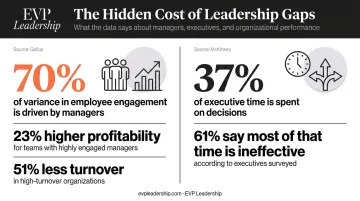
The cost of this is measurable. According to Gallup, managers account for 70% of the variance in team-level employee engagement—and highly engaged teams show 23% higher profitability and 51% less turnover than low-engagement teams. Leadership behavior isn't a soft variable. It's a business outcome driver.
Decision-making is where the damage compounds fastest. McKinsey research found that executives spend 37% of their working time on decisions, and 61% say most of that time is ineffective. Only 37% of organizations make decisions that are both fast and high quality. The rest are running on decision drag: every ambiguous situation queues up for the leader's attention and waits.
For founders and executives at small and mid-size companies, this problem is structural. Most built their approach to leadership reactively — surviving growth spurts, handling crises, plugging gaps — and never stopped to design the system intentionally.
When no one designs the OS, it designs itself. And the habits it reinforces rarely point in the right direction.
Three specific symptoms mark the absence of a leadership OS:
- Decision bottlenecks — every ambiguous situation routes back to the top
- Accountability gaps — ownership is implied, not named, and things fall through accordingly
- Cultural drift — stated values exist on paper but don't show up in daily behavior
The Core Components of a Leadership Operating System
A leadership OS isn't a single tool or a philosophy—it's four integrated components. Weakness in one creates drag across the whole system.
Decision Framework
A decision framework is a documented set of guardrails specifying what leaders can decide independently, what thresholds require escalation, and what the default answer is when no one is sure.
Without it, every ambiguity waits for the leader's calendar. The McKinsey data is clear: organizations that make decisions at the right level are 6.8x more likely to be high-performing than those that don't. Decision latency isn't just a time problem—it's a compounding organizational drag that slows everything downstream.
That data points directly to what needs to be documented. A functional decision framework answers three questions explicitly:
- What can each role decide without escalation?
- What requires peer input or cross-functional alignment?
- What requires executive sign-off?
The Bain RAPID model (Recommend, Agree, Perform, Input, Decide) is one well-tested structure for documenting these boundaries. The specific tool matters less than the act of documenting the boundaries at all.
Accountability Architecture
Accountability is not a cultural value. It is a named person, a defined deliverable, and a deadline—with visible consequences.
The gap between what companies think they have and what they actually have here is substantial. Gallup's 2026 research found that fewer than 50% of leaders rate themselves outstanding or exceptional at creating accountability. Managers who work under leaders who are exceptional at it are three times as likely to be engaged—51% vs. 17%.
That engagement gap traces back to something more basic: expectation clarity. Only 46% of employees clearly know what is expected of them at work, down from 56% in 2020. Implicit accountability—where everyone assumes someone else is handling it—is one of the most common and costly failures in growing companies.
Explicit accountability structures require:
- Clear ownership assigned to every key priority
- A visible system (scorecard, dashboard, or structured check-in) where progress is tracked
- Gaps surfaced early rather than explained away at quarter-end
Performance Rhythm
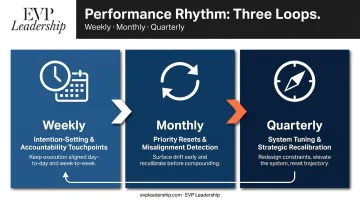
Performance rhythm is the structured cadence of reviews and resets—weekly, monthly, and quarterly—that compresses the gap between action and insight.
Gallup found that 80% of employees who received meaningful feedback in the past week were fully engaged. Yet only 16% of employees say their last manager conversation was extremely meaningful. Weekly cadence isn't optional—it's the baseline.
The mismatch at the goal level is equally stark. 70% of managers want monthly goal-progress updates, but 56% of organizations revise objectives only annually. Annual reviews don't generate learning. They generate surprises.
A functional performance rhythm has three distinct loops:
| Cadence | Purpose |
|---|---|
| Weekly | Intention-setting, focus check-ins, accountability touchpoints |
| Monthly | Priority resets, early misalignment detection |
| Quarterly | System tuning, performance reviews, strategic recalibration |
Capability Transfer System
If only one person can do it, it's not a system—it's a liability.
Key-person dependency is one of the most underestimated risks in small and mid-size businesses. When critical knowledge, relationships, or decision authority live with one person, a single departure—planned or not—can stall operations, erode client confidence, and create a leadership vacuum that no org chart can fix.
A capability transfer system ensures the frameworks, decisions, and standards of strong leadership can be taught, replicated, and improved by others—without the original leader in the room. When that's in place, the business stops running on individuals and starts running on structure.
How to Build a Leadership Operating System for Your Company
Step 1: Audit the Current State
Before building, document what already exists. The simplest diagnostic is a single question: If I left for 30 days, would my team make the same quality decisions I would?
Most founders and executives already know the answer. The audit makes the gap visible and specific—surfacing where decisions stall, where accountability breaks down, and where the system depends on the leader's physical presence to function.
EVP Leadership's Diagnostic Layer uses six components for exactly this kind of assessment: Mission Clarity, Force Alignment, Problem Intelligence, Decision Integrity, Execution Discipline, and Momentum Control. Each dimension reveals where the current leadership system is holding and where it's breaking down.
Step 2: Define Your Decision Boundaries
Work with the leadership team to explicitly document the decision rights for every role. Three categories cover most situations:
- Decide independently — actions within scope that don't require escalation
- Seek peer input — decisions that affect adjacent teams or shared resources
- Escalate to executive — high-stakes calls that require sign-off before moving
This is a living document, not a one-time org chart exercise. As the organization grows and roles evolve, the boundaries shift—and the document needs to shift with them.
Step 3: Establish Accountability Structures
Assign clear ownership to every key priority: a name, a deliverable, and a deadline. Then build a visible system—a scorecard, weekly check-ins, or a shared dashboard—so progress is tracked and gaps surface early.
The point isn't surveillance. Visibility is what allows problems to get addressed before they compound.
Step 4: Build a Rhythm That Forces Reflection
Design the weekly, monthly, and quarterly review cadence before it's needed—not in response to a crisis. The rhythm is what prevents the OS from degrading back into the reactive patterns it was designed to replace.
Structured reflection has measurable returns: an HBS-linked study found that workers who spent 15 minutes reflecting daily performed 22.8% better on performance measures than those who kept working without reflection.
Step 5: Condition, Don't Just Train
This is where most organizations fall short. They run a workshop, communicate new expectations, and assume the system will hold. It won't.
Gartner's 2024 research found that 75% of organizations were not seeing results from their manager development changes—and that traditional seminars and lectures can have a negative effect on development outcomes. The problem is how development is designed, not how much is spent on it.
EVP Leadership's 90-Day PressurePoint System is built specifically to close this gap. Rather than delivering information, it conditions leaders through structured, repeatable practice—testing the frameworks in real scenarios and embedding the system across the organization so it holds under pressure, not just in a conference room.
How to Run and Sustain Your Leadership OS
A leadership OS is not static. It runs on rhythm — built to be reviewed, pressure-tested, and refined over time.
Each cadence serves a different purpose:
- Daily/weekly: Intention-setting, check-ins, and accountability touchpoints keep the system active between bigger reviews
- Monthly/quarterly: Priority resets and performance reviews catch misalignment before it becomes a structural problem
- Annually: A full assessment of what to stop, start, and scale — evaluated from outside the daily execution, not from inside it
The Most Common Failure Point
The most predictable breakdown in sustaining a leadership OS is reversion under pressure.
When stakes are high, leaders fall back on their defaults. This isn't a character flaw—it's a conditioning gap. EVP Leadership's core positioning captures it precisely: leaders don't rise to expectations under pressure. They fall back on their conditioning.
The implication is direct: the OS must be practiced in low-stakes moments to hold in high-stakes ones. EVP Leadership's Execution Layer addresses this through a repeatable five-step protocol leaders can run automatically when pressure rises:
Pause the Noise → Locate the Pressure Point → Prioritize the Critical Move → Execute with Discipline → Lock in Momentum
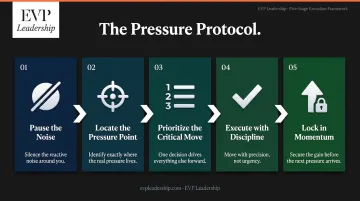
The protocol works because leaders have conditioned the response — not just learned the steps.
The Long-Term Payoff
Organizations that run a defined leadership OS no longer depend on any single person's presence or brilliance. They raise the floor of performance across the entire team—making good decisions and consistent execution the default, not the exception. For small and mid-size businesses, where the margin for leadership chaos is thin, that structural foundation is what separates businesses that scale from those that stall.
Frequently Asked Questions
What is a leadership operating system?
A leadership operating system is the intentional set of frameworks, rhythms, and behaviors that governs how leaders make decisions, set priorities, and hold people accountable. Without one, results depend on who's in the room rather than what the organization has built.
What are the 4 O's of leadership?
The 4 O's—Outcome, Others, Organization, and Own Development—represent four domains leaders must manage simultaneously. A structured leadership OS gives leaders the framework to address all four consistently, rather than reactively chasing whatever feels most urgent.
How is a leadership operating system different from a business operating system?
A business OS (like EOS) governs how the company runs—its processes, structures, and workflows. A leadership OS governs how the people leading that company think, decide, and behave within that structure. Both are necessary; neither substitutes for the other.
How long does it take to build a leadership operating system?
Initial frameworks can be established in 30–90 days. True conditioning—where the OS holds under real pressure—requires consistent practice. Think of it as an ongoing operating discipline you build and refine, not a project you complete.
How do you know your leadership OS is failing?
Key warning signs: decisions bottlenecking at the top, accountability falling through the cracks, results depending on who's present rather than what the system produces, and culture drifting from stated values. The Diagnostic Layer of the PressurePoint System is designed to surface these gaps before they become crises.
Can small businesses benefit from a leadership operating system?
Small and mid-size businesses benefit most. They have the least margin for leadership chaos—and a well-designed OS gives them the foundation to scale without becoming dependent on a single founder or a handful of key people.