Introduction
Your business has grown. Your headcount is up, revenue is moving, and the strategy looks right on paper. But goals keep slipping, your best people are disengaging, and decisions that should be straightforward somehow still land on your desk.
The problem often isn't your strategy — it's the leadership capacity behind it.
Gallup's research shows managers account for 70% of the variance in team-level employee engagement. That single statistic reframes what most business owners think is a people problem into what it actually is: a leadership problem.
A leadership gap analysis is the diagnostic tool that makes that problem visible. It identifies exactly where current leadership capabilities — yours and your team's — fall short of what your business needs to execute, scale, and sustain performance.
This article covers what a leadership gap analysis is, the most common competency gaps to watch for, a step-by-step process to conduct one, and how to turn findings into meaningful development rather than a report that sits in a drawer.
Key Takeaways
- A leadership gap analysis compares current capabilities against what your strategy actually requires
- Competency gaps (knowing but not doing) are more damaging than skills gaps and harder to close
- Managers drive 70% of variance in team engagement, making leadership quality a direct profitability lever
- You'll learn to identify the most common gaps: delegation, execution alignment, and decision-making under pressure
- Closing gaps requires consistent conditioning — the kind that changes how leaders perform when pressure is highest
What Is Leadership Gap Analysis?
A leadership gap analysis is a structured process of comparing the leadership competencies a business currently has against the skills, behaviors, and capabilities needed to execute its strategy and meet future demands.
The Center for Creative Leadership frames it simply: compare what leadership effectiveness looks like now against what the organization needs — and measure the distance.
Skills Gaps vs. Competency Gaps
These two terms get used interchangeably, but the distinction matters.
- A skills gap means a leader lacks knowledge or technical capability in an area — they've never learned it
- A competency gap means a leader knows what to do but fails to apply it consistently, especially under pressure or at scale
Competency gaps are often the more damaging and harder to detect. A leader who can articulate delegation principles in a meeting but still holds every decision captive has a competency gap — not a skills gap. Closing it requires behavioral conditioning over time, not a single training event.
Where Gap Analysis Applies
That distinction between skills and competency shapes which level of the organization the gap analysis needs to target. Leadership gap analysis operates at three levels:
- Individual — a specific leader's self-assessment and behavioral profile
- Team — collective capability across a leadership group
- Pipeline — bench strength and succession readiness across the organization
The process can be reactive (triggered by a performance breakdown) or proactive (built into strategic planning). Organizations that build gap analysis into their strategic planning cycle consistently carry stronger bench depth and cleaner succession readiness than those who run it only after a breakdown forces their hand.
Why Leadership Gap Analysis Matters for Business Growth
Unaddressed leadership gaps don't stay contained. They compound — and the business consequences show up in revenue, retention, and execution capacity.
Consider the data: Gallup's 2026 State of the Global Workplace report found global employee engagement fell to 20% in 2025, estimating the lost-productivity cost at $10 trillion. Manager engagement dropped from 27% to 22% in a single year. Leadership quality is an operational performance variable — one that shows up directly in output, retention, and growth capacity.
What Unaddressed Gaps Actually Cost
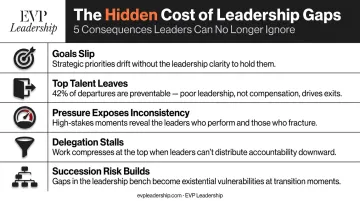
When leadership gaps go unexamined, the business consequences follow a familiar pattern:
- Goals slip despite teams with the capability to deliver them
- High-potential employees leave — 42% of voluntary departures are preventable, according to Gallup, yet most organizations don't act in time
- Pressure exposes inconsistency — decisions made under stress vary leader to leader, creating downstream confusion that compounds over weeks
- Delegation stalls, keeping the founder or senior leader buried in execution work instead of strategic leadership
- Succession risk builds unnoticed — DDI reports only 11% of companies have meaningful leadership bench strength
For small and mid-size businesses especially, this is a profitability and sustainability issue. How fast a business can scale — and whether it holds together while doing it — depends directly on the quality of leadership running the operation.
Common Leadership Competency Gaps to Assess
Research and what we consistently see in the field point to the same patterns in where leadership competencies fall short — particularly as businesses scale beyond the founder or early leadership team.
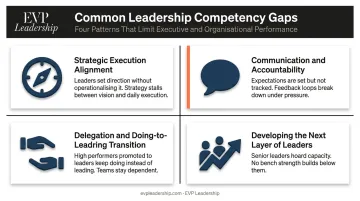
Strategic Thinking and Execution Alignment
This gap shows up as a disconnect between setting direction and translating it into daily decisions and team action. Some leaders are visionary but can't turn strategy into action. Others are operationally strong but can't see past the quarter.
A telling data point: MIT Sloan Management Review research found only 28% of executives and middle managers responsible for strategy execution could name three of their company's strategic priorities. Strategy can't execute if leaders can't articulate it.
Communication, Influence, and Accountability
This gap produces unclear expectations, inconsistent messaging, and teams operating in silos with no shared accountability. Leaders who are technically strong often struggle most here — they know what needs to happen but can't consistently influence others to make it happen.
A SHRM survey of 457 working Americans found 41% of workers identified communication as the primary area where managers need more training — the top response.
Adaptability and Decision-Making Under Pressure
Leaders who perform well in stable conditions often default to reactive, avoidant, or rigid behavior when pressure escalates. That's exactly the moment leadership matters most — and the moment this gap becomes most costly.
This isn't a knowledge problem. A leader can know every decision-making framework and still freeze or default to instinct when the situation demands something different. The gap isn't in their knowledge — it's in their conditioning.
Delegation and the Transition from Doing to Leading
Founders and operators are particularly vulnerable here. The tendency to stay involved in execution work — because it's familiar, because it's faster, because letting go feels risky — creates a ceiling on growth that no strategy can overcome.
When a leader can't delegate, organizational capacity is capped at whatever one person can personally manage.
Developing the Next Layer of Leaders
The absence of intentional investment in identifying and preparing high-potential team members for greater responsibility creates two compounding problems: succession risk and a hard cap on scalability. No business grows faster than its leadership capacity allows.
Research consistently shows that most mid-size businesses underinvest here until a departure or promotion creates a visible crisis — by which point the gap has already cost them time, momentum, and talent.
How to Conduct a Leadership Gap Analysis – Step by Step
The value of a gap analysis comes not from the assessment tool itself, but from how rigorously the process is structured. Most organizations skip steps, use inadequate inputs, or collect data they never act on.
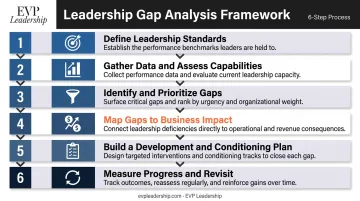
Step 1 – Define Leadership Standards and Business Goals
Before you can measure a gap, you need a baseline. Identify the specific leadership behaviors, decisions, and capabilities your business needs to execute its strategy over the next 12–24 months.
This step requires executive alignment on what "effective leadership" actually means in your context — not a generic competency model borrowed from a Fortune 500 framework. A small business scaling from $3M to $10M has different leadership requirements than an enterprise preparing for a market expansion.
Step 2 – Gather Data and Assess Current Capabilities
Reliable gap analysis requires multiple data inputs:
- 360-degree feedback from peers, direct reports, and managers
- Direct observation in high-stakes situations (not just normal operating conditions)
- Self-assessments (as one input, not the primary one)
- Performance data and goal attainment patterns
- Team engagement signals and turnover trends
- Input from direct reports on how leadership decisions land
The common mistake is relying solely on self-assessments or annual reviews. Both tend to reflect how leaders perform when conditions are comfortable — which reveals almost nothing about where they'll break under pressure.
Step 3 – Identify and Prioritize the Gaps
Map current capability scores against the leadership standards from Step 1. The distance between them is the gap — but not all gaps carry equal weight.
Prioritize based on which gaps most directly impact business outcomes. Also distinguish between three gap types:
- Development gaps are coachable and addressable through deliberate practice
- Skill gaps reflect missing knowledge or experience that structured development can build
- Selection gaps are fundamental role mismatches that training alone cannot fix — and may require a conversation about fit
Step 4 – Map Gaps to Business Impact
Connect each identified gap to a specific, observable business consequence. This step transforms the analysis from an abstract exercise into a business case.
If the delegation gap means the founder touches every client decision, name the consequence: the business can't scale past its current headcount because every bottleneck routes through one person.
If the communication gap means team expectations are unclear, name the cost: rework, missed deadlines, and turnover of people who stopped waiting for clarity. Named consequences turn a development conversation into a business decision.
Step 5 – Build a Development and Conditioning Plan
A credible action plan includes:
- Specific development priorities — the 2-3 gaps that most directly constrain business performance
- Method — coaching, structured practice, stretch assignments, or conditioning protocols
- Timeline — realistic milestones that account for behavioral change taking longer than knowledge acquisition
- Accountability — who owns progress and how it will be measured
A plan built around training events alone — workshops, online courses, one-day seminars — will rarely close a competency gap. Lasting improvement requires regular, deliberate practice under realistic conditions. How a leader practices is just as important as what they practice.
Step 6 – Measure Progress and Revisit Regularly
Establish behavioral benchmarks, not just performance metrics. A leader closing a delegation gap shouldn't only be measured by team output — track whether decisions are actually moving down the organization, whether accountability conversations are happening, and whether the leader is spending time differently.
Build in a cadence for re-evaluation. Leadership requirements evolve as the business grows, and a one-time gap analysis is a snapshot, not a system. Revisit at minimum annually — or whenever the business undergoes a significant strategic shift.
How EVP Leadership Can Help Close Your Leadership Gap
For small business owners and executives who have identified leadership gaps — or suspect they exist — EVP Leadership works as a strategic partner through the full process: from diagnostic clarity to closing the gap.
Founded in 2009 and with over 35 years of experience advising C-Suite leaders and entrepreneurial teams, EVP Leadership's approach is built on a specific premise: leaders don't rise to expectations when pressure rises — they fall back on their conditioning. That distinction drives everything.
The 90-Day PressurePoint System
EVP's primary engagement is the 90-Day PressurePoint System, a structured conditioning program — not traditional training — built around three layers:
- Develops the consistency, capacity, and character that make leadership behavior reliable under pressure (Identity Layer)
- Trains leaders to assess situations across six dimensions: Mission Clarity, Force Alignment, Problem Intelligence, Decision Integrity, Execution Discipline, and Momentum Control (Diagnostic Layer)
- Builds a repeatable protocol for high-stakes moments — Pause the Noise → Locate the Pressure Point → Prioritize the Critical Move → Execute with Discipline → Lock in Momentum (Execution Layer)
The system conditions leaders in real scenarios, not simulated ones. That's the difference between a leader who knows what delegation means and one who actually delegates.
Specialized Work for Common Gaps
For leaders specifically struggling with delegation and the founder-bottleneck pattern, EVP's Delegation, Accountability & Operating Discipline engagement delivers a clean delegation protocol, an accountability operating rhythm, and an execution-discipline framework — typically in 60–90 days.
Gennifer Baker's C-level executive consulting integrates strategic planning with leadership capacity — surfacing gaps that standard HR assessments miss by examining whether current leadership can actually execute the business's stated direction.
Every engagement starts with a complimentary scoping conversation to determine fit and identify the right entry point for your situation.
Frequently Asked Questions
What is an example of a leadership gap?
A founder who is visionary but struggles to delegate is a classic example. The business strategy is clear, but every decision still routes through the founder, creating a bottleneck that prevents the team from performing independently and caps the company's growth. The gap is behavioral, not strategic.
What is skills gap analysis in leadership?
Leadership skills gap analysis identifies the difference between the leadership capabilities an organization currently has and those it needs to achieve its goals. It covers both knowledge-based skills and the behavioral competencies that determine how effectively those skills are applied in practice.
How do you identify leadership gaps in your organization?
Use a combination of methods — all measured against clearly defined leadership standards:
- 360-degree feedback
- Performance data and direct observation
- Team engagement signals
- Structured self-assessments
Each input captures a different dimension; together, they give you an accurate read.
What are the most common leadership competency gaps?
The most frequently identified gaps include strategic execution alignment, communication and accountability, adaptability under pressure, delegation, and developing future leaders. The most impactful gaps tend to be behavioral: leaders know what to do but don't apply it consistently, especially under pressure.
How often should a leadership gap analysis be conducted?
At minimum annually, with additional analysis triggered by significant business changes — rapid growth, leadership transitions, strategic pivots, or M&A activity. Leadership requirements evolve as the business evolves, and the analysis should keep pace.
What is the difference between a skills gap and a competency gap in leadership?
A skills gap means a leader lacks knowledge or technical ability. A competency gap means a leader knows what to do but fails to apply it consistently — especially under pressure or in complex situations. Competency gaps are harder to close because they require behavioral conditioning, not just information transfer.