Introduction
Most teams don't fail from lack of effort. They fail because leadership skills were never systematically developed — just assumed.
A single off-site retreat or an annual team-building day rarely changes how people communicate, make decisions, or handle pressure. Gallup's 2026 State of the Global Workplace report found that global employee engagement fell to 20% in 2025, costing roughly $10 trillion in lost productivity — a figure tied directly to how managers lead. That's a conditioning gap, not a morale problem.
This post gives you 15 curated leadership and team building activities grouped by leadership competency — communication, trust, problem-solving, collaboration, and personal development. It also explains how to choose the right activity for your team's actual gap, how to debrief effectively, and how to make the learning stick beyond the session.
Whether you're running a small executive team or leading a 40-person organization, you can run most of these with no outside facilitation and minimal resources.
Key Takeaways
- Activities work best when matched to a specific competency gap, not chosen for convenience or entertainment value
- Skip the debrief and you've run a team event, not a development activity — the debrief is what makes the learning stick
- Trust-building activities should always come before activities requiring vulnerability or candid feedback
- Recurring monthly practice produces more lasting results than one quarterly off-site
- Most activities on this list work for small executive teams with no external facilitation
What Makes Leadership & Team Building Activities Actually Effective
Most leadership activities don't fail because they're poorly designed. They fail because nothing reinforces what happened once people return to their desks.
Most organizations run a team-building event once or twice a year, people enjoy it, and nothing changes on Monday morning. That's the transfer problem: a documented gap between what happens in a training session and what actually changes on the job.
EVP Leadership's core philosophy captures it plainly: leaders don't rise to the occasion — they fall back on their conditioning. A one-off activity exposes people to a concept. Conditioning builds the behavioral habits that hold under pressure. That distinction matters for how you design and sequence these activities.
Three Conditions That Make Any Activity Work
Research from Tannenbaum and Cerasoli's 2013 meta-analysis (covering 46 samples and 2,136 participants) found that properly conducted debriefs improve performance by approximately 20–25%. That's not a minor improvement. It makes the debrief the highest-leverage part of any activity.
But before the debrief, two other conditions matter:
- A clear learning objective — participants need to know what skill is being practiced before the activity starts, not just what the rules are
- Psychological safety — Edmondson's research connects psychological safety directly to learning behavior in work teams. Without it, people protect themselves instead of taking the risks that make growth possible
- A structured debrief conducted immediately after the activity, not the following week
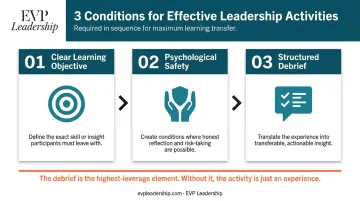
Get these three conditions right, and almost any activity produces real development. The 15 activities below are built with that framework in mind.
15 Effective Leadership & Team Building Activities for the Workplace
The activities below are grouped into five competency areas. Match the category to the gap you're actually seeing in your team — not to what sounds interesting or logistically convenient.
Communication & Active Listening Activities
Activity 1 — Active Listening Challenge
Participants rotate through three roles in triads: speaker, listener, and observer. The speaker shares a real work challenge for three minutes without interruption. The listener reflects back without offering advice or judgment. The observer provides structured feedback on what the listener did and missed.
- Skill built: Deep listening, non-judgment, empathy
- Group size: 6–40
- Remote-friendly: Yes — works well in breakout rooms
Activity 2 — Feedback: Start, Stop, Continue
Each team member gives structured written or verbal feedback to colleagues using three categories: behaviors they should start doing, behaviors they should stop doing, and behaviors they should continue doing. Structure prevents the conversation from becoming vague or personal.
- Skill built: Constructive communication, feedback culture
- Best for: Teams that have worked together for at least a few months
- Note: Psychological safety needs to exist before this one lands well
Activity 3 — What I Need From You (WINFY)
Representatives from different functions or roles articulate their single most important need to each other in a structured format, then respond with "I can," "I can't but I can offer," or "I need to think about it." No discussion until all needs have been stated.
- Skill built: Cross-functional clarity, silo reduction, structured communication
- Best for: Executive teams and cross-functional leadership groups where coordination friction is the real problem
Trust-Building Activities
Activity 4 — Minefield
One team member is blindfolded. Others guide them verbally through a course of obstacles without touching them. Roles rotate so everyone experiences both giving and following direction.
- Skill built: Trust, clear direction-giving, listening under uncertainty
- Leadership connection: Directly mirrors high-pressure situations where leaders must give clear guidance with incomplete information
Activity 5 — Trust Battery
Individuals privately reflect on their current level of trust toward each team member and identify specific actions that have charged or depleted that trust. A facilitated conversation follows — not to assign blame, but to surface invisible dynamics.
- Skill built: Relational awareness, trust repair, accountability
- Best for: Teams experiencing friction that no one is naming out loud
Activity 6 — Human Knot
The group stands in a circle, each person grabs two non-adjacent hands, then the group untangles itself without releasing grips. Simple rules, surprisingly complex execution.
- Skill built: Patience, collaborative problem-solving, organic leadership emergence
- Best used as: A low-stakes opener before more intensive activities — reveals who leads, who waits, and who gets frustrated
Problem-Solving & Decision-Making Activities
Activity 7 — Marshmallow Challenge
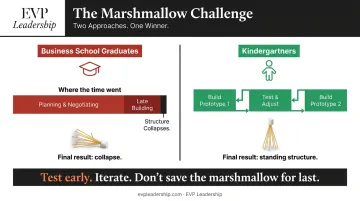
Teams of 4–5 have 18 minutes to build the tallest freestanding structure using only spaghetti sticks, tape, string, and a marshmallow placed on top.
The famous finding from Tom Wujec's TED2010 talk: kindergartners consistently outperform business school graduates. Children put the marshmallow on early and iterate. Adults spend most of their time planning, negotiating roles, and only test the structure in the final seconds — when there's no time to recover.
- Skill built: Prototyping vs. over-planning, natural leadership dynamics, assumption testing
- Debrief focus: Where did the group spend its time? Who held the marshmallow?
Activity 8 — Crisis Simulation
Present a realistic, industry-relevant scenario — a budget shortfall, a sudden leadership departure, a product failure, a team conflict that's escalating. The group works through it in real time with no pre-scripted answers.
Crisis simulations work because they create the cognitive and emotional conditions of real pressure without real consequences. The goal is to build the habit of pausing, locating the actual pressure point, and executing before the situation becomes paralyzing — not just talking about how you'd respond.
- Skill built: Decisive action under pressure, role clarity, calm in complexity
- Best for: Leadership teams that need to perform consistently in high-stakes environments
Activity 9 — Impact and Effort Matrix
The group maps a set of potential decisions or initiatives onto a 2×2 grid: high/low impact on one axis, high/low effort on the other. The conversation happens in real time, visibly, with everyone contributing.
- Skill built: Transparent prioritization, inclusive decision-making, communicating trade-offs
- Best for: Executive teams where priority confusion or competing agendas slow execution
Team Cohesion & Collaboration Activities
Activity 10 — Crocodile River
The entire group must cross a designated "river" using a limited number of stepping stones (physical objects on the floor). Rules vary — stones disappear if unoccupied, only one person per stone — forcing real-time strategy, physical coordination, and cross-role support.
- Skill built: Cross-role cooperation, patience, shared problem-solving
- Logistics: Best for groups of 10–40 with open floor space; not remote-friendly
Activity 11 — Team Canvas Workshop
A facilitated session where the team co-creates shared goals, values, working agreements, and role clarity on a structured visual template — all visible, all discussed, all agreed upon before leaving the room.
This is one of the highest-value activities for new teams or teams navigating a leadership transition. The principle holds across contexts: alignment sessions are most valuable before misalignment becomes a performance problem — not after.
- Skill built: Shared purpose, working norms, role clarity
- Remote-friendly: Yes — works well on digital whiteboards
Activity 12 — Plane Crash / Survival Exercise
Following a fictional disaster scenario, participants must collectively rank a limited set of resources in order of survival priority. The group must reach consensus.
- Skill built: Reveals leadership emergence, how the group handles disagreement, whether decisions are made by logic, consensus, or dominance
- Debrief focus: Who led? Who deferred? Did the loudest voice or the best argument win?
Leadership Reflection & Personal Development Activities
Activity 13 — Leadership Pizza
Individuals identify leadership skills they personally value, then rate their current level in each area on a circular visual framework divided into "slices." The resulting shape reveals where they feel strong and where they see gaps.
- Skill built: Honest self-assessment, goal-setting
- Best used: At the start of a leadership development program or coaching engagement as a non-threatening entry point
Activity 14 — Leadership Coat of Arms
Each participant draws a personal coat of arms representing their core leadership values, strengths, and philosophy — then presents it to the group. No design skills required. The point is articulation, not artistry.
- Skill built: Self-awareness, leadership identity, understanding of each other's styles
- Best for: Executive teams where individual leadership styles need to be understood collectively before the team can operate with real cohesion
Activity 15 — The GROW Coaching Model
A leader or facilitator guides a team member through four structured questions:
- Goal — What do you want to achieve?
- Reality — What's happening now?
- Obstacles/Options — What's in the way, and what are your options?
- Will — What will you commit to doing?
This isn't a one-off activity — it's a repeatable leadership tool. A 2020 controlled trial using a RE-GROW framework reported measurable improvements in coaching-based leadership skills, work engagement, and performance. Leaders who use it consistently shift their teams from waiting for answers to solving problems — which compounds over time.
How to Choose the Right Activity for Your Team
The most common mistake is choosing an activity based on logistics — group size, time available, whether it needs props — rather than the specific leadership gap the team is experiencing.
Identify the Gap First
Look at where your team is losing ground:
- Decisions slow down or stall → problem-solving and decision-making activities
- Conflict keeps recurring in the same spots → trust and communication activities
- Cross-functional coordination breaks down → WINFY, Team Canvas, Impact and Effort Matrix
- Leaders aren't developing their people → GROW Coaching Model, Leadership Pizza
- New team or new leader → Team Canvas before anything requiring vulnerability
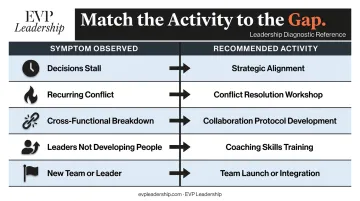
That symptom-to-competency mapping is the real work. EVP Leadership's Diagnostic Layer formalizes it across six signals — Mission Clarity, Force Alignment, Problem Intelligence, Decision Integrity, Execution Discipline, and Momentum Control — but the principle holds regardless of your framework: observe the symptom, trace it to the competency, then select the activity.
Sequence Matters
Trust-building activities should always precede activities that require candid feedback or interpersonal vulnerability. Running a Start/Stop/Continue exercise with a team that hasn't built psychological safety first is a reliable way to get surface-level answers and private resentment.
A Note on Frequency
Spaced, repeated practice outperforms massed, single-session training. Monthly activities integrated into existing team meetings tend to produce more sustained behavior change than a single quarterly off-site. The goal is conditioning — not exposure.
How to Debrief and Measure Impact After Every Activity
A structured debrief is what separates a team-building activity from actual behavior change. Without it, people walk away with impressions — maybe positive ones — but nothing shifts. With one, the same experience produces measurable skill improvement.
Three Questions That Make a Debrief Work
Use these in sequence after every activity:
- What happened? — Observable facts only. What did people do, say, or avoid?
- So what does it mean? — Interpretation. What does that behavior reveal about how this team operates?
- Now what will we do differently? — Committed action. What specific behavior will change, and how will we know?
The third question is where most debriefs fail. "That was interesting" is not a commitment. "Starting next Tuesday, I will ask one clarifying question before responding in team meetings" is.
Measuring Behavior Change Over Time
Getting a committed answer to "now what?" is only half the job. The other half is tracking whether that commitment actually held.
Participant satisfaction scores tell you whether people enjoyed the session — not whether behavior changed.
More useful measurement approaches:
- Pre/post self-assessments tied to the specific skill the activity targeted
- 360-degree peer observations at 30- and 60-day intervals after the activity
- Structured check-ins at subsequent team meetings: "What did you try? What happened?"
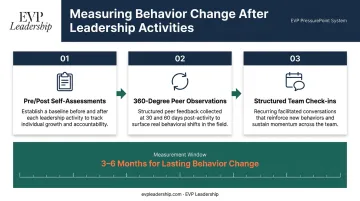
Meaningful behavior change takes at least 3 to 6 months to stick. Set that expectation with your team before you start — otherwise, two sessions in, someone will say it isn't working.
Conclusion
The 15 activities in this post aren't a curriculum by themselves — they're practice reps. Their value compounds when they're repeated, sequenced intentionally, and followed by structured debriefs that convert experience into committed behavior change.
One activity won't condition a leadership team. A pattern of activities, tied to real development gaps and measured over time, will.
That pattern requires a system behind it. For leaders ready to move beyond one-off activities and build a deliberate conditioning practice, EVP Leadership's 90-Day PressurePoint System was built for exactly that — giving small and mid-size business leaders the Identity, Diagnostic, and Execution layers they need to perform consistently when pressure is highest.
Frequently Asked Questions
What is the difference between leadership activities and team building activities?
Leadership activities develop specific competencies — decision-making, communication, coaching, self-awareness. Team building activities strengthen relationships and group dynamics. The best workplace activities often serve both purposes at once, which is why grouping them by competency (rather than just "team building") produces better development outcomes.
How often should teams do leadership and team building activities?
Frequency depends on the team's development stage, but recurring practice integrated into regular meetings produces more sustained behavior change than a single quarterly off-site. Spaced, repeated practice builds lasting habits; one-time sessions rarely do.
Can these activities be done remotely or with hybrid teams?
Many activities are fully remote-friendly with minor facilitation adjustments — including the Active Listening Challenge, GROW Coaching Model, Trust Battery, Team Canvas, and WINFY. Physical trust exercises like Minefield and Crocodile River require in-person settings with adequate space.
How do you measure whether leadership activities are actually working?
Use pre/post self-assessments, 360-degree peer feedback, and structured debriefs tied to specific behavioral goals. Participant satisfaction scores are useful for gauging experience quality, but they are not evidence of skill transfer or behavior change.
What leadership activities work best for small executive teams?
GROW Coaching, Impact and Effort Matrix, Team Canvas, WINFY, and the Trust Battery are most effective for small executive teams — where interpersonal dynamics, strategic alignment, and decision-making clarity are the primary development priorities.
Do leadership activities work for leaders who are skeptical or resistant?
Start with lower-vulnerability, higher-relevance activities — the Impact and Effort Matrix or Crisis Simulation — that connect directly to real business problems. Once leaders see direct utility, resistance to more reflective work drops.